
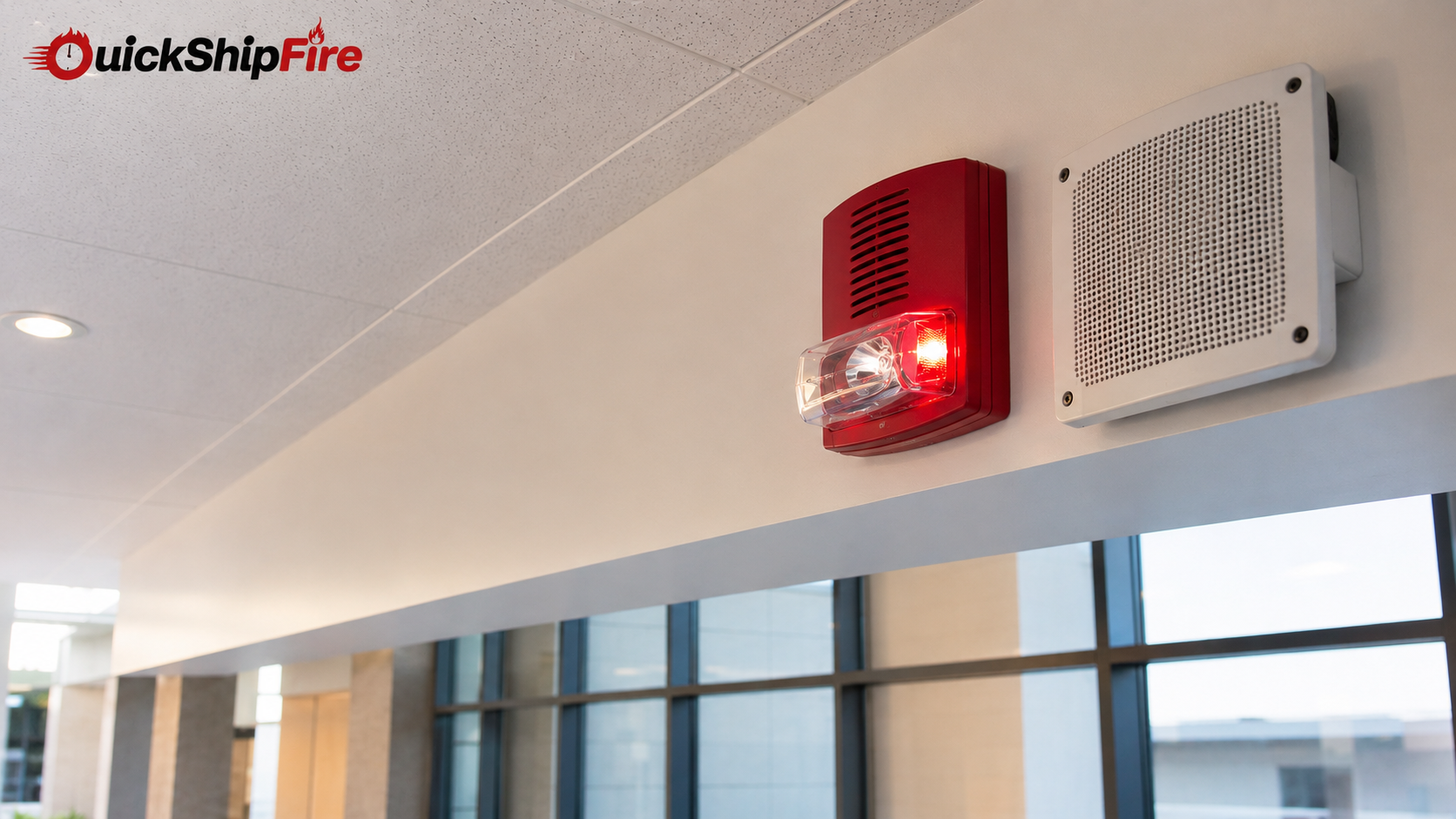
Every commercial building needs a way to detect fire and tell people to get out. Not every building needs a system that can also announce a shelter-in-place order, override a fire evacuation tone during an active-threat event, or push a targeted message to one wing of a campus while leaving the rest of the site undisturbed. That second capability belongs to a mass notification system, commonly abbreviated MNS, and it is a fundamentally different tool than a standard fire detection and signaling network, even though the two increasingly share the same control cabinet. This guide explains what fire alarms are actually designed to do, what an MNS adds on top of that baseline, and how to tell whether your facility needs one system, the other, or both working together under a single, code-compliant platform.
What Traditional Fire Alarms Are Built to Do
A conventional or addressable detection and signaling installation exists to answer one question as fast and reliably as possible: is there a fire, and if so, where? Everything about how these fire alarms are engineered flows from that single-purpose mission.
- Automatic detection – Smoke detectors, heat detectors, and duct sensors continuously monitor for the physical signs of combustion and report to the fire alarm control panel the moment a threshold is crossed.
- Manual initiation – Pull stations along egress routes let occupants report a fire even before automatic detection triggers, and they are positioned according to strict travel-distance rules.
- Standardized notification – Horns, strobes, and speaker circuits sound a recognizable temporal pattern that occupants are trained, often from childhood, to associate with one instruction: evacuate now.
- Supervising station monitoring – The panel reports alarm, trouble, and supervisory conditions to a central monitoring station around the clock, ensuring a response even when the building is unoccupied.
- A single code baseline – Standard fire alarms are engineered to NFPA 72’s core detection and notification chapters, which assume one hazard type and one appropriate occupant response: leave the building.
That single-purpose design is a strength, not a limitation. A dedicated addressable fire alarm system that does one job extremely well is exactly what most buildings need, and it remains the foundation every larger notification strategy is built on top of. Fire alarms alone have protected commercial buildings reliably for decades, and for the vast majority of occupancies, nothing more is required.
What a Mass Notification System Adds Beyond Fire Alarms
An MNS starts from a different premise: buildings face more than one kind of emergency, and a single three-pulse tone that always means “evacuate” is the wrong response for a chemical release, a severe weather warning, or an active-threat situation where sheltering in place may be safer than moving through a hallway.
All-Hazard Messaging and Compliance Requirements
- Live paging override – Trained staff or first responders can speak directly to building occupants in real time rather than relying solely on a pre-recorded message.
- Selective zone messaging – A large building or campus can target instructions to one floor, wing, or structure without alerting or confusing occupants elsewhere on the property.
- Shelter-in-place and all-clear messaging – The platform supports non-evacuation instructions and can confirm to occupants when a threat has passed, something a fire-only signaling network was never built to do.
- Multi-layer reach – A mature all-hazard notification strategy extends beyond in-building speakers to outdoor wide-area notification, desktop pop-up alerts, and mobile text messaging, so the same event triggers a coordinated response across every channel.
- Dedicated control unit listing – The control unit for any code-compliant MNS must carry a UL 2572 listing; a standard fire alarm control panel without it cannot legally serve as the primary mass notification controller.
Because an MNS is designed around this broader mission, NFPA 72 governs it under a completely separate section: Chapter 24, which covers what the code calls an emergency communication system, commonly shortened to ECS. Chapter 24 requires that every application be engineered around a documented risk analysis specific to that facility, considering occupant load, building characteristics, and the realistic range of hazards the site actually faces.
Fire Alarms vs Mass Notification: Key Differences
| Aspect | Traditional Fire Alarms | Mass Notification System |
| Primary purpose | Detect fire, signal evacuation | Deliver targeted, all-hazard instructions |
| Governing NFPA 72 section | Core detection/notification chapters | Chapter 24 (ECS) |
| Control unit listing | UL 864 | UL 2572 |
| Message types | Single evacuation tone | Live paging, shelter-in-place, all-clear, targeted zones |
| Typical trigger | Smoke, heat, or manual pull station | Fire, weather, security, or manual staff activation |
| Reach | In-building notification appliances | In-building plus outdoor, desktop, and mobile channels |
When a Facility Needs Both Systems Working Together
Most buildings are well served by fire alarms alone. A handful of occupancy types, however, face risk profiles broad enough that regulators, insurers, or an honest internal risk assessment point toward layering an MNS on top of the existing detection network.
- High-rise towers, where a phased or zone-by-zone response strategy during a non-fire emergency can be safer than a full-building evacuation instruction.
- University and K-12 campuses, where active-threat and severe weather scenarios are realistic possibilities alongside fire, and where a voice evacuation system is increasingly expected as a baseline life safety feature.
- Hospitals and healthcare campuses, where patients who cannot self-evacuate require carefully staged, zone-specific instructions rather than a blanket alarm.
- Government and military facilities, many of which are required by federal directive to maintain all-hazard mass notification regardless of building size.
- Hotels, arenas, and other high-occupancy hospitality venues, where large transient populations benefit from clear, live-voice instructions during any emergency, not only a fire event.
Facilities in these categories should also factor mass notification into their overall life safety system planning early, since retrofitting voice and paging hardware into an existing fire-only network is almost always more expensive than specifying a combined platform from the start. Insurance underwriters and campus risk managers increasingly ask about all-hazard capability during renewal reviews, and a facility that can document a coordinated, campus-wide notification strategy is generally viewed more favorably than one relying on fire alarms alone to cover every conceivable emergency scenario.
How Combined Platforms Handle Fire Alarms and Mass Notification From One Panel
Rather than installing two entirely separate systems, most modern enterprise buildings specify a single platform that performs both functions from shared hardware. Platforms built this way, such as the Gamewell-FCI E3 Series, hold both the UL 864 fire alarm listing and the UL 2572 mass notification listing, and NFPA 72 explicitly permits this combined approach provided every component that affects the fire alarm function remains listed for fire alarm use.
The practical advantage is significant: one panel footprint, one wiring infrastructure, and one operator interface handle both the evacuation tone for an actual fire and the live paging, selective zone messaging, and all-clear announcements needed for every other hazard type. Distributed audio storage at remote transponders is a common design feature on these platforms, ensuring that a damaged network link does not silence evacuation messages in the zones still capable of receiving them. This is also where sound engineering discipline matters most: message intelligibility, pathway survivability, and correct device listings all have to work together, not just exist on paper as a checklist item satisfying NFPA 72 compliance.
Compliance Checklist for an Integrated Notification Strategy
Before finalizing a design that layers mass notification on top of fire alarms, confirm the project addresses each of the following:
- A documented, facility-specific risk analysis that considers occupant load, building characteristics, and realistic hazard types, as required under NFPA 72 Chapter 24.
- A control unit correctly listed for mass notification wherever that functionality is present, in addition to the UL 864 listing for the underlying fire alarm function.
- Visual notification appliances alongside audible messaging, since the code requires visible notification information to serve occupants who are deaf or hard of hearing.
- Pathway survivability engineered to the level appropriate for the facility, since a severed communication link should not silence an entire building during an active event.
- Message intelligibility testing and complete documentation retained on site, the same way detection and notification testing records are maintained for the underlying fire alarm system.
Sourcing genuine, correctly listed components for either a standalone fire alarm network or a combined MNS platform is where many projects run into delay, particularly on retrofit jobs pairing new voice and paging hardware with an older panel. QuickShipFire supplies brand-new addressable panels, notification appliances, and interface modules across major manufacturer lines, and our team can help confirm which components are correctly listed for a combined fire and mass notification specification. Request a quote and we will help you source the right hardware the first time.
Conclusion
Fire alarms and mass notification systems solve related but distinct problems, and confusing the two during design is one of the more expensive mistakes a project team can make. A standard detection and signaling network remains the correct, sufficient solution for the overwhelming majority of buildings: it detects fire fast, sounds a clear evacuation signal, and reports reliably to a monitoring station. An MNS becomes necessary once a facility’s realistic risk profile expands beyond fire alone, whether that is a high-rise needing phased evacuation, a campus facing active-threat scenarios, or a government building operating under a federal mandate. The good news is that modern platforms no longer force a choice between the two: a single, correctly listed system can deliver both a reliable response from traditional fire alarms and full all-hazard mass notification from shared infrastructure, provided the design, risk analysis, and component listings are handled correctly from day one. Whether your facility needs standalone fire alarms or a fully integrated notification strategy, getting the specification right the first time protects both occupants and budget for the life of the system.
Frequently Asked Questions
Can a standard fire alarm panel be used as a mass notification system?
No. NFPA 72 requires the control unit for any code-compliant mass notification system to carry a UL 2572 listing. A standard panel listed only to UL 864 cannot legally serve as the primary controller, though combined platforms exist that hold both listings simultaneously.
Does every commercial building need a mass notification system?
No. NFPA 72 governs the design of an MNS when one is installed but does not universally mandate it for every building. Specific drivers include the International Building Code, federal directives for government and military facilities, and requirements adopted by certain healthcare, educational, and local authorities having jurisdiction.
What is the difference between UL 864 and UL 2572?
UL 864 is the listing standard for fire alarm control units and accessories, while UL 2572 is the listing standard specifically for mass notification system control units. A combined platform that performs both functions must satisfy both listings, and any component affecting the fire alarm function must remain UL 864 listed.
How does a mass notification system handle a non-fire emergency like severe weather or an active threat?
The platform can deliver shelter-in-place instructions, live paging from trained staff or first responders, and targeted zone-specific messages instead of the standard evacuation tone. NFPA 72 Chapter 24 specifically allows the system to override the standard fire response when the emergency response plan calls for a different occupant action.
Can fire alarms and a mass notification layer share the same wiring and notification appliances?
In many combined-platform designs, yes, provided every device is correctly listed for its function and the notification appliance marking meets code requirements for multipurpose use. NFPA 72 includes specific provisions for field-modifying existing fire-only appliances when they are repurposed for broader emergency communication.
What building types are most likely to require both systems?
High-rise towers, university and K-12 campuses, hospitals, government and military facilities, and high-occupancy hospitality venues most frequently combine fire alarms with a mass notification layer, driven either by code, insurance requirements, or an honest internal risk assessment.
Is a voice evacuation system the same thing as a mass notification system?
Not exactly. Voice evacuation delivers spoken fire-specific instructions in place of a tone-only alarm, but it is not automatically all-hazard capable. A full mass notification platform builds on that voice capability by adding live paging override, non-fire messaging, selective zone targeting, and the UL 2572 listing required for true all-hazard emergency communication.