
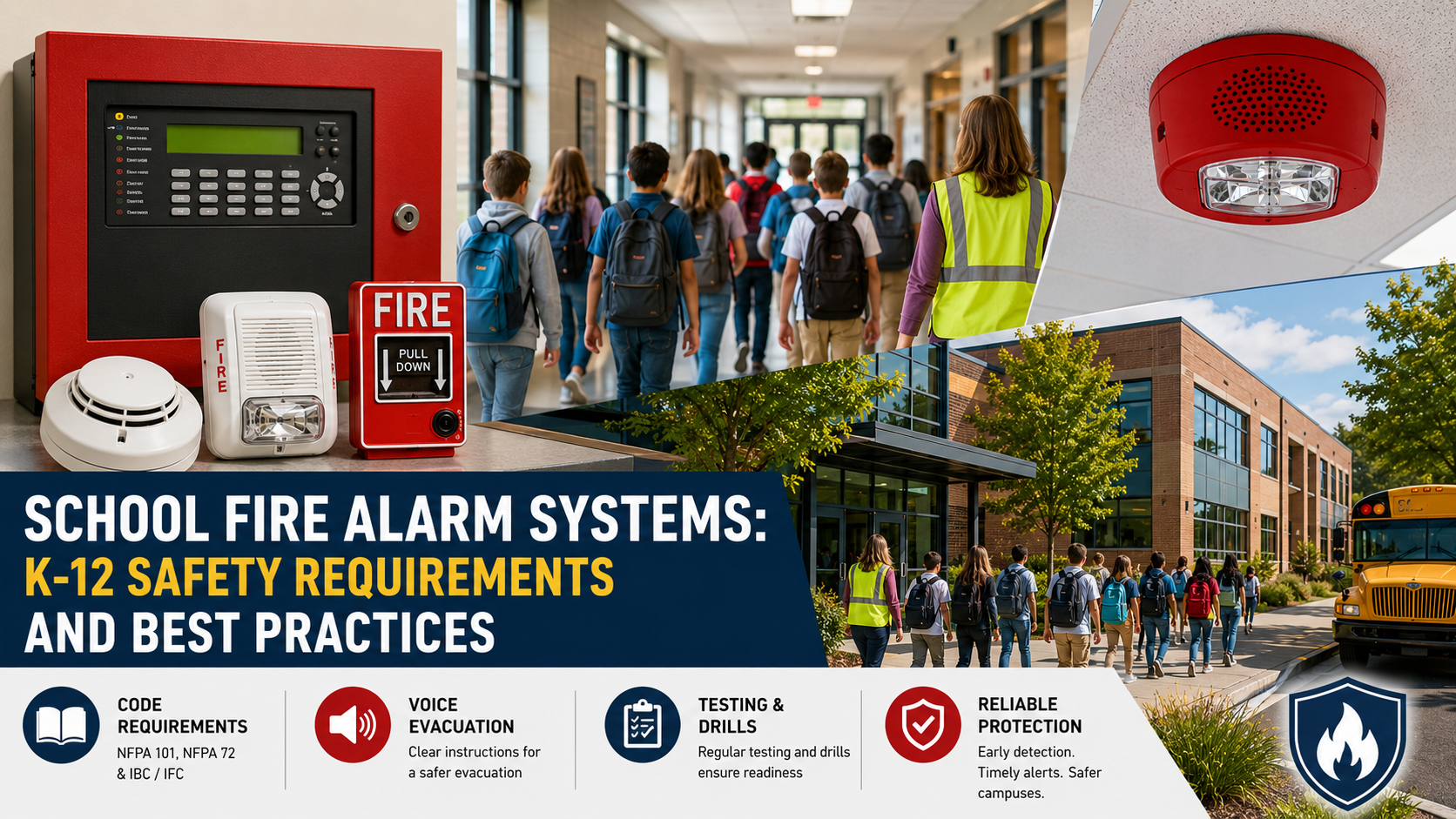
Few buildings carry a higher duty of care than a school. A modern school fire alarm system is responsible for protecting hundreds or even thousands of children every day, many of whom depend entirely on adults and on technology to guide them safely out of a building. For administrators, facility managers, and contractors, understanding what the code requires and what best practice adds on top of it is essential. The cost of getting it wrong is measured not only in fines and failed inspections but in the safety of minors.
This guide explains the K-12 requirements for a school fire alarm system in clear terms. It covers the codes that apply, the components every campus needs, the role of voice notification, testing obligations, and the practical steps that keep a system reliable year after year.
Why Schools Are Held to a Higher Standard
Schools combine several risk factors that few other buildings share. They hold large numbers of young occupants, some of whom may not react quickly or correctly to an alarm. Classrooms, corridors, laboratories, and gymnasiums all behave differently in a fire. Walls are often covered with paper and student artwork that can accelerate fire spread. And because public campuses sit on government property, they face an additional layer of oversight.
For all these reasons, a school fire alarm system is designed and maintained to a demanding standard. The goal is early detection, clear notification, and orderly evacuation every time, with no exceptions. Getting children out of a building safely requires technology that is both robust and easy for staff to understand under pressure. A second consideration is age range: a kindergarten wing and a high-school science block present very different evacuation challenges, and the system has to serve both reliably from the same network.
The Codes That Govern School Fire Alarm Systems
Three documents form the backbone of fire safety design for schools. NFPA 101, the Life Safety Code, defines what an educational occupancy is and what life-safety features it must include. NFPA 72, the National Fire Alarm and Signaling Code, specifies how the detection and notification system is installed, tested, and maintained. Model building codes such as the International Building Code and International Fire Code tie these standards into enforceable law.
Under NFPA 101, a facility where six or more people up to grade 12 receive instruction for four or more hours per day or more than twelve hours per week is classified as an educational occupancy. That single definition applies to both public and private schools. Once a building carries that classification, the NFPA 72 requirements for detection, notification, and monitoring apply in full, alongside any stricter rules adopted by the local Authority Having Jurisdiction.
Upgrading or maintaining a campus system? Browse our in-stock fire alarm panels and detection equipment — brand new, in original manufacturer packaging, with fast U.S. shipping so your project stays on schedule.
Core Components of a School Fire Alarm System
A compliant campus system is built from several coordinated parts. Each one has a defined job, and together they form a complete chain from detection to evacuation.
The Control Panel
The fire alarm control panel is the brain of the system. It supervises every connected device, processes alarm and trouble signals, drives the notification appliances, and reports conditions to a monitoring station. In a larger campus, the panel may be networked across multiple buildings so that an event in one structure can notify the entire site. Selecting a panel with enough capacity for future expansion is a sound investment for any growing district.
Initiating Devices
Initiating devices are what detect a fire or allow a person to report one. Manual pull stations, more formally called manual fire alarm boxes, are placed along exit routes so occupants can signal an alarm as they leave. Automatic devices include smoke detectors and heat detectors positioned according to code in corridors, mechanical rooms, and other defined areas. Reliable smoke detectors and well-placed pull stations are the front line of any campus design.
Notification Appliances
Notification appliances are the horns, strobes, and speakers that tell occupants to evacuate. They must deliver both audible and visible signals throughout the building so the alarm reaches every occupant, including those with hearing loss. Their placement and output are governed strictly by code to ensure no space is left without adequate coverage. Gymnasiums, cafeterias, and shop classrooms are often noisy or large, so designers must verify that audible levels rise clearly above ambient sound and that strobes are visible from every occupied position.
The Role of Voice Evacuation in Schools
One of the most important trends in campus safety is the move toward voice notification. While traditional horns and strobes remain common, code increasingly recognizes the value of a voice evacuation system for educational buildings, and new K-12 construction frequently requires one.
Voice notification broadcasts a clear spoken message rather than only a tone. For children, this difference is significant. A calm, intelligible instruction is far more effective at preventing panic than a loud, undifferentiated horn. The system can also direct occupants to specific exits or communicate the nature of an emergency, which is invaluable when part of a building must be avoided. Upon receiving an alarm, the system first sounds an alert tone to capture attention, then delivers an approved recorded message throughout the building.
For a modern school fire alarm system, a voice evacuation system turns a blunt warning into actionable guidance. It also supports coordinated, orderly movement exactly the behavior schools rehearse in their drills.
Inspection, Testing, and Drills
Installing a system is only the beginning. A school fire alarm system must be inspected, tested, and maintained on the schedule set by code and the local AHJ. Monthly visual checks, an annual functional test of every device, and periodic smoke detector sensitivity testing are all part of keeping the system trustworthy.
Schools carry an additional obligation that most buildings do not: frequent evacuation drills. Educational facilities are required to conduct and document fire and emergency egress drills regularly while school is in session. During each drill, all alarms must sound, every occupant must participate, and a staff member should confirm that exit routes, stairwells, and doors are clear and functional. Drills turn a technical system into a practiced human response. They also reveal practical problems that paperwork cannot, such as a propped exit door, a blocked stairwell, or a classroom that does not hear the alarm clearly. Treating each drill as a genuine rehearsal, rather than a formality, is one of the simplest ways to improve campus safety.
Because schools protect vulnerable occupants, their testing rigor is comparable in spirit to other sensitive environments. The same care that goes into a hospital program discussed in our guide to fire safety requirements for healthcare facilities should inform how a district approaches its own inspections.
Best Practices for Safer Campuses
Beyond the minimum code, the following practices help districts build genuinely resilient campuses.
- Plan for expansion. Choose a control panel and infrastructure with spare capacity, since schools frequently add classrooms, portables, or wings.
- Locate lower grades near ground-level exits. Placing younger students closer to the ground simplifies and speeds their evacuation.
- Keep corridors and artwork in check. Limit combustible decorations and keep exit paths completely clear at all times.
- Train staff thoroughly. Every teacher and aide should know how the school fire alarm system behaves, where pull stations are, and what the voice messages mean.
- Coordinate with the AHJ early. Involving the fire marshal during planning prevents costly redesign and delayed occupancy.
- Maintain detailed records. Keep every inspection, test, and drill documented and available for review.
A campus that follows these steps treats fire safety as an ongoing program rather than a one-time installation. That mindset is what separates a compliant building from a genuinely safe one. Districts that review their fire safety program every year, rather than only when an inspection is due, consistently catch small issues early and avoid the scramble of last-minute corrections before the fire marshal arrives.
Need parts or guidance for a campus project? Our specialists can help you match the right equipment to your district’s needs. Request a quote or contact our team for fast, knowledgeable assistance.
Conclusion
Protecting students is the highest responsibility a building can carry, and a well-designed school fire alarm system is central to meeting it. The codes NFPA 101, NFPA 72, and the model building codes set a firm baseline for detection, notification, and evacuation in any school building. Voice notification, diligent testing, regular drills, and forward-looking design all build on that baseline to create campuses where children are genuinely safe.
At QuickShipFire, we have spent more than twenty years helping schools, contractors, and facility managers find the equipment their systems depend on, including hard-to-source and obsolete components. Every product we ship is brand new in its original manufacturer packaging, backed by fast U.S. shipping and support that does not stop until your installation is complete. When a district’s safety is on the line, having a reliable parts partner makes all the difference.
Frequently Asked Questions
1. What classifies a building as an educational facility under fire code?
Under NFPA 101, a facility falls into this category when six or more people up to grade 12 receive instruction there for four or more hours per day, or more than twelve hours per week. This classification applies equally to public and private schools and triggers the full set of fire safety requirements.
2. Do all K-12 schools need voice notification?
Many new K-12 buildings are required to include voice notification, and code increasingly favors a spoken-message approach for educational buildings. Existing schools may continue to use horns and strobes unless a major renovation or local rule triggers an upgrade. Always confirm the current requirement with your AHJ.
3. How often must a school fire alarm system be tested?
A school fire alarm system follows the same general schedule as other commercial buildings: monthly visual checks, an annual functional test of all devices, and periodic smoke detector sensitivity testing. Schools must also conduct frequent documented evacuation drills while in session, which is an additional obligation beyond standard testing.
4. Are manual pull stations required in every part of a school?
Manual pull stations are generally required along exit routes so occupants can report a fire as they leave. Code allows some exceptions for example, in spaces protected by automatic sprinklers or other approved detection but pull stations remain a core component of most campus designs.
5. Who enforces fire alarm requirements for schools?
The Authority Having Jurisdiction, typically the local fire marshal or fire department, enforces the NFPA 72 requirements and any local amendments. For public schools, state fire marshals and education authorities may add further requirements. The AHJ has final say on inspection schedules and corrective action.
6. Can an older school keep its existing fire alarm system?
Building codes generally are not retroactive, so an existing school fire alarm system may often remain in service if it was compliant when installed and is properly maintained. However, major renovations, additions, or specific local rules can trigger a required upgrade to current standards.
7. What is the most important component of a school fire alarm system?
No single component works alone, but the fire alarm control panel is the heart of the system because it supervises every device and drives the response. That said, a campus is only as safe as its weakest link — detection, notification, monitoring, and trained staff all have to function together.
8. How should a district plan for future growth?
Districts should specify panels and infrastructure with spare capacity, since schools frequently add classrooms, portable buildings, or entire wings. Planning for expansion at the design stage is far cheaper than replacing an undersized system later, and it keeps the campus continuously protected.