
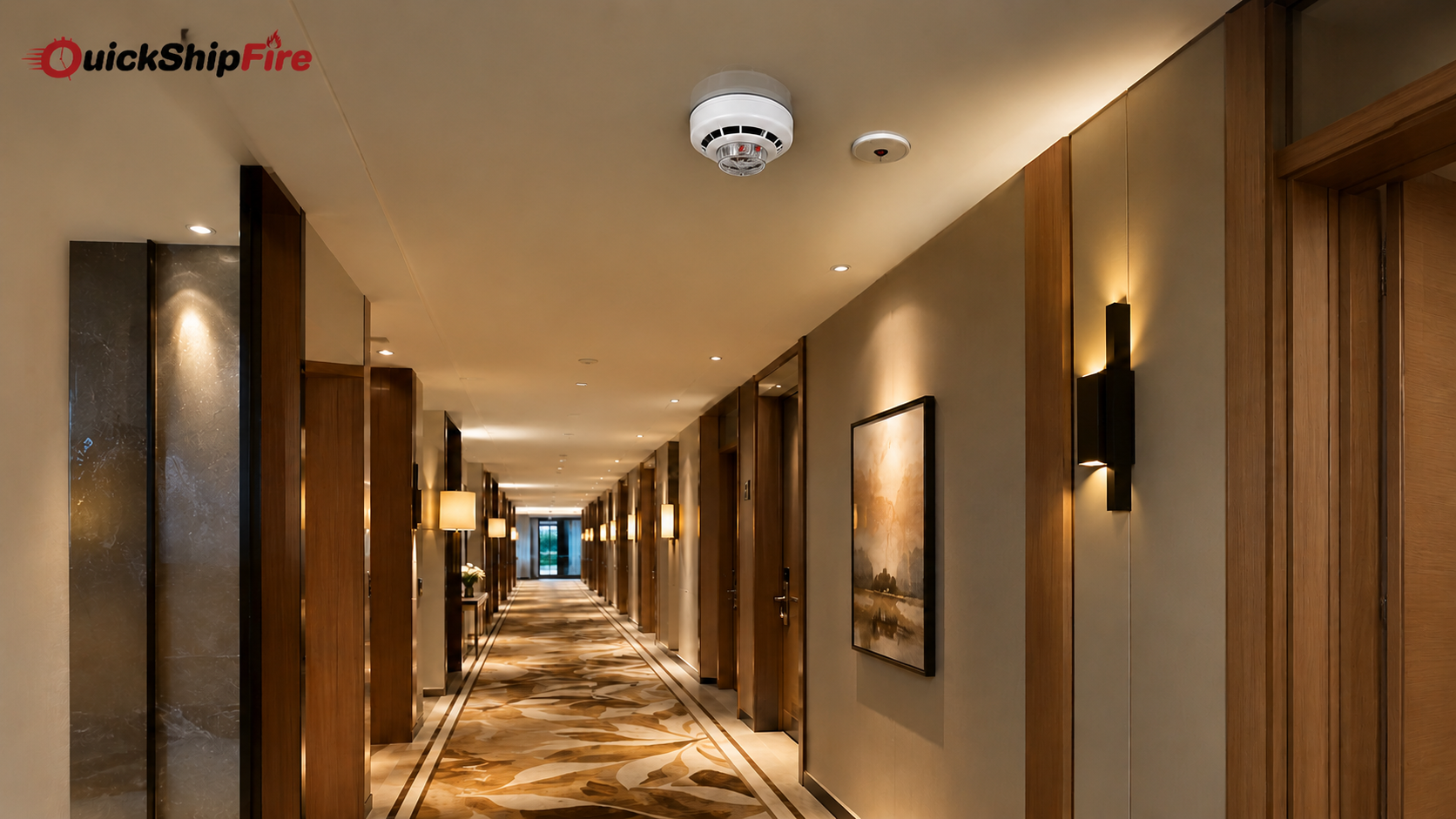
A hotel never sleeps, and neither can its life-safety equipment. From the lobby to the top-floor suite, a properly designed fire alarm network is what gives guests the precious minutes they need to evacuate safely. Because hotel guests are often asleep, unfamiliar with the building, and spread across many floors, hotels face some of the strictest fire alarm requirements of any occupancy type. This guide explains what those requirements are, which codes drive them, and how owners and facility managers can keep every guest protected while staying fully compliant.
Fire alarm compliance in a hotel is about far more than passing an inspection. It directly affects guest safety, operational reliability, insurance standing, and the property’s reputation. A single lapse, an inoperable detector, a missing inspection record, or an alarm that cannot be heard over a running shower, can carry severe consequences. The sections below walk through the codes, the components, the testing schedule, and the practical steps that keep a hotel fire alarm ready the moment it is needed.
Why Hotels Face Stricter Fire Alarm Requirements
Hotels are classified as transient occupancies, meaning most occupants stay for fewer than thirty days and do not know the building’s layout. Guests sleep behind closed doors, sometimes after travel fatigue, and they rely entirely on the building to wake them and guide them out. That combination of sleeping risk and unfamiliarity is exactly why a hotel needs a robust, interconnected fire alarm in every part of the property, not just the common areas.
Several factors make hospitality fire protection uniquely demanding:
- Large, fluctuating occupant loads who are unfamiliar with exits and stairwells.
- Guests who may be asleep, requiring a loud audible and bright visual fire alarm to wake them.
- Multi-story layouts with long corridors that smoke can travel through quickly.
- Mixed uses on one property, such as kitchens, laundry, pools, and event spaces, each with its own hazards.
- A clear duty of care to guests with hearing loss, mobility limitations, or other accessibility needs.
Because the risk profile is so high, regulators expect a hotel fire alarm to do three things flawlessly: detect a fire early, notify everyone effectively, and summon help automatically. Every requirement that follows supports one of those three goals.
The Codes Behind Hotel Fire Alarm Compliance
Hotel fire alarm design is governed primarily by NFPA 72, the National Fire Alarm and Signaling Code, alongside the Life Safety Code and the International Fire Code. Local jurisdictions adopt these standards, sometimes with amendments, so the Authority Having Jurisdiction always has the final word. The national standard spells out how devices must be placed, how loud and bright notification must be, and how often the system must be tested.
In practice, new hotel construction requires a complete, interconnected fire alarm: detection devices, manual initiating devices, and audible and visual notification, all monitored and supervised. Sprinkler systems installed under the relevant NFPA installation standards are also required in most new hotels and work hand in hand with detection. Understanding how these codes overlap is the foundation of any compliance program, and it is the first thing an inspector will check.
Core Components of a Hotel Fire Alarm System
A compliant hotel fire alarm brings several device families together into one supervised network. Each plays a specific role in detecting a fire early and alerting everyone in the building before conditions become dangerous.
Detection Devices
Guestrooms and corridors require smoke detectors placed and spaced according to the code’s detection chapter. Corridor detection activates when smoke travels outside a room, giving everyone on that floor early warning. Proper ceiling and wall clearances ensure smoke reaches each device quickly. Heat detection is often added in kitchens and mechanical rooms where smoke sensing would cause nuisance fire alarm activations.
Audible and Visual Notification
Audible and visual notification appliances must reach occupants throughout the property at the required decibel and candela levels. Because guests may be asleep, sleeping rooms increasingly require a low-frequency 520 Hz audible signal, which is far more effective at waking people than a standard high-pitched tone. Accessible rooms must include enhanced visual and tactile alerting for guests with hearing loss so the fire alarm reaches every occupant.
Manual Initiation and Control
Manual pull stations are typically located at exits and in stairwells so staff and guests can trigger the alarm by hand. All field devices report back to a central control panel, the brain of the fire alarm, which supervises every circuit and transmits signals to a monitoring station. The panel is also where technicians review trouble conditions and confirm the system is healthy.
Specialized Detection
Large hotels with extensive HVAC systems often add duct detectors to shut down air handling and stop smoke from spreading through the building. Atriums and tall lobbies may call for beam or aspirating detection that can cover large open volumes. Matching the right device to each space is what turns a basic install into a genuinely protective fire alarm.
Upgrading guestrooms or replacing an aging panel? QuickShipFire stocks brand-new and hard-to-find hotel fire alarm components with fast U.S. shipping and installation support. Request a quote and keep your property inspection-ready.
Notification, Monitoring, and the 24/7 Requirement
Detecting a fire is only half the job; the system must also announce it and summon help. Larger hotels frequently require an emergency voice communication system so staff can deliver clear instructions during an emergency instead of relying on tones alone. Just as importantly, a hotel fire alarm must be supervised around the clock and transmit signals to an approved supervising station. Continuous monitoring is not a luxury; national standards treat 24/7 supervision as a legal expectation so every alarm event reaches first responders without delay.
Supervision also protects against silent failures. If a wire is cut, a battery weakens, or a device drops offline, the panel reports a trouble signal so the problem is fixed before a real emergency exposes it. For a building full of sleeping guests, that constant self-checking is one of the most valuable features a fire alarm can offer.
Inspection, Testing, and Maintenance Schedule
Compliance is ongoing, not a one-time event. The national standard sets minimum frequencies for inspecting and testing each part of the system, and records must be producible on demand for the fire marshal or AHJ. A typical hotel fire alarm program looks like this:
- Semi-annual visual inspection of the control panel and accessible detection devices.
- Annual functional testing of all detectors, manual stations, and notification devices, including any voice evacuation system.
- Detector sensitivity testing and battery verification on the schedule the manufacturer and code require.
- Prompt repair of any deficiency, with written documentation retained for inspection.
- Staff training and regular drills so the team can recognize alarm signals and guide guests out safely.
Skipping any of these steps creates exactly the kind of gap an inspector looks for. Worse, an untested device may fail at the only moment it matters. Treating the schedule as a fixed routine, rather than a task to defer, is what separates a compliant property from a vulnerable one.
Hotel Fire Alarm Requirements at a Glance
The table below summarizes the typical requirements across key areas of a hotel so teams can see the full picture quickly.
| Area | Typical Requirement | Governing Reference |
| Guestrooms | Smoke detection plus low-frequency 520 Hz audible signal | NFPA 72 Ch. 17 & 18 |
| Corridors | Spaced smoke detection and notification devices | Detection chapter, Ch. 17 |
| Accessible rooms | Visual and tactile alerting for hearing loss | Code & ADA |
| Kitchens | Heat detection and hood suppression interface | Fire code & NFPA 96 |
| Whole building | 24/7 supervision and monitoring | National standard |
| Records | Inspection and test documentation retained | Code Ch. 7 & 14 |
How to Choose Hotel-Grade Fire Alarm Equipment
When it is time to expand, modernize, or simply replace a failed device, the equipment you choose affects both compliance and downtime. A few principles keep a hotel fire alarm reliable for years:
- Match new devices to the existing panel’s protocol so they integrate cleanly instead of forcing a full system replacement.
- Favor brand-new equipment in original manufacturer packaging to ensure certification and warranty coverage.
- Stock a few spare detectors, bases, and modules so a single failure never takes a room or floor out of service.
- Source obsolete parts from a specialist supplier when an older fire alarm panel is still serviceable but no longer mainstream.
Replacing an entire system is expensive and disruptive. In many hotels, the smarter path is keeping a proven fire alarm running with compatible, readily available components, which is exactly where a dedicated parts supplier earns its keep.
Common Compliance Pitfalls in Hotels
Even well-managed properties drift out of compliance, usually during turnover, renovation, or when maintenance lapses. Watch for these recurring gaps:
- Battery-only guestroom alarms that are not interconnected with the building fire alarm.
- Notification devices that cannot meet decibel levels in noisy or remodeled rooms.
- Missing or disorganized inspection records that cannot be produced during an audit.
- Detectors painted over, blocked, or knocked out of position during housekeeping or renovation.
- Outdated panels for which replacement parts are hard to find, lengthening any outage.
Conclusion
Hotel fire alarm requirements exist because the stakes are uniquely high: sleeping guests, unfamiliar layouts, and large crowds all depend on a system that works the moment it is needed. By following the national codes, installing the right mix of detection and notification, supervising the system 24/7, and keeping a disciplined testing and documentation routine, hotels protect both their guests and their business. The properties that excel treat fire safety as a continuous commitment rather than an annual checkbox.
When a detector fails or a panel needs an upgrade, fast sourcing keeps your hotel compliant and your rooms in service. QuickShipFire specializes in new and obsolete fire alarm components, backed by the support to help you find exactly what your property needs. If you are unsure which part fits your system, our team is ready to help you identify it.
Frequently Asked Questions
Are smoke detectors required in every hotel guestroom?
Yes. New hotel construction requires smoke detection in every guestroom, and codes generally call for those devices to be part of, or interconnected with, the building fire alarm rather than standalone battery units. Corridor detection is also required so smoke leaving a room alerts the whole floor.
What is the 520 Hz low-frequency alarm requirement?
Research shows a low-frequency 520 Hz audible signal wakes sleeping people, including those with mild to moderate hearing loss, far more reliably than a standard high-pitched tone. Current codes require this low-frequency signal in the sleeping rooms of new hotels, which is why it has become a standard part of guestroom fire alarm notification.
How often must a hotel fire alarm system be tested?
Hotels typically need a semi-annual visual inspection of the panel and detectors and a full annual functional test of all detection devices, manual stations, and notification appliances, including any voice evacuation system. Sensitivity testing and battery checks follow the intervals set by code and the manufacturer, and all results must be documented and retained.
Is 24/7 monitoring legally required for hotels?
In virtually all jurisdictions, yes. Local fire codes and national standards require a hotel fire alarm to be supervised 24/7 and to transmit signals to an approved supervising station, so every alarm is received and relayed to first responders without delay.
What fire alarm accommodations are needed for guests with disabilities?
Accessible guestrooms must include enhanced notification for occupants with hearing loss, such as visual strobes and tactile alerting devices, in addition to audible signals. These accommodations align both with the national fire code and with accessibility requirements like the ADA.
Do older hotels have to meet the latest fire alarm codes?
Existing buildings are often allowed to keep compliant legacy systems if they are properly maintained, but major renovations, occupancy changes, or new construction typically trigger current requirements. Because local AHJs interpret these rules, owners should confirm their specific obligations before any project begins.
What happens if a hotel fails a fire alarm inspection?
Failing an inspection can result in citations, fines, required corrective work, and in serious cases a closure order until the fire alarm is brought into compliance. Keeping spare parts on hand and addressing deficiencies quickly is the most reliable way to avoid costly downtime.