
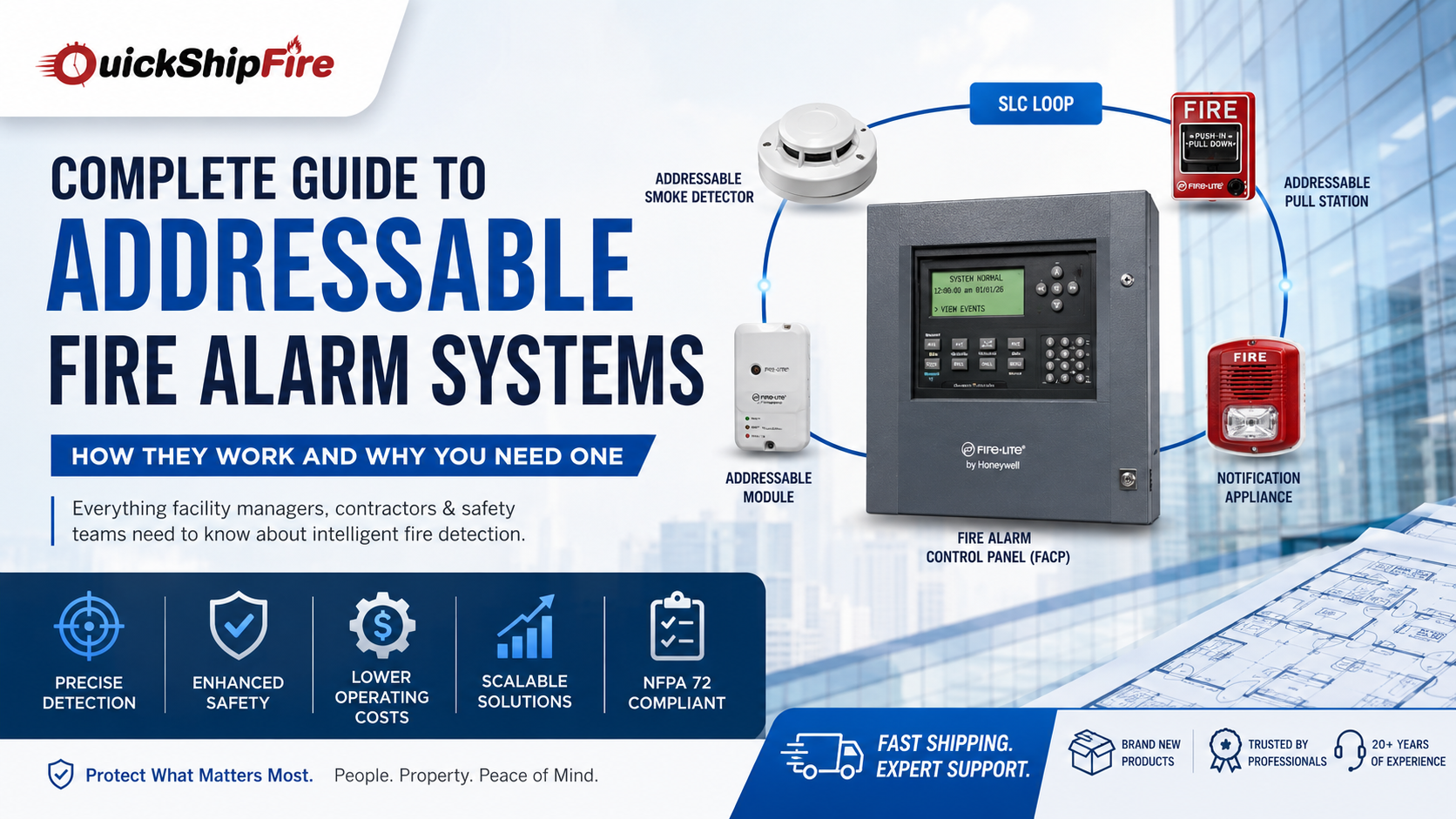
When a fire breaks out in a commercial building, every second counts. The difference between a contained incident and a catastrophic loss often comes down to one critical factor: how quickly your system pinpoints where the problem is and gets the right information to the right people. That’s precisely why the addressable fire alarm system has become the industry benchmark for commercial fire protection across the United States.
Unlike older detection methods, an addressable system doesn’t just tell you that something is wrong it tells you exactly which device triggered, on which floor, in which room, down to a custom label you define. For facility managers, building owners, and fire protection contractors, this precision isn’t a luxury. It’s operationally essential.
In this complete guide, we’ll walk through everything you need to know: how addressable systems work, what components they include, how they stack up against conventional alternatives, what realistic installation and cost expectations look like, and why this technology has become the default choice for virtually every serious commercial fire protection application today.
What Is an Addressable Fire Alarm System?
An addressable fire alarm system is an intelligent detection and notification network where every connected device smoke detectors, pull stations, modules, and notification appliances is assigned a unique numerical address. That address is continuously communicated back to the fire alarm control panel (FACP), giving operators real-time, point-specific information about any alarm, trouble, or supervisory condition anywhere on the system.
Think of it like a smartphone network. Each device has its own unique identifier, and the panel can hold a two-way conversation with every one of them independently. This is fundamentally different from conventional systems, where groups of devices share a single zone circuit and the panel can only tell you which zone triggered not which individual device.
The intelligence goes even further in modern systems. Many addressable detectors continuously report analog data back to the panel live smoke density readings, temperature levels, and self-diagnostic results — so the system can flag a dirty detector before it causes a false alarm or misses a real event. For any commercial property today, an addressable fire alarm panel represents the baseline expectation from code officials, insurance carriers, and safety-conscious ownership teams.
How Does an Addressable Fire Alarm Work?
The communication backbone of an addressable system is the Signaling Line Circuit – commonly called the SLC loop. This is a two-wire circuit that runs from the fire alarm control panel throughout the building, connecting every addressable device in a continuous supervised loop. The panel sends polling signals down this loop constantly, querying each device for its current status many times per minute.
Here’s what that polling cycle looks like in practice:
SLC polling cycle (Real Example):
| Poll # | Device ID | Location | Panel query | Device response | Status |
| 01 | 001 | Lobby smoke detector | Status? | Normal | Normal |
| 02 | 002 | Stairwell pull station | Status? | Normal | Normal |
| 03 | 047 | Server room detector – 2nd floor east | Status? | 35% smoke obscuration detected | Alarm |
This entire cycle from the detector entering alarm to the panel displaying the exact location happens in under three seconds. The result is dramatically faster emergency response, more precise evacuation decisions, and significantly quicker troubleshooting when issues arise.
For larger buildings, the SLC loop is often wired in a Class A configuration a redundant design where the signal travels in two directions simultaneously around the loop. This means even if a wire break occurs somewhere between devices, the system remains fully operational, an important resilience feature that most jurisdictions now require for high-rise and healthcare occupancies.
Key Addressable Fire Alarm System Components
A properly designed addressable system is built from several interdependent components. Understanding each one helps you make better decisions whether you’re planning a new installation, evaluating a system upgrade, or sourcing replacement parts.
1. The Fire Alarm Control Panel (FACP)
The FACP is the brain of the entire operation. It processes all incoming device signals, manages SLC loop communication, controls output functions, logs system history, and provides the operator interface. Modern addressable panels such as the Fire-Lite ES-200X or Notifier NFS-320 also integrate built-in dual-path communicators for central station monitoring, making them complete head-end solutions in a single enclosure.
2. Addressable Initiating Devices
These are the field devices that detect fire conditions and report them back to the panel with their individual address. A complete addressable smoke detector system typically includes:
- Photoelectric, ionization, or multi-sensor addressable smoke detectors
- Fixed temperature and rate-of-rise heat detectors
- Duct smoke detectors integrated with HVAC systems
- Manual pull stations for occupant-initiated alarms
- Waterflow and valve tamper switches for sprinkler system supervision
3. Addressable Modules
Monitor modules allow the addressable panel to supervise conventional devices or dry-contact inputs (such as a sprinkler waterflow switch) as individually addressed points. Control modules let the panel trigger output functions: door holder release, HVAC shutdown, elevator recall, or suppression system activation. These modules are what make an addressable platform genuinely flexible across different building types and applications.
4. Notification Appliances
Horns, strobes, horn/strobe combinations, and speakers alert occupants when an alarm activates. These devices are wired on Notification Appliance Circuits (NACs) powered by the panel, and in more advanced configurations can be individually addressed to allow selective, floor-by-floor evacuation signaling.
5. The SLC Loop Card
Inside the panel, the loop card is the circuit board that manages all communication with field devices on the signaling line circuit. Entry-level panels typically include a single loop card supporting 99–198 addressable points. Multi-loop enterprise panels can expand across multiple loop cards, supporting thousands of points across large campuses or high-rise towers.
Addressable vs Conventional Fire Alarm: A Clear Comparison
One of the most common questions facility managers ask when evaluating fire alarm system types is: addressable vs conventional fire alarm – which is actually right for our building? Here’s a straightforward comparison:
| Feature | ✔ Addressable | Conventional |
| Device identification | Exact point (device + custom label) | Zone only (group of devices) |
| Troubleshooting speed | Minutes – pinpoint location | Hours – check every device in zone |
| False alarm management | Superior – pre-alarm, drift comp | Limited – alarm or nothing |
| Wiring topology | Single SLC loop covers whole floor | Separate circuit per zone |
| System scalability | Expand with a module, no rewire | Rewire required for expansion |
| Self-diagnostics | Continuous – dirty detector alerts | None – reactive only |
| Upfront cost | Higher equipment cost | Lower equipment cost |
| Long-term ROI | Significantly better | Poor for complex buildings |
For buildings with more than a handful of zones, a device count above 25–30 detectors, or any meaningful occupancy complexity, the addressable system is not just the better choice in many jurisdictions it is the only code-compliant option for new commercial construction. Conventional systems remain legitimate for very small, straightforward buildings, but for most commercial properties the operational math firmly favors addressable technology.
NFPA 72 and Addressable Fire Alarm Systems
All fire alarm systems installed in the United States must comply with NFPA 72: the National Fire Alarm and Signaling Code. NFPA 72 addressable systems are referenced throughout the code, with specific provisions governing several critical areas:
- Device addressing and identification: NFPA 72 requires the system to identify the specific device in alarm or trouble, a requirement addressable technology meets by design.
- SLC loop circuit styles: Class A, Class B, and Class X wiring configurations each carry defined fault-tolerance requirements. Class A is typically mandated for higher-risk or higher-occupancy facilities.
- Detector sensitivity testing: Addressable panels must conduct annual sensitivity verification for each smoke detector per Table 14.3.1. Most modern panels perform this via automated diagnostics, dramatically reducing labor costs.
- Documentation and records: NFPA 72 requires a formal Record of Completion, as-built drawings, and a maintenance log. Addressable panels simplify compliance with built-in alarm and event history logs.
One practical advantage worth highlighting: modern addressable panels maintain a detailed event history log every alarm, trouble, test, and restore event, timestamped and stored. This log is exactly what Authority Having Jurisdiction (AHJ) inspectors expect to review during annual fire alarm inspections, and it’s far easier to produce than paper maintenance records.
Addressable Fire Alarm System Installation: What to Expect
Addressable fire alarm system installation is a multi-phase, code-driven process that requires a licensed fire alarm contractor in most jurisdictions. Here’s what a standard commercial project typically involves:
- System design and engineering: A qualified designer maps every device location, SLC loop path, and panel placement per NFPA 72 and local amendments. A permit is pulled from the local AHJ before any work begins.
- Rough-in wiring: Conduit and fire alarm cable are run throughout the building before devices are installed. Cable routing must follow local electrical code requirements.
- Device installation: Smoke detectors, modules, pull stations, duct detectors, and notification appliances are mounted and terminated per the engineered drawings.
- Panel programming: Every device is programmed with a unique SLC address, a custom descriptive label (e.g., ‘Room 214 – Corridor Smoke’), and the appropriate response logic for alarm, supervisory, and trouble events.
- Acceptance testing: Every device is functionally tested in the presence of the AHJ inspector before the building receives occupancy approval. All results are recorded on the NFPA 72 Record of Completion.
Timeline expectations vary significantly by project size. Small commercial systems of 50–100 addressable points are often fully installed in one to two weeks. Large multi-loop installations in hospitals, universities, or high-rises may represent months of coordinated work across multiple contractors. Selecting a fire alarm contractor with specific brand experience on your chosen panel – whether that’s Fire-Lite, Notifier, Simplex, or Silent Knight makes a measurable difference in programming quality, commissioning speed, and long-term system reliability.
Addressable Fire Alarm System Cost: Realistic Budget Framework
Addressable fire alarm system cost varies considerably depending on building size, device count, panel brand, regional labor rates, and whether you’re doing a new installation or a partial retrofit. Here’s a practical framework for budgeting:
Estimated Installed Cost Ranges (2026 U.S. Market)
| Item | Cost range | Note |
| Panel & head-end equipment | $1,000 – $8,000+ | Varies by point capacity |
| Addressable smoke detectors | $80 – $200 each | Equipment only |
| Pull stations | $100 – $250 each | Equipment only |
| Addressable modules | $80 – $300 each | Equipment only |
| Installation labor | $75 – $150 / hr | Varies by region |
| Small commercial 25–50 points | $8,000 – $20,000 | Fully installed |
| Mid-size commercial 100–200 points | $25,000 – $65,000 | Fully installed |
| Large commercial 300+ points | $75,000+ | Fully installed |
While the upfront equipment cost of an addressable system is higher than conventional alternatives, the total cost of ownership over 10–15 years consistently favors addressable technology. Faster troubleshooting, reduced false alarm incidents, built-in maintenance alerts, and significantly lower labor costs during annual inspections all contribute to a better long-term financial outcome.
One additional cost consideration: parts availability. Addressable systems from major manufacturers like Fire-Lite, Notifier, and Simplex typically enjoy 10–15 years of supported parts supply after a model is released. Planning for eventual parts replacement – particularly for detector heads, loop cards, and communicators is a smart part of any long-term facilities budget.
Five Reasons Your Commercial Building Needs an Addressable System
1. Precision when it matters most. When firefighters arrive at an alarm, knowing “smoke detector in the server room, 2nd floor east wing” versus “something in Zone 4” can directly impact how quickly the situation is contained and how much property damage occurs.
2. Dramatically fewer false alarms. The pre-alarm reporting, analog sensitivity data, and drift compensation built into a modern intelligent fire alarm system catch problem detectors before they false alarm. This protects you from AHJ fines, unnecessary fire department responses, and the operational disruption of building evacuations.
3. Lower ongoing maintenance costs. Addressable panels flag dirty, slow, or failing detectors automatically. This transforms maintenance from a reactive scramble into a proactive, scheduled process and significantly reduces the labor hours required during annual inspections.
4. Code compliance today and tomorrow. Most current local amendments to the International Fire Code require addressable systems for commercial new construction. Getting ahead of that requirement rather than facing a costly forced retrofit is always the better financial decision.
5. True scalability. Adding a wing, reconfiguring a floor, or integrating with a mass notification system is architecturally straightforward on an addressable platform. You add devices to the SLC loop and program addresses no rewiring of zone circuits, no panel replacement required.
Choosing the Right Addressable Fire Alarm Panel
Selecting the right addressable fire alarm panel for your commercial building means honestly evaluating current needs while planning intelligently for future growth. The key factors to assess:
- Point capacity: How many addressable devices does the system need to support today, and in five years? Buy capacity you’ll actually use.
- Loop count: Single-loop panels work well for small-to-mid buildings. Multi-loop platforms scale to enterprise applications without panel replacement.
- Communicator type: NFPA 72 and most AHJs now require dual-path monitoring (cellular + IP). Confirm the panel supports it natively or via add-on.
- Brand ecosystem and parts availability: Strong contractor networks, accessible replacement parts, and long-term manufacturer support matter as much as features. Fire-Lite, Notifier, Silent Knight, and Simplex all check these boxes.
- UL 864 listing: Every panel you specify must carry this listing; it’s the baseline UL standard for fire alarm control units.
At QuickShipFire, we stock a wide range of addressable fire alarm panels, detector heads, modules, and hard-to-find replacement components all brand new in original manufacturer packaging with fast nationwide shipping. Whether you’re commissioning a new system or keeping an older one running, we can help you find exactly what you need.
Frequently Asked Questions
Can I mix addressable and conventional devices on the same system?
Yes, with the right interface modules. A conventional zone monitor module allows the addressable panel to supervise a group of conventional detectors as a single addressable point. This makes hybrid installations practical during phased upgrades, allowing you to migrate to fully addressable technology over time without replacing everything at once.
How many devices can one SLC loop support?
This varies by panel manufacturer and model. Most modern addressable platforms support 99–250 devices per SLC loop. Multi-loop panels such as the Notifier NFS2-640 or Simplex 4100U support several thousand total addressable points across multiple loops, making them suitable for any size facility.
How often do addressable smoke detectors need to be tested?
NFPA 72 requires functional testing and sensitivity verification for addressable smoke detectors annually (at minimum). The advantage of addressable technology here is significant: most panels can perform automated sensitivity readings via a laptop interface in a fraction of the time it takes to manually test conventional detectors one-by-one.
How long does an addressable fire alarm system last?
A well-maintained addressable system can remain in active service for 15–20 years. However, manufacturer parts support typically has a 10–15 year horizon after a product generation is released. After that, finding detector heads, loop cards, and communicator modules requires specialty suppliers. This is one of QuickShipFire’s core strengths we specialize in sourcing brand-new, hard-to-find fire alarm components for systems that manufacturers no longer actively support.
Final Thoughts
An addressable fire alarm system is far more than a code compliance checkbox. It’s an intelligent safety infrastructure that protects lives, reduces operational risk, lowers long-term costs, and scales with your building’s needs for decades. The precision, self-diagnostic capability, and flexibility it delivers over conventional alternatives make it the right choice for virtually every commercial application today.
Whether you’re designing a new system from scratch, evaluating an upgrade from an older conventional or legacy addressable platform, or simply trying to source a hard-to-find replacement part to keep your current system running the information and products you need are available.
QuickShipFire has been supplying fire safety professionals, contractors, and facility managers with brand-new fire alarm equipment since 2017. With over 20 years of industry expertise, we stock everything from complete addressable panels to individual detector heads and specialty modules including components for discontinued systems that other suppliers no longer carry.