
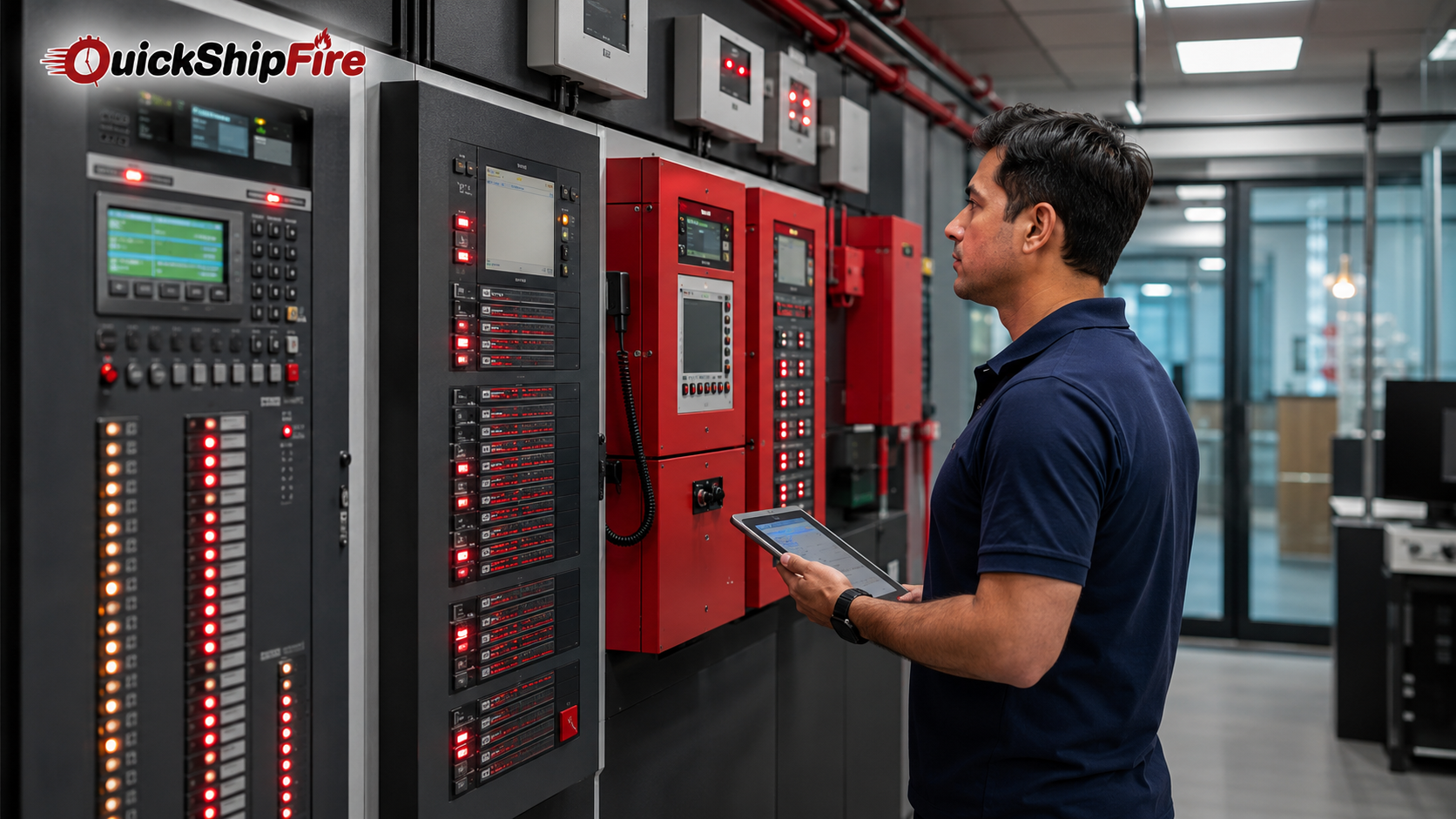
When a facility spans multiple buildings, thousands of devices, and dozens of stakeholders, choosing the wrong control panel is not a paperwork problem, it is a life-safety problem. Siemens builds two addressable platforms that dominate the enterprise conversation: the FireFinder XLS and the Cerberus PRO series. Both carry the Siemens name, both are UL-listed, and both appear in specifications for hospitals, universities, airports, and industrial campuses across the country. But the two platforms are not interchangeable, and choosing between them without understanding their architecture, capacity, and networking limits can leave an owner either overpaying for capability they will never use or outgrowing a panel within a few years of installation. This guide breaks down how each platform is built, where each one earns its keep, and how to evaluate fire safety solutions the way a specifying engineer would: by device count, campus layout, mass notification requirements, and lifecycle cost. Whether you are planning a large-building retrofit or a new campus-wide build-out, the comparison below should make the decision considerably easier.
What Sets Enterprise Fire Safety Solutions Apart from Standard Commercial Systems
A single-building office or retail store can usually be protected by a compact addressable fire alarm control panel with a couple hundred points. Enterprise environments are a different animal entirely. A hospital campus, a corporate headquarters, a university, or a multi-building industrial site introduces scale and complexity that a small panel was never engineered to handle.
Enterprise-grade fire safety solutions typically need to deliver:
- Massive device capacity: thousands, not hundreds, of addressable smoke detectors, heat detectors, modules, and notification appliances across one building or several.
- Panel networking: the ability to link dozens of individual control panels into a single, coordinated system that shares alarm, trouble, and supervisory information campus-wide.
- Integrated mass notification: voice evacuation, live paging override, and all-hazard messaging that goes beyond a simple three-pulse fire tone.
- Survivability under stress: Style 7 wiring, seismic certification, and distributed intelligence so a single wiring fault or damaged transponder does not take down the whole network.
- Long-term supportability: a modular architecture that can be expanded, serviced, and partially replaced over a 15- to 25-year service life without a full system teardown.
Both the FireFinder XLS and the Cerberus PRO line were designed with these demands in mind, but they approach the problem from different directions, and that difference is exactly what makes the comparison worth doing carefully before a purchase order goes out.
Siemens FireFinder XLS: Purpose-Built for High-Rise and Campus-Scale Protection
The FireFinder XLS is Siemens’ flagship platform for large, sophisticated buildings: high-rises, hospitals, airports, and sprawling campuses where a single event may need to be managed across dozens of zones simultaneously. It is not a panel that a facility grows into gradually; it is engineered from the ground up for scale, and it represents some of the most capable enterprise fire safety solutions available on the market today.
Key Specifications and Capabilities
- Point capacity: Each FireFinder XLS panel supports up to 2,500 addressable points, and multiple panels can be networked together for essentially unlimited campus-wide capacity.
- FirePrint detection technology: Proprietary signal processing that Siemens states can detect a developing fire condition and begin notification in under three seconds, reducing the window between ignition and occupant alert.
- PMI operator interface: A 6-inch, full-color touchscreen with large, lighted buttons that guides operators through Acknowledge, Silence, Unsilence, and Reset functions without requiring specialized training.
- Survivability features: Seismic-certified enclosures and Style 7 (Class A-equivalent) signaling line circuit wiring, so a single break in the loop does not compromise detection on either side of the fault.
- Native VESDA integration: The system interfaces directly with up to 100 VESDA aspirating smoke detectors, making it a strong fit for adjoining data center or clean-room protection.
- FireFinder XLSV voice option: Adds integrated digital voice evacuation with up to 300 stored custom messages and roughly 100 minutes of recorded audio, listed under UL 2572 for mass notification.
Where the FireFinder XLS Fits Best
This platform earns its specification on the largest and most complex projects: high-rise office and residential towers, hospital campuses, airports, government buildings, and any site where phased, zone-by-zone voice evacuation and deep mass-notification integration are non-negotiable requirements rather than nice-to-have features. For owners comparing fire safety solutions at this scale, the FireFinder XLS is usually the default starting point.
Siemens Cerberus PRO: Modular, Scalable Addressable Protection
Where the FireFinder XLS is built for the largest end of the market, Cerberus PRO is Siemens’ modular addressable family that scales from a single small building up through genuinely large, multi-panel networks. Rather than one panel with one capacity, Cerberus PRO is a family of five panel sizes that share a common architecture and can be mixed within the same networked system, offering more flexible fire safety solutions for organizations that expect to grow.
Key Specifications and Capabilities
- Tiered point capacity: The smallest Cerberus PRO panel supports 126 addresses on a single loop, scaling through 252, 504, and 756 addresses up to 1,512 addresses on the largest model, which uses 28 loops.
- SafeDLink networking: Up to 32 Cerberus PRO panels can be networked together over a fiber-optic C-net backbone, with no additional cabling required to maintain degrade-mode communication even across networks with more than 512 detectors.
- Danger Management Station (DMS): A centralized software layer that can monitor and control up to 32 networked panels from one operator workstation, which is particularly valuable for multi-building portfolios managed by a single facilities team.
- 10,000-event history log: Every FC922 and FC924 panel retains a detailed event history for troubleshooting, audits, and code inspections.
- Explosion-hazard product line: Cerberus PRO offers detection devices specifically listed for hazardous and explosion-risk areas, extending the platform into industrial and process environments that a standard commercial panel cannot legally serve.
- Auto-configuration and web tools: Faster commissioning through auto-configuration routines and browser-based programming, which shortens startup time on large multi-panel jobs.
Where Cerberus PRO Fits Best
Cerberus PRO is the more flexible starting point for mid-size commercial buildings, healthcare facilities, and industrial sites that need real scalability without committing to the largest available platform on day one. Because the panel family shares architecture across all five sizes, a facility can start with a 252-point FC922 and expand into networked fire alarm panels spanning a multi-building Cerberus PRO deployment years later, without replacing the original hardware. It is a practical route to durable fire safety solutions for organizations still defining their long-term footprint.
Siemens FireFinder XLS vs Cerberus PRO: Feature-by-Feature Comparison
The table below lines up both fire safety solutions side by side across the criteria that matter most to a specifying engineer, from raw point capacity to voice evacuation system support.
| Feature | Siemens FireFinder XLS | Siemens Cerberus PRO |
| Point capacity (single panel) | Up to 2,500 addressable points | 126 to 1,512 addressable points across five models |
| Best-fit building type | High-rise, hospital campus, airport, government | Mid-size commercial to large multi-building sites |
| Networking | Multi-panel network for campus-wide capacity | Up to 32 panels via SafeDLink/C-net fiber |
| Voice / mass notification | FireFinder XLSV, UL 2572, 300 stored messages | Optional intelligent voice communication |
| Aspirating detection integration | Native interface for up to 100 VESDA detectors | Compatible via standard input modules |
| Hazardous location support | Standard commercial/institutional listing | Dedicated explosion-hazard product line |
| Centralized multi-site management | Networked PMI operator stations | Danger Management Station (up to 32 panels) |
| Typical deployment scale | Enterprise / campus from day one | Scales from single building to enterprise |
Choosing the Right Enterprise Fire Safety Solutions for Your Facility
Neither platform is objectively “better” in isolation. The right choice depends on how the numbers on your project actually stack up. When evaluating an enterprise fire alarm system for a large facility, run through these factors before finalizing a specification:
- Total device count today and in five years. A building already near 1,500 points should not be specified onto a panel whose ceiling sits at 1,512 addresses; leave real expansion headroom.
- Single building versus true multi-building campus. If the project genuinely spans several structures reporting to one command point, panel networking and centralized management (DMS or networked PMI stations) matter more than raw single-panel capacity.
- Mass notification and voice evacuation requirements. Government, higher-education, and high-occupancy buildings increasingly require UL 2572-listed mass notification system capability, not just fire-specific tones.
- Hazardous or industrial process areas. A facility with paint booths, chemical storage, or combustible dust needs detection devices rated for the classified area, which points toward a platform with an explosion-hazard product line.
- Long-term parts availability. Enterprise panels stay in service for two decades or longer; confirm that replacement cards, power supplies, and detector heads will still be sourceable a decade from commissioning.
Building a Complete Fire Alarm Panel Comparison Into Your Project Budget
A panel decision never happens in a vacuum, and specifying comprehensive fire safety solutions means budgeting for far more than the cabinet on the wall. The control panel is the brain of the system, but an addressable fire alarm system only performs as well as the detectors, modules, power supplies, and notification appliances wired into it. Before finalizing budget numbers for either platform, account for:
- Detector and module quantities across every floor and zone, not just the panel’s rated ceiling.
- Battery and power supply sizing for standby and full-alarm current draw.
- Notification appliance circuits, including any Class A survivability requirements tied to NFPA 72 compliance.
- Commissioning and networking hardware if the project spans multiple panels or buildings.
- A realistic maintenance and replacement-parts budget for the full service life of the system.
Because enterprise systems remain in the field for decades, sourcing genuine replacement components later in the system’s life is often the harder part of the project, not the initial installation. QuickShipFire has spent more than 20 years helping facility managers and contractors track down brand-new and hard-to-find fire alarm components across major manufacturers, including Siemens, Notifier, Simplex, and Gamewell-FCI. If your enterprise system is due for an upgrade, a parts refresh, or a full new-building specification, request a quote from our team and we will help you match the right components to your platform.
Conclusion
The FireFinder XLS and Cerberus PRO both represent serious engineering investments from Siemens, but they solve different problems. FireFinder XLS is purpose-built for the largest, most complex enterprise campuses where 2,500-point capacity, native VESDA integration, and deep voice evacuation are baseline requirements. Cerberus PRO offers a genuinely modular path that scales from a single mid-size building up through a 32-panel networked deployment, with a dedicated hazardous-location product line that extends its reach into industrial applications. The right decision comes down to an honest accounting of device count, campus layout, notification requirements, and the multi-decade lifecycle every enterprise fire alarm system must survive. Whichever platform your project specifies, planning for parts availability, code compliance, and network architecture from day one will save far more time and money than choosing based on brand reputation alone. Enterprise fire safety solutions built on either platform can protect a facility reliably for decades, provided the initial specification actually matches the building it is meant to serve.
Frequently Asked Questions
Is the Siemens FireFinder XLS compatible with the Cerberus PRO product line?
The two platforms use different core architectures and are not directly interchangeable at the panel level. However, Siemens offers migration and interface kits for certain legacy systems, and both platforms can coexist on a properly engineered campus network with the correct gateway hardware. A qualified Siemens-authorized integrator should evaluate any mixed-platform project before specification.
How many addressable points can a single Cerberus PRO panel support?
Cerberus PRO is offered in five sizes ranging from 126 addresses on a single loop up to 1,512 addresses on the largest model, which uses 28 loops. Facilities that need more capacity than a single panel provides can network up to 32 panels together via the SafeDLink fiber-optic backbone.
Does the FireFinder XLS require the XLSV option for mass notification compliance?
Yes. The base FireFinder XLS handles fire detection and standard notification, but UL 2572-listed mass notification and integrated digital voice evacuation require the FireFinder XLSV voice option, which adds stored-message capacity and live paging override capability.
Which platform is better suited to a facility with hazardous or explosion-risk areas?
Cerberus PRO offers a dedicated line of detection devices listed specifically for explosion-hazard areas, which makes it the more direct fit for industrial sites with classified locations. Any hazardous-area installation should still be engineered in coordination with a qualified fire protection engineer familiar with the facility’s specific classification.
Can an older Siemens panel be upgraded to FireFinder XLS or Cerberus PRO without rewiring the entire building?
In many cases, yes. Both platforms are designed with backward-compatible field device support and migration hardware for common legacy Siemens systems, which can significantly reduce rewiring scope. The extent of reuse depends on the specific legacy system, existing wire gauge, and current code requirements in the jurisdiction.
How long do enterprise fire alarm panels like these typically remain in service?
Enterprise-grade panels are generally designed for a service life of 15 to 25 years, though individual components such as batteries, detectors, and power supplies have shorter replacement intervals under NFPA 72. Planning for parts availability over that full lifecycle is one of the most overlooked parts of specifying durable fire safety solutions for a large facility.
Do these platforms integrate with existing sprinkler monitoring and mass notification infrastructure?
Both platforms support standard monitor and control modules that interface with sprinkler waterflow and tamper switches, elevator recall, HVAC shutdown, and other building systems. Voice evacuation and mass notification features on both platforms can also be integrated with campus-wide emergency communication infrastructure where required by the authority having jurisdiction.