
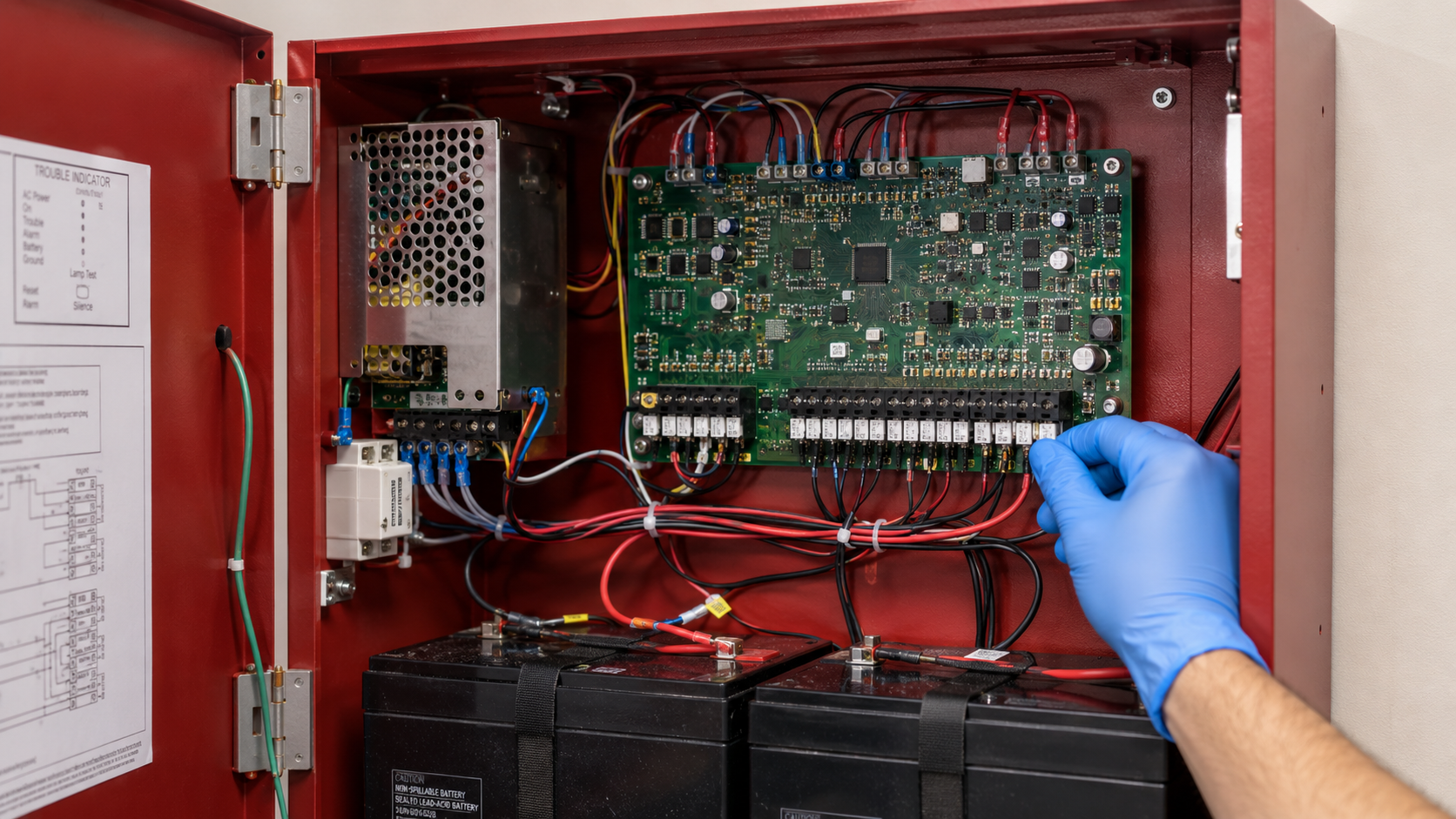
When a hospital, a university campus, or a commercial high-rise needs a fire alarm system that does not just detect smoke but coordinates an entire building’s emergency response – the engineering behind that system matters enormously. The Gamewell-FCI E3 Series is one of the most capable and widely specified fire alarm platforms in large-scale commercial and institutional applications in the United States. Backed by Honeywell International and built on decades of fire protection engineering, it represents what modern life safety infrastructure actually looks like when it is done at full scale. This guide breaks down the architecture, capabilities, and specifications you need to understand before evaluating or specifying this system.
What Is the Gamewell-FCI E3 Series?
The Gamewell-FCI fire alarm panel product line has evolved significantly since the company’s founding in the 1800s – one of the oldest names in fire protection in the U.S. The E3 Series is the current flagship: a modular, distributed network fire alarm and emergency evacuation system designed specifically for large, complex facilities that require more than a conventional panel architecture can deliver.
As an addressable fire alarm control panel platform, the E3 Series uses device-level intelligence every detector, module, and monitor has a unique address on the Signaling Line Circuit (SLC) loop, reporting its exact status continuously to the system. This granularity is fundamental to how the Gamewell-FCI E3 Series manages large facilities: instead of a zone lighting up and requiring a physical search of 50 devices, the panel tells you exactly which device at exactly which location is in trouble or alarm.
The Gamewell-FCI E3 Series is built around a “building block” design philosophy. You start with the core hardware and expand the system by adding modular components loop interface boards, audio transponders, network repeaters, graphic annunciators without replacing the cabinet or core infrastructure. For facilities that grow, renovate, or change occupancy over time, this scalability is a meaningful long-term advantage.
Core Architecture – What Makes the E3 Different
Distributed vs. Centralized Communication
Most conventional fire alarm systems use a centralized communication architecture every field device ultimately reports back to one main processor, which handles all alarm logic and output activation. The Gamewell-FCI E3 Series takes a fundamentally different approach. Each Intelligent Loop Interface Main Board (ILI-MB-E3) in the system operates as a semi-autonomous node with its own processing capability. These nodes communicate with each other in a peer-to-peer fashion rather than all routing through a single master controller.
The practical consequence of this architecture is survivability. In a conventional centralized system, a failure of the main processor or network controller affects the entire system. In the E3’s distributed model, if one node or network segment fails, the remaining nodes continue to operate independently. For a hospital that cannot afford system-wide impairment, or a campus where a single conduit failure should not take down every building, this architecture is not a feature – it is a fundamental requirement.
Broadband Technology Over Two Wires
One of the more distinctive capabilities of the Gamewell-FCI E3 Series fire alarm panel is its use of proprietary broadband technology to carry the entire system network – voice audio, data, alarm signals, and control commands over just two wires or fiber optic cable. This ARCNET-based high-speed network runs at 625K baud, fast enough to keep all networked nodes synchronized in real time.
The wiring economy this enables is substantial in large facilities. Running a multi-conductor network cable to every node throughout a sprawling campus or multi-story building represents a significant installation cost. Being able to achieve the same network connectivity over a simple twisted-pair run or a fiber segment reduces both installation time and long-term maintenance complexity.
SLC Loop Capacity and Device Support
Each ILI-MB-E3 Intelligent Loop Interface board supports one SLC loop of up to 318 addressable devices using System Sensor Velocity Protocol – 159 detectors and 159 modules per loop. The ILI95 variant supports Apollo XP95 protocol devices at up to 126 devices per SLC loop, making the Gamewell-FCI E3 compatible with both major addressable device protocol families used in commercial fire protection.
In a fully networked E3 configuration, the system can support up to 244 SLC loops – translating to over 77,000 addressable points on a single networked system. This is among the highest device capacity available in any networked commercial fire alarm platform, which is why the E3 is consistently specified for large hospital campuses, government complexes, and university systems where point counts in the thousands are routine.
Voice Evacuation and Mass Notification Capabilities
If there is one capability that most clearly distinguishes the Gamewell-FCI E3 Series from conventional fire alarm systems, it is its integrated mass notification fire alarm system functionality. The Gamewell-FCI E3 is not just a fire detection platform it is a full emergency communications system that handles voice evacuation, all-hazard mass notification, selective zone paging, and live microphone override from the same hardware infrastructure.
This matters because the nature of building emergencies has expanded well beyond fire. A hospital receiving a mass casualty event, a university responding to an active threat, or a government facility managing a hazardous material release all require the ability to deliver targeted, real-time instructions to specific building zones not just the generic three-pulse tone that says “fire alarm, evacuate.” The E3’s platform was designed from the ground up to handle all of this.
E3 Series Voice Evacuation and Mass Notification Features:
- Distributed audio storage: Every remote audio transponder in the Gamewell-FCI E3 network stores its own local copy of pre-recorded evacuation messages and tones. This means that even if the network connection between a remote transponder and the main panel is severed, that transponder continues to play evacuation announcements in its audio zones independently.
- Selective zone paging: The Gamewell-FCI E3 allows building operators and first responders to target specific building zones, floors, or sections for announcements rather than activating the entire building simultaneously. This capability is critical in high-rise buildings where a phased evacuation strategy is often safer than simultaneous full-building evacuation.
- Live paging override: First responders, incident commanders, and designated building staff can override pre-recorded messages with live microphone broadcasts directly from the panel or from remote paging stations throughout the facility. This replaces generic tone-based warnings with specific situational instructions during a real emergency.
- UL 2572 listing: The Gamewell-FCI E3 Series is listed under UL 2572 for Mass Notification Systems, meeting the requirements used by government agencies, military installations, and large institutional facilities that mandate all-hazard emergency communications capability rather than fire-only notification.
How Mass Notification Differs from Standard Voice Evacuation
Standard voice evacuation systems do one thing: play pre-recorded fire-specific messages and temporal code tones when a fire alarm activates. A mass notification fire alarm system handles the full spectrum of emergency events shelter-in-place for severe weather or active threats, all-clear announcements after a false alarm, staged evacuation instructions for high-rise buildings, and real-time broadcast capability for incident commanders to speak directly to building occupants. The Gamewell-FCI E3 handles both from the same hardware, with the operating mode determined by the type of event, not by a separate system.
Network Configuration and Scalability
The fire alarm system network configuration flexibility of the Gamewell-FCI E3 Series is one of its most practically significant advantages for facilities that grow or change over time. A single E3 installation can scale from a standalone node in a single building to a 122-node networked system spanning an entire campus all using the same hardware platform and programming environment.
This level of fire alarm system network configuration flexibility is what makes the Gamewell-FCI E3 Series the specification standard for hospitals that are continually expanding, universities that are adding residential facilities and research buildings, and government campuses that may evolve over decades. You do not need to rip out core infrastructure to scale – you add nodes. For comparison, our breakdown of the Fire-Lite ES-200X fire alarm panel covers what a mid-range addressable platform looks like for smaller commercial buildings.
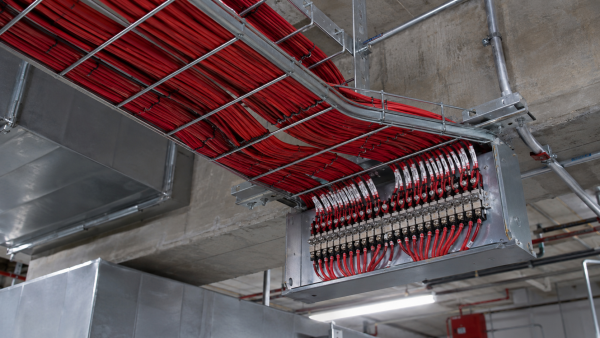
E3 Series Network Capabilities at a Glance:
- Up to 122 networked nodes: A fully networked Gamewell-FCI E3 system supports up to 122 nodes, with each node operating as a peer-level participant in the network rather than a subordinate to a master controller. Nodes can be ILI-MB-E3 loop interface boards, S3 Series panels, or audio transponders, giving integrators flexibility in how they design the system architecture.
- Fiber optic and UTP options: Long-distance campus connections between buildings or remote structures are supported via fiber optic cable using RPT-E3 repeaters. Shorter inter-node runs within a building can use standard unshielded twisted-pair (UTP) copper wire, keeping installation costs manageable for typical commercial high-rise configurations.
- Focal Point Graphic Workstation integration: The Gamewell-FCI E3 Series integrates with Honeywell’s Focal Point software, enabling graphical floor plan annunciation where alarm and trouble conditions appear as icon indicators directly on building drawings. For large facilities with security and operations centers, this integration provides spatial awareness that a text-based display panel cannot deliver.
- Cross-panel compatibility: The Gamewell-FCI E3 Series networks with existing 7100 Series and S3 Series Gamewell-FCI panels, making it possible to expand or modernize an existing Gamewell-FCI installation without replacing all legacy hardware simultaneously. S3 panels can serve as smaller satellite nodes on an E3 network, preserving existing infrastructure investment.
Key E3 Series Components You Should Know
Understanding how the Gamewell-FCI fire alarm panel E3 Series is assembled helps both specifying engineers and facility managers make informed decisions about upgrades, repairs, and expansion. As an addressable fire alarm control panel platform, the E3 uses a modular component structure where each node consists of several distinct assemblies that can be replaced or upgraded independently.
Essential E3 Series Hardware Components:
- ILI-MB-E3 (Intelligent Loop Interface Main Board): The core processing and loop controller for each E3 node. Each ILI-MB-E3 manages one SLC loop of up to 318 System Sensor devices, handles alarm logic, and participates in the network as a peer node. This board is the operational heart of each E3 installation point and the component most frequently needed for system repair or expansion.
- PM-9 (9-Amp Power Supply): The system power supply and battery charger for each E3 node, supporting up to 18 amp-hour backup batteries. The PM-9 sustains panel and field device operation during AC power outages per NFPA 72 secondary power requirements. Proper sizing of the PM-9 relative to total connected load is a critical design step for every E3 node.
- LCD-E3 (LCD Keypad Display): The local operator interface for an E3 node, providing alarm point display, system status indication, and manual control functions including Acknowledge, Silence, and Reset. The LCD-E3 can be mounted directly on the panel enclosure or located remotely via RS-485 connection at distances up to thousands of feet from the panel.
- RPT-E3-UTP (Network Repeater): Extends the Gamewell-FCI E3 ARCNET network over longer cable runs or between buildings, maintaining signal integrity on the network bus across distances that exceed standard wiring specifications. Essential for any multi-building campus configuration where node-to-node distances require signal amplification or regeneration.
Who Should Specify the Gamewell-FCI E3 Series?
For anyone evaluating which addressable fire alarm control panel platform to specify for a large or complex project, the honest answer is that the Gamewell-FCI E3 Series is not a small-building solution. Its modular architecture, distributed network design, and mass notification capabilities represent engineering that is overkill for a 20,000-square-foot strip mall and exactly right for a 400-bed hospital campus, a multi-building university complex, or a government facility with security integration requirements.
The facilities where the Gamewell-FCI E3 consistently wins specifications include buildings over 100,000 square feet requiring voice evacuation, multi-building campuses where a single fire alarm network needs to span several structures, high-rise commercial and residential buildings requiring phased evacuation strategies, healthcare facilities where survivability and distributed audio are non-negotiable, and government or military installations with UL 2572 mass notification requirements.
If your facility is smaller or more straightforward in its life safety requirements, the S3 Series from the same Gamewell-FCI family is worth evaluating. It uses compatible hardware, connects into Gamewell-FCI E3 networks when future expansion is anticipated, and delivers strong performance at a scale appropriate for mid-size commercial buildings.
Conclusion
The Gamewell-FCI E3 Series is not a fire alarm system you install and forget. It is a life safety platform you build your building’s entire emergency response strategy around detection, notification, evacuation coordination, and in facilities that require it, a full mass notification fire alarm system capable of addressing any emergency from a fire to a severe weather event to an active threat scenario. The engineering that goes into it reflects the environments it was built for: large, complex, high-occupancy facilities where failure is simply not an acceptable option.
At QuickShipFire, we specialize in sourcing Gamewell-FCI fire alarm panel components including parts for the E3 Series with fast U.S. shipping and expert support backed by 20+ years in the fire protection industry. Whether you are expanding an existing E3 installation, sourcing a replacement ILI-MB-E3 board, or tracking down a hard-to-find component for a system that cannot afford downtime, our team knows the product line and understands the urgency.
Frequently Asked Questions
Q1: What is the Gamewell-FCI E3 Series used for?
The Gamewell-FCI E3 Series is a modular, networkable fire alarm and emergency evacuation system designed for large and complex facilities. It supports addressable fire detection, voice evacuation, mass notification, and networked multi-building configurations – making it a standard specification choice for hospitals, universities, high-rise commercial buildings, and government and military facilities.
Q2: How many devices can the Gamewell-FCI E3 Series support?
The Gamewell-FCI E3 Series supports up to 318 addressable devices per SLC loop using System Sensor Velociti Protocol. In a fully networked configuration of up to 122 nodes with 244 SLC loops, the system can support over 77,000 addressable device points one of the highest total capacities available in any networked commercial fire alarm platform currently in production.
Q3: What is the difference between the E3 Series and the S3 Series?
The Gamewell-FCI E3 Series is engineered for large, complex facilities requiring multi-building networks, voice evacuation, and mass notification at scale. The S3 Series is a smaller, touchscreen-based addressable panel suited for small to mid-size buildings. Both series are compatible S3 panels can operate as satellite nodes on an E3 network, which allows facilities to start with S3 hardware and expand into an E3 network as their needs grow.
Q4: Does the Gamewell-FCI E3 Series support mass notification?
Yes — the Gamewell-FCI E3 Series is listed under UL 2572 for Mass Notification Systems. It supports all-hazard emergency communications including voice evacuation, live paging override, selective zone announcements, and pre-recorded all-hazard messages, all operating from the same hardware platform as the fire alarm system. This makes it a compliant solution for government, military, and institutional facilities with all-hazard emergency communication requirements.
Q5: What wiring options are available for the E3 Series network?
The E3 Series network supports both standard unshielded twisted-pair (UTP) copper wiring and fiber optic cable via RPT-E3 repeaters. The network runs on a 625K baud ARCNET protocol. UTP is commonly used for intra-building node connections, while fiber is preferred for long-distance inter-building campus runs where signal integrity over hundreds or thousands of feet is required.
Q6: Where can I find Gamewell-FCI E3 Series replacement parts?
Gamewell-FCI E3 Series components including ILI-MB-E3 loop interface boards, PM-9 power supplies, LCD-E3 displays, and RPT-E3 repeaters are available from authorized distributors and specialty fire alarm parts suppliers. When standard distribution channels face stock delays on specific components, independent suppliers with deep Gamewell-FCI expertise and existing inventory can often fulfill critical parts faster.