
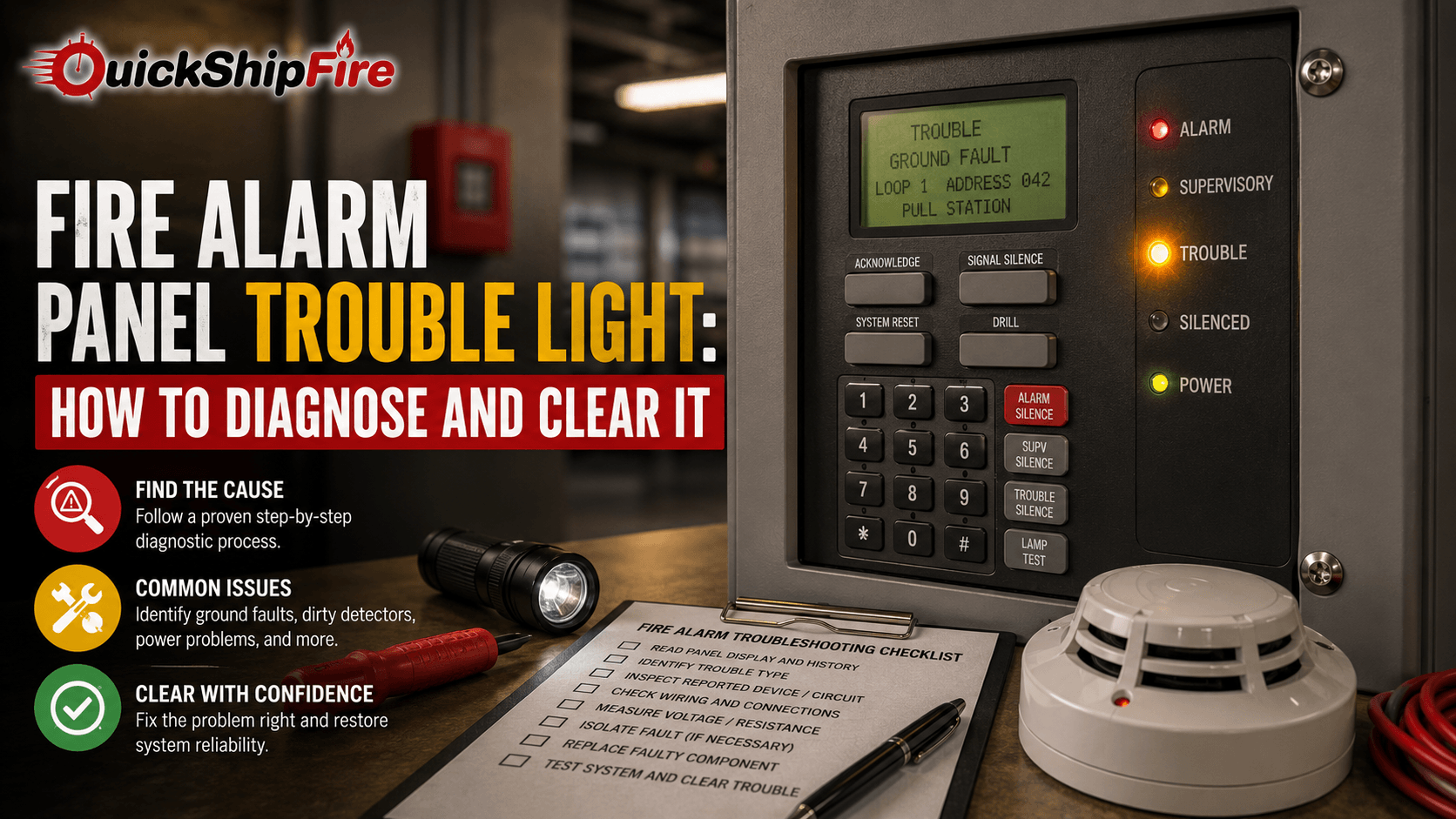
A steady amber lamp and an intermittent beep at the fire alarm panel are the most common service call in commercial buildings, and also the most commonly mishandled. The instinct is to silence the sounder and get on with the day. But a fire alarm trouble light means the panel has detected a condition that prevents some part of the system from performing as designed and until it is cleared, the building is running with a documented impairment.
This guide works through what the trouble condition actually means, a diagnostic sequence that finds the cause instead of guessing at it, and the components that most often need replacing at the end of it.
What a Trouble Signal Is and What It Is Not
Fire alarm panels distinguish three signal states, and confusing them causes bad decisions.
Alarm means an initiating device has detected fire conditions. Everything else stops.
Supervisory means a condition affecting a fire protection system has changed a closed sprinkler valve, for example. It is not a fault in the alarm system itself.
Trouble means the panel cannot vouch for part of its own operation. A circuit is open, a device is not answering, power is out of tolerance, or a component has failed self-test.
The key point about trouble is that it is a statement about *supervision*, not about danger. The panel is telling you it has lost confidence in something. That loss of confidence usually means one specific piece of hardware, and the diagnostic job is to find which one.
Read the Panel Before You Touch Anything
The panel already knows more than any test you are about to run. Before opening enclosures or pulling devices:
Read the full display text, not just the first line. Most addressable panels report the device address, the loop number, the device type, and the fault descriptor. That is usually enough to walk directly to the problem.
Check the event history. Nearly every commercial panel logs events with timestamps. The history answers questions the live display cannot: has this fault appeared before, does it correlate with time of day, did it start on the date the roof work began?
Note whether the trouble is latched or intermittent. A fault that clears and returns is a different problem from one that is permanently present. Intermittent faults are usually connection, moisture, or thermal issues; permanent faults are usually failed components or genuinely open circuits.
Do not reset the panel yet. Resetting clears the live information you need. Record everything first.
The Six Most Common Causes, in Order of Frequency
1. Ground fault
An unintended path between a circuit conductor and earth. Very common, often caused by damaged insulation, water ingress, or a device screwed down onto a conductor. Panels usually report it as a system-level trouble rather than pointing at a device, which is what makes it time-consuming. Our step-by-step guide to ground fault troubleshooting covers the loop-halving method that isolates it fastest.
2. Detector dirty or sensitivity out of range
Addressable detectors self-report when the sensing chamber drifts outside listed limits. Cleaning resolves it once; a detector that returns to trouble after cleaning is at the end of its service life and needs replacing.
3. Open circuit on an initiating or notification circuit
A broken conductor, a loose terminal, or a missing end-of-line device. Conventional circuits report the zone; addressable loops report the point at which supervision fails.
4. Missing or non-answering device
The panel is polling an address that does not respond. Causes range from a device removed for building work and never refitted, through a failed device, to a communication problem upstream on the loop.
5. Battery or AC power trouble
Standby batteries that no longer hold charge, a failed charger circuit, or loss of the AC supply. Battery faults follow a predictable age curve and are the most preventable item on this list sizing and replacement planning are covered in our guide to fire alarm battery calculation.
6. Board or module failure
Least common, but real. A failed loop card, NAC circuit, or interface module will not clear no matter what you do at the field-device end. This is where sourcing becomes the task rather than troubleshooting.
A Diagnostic Sequence That Works
Run this in order. Skipping steps is what turns a one-hour call into a three-visit job.
- Record the display and history exactly as found, including timestamps.
- Categorise the fault power, circuit, device, or system-level.
- Go to the reported point if the panel names one. Inspect the device and its wiring physically before testing anything.
- Check the obvious mechanical causes device not seated in its base, terminal backed off, conduit damage, water staining, recent building work nearby.
- Measure rather than assume. Confirm supply voltage at the panel and at the far end of the affected circuit. Confirm end-of-line resistance where applicable.
- Isolate by halving for circuit-level faults with no reported point. Disconnect at the midpoint, see which half retains the fault, repeat.
- Substitute a known-good device only after the wiring has been cleared. Swapping parts first is how good components get discarded.
- Clear, then re-verify. A trouble that clears on reset without any physical change has not been fixed.
When the Answer Is a Replacement Part
A significant share of trouble calls end with a component that needs swapping rather than adjusting. The most frequent are addressable detectors that fail sensitivity testing, monitor and control modules that no longer answer, standby batteries past their service life, and less often but more disruptively loop cards and main boards.
On older panels this is where the job stalls. The diagnosis is complete, the failed part is identified, and the part number turns out to be discontinued. Our reference on Fire-Lite ES-200X trouble codes shows how panel-specific fault codes map to particular boards and modules, which is the fastest route from a code on the display to a part number you can actually order.
Diagnosed the fault but can’t find the part? Send us the panel model and the part number and we will confirm same-day whether it is on the shelf, sourceable, or has a cross-reference equivalent. Request a quote or call (833) 747-7845 a down system is not something to leave sitting in a form queue.
What Not To Do
Two habits cause more harm than the original faults.
Do not silence and walk away repeatedly. A trouble that is silenced daily for months is an impairment the building is choosing not to fix, and it will be visible in the panel history to any inspector who looks.
Do not disable the point to make the display clean. Disabling a device removes it from supervision entirely. If it is disabled and forgotten, that part of the building is unprotected and nothing on the panel will remind anyone. If a device genuinely must be disabled during repair, log it and set a date.
A third habit is subtler: replacing the same component repeatedly without asking why it keeps failing. A monitor module that has been swapped three times in two years is not a bad module it is a symptom of something upstream, usually a power quality problem, a wiring fault that only manifests under load, or an environmental condition the device was never specified for. When the same point appears in the event history across multiple service visits, stop replacing and start investigating the circuit it sits on.
Conclusion
A trouble light is a diagnostic starting point, not a nuisance to be silenced. Read the panel first, categorise the fault, inspect physically before testing, and test before substituting parts. Follow that order and most trouble conditions resolve in a single visit.
Where the sequence ends in a failed component, the constraint is usually availability rather than skill particularly on panels that have been in service fifteen years or more. Keeping a small stock of the addressable modules and detectors your system depends on turns those calls from multi-day outages into single-visit repairs.
Frequently Asked Questions
How long can a fire alarm system stay in trouble before it becomes a compliance issue?
An unresolved trouble is an impairment from the moment it appears. Documented impairment procedures generally require notification of responsible parties and interim measures until repair. There is no grace period that makes an ignored trouble acceptable.
Why does the trouble light come back after I reset the panel?
Because the underlying condition still exists. Reset clears the annunciation, not the fault. A trouble that returns immediately after reset means the panel has re-detected the same condition on its next supervision cycle.
Can a trouble condition stop the system from detecting a fire?
It depends on the fault. A single dirty detector affects one point; an open circuit or a failed loop card can remove supervision and detection from a whole area. Treat every trouble as potentially affecting coverage until you know which.
What causes intermittent troubles that clear by themselves?
Most often loose terminations, thermal expansion in long conductor runs, moisture that dries out, or a device on the edge of its sensitivity range. Event history with timestamps is the best tool for these patterns show up in the log that are invisible on the live display.
Should the trouble buzzer be silenced during business hours?
Silencing the audible signal is acceptable while a repair is in progress; the visual indication must remain. What is not acceptable is silencing as a substitute for repair, week after week.
Does a ground fault need fixing immediately if everything still works?
Yes. A single ground fault may not affect operation, but a second one on the opposite polarity can create an unintended current path that disables circuits. Ground faults are cumulative risks, not isolated ones.
Who is allowed to clear a fire alarm trouble?
Basic actions such as reading the display and silencing are normally within building staff scope. Diagnosis, disabling points, wiring work, and component replacement should be carried out by qualified fire alarm service personnel, and many jurisdictions require certification for programming changes.