
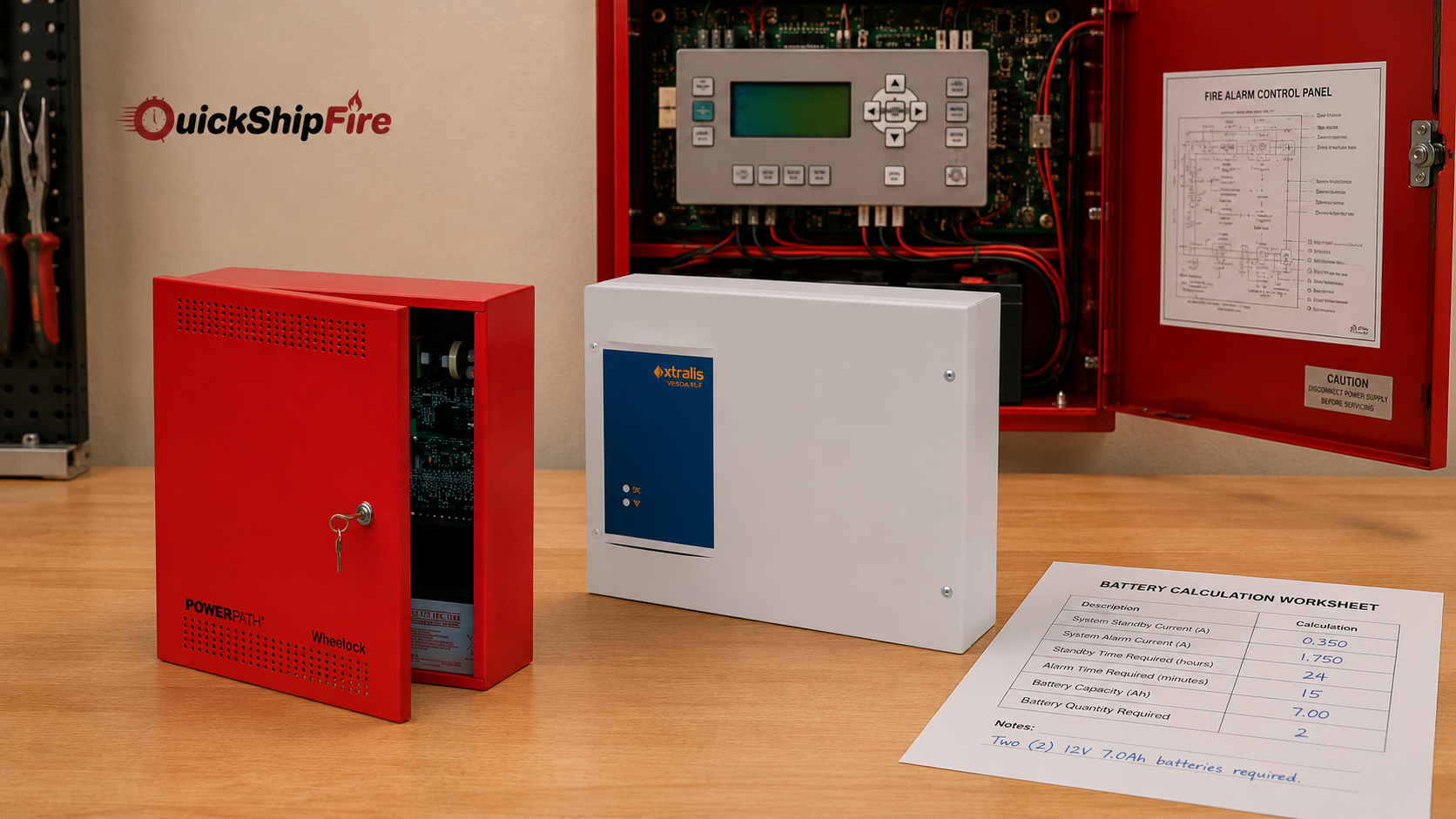
An undersized backup battery is one of the most quietly dangerous oversights in commercial fire alarm design. During normal business hours, when utility power is present, nothing looks wrong. The moment AC power fails a major storm, a grid fault, a tripped breaker nobody noticed you find out exactly how well your fire alarm battery calculation was done. A system that exhausts its secondary power before the required 24-hour standby window is not just a compliance problem – it is a building with no fire detection, no alarm notification, and no monitoring station transmission during precisely the scenario that demands all three. This guide walks through the complete fire alarm battery calculation process: the two-phase calculation structure, the step-by-step math, battery selection constraints, the generator exception, the mistakes that fail AHJ plan review, and the documentation practices that keep you compliant over the system’s entire service life. If you have ever needed to understand what a correct fire alarm battery calculation looks like, this is the guide.
Why Battery Sizing Matters More Than Most People Realize
The NFPA 72 standby power requirements for commercial fire alarm systems are mandatory minimums, not guidelines. Section 10.6.7.2 of NFPA 72 mandates that secondary power sustain the system in standby for at least 24 hours, followed by full alarm operation for a minimum of 5 minutes. Voice evacuation systems face a higher threshold: 15 minutes of alarm operation. Every fire alarm battery calculation submitted for AHJ plan review is measured against these benchmarks before the system earns an approval.
The fire alarm secondary power supply is not optional equipment. It is code-mandated from the day the system is commissioned. A fire alarm battery calculation that is performed incorrectly or not performed at all creates a compliance record that follows the system through every subsequent inspection and insurance review for its entire service life.
The practical consequence of getting the fire alarm battery calculation wrong is straightforward: if the battery runs out before utility power returns, the fire alarm panel shuts down completely. No detection, no notification, no monitoring transmission, and full liability exposure for any incident that occurs while the system is dark. The 24-hour standby window exists because extended power outages are precisely the scenarios when fire risk is elevated and emergency response times may be longer.
The Two Phases Every Fire Alarm Battery Calculation Must Address
Before working through the numbers, you need to understand the structure of any fire alarm battery calculation. Every battery sizing exercise has two distinct phases Standby and Alarm that are computed separately and then summed. They represent fundamentally different operating conditions with different currents and different durations. Collapsing them into a single estimate is how errors get introduced.
The fire alarm battery sizing process produces a result only as accurate as the inputs fed into it. Using panel-level estimates instead of individual device specification sheet data or using maximum rated currents instead of installed operating currents produces numbers that pass a quick visual check but fail under real conditions. A proper fire alarm battery calculation starts with every device’s published specification sheet on the table.
Phase 1 – Standby Load: The 24-Hour Window
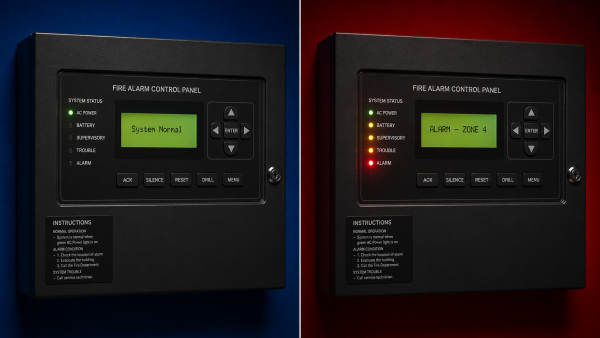
Standby current is the total continuous electrical draw when the system is monitoring normally no alarms active, no notification appliances energized. This phase of the fire alarm battery calculation requires summing the standby current of the panel’s own processor, all addressable device polling currents, magnetic door holders, remote annunciators, relay modules in supervised position, and any auxiliary power outputs. Each contributes to the load the battery must sustain continuously for the full 24-hour standby period.
Individual device standby currents look small an addressable smoke detector draws as little as 0.3 milliamps in polling mode. Multiply that by 250 detectors and you have 75 milliamps from detectors alone, which adds 1.8 amp-hours over 24 hours. Add 30 magnetic door holders at 20 milliamps each and you are contributing another 14.4 amp-hours. These add up faster than most people expect when they have only looked at the panel quiescent current alone.
To compute Phase 1: sum every component’s standby current in amps, add the panel’s documented quiescent current, and multiply the total by 24. The result is your standby amp-hours.
Phase 2 – Alarm Load: The 5 or 15-Minute Requirement
Alarm current is the draw when every notification appliance on every NAC circuit energizes simultaneously. This phase of the fire alarm battery calculation involves currents an order of magnitude higher than standby. A single horn/strobe combination can draw 80 to 300 milliamps depending on technology and candela setting. With 40 devices across multiple NAC circuits, the alarm current can reach 5 to 8 amps.
The duration multiplier keeps Phase 2 manageable in terms of total Ah: standard systems require only 5 minutes of alarm operation (0.083 hours), so the alarm Ah product is relatively small. Voice evacuation systems require 15 minutes (0.25 hours), tripling the alarm Ah. Add Phase 1 and Phase 2 together to get the raw total before applying the mandatory safety factor.
The Complete Fire Alarm Battery Calculation: Step by Step
A properly documented fire alarm battery calculation follows a sequential process that any technician or engineer with a device schedule and specification sheets can execute. This methodology is what AHJs and plan reviewers expect to see in submitted documentation. Deviation from the sequence particularly skipping individual device currents or omitting the safety factor is the most common reason a fire alarm battery calculation gets returned at plan review.
Per NFPA 72 standby power requirements, the completed fire alarm battery calculation must be included in the system documentation package submitted to the AHJ. It becomes part of the permit record and is referenced at every subsequent inspection, not just the initial approval.
Step-by-Step Process:
- Step 1: Gather all device specification sheets and identify standby (quiescent) currents. Pull published data sheets for every component in the system: the panel, all addressable detectors, all modules, door holders, annunciators, and any auxiliary powered device. Accuracy at this step determines the accuracy of the entire calculation — estimates and round numbers are not acceptable inputs for a submittable document.
- Step 2: Sum all standby currents and multiply by 24 hours. Add the standby current of every device together in amps, including the panel’s own quiescent current. Multiply the total by 24. Large systems with many modules and door holders can produce standby amp-hour requirements of 15 to 25 Ah before alarm load is added — the standby phase is where the most frequent underestimates occur.
- Step 3: Sum all alarm currents and multiply by the appropriate duration. Use the installed candela/power setting for each appliance, not the maximum rated current from the spec sheet. Multiply by 0.083 hours (5 minutes) for standard systems or 0.25 hours (15 minutes) for voice evacuation. Add the result to your standby Ah total.
- Step 4: Apply the 25% safety factor and select the battery. Multiply the combined total by 1.25 to account for battery aging, temperature derating, and the NFPA 72 mandatory margin. Round UP to the next standard battery size – 7, 12, 18, 24, 33, or 40 Ah. Never round down. Confirm the selected size falls within the panel manufacturer’s stated maximum battery capacity for your specific model.
Voice Evacuation Systems and the 15-Minute Requirement
Voice evacuation systems change the fire alarm battery calculation significantly because the alarm phase triples from 5 to 15 minutes. Voice amplifiers draw substantially more current than standard horn/strobe NAC outputs a 50-watt amplifier can pull 2 to 4 amps during active messaging. In a large multi-zone voice system, the alarm phase dominates the total Ah requirement. For proper documentation of these calculations in your submittal package, see our guide on fire alarm system documentation requirements for commercial buildings.
Battery Type, Size Selection, and Placement Constraints
The fire alarm battery calculation tells you the minimum amp-hour capacity required. The next step is translating that number into a battery selection that satisfies both the calculated minimum and the panel’s charger capacity limit. These two boundaries post-safety-factor minimum and panel maximum define the acceptable selection range.
The standard chemistry for commercial fire alarm backup power is the sealed lead acid battery fire alarm industry relies on: valve-regulated lead-acid (VRLA) at 12 volts. For 24-volt panels, two 12-volt batteries are wired in series both must be identical in make, model, and amp-hour rating. Mismatched batteries develop different internal resistance over time, causing uneven charging and accelerated failure of the weaker cell.
Always select the next standard battery size above your post-safety-factor fire alarm battery calculation result. If the calculation yields 10.2 Ah, you install a 12 Ah unit not a 7 Ah. The second boundary: check the panel manufacturer’s documented maximum battery capacity. Every fire alarm control panel has a charger-determined ceiling. Exceeding that ceiling means the charger cannot fully recharge the battery within NFPA 72’s required 48-hour window, which is independently a code violation. Your fire alarm battery calculation result must fall above the calculated minimum and below the panel maximum. If the minimum exceeds the panel maximum, the solution is a larger power supply or supplemental charger not a workaround.
Practical Battery Selection Rules:
- Always round UP to the next standard Ah size – 7, 12, 18, 24, 33, and 40 Ah are the common increments. Rounding down to save cost or fit a smaller battery into a tight enclosure means the code-required minimum is not met from the first day of operation.
- Verify the panel’s maximum rated battery capacity before final selection. Every fire alarm control panel has a manufacturer-stated battery maximum based on charger recharge capability. Exceeding this maximum violates the NFPA 72 48-hour recharge requirement independently.
- Replace both batteries in a 24V series pair simultaneously. Mismatched batteries age at different rates in series. The weaker cell degrades faster, reducing the effective pair capacity below either battery’s individual rating, and eventually driving the stronger battery to fail through chronic overcharge.
- Sealed lead acid battery fire alarm capacity ratings are published at 77 degrees Fahrenheit. In cold environments unconditioned mechanical rooms, outdoor enclosures available capacity drops 20 to 30 percent. Apply the manufacturer’s temperature derating factor to the calculated minimum before selecting battery size when cold operating conditions apply.
Generator Backup and the 4-Hour Standby Exception
An approved emergency generator changes the fire alarm battery calculation in one specific, well-defined way: the required battery standby duration drops from 24 hours to 4 hours. This 4-hour window covers the generator startup sequence and a brief failure-to-start scenario, ensuring the system operates during the transition. The reduction is meaningful in large systems where 24-hour standby loads are substantial, it can significantly decrease the required battery size and the number of batteries needed.
The 4-hour exception has two simultaneous conditions that must both be fully met for a revised fire alarm battery calculation to be accepted at plan review. First, the generator must qualify as NFPA 110 Type 10, Class 24, Level 1. Second, the entire downstream power distribution path from generator to fire alarm panel must classify under NEC Article 700 emergency power. If any segment of the distribution, a transfer switch, a subpanel, a branch circuit, does not meet Article 700, the full 24-hour fire alarm battery calculation requirement applies regardless of the generator’s presence. This second condition is the one that most frequently surfaces as a surprise at plan review. Confirm both conditions with your electrical engineer before designing the battery package around the reduced standby time.
The fire alarm secondary power supply design must document both conditions explicitly in the plan review submittal. A generator on-site does not automatically satisfy the exception both the generator classification and the complete power path classification must be documented and verified.
Common Fire Alarm Battery Calculation Mistakes That Fail AHJ Review
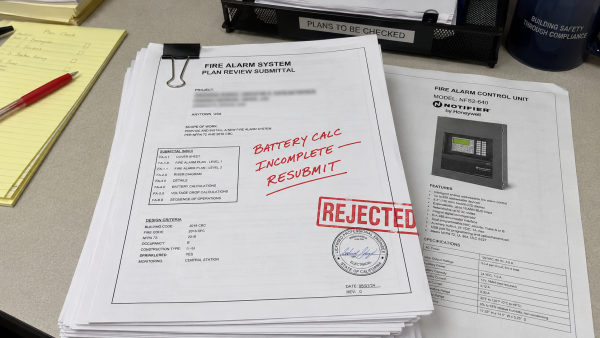
The fire alarm battery calculation formula is not complicated. The errors consistently come from what goes into it, incomplete inputs, skipped steps, and rounding in the wrong direction. Every common fire alarm battery calculation mistake follows the same pattern: a shortcut taken at submission time that becomes a failed inspection or a discovered non-compliance when it matters least.
Mistakes to Avoid:
- Using the panel’s quiescent current without adding all field device standby draws – The panel specification sheet shows only the panel’s own consumption. The calculation requires individual standby currents for every connected device. Magnetic door holders are the most consistently missed item. A building with 30 door holders at 20 mA each adds 600 mA of continuous load 14.4 Ah over 24 hours – often exceeding the panel’s own standby draw. Any fire alarm battery calculation that omits field device currents will be undersized.
- Omitting the 25% safety factor before battery selection – NFPA 72 explicitly requires this margin. Submitting a calculation where the battery Ah equals the raw calculated total without the 1.25 multiplier is flagged at plan review in most jurisdictions. Apply the factor every time, without exception, before choosing the battery size.
- Using maximum published alarm current instead of the installed operating setting – Spec sheets list alarm current at the maximum available candela setting. If your devices are configured at a lower setting, the actual alarm current is meaningfully lower. Using the maximum overstates the alarm Ah, potentially driving you to a battery size the panel charger cannot support within 48 hours.
- Rounding down to a smaller standard battery size – This is the most consequential sizing error because it is completely silent in normal operation. The deficiency only reveals itself when AC power fails for longer than the battery’s actual capacity can sustain and by then, the building is unprotected. Round up, always. The direction of rounding is not a judgment call under NFPA 72.
Documenting, Verifying, and Maintaining Battery Capacity Over Time
Completing the fire alarm battery calculation at system commissioning is not a one-time event. NFPA 72 requires annual battery testing to verify that the battery continues to meet its required capacity over time. Lead-acid batteries degrade gradually a battery that satisfied the fire alarm battery calculation requirement at installation may fall below the threshold after three years of charge-discharge cycling, particularly in temperature-extreme environments. Annual testing identifies this degradation before a power outage exposes it.
Maintaining a record of each annual battery test result – date, measured voltage under load, and pass/fail status linked to the original fire alarm battery calculation creates the compliance paper trail that AHJs and insurance reviewers expect at inspection. This documentation continuity, from commissioning through the current inspection date, demonstrates ongoing compliance rather than point-in-time compliance.
Battery Maintenance and Replacement Guidelines:
- Replace both batteries in a series pair on a four-to-five year proactive schedule regardless of apparent condition. Lead-acid capacity loss is not visible without load testing. A battery that reads acceptable voltage at rest can still fail under the high-rate discharge demand of a full alarm event. Proactive replacement eliminates this risk at a small fraction of an emergency replacement under time pressure.
- Conduct an annual battery load test and document the result with date and measured voltage. Link the record to the system documentation package maintained at the panel location. AHJs increasingly require on-site documentation access rather than permit file retrieval, so keeping test records at the panel itself prevents delays at reinspection.
- When expanding an existing system adding detectors, modules, door holders, or notification appliances rerun the sizing calculation to verify the installed battery remains adequate for the increased load. A battery correctly sized for the original installation may fall short when additional standby and alarm currents are added during renovation or expansion.
- Store a copy of the calculation documentation in the fire alarm records package maintained at the panel. Having the calculation accessible to inspection personnel demonstrates proactive compliance management and prevents administrative delays when AHJ inspectors request it during the review process.
Conclusion
A correct fire alarm battery calculation is not the most visible part of a fire alarm installation, but it may be the most consequential. Every other component the panel, the detectors, the notification appliances, the SLC loop depends on secondary power being present and adequate when utility power fails. A fire alarm battery calculation done correctly and documented properly means the system survives an extended outage and continues to protect the building. A fire alarm battery calculation that is estimated, incomplete, or rounded incorrectly means the system fails silently at the moment it is needed most.
The discipline of getting the fire alarm battery calculation right pulling every specification sheet, running Phase 1 and Phase 2 separately, applying the 25% safety factor, selecting from the correct standard size, verifying against the panel maximum, and documenting everything for the AHJ is not paperwork for its own sake. It is the specific practice that keeps occupants protected and facilities compliant across the full duration of any power interruption. A fire alarm battery calculation is an engineering deliverable, not an afterthought in a submittal package. Treat it that way, and you will never face an impaired system or a failed inspection for a preventable reason. If you want to know your system is correctly protected, start with the fire alarm battery calculation.
At QuickShipFire, we supply power supplies, backup batteries, and fire alarm system components to contractors, engineers, and facility managers across the United States. Our team has over 20 years of experience in the fire and life safety industry. If you need a replacement power supply, a correctly rated battery, or expert guidance on sourcing components for a system that must meet NFPA 72, we ship fast and we know what works.
Frequently Asked Questions
Q1: What is the NFPA 72 requirement for fire alarm battery backup?
NFPA 72 Section 10.6.7.2 requires fire alarm systems to sustain standby operation for a minimum of 24 hours, followed by full alarm operation for 5 minutes for standard systems and 15 minutes for voice evacuation. Every fire alarm battery calculation must include a 25% safety factor applied to the combined standby plus alarm amp-hour total before the battery size is selected. Generator-backed systems may qualify for a reduced 4-hour standby requirement under specific NFPA 110 and NEC Article 700 conditions.
Q2: How do I perform a fire alarm battery calculation?
Sum the standby current of every system component panel, detectors, modules, door holders, and annunciators and multiply by 24 hours for standby amp-hours. Separately, sum all notification appliance alarm currents at installed settings and multiply by 0.083 hours (5 min) or 0.25 hours (15 min for voice evac). Add the two totals, multiply by 1.25, and round UP to the next standard battery size. This complete fire alarm battery calculation process must be documented and submitted with AHJ plan review packages.
Q3: What type of battery is used in commercial fire alarm systems?
Commercial fire alarm systems use 12-volt sealed lead-acid (SLA / VRLA) batteries. For 24-volt panels, two 12-volt batteries are connected in series and must be identical in make, model, and amp-hour rating. Standard sizes used in fire alarm battery calculation work include 7, 12, 18, 24, 33, and 40 Ah. Always round UP to the next size above your post-safety-factor calculated minimum, never down.
Q4: Can a generator replace the battery backup in a fire alarm system?
A qualifying generator reduces the required battery standby from 24 to 4 hours, but batteries remain mandatory. The generator must meet NFPA 110 Type 10, Class 24, Level 1 standards, and the entire downstream power path must qualify under NEC Article 700. If either condition is unmet, the full 24-hour fire alarm battery calculation applies. Confirm both requirements with your electrical engineer before designing the battery package around the 4-hour exception.
Q5: How often should fire alarm system batteries be replaced?
NFPA 72 requires replacement per manufacturer specifications or when annual load testing shows voltage or current below published limits. Practically, most fire alarm professionals replace sealed lead-acid batteries proactively every four to five years regardless of apparent condition, because capacity degradation is invisible without load testing. Batteries in temperature-extreme environments should be evaluated on a shorter cycle. Always rerun the fire alarm battery calculation when replacing batteries to confirm the replacement size still covers the current system load.
Q6: What happens if a fire alarm battery is undersized?
An undersized battery may fail to sustain the system through the full 24-hour standby window. If utility power is interrupted for longer than the battery’s actual capacity, the panel shuts down no detection, no notification, and no monitoring transmission for the remainder of the outage. This creates a code violation at commissioning (the fire alarm battery calculation was wrong), an inspection non-compliance at every AHJ visit, and liability exposure for any incident while the system is dark.
Q7: Does temperature affect fire alarm battery capacity?
Yes, significantly. Published amp-hour ratings are measured at 77 degrees Fahrenheit. At 32 degrees Fahrenheit, available capacity drops 20 to 30 percent. When the fire alarm battery calculation result will be installed in a cold environment, apply the manufacturer’s temperature derating factor to the minimum before selecting battery size. Skipping the temperature adjustment is a common reason system that meet the paper calculation fail to meet the 24-hour standby requirement during winter power outages.