
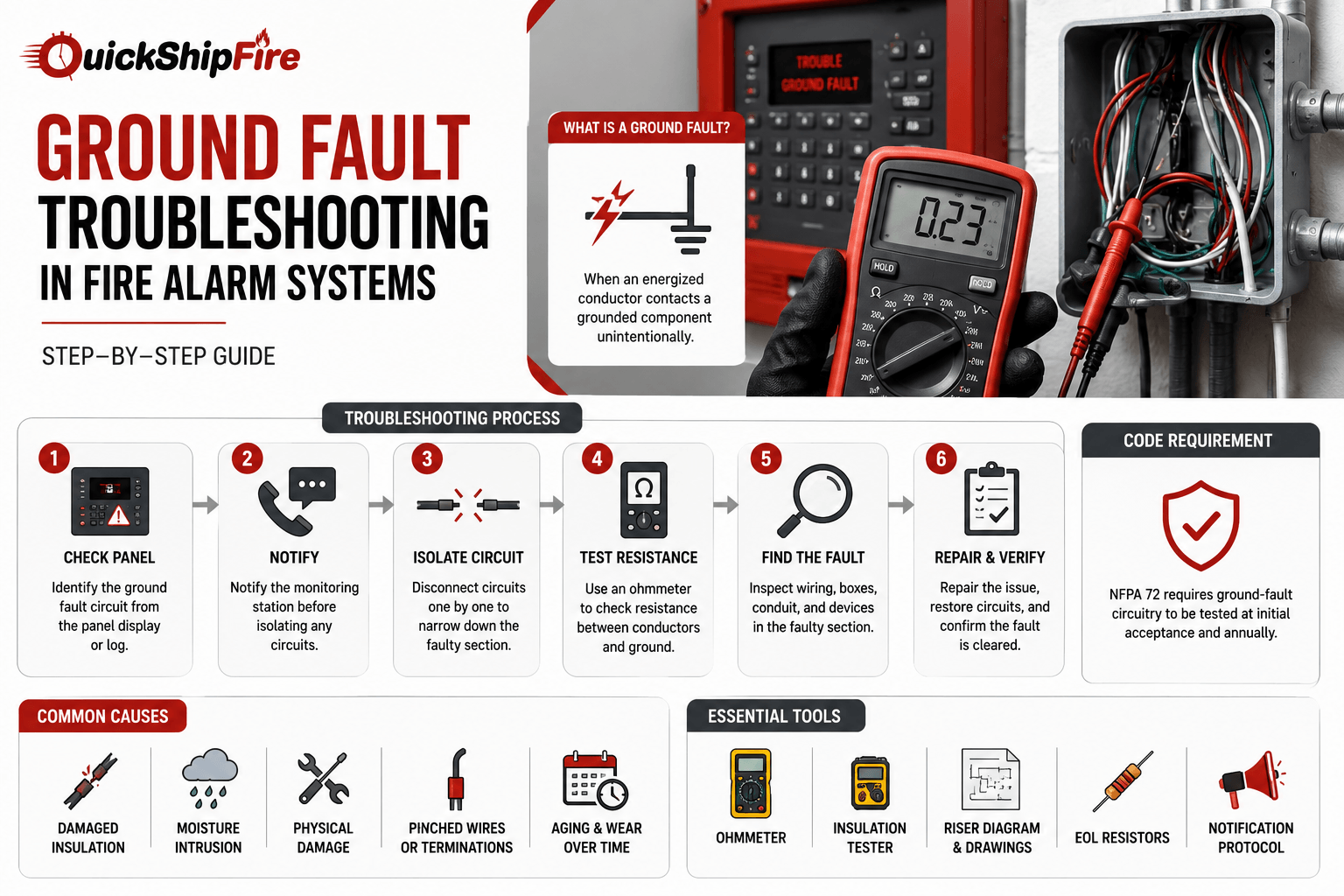
Ground faults are one of the most common trouble conditions technicians encounter on fire alarm systems, and also one of the most frustrating to chase down, particularly when the fault is intermittent. Unlike an open circuit or a device failure, a ground fault does not point directly at a single device; it can originate almost anywhere along miles of wiring, junction boxes, and conduit runs. This guide walks through what a ground fault actually is, why fire alarm systems are required by code to monitor for them, and a structured, step-by-step troubleshooting method that gets a technician to the source faster than randomly disconnecting circuits.
What Is a Ground Fault in Fire Alarm Systems?
A ground fault occurs when an energized conductor in one of a building’s fire alarm systems makes unintended electrical contact with a grounded component, such as metallic conduit, a junction box, or an equipment enclosure. Because fire alarm raceways and enclosures are bonded together per electrical code, this creates a continuous ground path back to the grounding bus at the fire alarm control panel, and modern fire alarm systems are required to detect and report that condition as a trouble signal rather than letting it pass silently.
Across fire alarm systems generally, ground faults fall into two general categories. On most fire alarm systems, a hard ground fault occurs when a conductor directly contacts a grounded surface, producing a consistent, repeatable trouble signal that is usually easier to isolate. A soft ground fault, by contrast, is typically caused by moisture or compromised insulation rather than bare copper touching ground, which means the fault can appear and disappear as conditions change, making it considerably harder to pin down without a structured approach.
- A ground fault occurs when an energized conductor contacts a grounded component like conduit or a junction box.
- Hard ground faults involve direct copper-to-ground contact and are typically consistent and easier to isolate.
- Soft ground faults are usually caused by moisture or degraded insulation and can be intermittent.
- Fire alarm systems must remain able to operate with a single ground fault present without losing core functionality.
- NFPA 72 Table 14.4.3.2 requires ground-fault circuitry to be tested at initial acceptance and then annually.
Common Causes of Ground Faults
Across most fire alarm systems, ground faults trace back to a handful of recurring causes. Conductor insulation damaged while being pulled through a raceway with rough or unfinished edges is one of the most frequent culprits, since even a small nick in the insulation can eventually make contact with grounded metal. Moisture intrusion is another major cause, particularly after heavy rain finds its way into an outdoor conduit run or a junction box that was not properly sealed. Physical damage from later construction work, pinched insulation at a device termination, and simple wear over years of service all contribute as well.
- Insulation damage from wire being pulled through rough or unfinished raceway edges.
- Moisture intrusion into outdoor conduit runs, junction boxes, or below-grade wiring after rain or flooding.
- Physical damage from unrelated construction or renovation work disturbing existing fire alarm wiring.
- Pinched or compressed insulation at a device termination or behind a mounting plate.
- Gradual insulation degradation from age, heat cycling, or vibration in industrial environments.
Tools Needed for Ground Fault Troubleshooting
Effective ground fault troubleshooting on fire alarm systems requires a handful of specific tools rather than general electrical test equipment alone, since fire alarm systems are held to tighter tolerances than typical low-voltage wiring. An ohmmeter is the primary tool for reading resistance to ground on an isolated circuit, and some technicians prefer a meter with a slightly higher output voltage than a standard multimeter to make soft ground faults easier to locate. An insulation resistance tester, sometimes called a megger, helps confirm compromised insulation once a suspect circuit segment has been identified. A basic understanding of the system’s riser diagram and as-built wiring documentation is just as important as the physical tools, since it tells the technician which circuits actually exist and where they run.
- An ohmmeter to read resistance between an isolated circuit and ground.
- An insulation resistance tester (megger) to confirm compromised wire insulation.
- Current riser diagrams and as-built wiring documentation for the system being tested.
- A variety of end-of-line resistor values on hand, since common fire alarm EOL values vary by manufacturer.
- Notification to the monitoring station and, where required, the fire department before placing the system on test.
Step-by-Step Ground Fault Troubleshooting Process
Step 1: Check the Panel Display and Trouble Log
Every ground fault investigation across different fire alarm systems starts the same way: at the fire alarm control panel itself. Most panels indicate which circuit type is reporting the fault, and on an addressable fire alarm system, the trouble log or diagnostics screen can sometimes point to a specific loop, card, or even device address, which dramatically narrows the search before any wire is ever disconnected. Networked systems such as Gamewell-FCI EST3 installations often let a technician drill into loop controller diagnostics for exactly this reason.
Step 2: Notify Before Disabling Any Portion of the System
Before disconnecting any circuit on fire alarm systems that report to a supervising station, notify the monitoring station and place the account on test, and inform the fire department where local procedure requires it. Skipping this step risks an unnecessary emergency response if a disconnected circuit triggers a trouble or alarm signal at the supervising station during testing.
Step 3: Isolate Circuits One at a Time
On virtually all fire alarm systems, disconnect one circuit at a time at the panel and read resistance to ground with an ohmmeter. It may be necessary to temporarily remove the end-of-line resistor to get a clean reading. Any measurable resistance to ground on an isolated circuit indicates the fault is on that circuit rather than elsewhere in the system. Because more than one ground fault can be present simultaneously, and their combined effect can cross the panel’s trouble threshold even if each fault alone would not, isolating circuits methodically avoids chasing a false lead.
Step 4: Split the Circuit and Narrow the Location
Across virtually all fire alarm systems, once a specific circuit is confirmed to have the fault, the fastest way to locate it physically is to split the circuit roughly in half, test each half, and repeat the process on whichever half still shows the fault. This binary search approach converts what could be a wire-by-wire hunt across an entire building into a handful of test points, and it works whether the affected circuit is a signaling line circuit or a conventional initiating device circuit.
Step 5: Inspect and Repair the Identified Segment
On any of these fire alarm systems, once the fault is narrowed to a specific run or junction box, visually inspect the wiring for frayed insulation, pinched conductors, or signs of moisture intrusion. Replace or properly re-terminate the damaged section, restore the circuit, and confirm the trouble condition has cleared at the panel before removing the system from test.
- Check the panel display and trouble log first; addressable systems often narrow the search significantly.
- Notify the monitoring station and fire department before disabling any part of the system.
- Isolate and test one circuit at a time, remembering multiple simultaneous ground faults are possible.
- Use a binary split-and-test approach to physically narrow the fault to a specific wire run or junction box.
- Confirm the trouble condition has fully cleared at the panel before returning the system to normal operation.
Hard Ground Fault vs. Soft Ground Fault: Troubleshooting Approach
| Factor | Hard Ground Fault | Soft Ground Fault |
| Typical cause | Direct copper-to-ground contact | Moisture or degraded insulation |
| Consistency | Constant, repeatable trouble signal | Intermittent, may clear and return |
| Difficulty to locate | Generally easier and faster | Can require extended monitoring over days |
| Best diagnostic tool | Standard ohmmeter reading | Higher-voltage ohmmeter or megger |
| Common trigger | Physical damage or pinched insulation | Rain, flooding, or humidity changes |
When to Escalate Beyond Basic Troubleshooting
On some fire alarm systems, ground faults resist the standard isolation process, particularly intermittent faults tied to weather conditions that are not present during the service call. In these cases, correlating trouble timestamps in the panel log with weather data, or temporarily logging conditions with a data logger, can reveal a pattern that points to a specific outdoor run or below-grade conduit. On fire alarm systems where a ground fault keeps returning despite repairs, it is worth checking the condition of the panel’s power supplies and grounding connections directly, since a compromised ground reference at the panel itself can produce symptoms that look like a field wiring problem.
- Correlate ground fault timestamps in the trouble log with weather conditions to identify weather-related patterns.
- Verify the panel’s own ground reference connection before assuming the fault is entirely in field wiring.
- Check for damaged fire alarm boards or corroded terminal connections inside the panel cabinet itself.
- Consider a dedicated ground fault locator tool for large systems with extensive conduit runs.
- Document every ground fault repair for the system’s permanent maintenance record and future troubleshooting reference.
On older fire alarm systems, persistent ground faults sometimes point to a deeper equipment problem rather than a simple wiring issue, particularly on older systems where insulation across an entire circuit has degraded uniformly rather than failing at one specific point. In these cases, replacing an aging run of notification appliances or pull stations along with their wiring may resolve a recurring fault more permanently than repeated spot repairs.
Whether you need a replacement end-of-line resistor, a new signaling line circuit module, or a full panel board to complete a ground fault repair, QuickShipFire stocks fire alarm control panels, boards, modules, notification appliances, and power supplies from Notifier, Fire-Lite, Gamewell-FCI, Silent Knight, and other leading manufacturers. Request a quote and our team will help you get the right parts shipped fast.
Conclusion
Ground faults are one of the more time-consuming trouble conditions technicians face across commercial fire alarm systems, but a structured, step-by-step approach turns what could be an all-day hunt into a manageable process: check the panel first, isolate circuits methodically, split and test to physically narrow the location, and confirm the repair before closing out the call. Soft, intermittent faults tied to moisture require patience and sometimes correlation with weather data, but the underlying troubleshooting method stays the same regardless of whether the fault is hard or soft. Keeping the right test tools, documentation, and replacement parts on hand turns ground fault calls on any of a facility’s fire alarm systems from a dreaded service visit into a routine, predictable repair.
Frequently Asked Questions About Ground Fault Troubleshooting
What causes a ground fault in fire alarm systems?
The most common causes are damaged wire insulation from being pulled through rough raceway edges, moisture intrusion into conduit or junction boxes, physical damage from unrelated construction work, and gradual insulation degradation with age.
How do I test for a ground fault at the fire alarm panel?
Touch one end of a test wire to a grounded component, such as conduit or an electrical outlet ground terminal, and the other end to an initiating device or signaling line circuit terminal at the panel. If the ground reference is properly connected, this should produce a trouble condition, confirming the panel’s ground fault monitoring is functioning.
What is the difference between a hard ground fault and a soft ground fault?
A hard ground fault involves a conductor directly contacting a grounded surface, producing a consistent trouble signal. A soft ground fault is usually caused by moisture or compromised insulation and can be intermittent, appearing and disappearing as conditions change.
Can a fire alarm system still operate with a ground fault present?
Yes, fire alarm control units are required to remain operational with a single ground fault present on any circuit, though the condition must still be repaired promptly since it can mask other issues or, in some configurations, disable specific control functions.
How often does NFPA 72 require ground fault testing?
NFPA 72 Table 14.4.3.2 requires ground-fault circuitry to be tested at the initial acceptance test and then annually thereafter as part of the system’s regular inspection and testing program.
Why is my ground fault intermittent instead of constant?
Intermittent ground faults are usually soft faults caused by moisture or partially compromised insulation, where the fault only becomes conductive under certain conditions such as rain, humidity, or temperature changes, making it appear and disappear over time.
Can more than one ground fault exist at the same time?
Yes, and this can complicate troubleshooting significantly. Multiple minor ground faults can combine to cross the panel’s trouble threshold even if none would trigger a fault individually, so disconnecting one circuit and seeing the trouble clear does not always mean that circuit was the only source.