
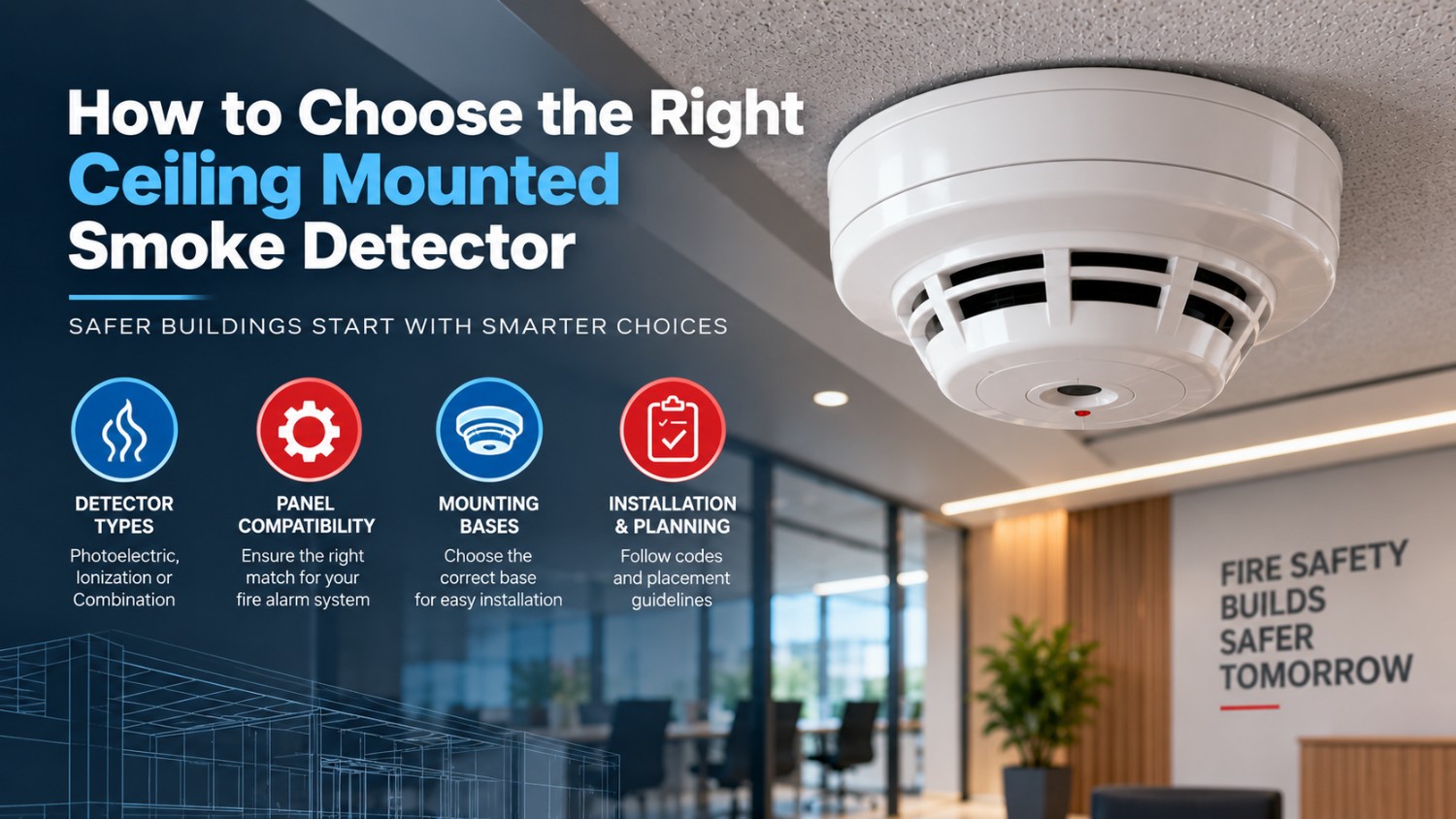
The right choice depends on the fire risk in the space, the environment around the device and the fire alarm panel it must communicate with. Because smoke rises and spreads across a ceiling, this is the standard location for detection in most commercial buildings. This guide explains detector types, compatibility, mounting bases, installation and replacement, so you can specify a ceiling mounted smoke detector with confidence and avoid costly mismatches.
What a Ceiling Detector Does
A ceiling detector senses combustion products that rise to ceiling level and sends a signal to the control panel, which then activates alarms and any connected functions. It is one component of a wider fire alarm system that also includes notification devices, manual pull stations, modules and power supplies.
Detectors typically consist of two parts: a base fixed to the ceiling or an electrical box, and a detector head that plugs into the base. That separation matters, because the head and base must be compatible, and because heads can be replaced without rewiring the base. It also means that maintenance teams can swap a contaminated head for a clean one during service, which shortens downtime. Keeping a small stock of spare heads that are known to match your bases is a practical habit for facilities with many detectors, particularly where older product lines are involved.
Commercial Ceiling Mounted Smoke Detector Requirements
A commercial ceiling mounted smoke detector must meet the requirements of the building’s fire alarm design, local codes and the authority having jurisdiction. Standards such as NFPA 72 set out rules for spacing, coverage and testing, and manufacturer instructions add device-specific limits. Offices, corridors, meeting rooms and retail areas usually call for a different approach than kitchens, plant rooms or loading bays.
Before choosing any commercial detector, gather the panel model, existing device series, ceiling height, room use and any known nuisance alarm sources. This information narrows the options quickly.
Photoelectric Ceiling Mounted Smoke Detector Options
A photoelectric ceiling mounted smoke detector uses a light source and sensor. Smoke particles scatter light onto the sensor, which triggers the alarm. This design generally responds well to smoldering fires and is widely used in offices and general commercial areas. An example on the QuickShipFire site is the PSD7155, listed as a ceiling mount fire alarm sensor for offices, commercial buildings and industrial use.
| Detector type | How it senses | Typically well suited for | Points to consider |
| Photoelectric | Light scattered by smoke particles | Smoldering fires, offices, corridors | Dust and steam can affect some areas |
| Ionization | Change in ionization current | Fast-flaming fire risks | Sensitive to fumes and airflow in some spaces |
| Smoke and heat combination | Smoke sensing plus thermal element | Areas needing both signals | Confirm panel and base compatibility |
Addressable Ceiling Mounted Smoke Detector vs Conventional
An addressable ceiling mounted smoke detector has a unique address on the signalling line circuit, so the panel can report exactly which device has activated. Conventional detectors are grouped by zone, which shows only the general area. Addressable systems help responders and maintenance teams locate events faster, particularly in larger buildings.
An example is the SD365, listed as an addressable ceiling mount sensor for commercial and industrial use. Whichever type you choose, the detector must match the technology of the panel, because addressable and conventional devices are not interchangeable.
Industrial Ceiling Mounted Smoke Detector Environments
An industrial ceiling mounted smoke detector may face dust, vapours, high ceilings, airflow from ventilation and wide temperature swings. These conditions influence both false alarm risk and how quickly smoke reaches the device. Warehouses and production halls often need careful layout design, and some spaces may need alternative detection methods altogether. Our overview of smoke detectors for warehouses and industrial facilities discusses these factors in more detail.
Smoke Detector Compatibility With Fire Alarm Panels
Smoke detector compatibility with fire alarm panels is the single most important selection check. A detector that looks correct but uses a different communication protocol can cause faults or fail to be recognised. Panel manufacturers publish compatibility listings, and the panels you already own define what can be connected.
Compatibility Checks Before You Buy
- Panel manufacturer and model: compatibility is defined by the panel’s documentation.
- Protocol and device series: addressable protocols differ between manufacturers and product lines.
- Detector head and base pairing: confirm which bases each head fits.
- Listing and approvals: verify that the combination is listed for your application.
- Programming needs: some devices require address setting or panel configuration after installation.
Ask a qualified technician when documentation is unclear. Guesswork on smoke detector compatibility with fire alarm panels can leave zones unprotected.
Fire Alarm Smoke Detector Mounting Base Basics
A fire alarm smoke detector mounting base holds the head, provides the wiring terminals and connects the device to the loop. Bases can differ in terminal layout, features and the heads they accept, so treat the base as part of the specification. When browsing bases, match the base to the exact head series and the panel platform. Reusing a fire alarm smoke detector mounting base during an upgrade can save work, but only when the new head is documented as compatible.
Ceiling Mounted Smoke Detector Installation
Ceiling mounted smoke detector installation should follow the approved design, manufacturer instructions and applicable codes. The process usually involves marking positions, fixing the base to a suitable box, terminating wiring, setting addresses where required, fitting the head and testing. Installation is best carried out by qualified personnel, because life-safety systems must be commissioned and documented properly.
Installation Points to Plan
- Location: avoid placing detectors too close to supply vents, dead-air corners or heat sources.
- Spacing and coverage: follow the design and code rules, not a rule of thumb.
- Wiring integrity: check terminations and polarity, and keep loop documentation.
- Dust protection: protect devices during construction and remove covers only when the area is ready.
- Access: allow safe access for future testing and cleaning.
A well-planned installation reduces callbacks and nuisance alarms.
Ceiling Mounted Smoke Detector Replacement
Ceiling mounted smoke detector replacement is common as devices age, suffer contamination or are damaged. Start by identifying the current model, base and panel. Replacing a head with another of the same series is often simpler than changing the whole family of devices. When a model is obsolete, a compatible alternative may exist, but confirm this against panel documentation. After any replacement, test the device, check that the panel shows the right address and update your records.
Where to Place a Ceiling Detector
A ceiling detector performs best when it is positioned where smoke will actually travel. Flat ceilings are straightforward, but beams, ducts, sloped roofs and mezzanines change airflow and can trap smoke or delay its arrival. In tall spaces, warm air near the ceiling can hold smoke below the detector for a time, so the layout may need specialist review. A detector installed in an industrial high bay, for example, may need a different strategy from one in a low office ceiling. Take drawings of the room, mark obstructions and record airflow sources before finalising any layout. Where doubt remains, ask a fire protection engineer to review the layout before devices are ordered, because relocating fixed devices after installation is far more disruptive than adjusting a drawing.
Common Mistakes When Buying Ceiling Detectors
Buyers most often assume that visual similarity means compatibility. Other frequent errors include ordering a head without checking the base, mixing conventional and addressable devices, and choosing a photoelectric ceiling mounted smoke detector for an area where a different technology or a combination device would be more appropriate. Some purchasers also overlook programming: an addressable ceiling mounted smoke detector may need its address set and the panel updated before it is recognised. Finally, skipping documentation for a detector makes later audits and replacements harder than necessary.
Advantages and Disadvantages of Ceiling Mounted Detection
Advantages
- Smoke naturally rises, so ceilings are a logical place to detect fires early.
- Ceiling coverage protects large open areas with an organised layout.
- Heads can be replaced without rewiring when bases remain compatible.
- Addressable options show the exact location of an event.
Disadvantages
- High ceilings and airflow can delay smoke reaching detectors.
- Access for testing and cleaning can be difficult in tall spaces.
- Dust, steam or cooking fumes may cause nuisance alarms in some areas.
- Wrong head and base pairings cause faults or failed recognition.
Frequently Asked Questions
What is a ceiling mounted detector?
It is a fire detection device fixed to the ceiling that senses smoke or combustion products and signals the fire alarm panel. It usually consists of a detector head and a mounting base, and it is designed to detect smoke as it rises.
Which type of ceiling detector is best?
There is no single best type. Photoelectric devices suit smoldering fires, ionization devices suit fast-flaming fires, and combination devices detect more than one signal. The right choice depends on fire risk, environment, panel compatibility and local code requirements for the space.
What is the difference between addressable and conventional smoke detectors?
Addressable detectors have unique addresses so the panel can identify the exact device that activated. Conventional detectors report by zone, showing only the general area. The two types use different technologies and are not interchangeable on the same panel or loop.
Do all smoke detectors work with any fire alarm panel?
No. Compatibility depends on the panel manufacturer, communication protocol and device series. A detector must be listed as compatible with the specific panel and base. Always verify with the panel documentation or a qualified technician before purchasing or installing.
Can I replace a ceiling detector without changing the base?
Sometimes. If the replacement head is documented as compatible with the existing base and panel, the base can often remain in place. If the model or protocol differs, the base may also need to change. Check documentation before removing anything.
How high should a ceiling detector be installed?
Detectors are mounted at the ceiling within limits defined by codes, the design and manufacturer instructions. High ceilings and airflow can change performance and may require special design consideration, so consult the applicable standard or a fire protection professional.
Conclusion
A dependable ceiling mounted smoke detector is the result of good matching: detector technology to hazard, head to base, and device to panel. Confirm documentation before ordering, plan installation and testing carefully, and treat replacement as a documented procedure rather than a quick swap. These steps reduce nuisance alarms, maintenance surprises and protection gaps, and they give inspectors a clear record of what was installed, where it is and how it was tested.
If you are sourcing devices for a new installation or an upgrade, list your panel model, existing detector series and base type first. You can then explore the QuickShipFire ceiling detector range or contact the team for help identifying compatible parts.