
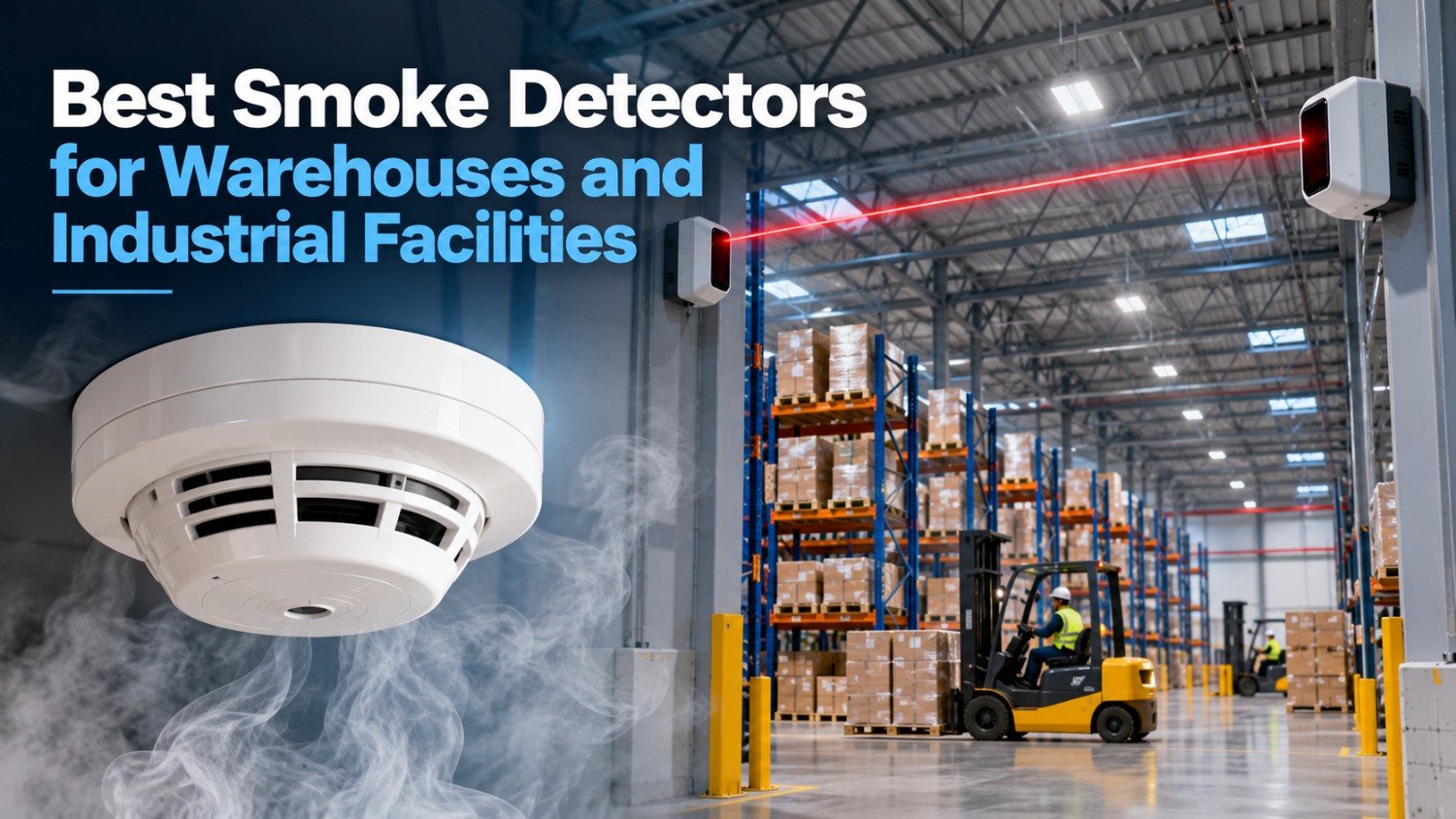
Choosing smoke detectors for a warehouse is a different exercise from specifying them for an office. Ceiling heights push smoke through long dilution paths, forklift exhaust and airborne dust sit in the same air the sensing chamber samples, and racking changes the way a plume travels long before it reaches a detector. This guide covers which detection types suit industrial buildings, the features that matter at height and in dust, how addressable and conventional devices differ, and what to check during installation and maintenance.
Why Smoke Detection Matters in Warehouses and Industrial Facilities
Industrial fires develop in conditions that work against detection. Stored goods provide dense fuel loads, aisles act as chimneys, and a fire inside racking can burn for some time before smoke reaches ceiling level. Early warning buys the time that sprinkler activation, evacuation and fire service response depend on.
Smoke detectors here must also survive the environment. Temperature swings, vibration from material handling equipment and constant exposure to particulates shorten service life and shift sensitivity. Specifying industrial smoke detectors rated for the actual conditions is what prevents a cycle of nuisance alarms followed by disabled devices.
Types of Smoke Detectors for Industrial and Warehouse Applications
Several detection technologies are used across industrial buildings, and large sites often combine them.
- Photoelectric spot detectors detect smouldering fires well and remain the general-purpose choice for ceilings within normal spot detection limits.
- Ionization spot detectors respond faster to fast-flaming fires and are used where flammable liquids or solvents are present.
- Combination units such as the TrueSense photoelectric smoke detector add thermal confirmation, which helps where airborne contamination would otherwise cause false activations.
- Beam detectors project across a wide open volume and suit long, high spaces where spot devices would need impractical quantities.
- Aspirating systems draw air through a pipe network to a central sensing unit, giving very early warning in high, cold or contaminated environments.
- Duct detectors monitor air handling systems so smoke is not distributed through the building by the ventilation plant.
Best Smoke Detector Features for Warehouses
Certain features consistently matter more in industrial buildings than in commercial offices:
- Drift compensation, which adjusts for gradual chamber contamination and flags a dirty device before it alarms falsely.
- Panel-adjustable sensitivity, allowing settings to be tuned by location rather than by replacing hardware.
- Remote test capability, valuable where devices sit at height and access requires lifts or scaffolding.
- Environmental ratings suited to temperature range, humidity and washdown exposure in the specific area.
- Clear diagnostics, so maintenance teams can identify which head is degrading instead of testing every device on the loop.
How to Choose Smoke Detectors for Industrial Facilities
Selecting smoke detectors for industrial facilities follows the building rather than the catalogue, so work through the site conditions before shortlisting smoke detectors for industrial facilities on specification alone.
Start with ceiling height and roof geometry, because these determine whether spot smoke detectors can work at all. Then assess the air: dust concentration, humidity, vehicle exhaust and process emissions all influence which technology stays stable. Consider temperature extremes, particularly in unheated or refrigerated areas where temperatures fall outside the listed range of standard smoke detectors. Finally, confirm the existing panel and protocol, since the devices must communicate with what is already installed.
The most common specification error is applying an office solution across an industrial roof. Warehouse smoke detectors chosen on price alone tend to be replaced twice: once when nuisance alarms start, and again when the correct technology is finally specified.
Smoke Detectors for High-Ceiling Warehouses
Height works against smoke detection. As a plume rises it entrains cool air, loses buoyancy and spreads laterally, so smoke may stratify below the ceiling and never reach a spot device. Roof vents, radiant heat and stack effect make this worse.
Two approaches address it. Beam detectors sit across the volume and respond to obscuration along the path, which suits long clear spans. Aspirating detection samples air continuously through pipework that can be run at multiple levels, catching smoke that stratifies well below the roof. Both are commonly specified where spot warehouse smoke detectors alone could not give timely warning. Where roof height is moderate, warehouse smoke detectors at ceiling level still work, provided spacing and airflow are checked. The principle behind sampling systems is summarised in the reference entry on aspirating smoke detection.
Smoke Detection in Dusty and Industrial Environments
Dust is the most frequent cause of unreliable industrial detection. Fine particulate accumulates in the sensing chamber, sensitivity drifts, and the device eventually alarms on its own contamination. Several measures help:
- Select devices with drift compensation and dirty-detector reporting so degradation is visible before it becomes an alarm.
- Use aspirating systems with filtration where particulate levels are continuously high.
- Consider combination smoke and heat devices where confirmation reduces unwanted activations.
- Increase cleaning frequency in specific zones rather than desensitising the whole system.
- Investigate repeated activations by location; a single problem area usually points to a process or airflow issue, not a defective head.
Addressable vs. Conventional Smoke Detectors for Warehouses
| Factor | Conventional | Addressable |
| Reporting | By zone | By individual device |
| Fault finding | Search the zone | Panel identifies the exact device |
| Sensitivity control | Fixed at the device | Programmable at the panel |
| Drift compensation | Generally not available | Commonly supported |
| Wiring | Separate zone circuits | Loop architecture |
| Best suited to | Small sites, simple layouts | Large warehouses and multi-building industrial sites |
On a large floor plate, addressable detection usually pays for itself in maintenance time alone: locating one dirty head on a conventional zone covering thousands of square metres can absorb a full shift.
Popular Smoke Detector Options for Commercial and Industrial Systems
Specific device choice follows the panel already installed. On Notifier intelligent systems, the FSP-851 photoelectric head was the long-standing addressable detector, with sensitivity programmed and monitored at the panel. It has since been superseded by the FSP-951 series, which uses an updated optical chamber and a lower-profile housing while serving as the direct replacement on the same loops.
On Simplex platforms, the TrueAlarm photoelectric sensor reports an analogue smoke level to the panel, which applies drift compensation and alarm thresholds in software rather than at the device. That makes a TrueAlarm photoelectric sensor easy to tune by location without changing hardware. Where thermal confirmation is wanted, the TrueSense photoelectric smoke detector combines photoelectric sensing with fixed-temperature and rate-of-rise heat detection in one head. A TrueSense photoelectric smoke detector is a practical option in bays where dust alone would otherwise trigger an optical chamber, and it keeps the device count down by covering both smoke and heat from one address.
These are not interchangeable across brands. A Notifier head does not operate on a Simplex loop, and a TrueAlarm photoelectric sensor does not communicate with a Notifier panel. Confirm the protocol before ordering, and confirm the base separately, since heads and bases are matched components.
Installation, Inspection, and Maintenance Considerations
- Keep detectors clear of roof vents, unit heaters, fans and loading doors where airflow diverts smoke.
- Respect the listed spacing and ceiling-height limits for spot devices; exceeding them is a design change, not a shortcut.
- Review coverage whenever racking is reconfigured; a layout change can invalidate the original design.
- Schedule cleaning by zone, weighting dusty areas more heavily than clean ones.
- Test after work in the space, particularly after hot works, painting or floor cleaning.
- Keep a device schedule with part numbers so replacements can be sourced without a site visit.
Devices that repeatedly fail in one bay usually indicate an environmental cause. Changing technology or location there is more effective than lowering sensitivity across the system.
Why Choose QuickShipFire for Industrial Smoke Detectors?
QuickShipFire supplies smoke detectors, bases, duct detectors, modules, panels and notification equipment across major manufacturers, including legacy and discontinued devices that are hard to source elsewhere. For facilities running older systems, that matters: keeping an existing panel in service is usually far cheaper than a full replacement, provided compatible heads can still be found.
Frequently Asked Questions
What type of smoke detectors work best in warehouses?
It depends on ceiling height and air quality. Photoelectric spot devices suit standard heights and clean air, while beam and aspirating detection perform better in high-ceiling, dusty or cold environments where smoke stratifies before reaching the roof.
Why do industrial smoke detectors give false alarms?
Most unwanted alarms come from dust, vehicle exhaust, steam or humidity entering the sensing chamber. Drift compensation, correct siting and scheduled cleaning resolve the majority; persistent cases usually indicate the wrong technology for that area.
Can standard smoke detectors be used in cold storage?
Not usually. Standard heads have a listed temperature range that refrigerated areas fall below. Use devices rated for the temperature, or an aspirating system with the sensing unit located in a conditioned space.
What is the difference between FSP-851 and FSP-951 detectors?
Both are Notifier addressable photoelectric detectors. The FSP-951 series replaced the FSP-851 series, using an updated optical sensing chamber and a lower-profile design while acting as the direct replacement on compatible loops.
Are addressable smoke detectors worth it for a warehouse?
For large sites, generally yes. Device-level reporting, panel-programmed sensitivity and drift compensation cut fault-finding time significantly compared with searching a conventional zone covering a large floor area.
How often should industrial smoke detectors be cleaned?
Follow the manufacturer’s schedule and increase frequency in dusty zones. Panels that report dirty-detector status let teams clean by condition rather than waiting for the calendar or an unwanted alarm.
Do duct detectors replace ceiling smoke detectors?
No. Duct detectors prevent smoke being distributed through air handling systems but do not provide area coverage. Both are needed where mechanical ventilation serves a protected space.
Conclusion
The best smoke detectors for a warehouse are the ones matched to its height, its air and its existing fire alarm panel. Spot devices remain effective at ordinary ceiling heights in reasonably clean air; beam and aspirating detection earn their place where height, dust or cold defeat them; and addressable platforms make maintaining a large site practical rather than punishing. Get the technology right for each area, then keep the devices clean and correctly sited that combination does more for reliability than any single product choice.
If you are specifying or replacing smoke detectors, note the panel manufacturer, protocol, base type and existing part numbers before ordering. Browse the QuickShipFire detector range or send your device details for help identifying compatible replacements, including obsolete models.