
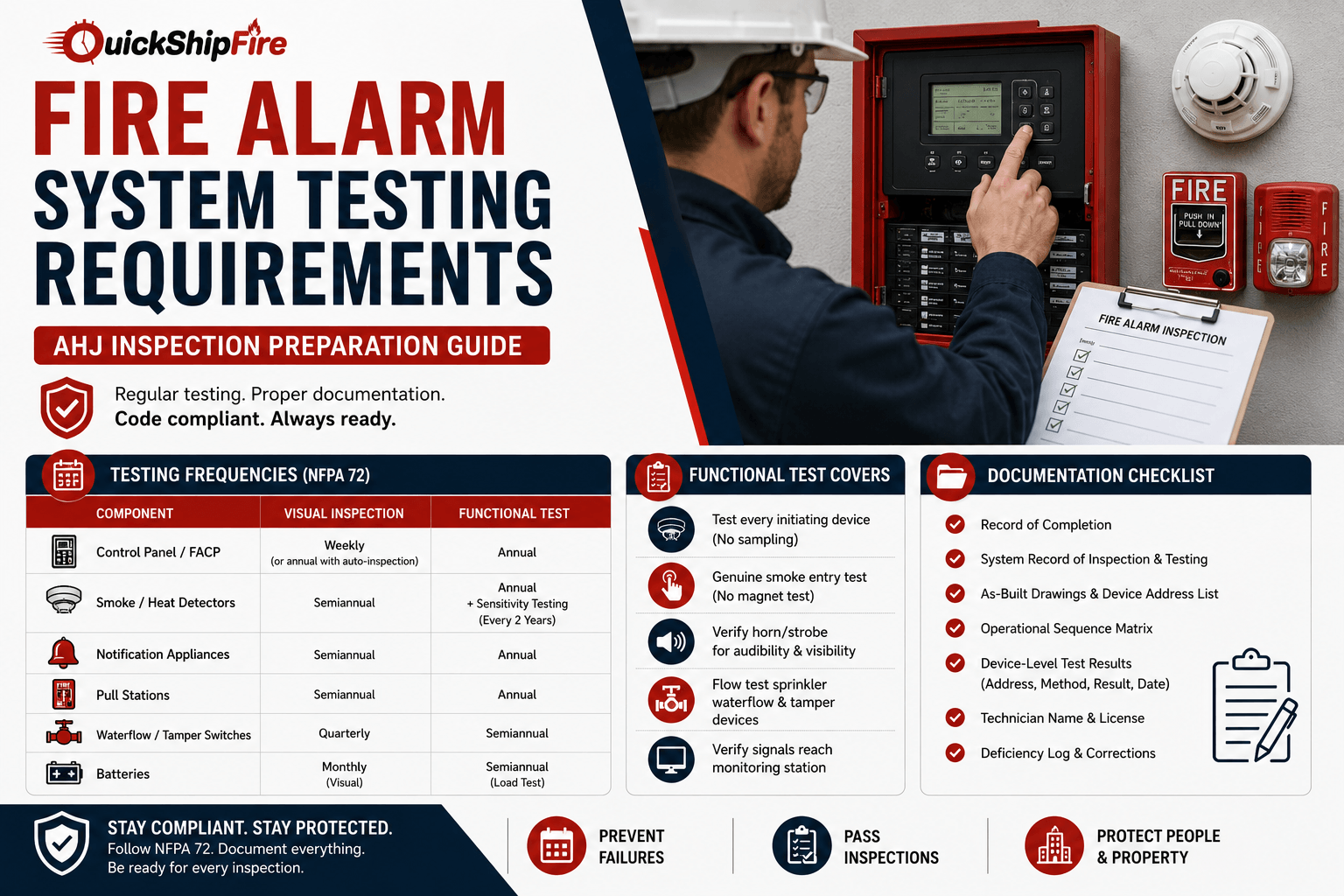
An annual inspection is not the moment to discover that a device has been failing quietly for months. Testing every single device on the fire alarm system, rather than a sample, is the standard NFPA 72 sets. Every commercial fire alarm system is subject to a defined testing schedule under NFPA 72, and the authority having jurisdiction expects to see both passing results and complete documentation, not just a system that happens to work on the day the inspector shows up. This guide walks through the testing frequencies NFPA 72 Chapter 14 requires, what a typical AHJ inspection actually reviews, and how to prepare a building so the inspection goes smoothly the first time rather than generating a deficiency report and a re-inspection fee.
NFPA 72 Testing Frequencies by Device Type
NFPA 72 Chapter 14 sets out inspection and testing intervals that vary by component, and understanding these frequencies is the foundation of any fire alarm system testing program. Control equipment requires weekly visual checks for trouble conditions, though listed addressable systems capable of automatic weekly self-inspection with a printed record are often permitted to reduce this to an annual visual inspection. Most initiating devices and notification hardware fall under a semiannual visual inspection and annual functional test cycle, while smoke detectors carry an additional sensitivity testing requirement layered on top of the standard functional test.
| Component | Visual Inspection | Functional Test |
| Control panel / FACP | Weekly (or annual with auto-inspection) | Annual full functional test |
| Smoke and heat detectors | Semiannual | Annual, plus sensitivity testing |
| Notification appliances | Semiannual | Annual |
| Pull stations | Semiannual | Annual |
| Waterflow and tamper switches | Quarterly | Semiannual |
| Batteries | Monthly (visual) | Semiannual load test |
Smoke detector sensitivity testing has its own specific cadence: testing is required within one year of installation, and every other year after that, provided the detector continues to test within its listed and marked sensitivity range. Detectors that drift outside that range must be cleaned, recalibrated, or replaced and then retested before returning to service. Some jurisdictions allow this interval to extend further for detectors on a listed addressable system with a documented history of stable readings, but the underlying requirement to test, not just visually inspect, never goes away.
- Control panels require weekly visual checks unless the system performs and documents automatic weekly self-inspection.
- Smoke detectors, heat detectors, and horns and strobes need semiannual visual inspection and annual functional testing.
- Smoke detector sensitivity testing is required within one year of installation and every other year thereafter.
- Waterflow and tamper switches require quarterly visual inspection and semiannual functional testing.
- Standby batteries need monthly visual checks and a semiannual load test to confirm actual capacity, not just voltage.
What a Fire Alarm System Functional Test Actually Covers
A full annual functional test on a fire alarm system means physically testing every initiating device and every notification appliance, not a representative sample. Every addressable smoke detectors unit gets tested with actual smoke entry, not just a magnet test, since NFPA 72 specifically prohibits substituting a magnet test for genuine smoke entry testing on functional tests. Every pull stations gets physically activated with the correct key or tool, every notification appliances is verified for audibility and visibility, and every duct smoke detectors unit is tested along with its associated HVAC shutdown function.
Sprinkler-connected devices on a fire alarm system get tested as part of the same overall program even though NFPA 25 technically governs the water-based system itself: a waterflow switch should be flow-tested to confirm it reports correctly to the panel, and the resulting signal needs to reach the supervising station within the required time window, not just register locally at the FACP.
- Every initiating device gets individually tested, not a representative sample of the total device count.
- Smoke detectors require genuine smoke entry testing; a magnet test alone does not satisfy the functional test requirement.
- Notification appliances are checked for both audibility and visibility, not just electrical activation.
- Sprinkler waterflow and tamper devices are flow-tested to confirm correct signal reporting to the panel.
- Off-premises signal transmission is verified to arrive at the supervising station within the required timeframe.
Documentation the AHJ Will Ask For
Missing or incomplete documentation is one of the most common reasons a compliant fire alarm system fails an inspection, even when every device in the building is actually functioning correctly. Inspectors expect to see a properly executed Record of Completion from the original installation, or from the most recent major modification, along with the System Record of Inspection and Testing for the current period. As-built riser diagrams, a device address list matching the panel programming, and the operational sequence matrix for any life-safety functions the fire alarm control panel controls should all be on hand and current, not archived documents from a decade-old installation that no longer match the building.
Every individual test result needs to be logged by device address, method used, and outcome, along with the technician’s name and the date. A summary statement that “all devices tested satisfactorily” without device-level detail is a common deficiency finding, since it gives the AHJ no way to verify which specific devices were actually tested.
- A properly executed Record of Completion from the original installation or most recent major modification.
- Current System Record of Inspection and Testing covering the applicable reporting period.
- As-built riser diagrams and a device address list that match the panel’s current programming.
- Device-level test logs showing method, result, technician, and date for every device tested, not a summary statement.
- Documentation of any deficiencies identified during testing and the corrective action taken to resolve them.
Preparing a Building for an AHJ Inspection
Before the inspection date, pull the as-builts, the last inspection report, the riser diagram, and the current device inventory, since a large share of inspection failures trace back to missing documentation rather than failed hardware. Walk every floor ahead of the actual inspection and look for the issues that repeatedly show up on deficiency reports: painted-over detectors, missing or damaged appliance covers, blocked access to devices, and signage that no longer matches the as-built riser. Photograph anything questionable, since the inspector will likely ask about it, and it is far better to have already identified and addressed the issue than to be caught off guard.
Verify standby battery capacity against the fire alarm system’s calculated load rather than assuming age alone tells the story; NFPA 72 requires 24 hours of standby capacity plus 5 or 15 minutes of alarm current depending on the system type, and batteries approaching four to five years old should generally be replaced proactively rather than argued over during an inspection. Confirm power supplies throughout the system, not just the main panel battery, are within their rated service life.
- Gather all documentation, as-builts, and the prior inspection report before the AHJ visit, not the day of.
- Walk the building beforehand looking for blocked, painted, or damaged devices and mismatched signage.
- Verify standby battery capacity against the calculated load, and replace batteries proactively near end of service life.
- Confirm fire alarm monitoring signals are reaching the supervising station correctly before the inspector arrives, not during the test itself.
- Notify building occupants, the monitoring company, and where required the fire department before testing begins.
Why Fire Alarm System Testing Documentation Matters Beyond the AHJ
A well-documented fire alarm system testing history has value for any commercial fire alarm system beyond satisfying the inspector on any given visit. Insurance carriers frequently request testing records during underwriting or after a claim, and a fire alarm system with gaps in its documented testing history can complicate both premium negotiations and claims processing. Property transactions also increasingly involve a review of fire alarm system compliance records as part of due diligence, since an incoming owner does not want to inherit an undocumented compliance gap along with the building.
For facility teams managing more than one fire alarm system across a portfolio, a consistent testing and documentation format makes it far easier to track which properties are due for testing, which have open deficiencies, and which are fully current, rather than reconstructing that picture building by building every time a question comes up.
Common Deficiencies That Fail an Inspection
A handful of recurring issues account for a large share of failed fire alarm system inspections across every occupancy type: expired or undocumented smoke detector sensitivity testing, batteries that have not been load-tested within the required interval, device-level test logs that are missing or incomplete, and horns or strobes that have been painted over or otherwise physically altered from their listed configuration. On buildings with integrated smoke control, a functioning fan sequence that does not correctly position dampers under fault conditions is a particularly common finding, since a passing visual check of fan operation does not confirm the full sequence actually works.
- Expired smoke detector sensitivity testing beyond the required one-year and biennial intervals.
- Missing semiannual battery load test results, relying on voltage checks alone instead of true capacity testing.
- Incomplete or summary-only test logs that do not document individual device results.
- Notification appliances that have been painted, obstructed, or otherwise altered from their listed configuration.
- Smoke control fan and damper sequences that run but do not correctly reposition dampers under simulated fault conditions.
Whether you need replacement smoke detectors ahead of an inspection deadline, replacement horns and strobes to correct a painted-over device finding, or a power supply to resolve a failed battery load test, QuickShipFire stocks fire alarm control panels and components from Notifier, Fire-Lite, Silent Knight, System Sensor, and other leading manufacturers, with fast shipping to keep an inspection on schedule. Request a quote and our team will help you get the right parts before the inspector arrives.
Conclusion
A fire alarm system passes its AHJ inspection because of a testing program that runs all year, not because of a last-minute scramble the week before the inspector arrives. Knowing the correct NFPA 72 testing frequencies for each device type, testing every device rather than a sample, and keeping device-level documentation current are what separate a smooth inspection from a deficiency report and a re-inspection fee. Building owners and facility managers who treat fire alarm system testing and documentation as an ongoing discipline, rather than an annual event, consistently spend less time and money on compliance over the life of the system.
Frequently Asked Questions
How often does a commercial fire alarm system need to be tested?
Most components require semiannual visual inspection and annual functional testing under NFPA 72 Chapter 14, though specific intervals vary by device type: control panels are checked weekly, waterflow switches quarterly, and smoke detector sensitivity within one year of installation and every other year after that.
Can I use a magnet test instead of smoke entry testing for smoke detectors?
No. NFPA 72 requires genuine smoke entry testing using listed aerosols for functional and sensitivity testing of smoke detectors. A magnet test alone does not satisfy this requirement.
What documentation does the AHJ require during a fire alarm inspection?
Typically a Record of Completion, the current System Record of Inspection and Testing, as-built riser diagrams matching the panel programming, and device-level test logs showing method, result, technician, and date for every device tested, not a summary statement.
Why do fire alarm systems fail inspections even when devices are working?
Missing or incomplete documentation is one of the most common reasons a functioning system fails inspection. Expired sensitivity testing records, missing battery load test results, and summary-only test logs are frequent findings even in buildings with no actual device failures.
How long should fire alarm inspection records be kept?
NFPA 72 requires inspection and testing records to be retained for a minimum of five years, and many facilities keep records for the full life of the system to support future troubleshooting and AHJ reviews.
Who is qualified to perform fire alarm system testing?
NFPA 72 requires testing be performed by qualified personnel with appropriate training, often a licensed fire alarm technician or NICET-certified specialist. Building owners may perform certain basic visual inspections with appropriate training, but functional and sensitivity testing generally requires a qualified technician.
What should I check before an AHJ inspection to avoid common deficiencies?
Verify smoke detector sensitivity testing is current, confirm battery load tests have been performed within the required interval, walk the building for painted-over or obstructed devices, and make sure device-level test logs and as-built documentation are complete and match the current system configuration.