
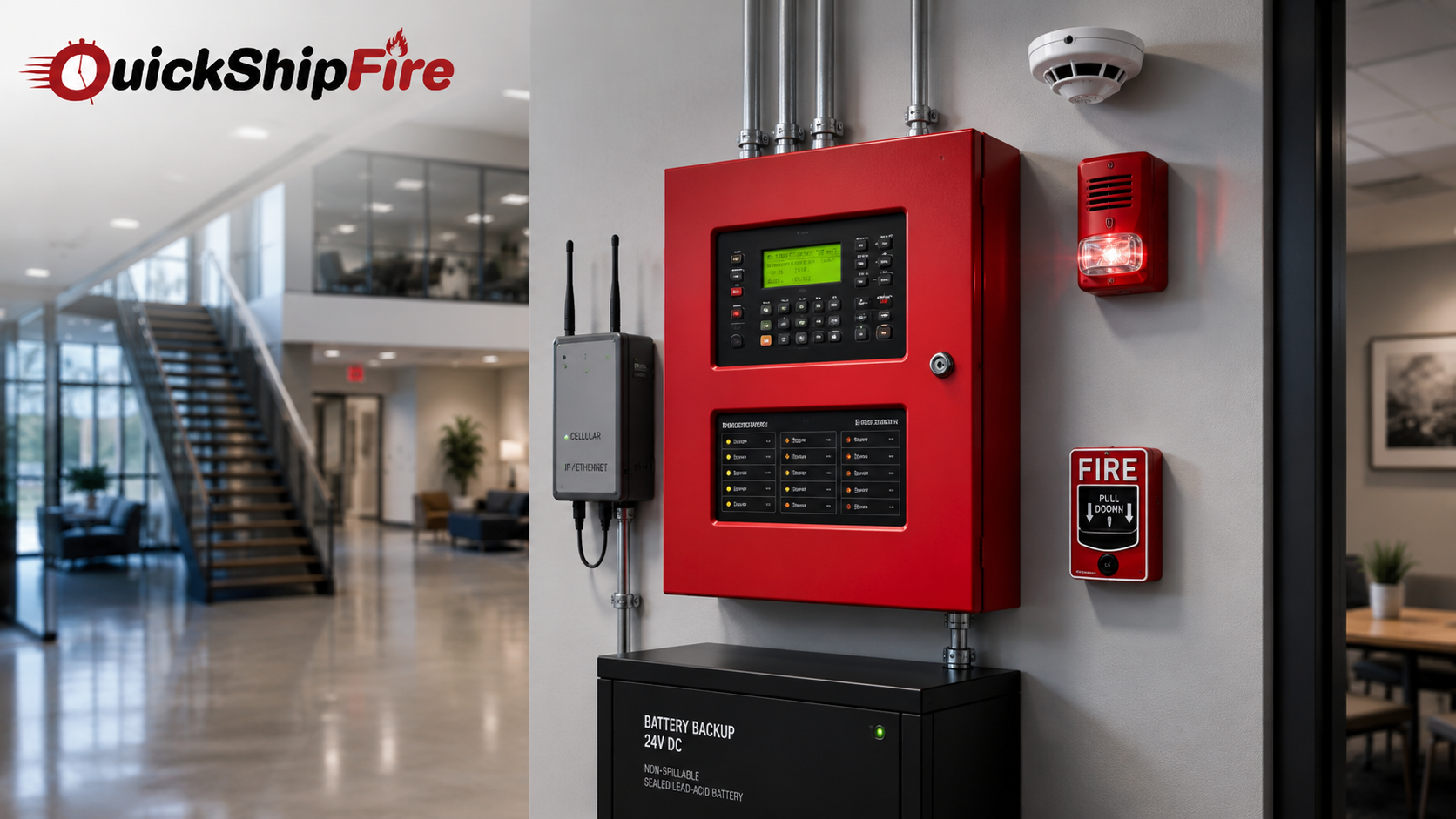
When a fire alarm control panel detects smoke, heat, or a pulled station, its job is only half finished. The other half is fire alarm monitoring making sure that alarm signal actually reaches someone who can dispatch the fire department and get help moving toward the building. Facility managers evaluating a new or upgraded fire alarm system are often surprised to learn that NFPA 72 recognizes several distinct arrangements for accomplishing this, and the right choice depends heavily on the size, ownership structure, and risk profile of the property. This guide breaks down the two monitoring models that come up most often in commercial fire protection projects, central station monitoring and proprietary monitoring, along with where remote station service fits in, what equipment each approach requires, and how to decide which fire alarm monitoring strategy is the better fit for your building or campus.
What Is Fire Alarm Monitoring and Why It Matters
Fire alarm monitoring is the process of transmitting alarm, supervisory, and trouble signals from a building’s fire alarm system to a staffed location that can act on them. Without monitoring, a fire alarm is effectively a local alert: it sounds horns and strobes inside the building, but if no one is present, or if occupants are already trying to evacuate, nobody outside the building learns about the emergency. A monitored system closes that gap. The moment a device activates, the signal travels over a communicator to a supervising station, where a trained operator verifies the event and notifies the fire department. Most commercial occupancies, including offices, hotels, healthcare facilities, and multi-family buildings, are required by the adopted building and fire codes to maintain fire alarm monitoring through a supervising station that is compliant with NFPA 72, National Fire Alarm and Signaling Code.
Insurance carriers also have a strong interest in fire alarm monitoring. Many policies offer premium reductions for properties protected by a verified, code-compliant monitoring arrangement, since a faster notification generally translates into a smaller loss. That financial incentive, combined with the life-safety requirement, is why choosing the right monitoring category is one of the more consequential decisions in a fire alarm system design.
NFPA 72 Supervising Station Categories
NFPA 72 Chapter 26 defines the types of supervising stations that are permitted to receive signals from a protected premise. The three categories that matter most for commercial buildings are central station service, proprietary supervising stations, and remote supervising stations. Each one satisfies the code requirement for fire alarm monitoring, but they differ in who owns and staffs the monitoring location, what additional services are bundled in, and which building types they suit best.
Central Station Fire Alarm Monitoring Explained
Central station monitoring is provided by a third-party company that has no ownership interest in the buildings it monitors. The central station is UL-listed to ANSI/UL 827 and must comply with strict requirements for staffing, signal handling, record keeping, and what the code calls “runner service,” meaning a technician must be able to reach the property within two hours of an unrestored alarm or supervisory signal. Central station service typically bundles installation, inspection, testing, and maintenance responsibilities under a single contract between the subscriber, meaning the building owner, and the prime contractor. Because the provider is a specialist with dedicated staff working around the clock, this arrangement is by far the most common form of fire alarm monitoring for standard commercial buildings, retail locations, and multi-tenant properties.
Proprietary Fire Alarm Monitoring Explained
Proprietary monitoring flips the ownership structure: the monitoring location is owned and operated by the same organization that owns the protected buildings. A dedicated control room, staffed at all times with trained personnel, receives signals from one or many properties under common ownership. This model shows up most often on large campuses, in hospital systems, at airports, and with big-box retail chains that operate identical fire alarm monitoring infrastructure across dozens or hundreds of locations. Because the same organization controls installation, staffing, testing, and response, proprietary monitoring can deliver faster on-site response and more customized alarm handling than an outside central station, but it requires enough scale to justify continuous 24/7 staffing and the redundant power and communication infrastructure NFPA 72 requires of any supervising station.
Remote Supervising Station Monitoring
A remote supervising station receives signals from multiple, unrelated properties, similar to a central station, but it is not held to the full ANSI/UL 827 central station listing and does not necessarily bundle in installation, testing, or maintenance services. Many municipal or county-operated monitoring arrangements fall into this category. It is less common in new commercial construction today, but it still appears in specific contexts such as certain industrial fire brigade operations.
- Central station service is delivered by an independent, third-party company that has no ownership stake in the monitored property.
- Proprietary supervising stations are owned and staffed by the same organization that owns the protected buildings, typically campuses or multi-site chains.
- All three supervising station categories require trained personnel, redundant power, and continuous signal supervision under NFPA 72.
- A communicator module at the panel is what transmits alarm, supervisory, and trouble signals to the chosen supervising station.
- Unmonitored, local-only fire alarm systems do not satisfy code in most commercial occupancies and leave notification entirely up to whoever happens to be on site.
Central Station vs Proprietary Fire Alarm Monitoring: Side-by-Side Comparison
| Factor | Central Station Monitoring | Proprietary Monitoring |
| Ownership of monitoring location | Independent third-party company | Same entity that owns the protected building(s) |
| Governing NFPA 72 section | Chapter 26.3 (Central Station Service) | Chapter 26.4 (Proprietary Supervising Station) |
| Typical building types | Single commercial buildings, retail, offices, multi-tenant properties | Campuses, hospital systems, airports, multi-site retail chains |
| Included services | Monitoring plus installation, inspection, testing, and maintenance under one contract | Monitoring only; ITM is arranged separately by the owner |
| Startup and staffing cost | Low; pay a recurring monitoring fee to the provider | High; requires 24/7 staffing, dedicated space, redundant systems |
| Best suited for | Most commercial buildings that lack the scale for in-house monitoring | Organizations large enough to amortize the cost across many buildings |
How Fire Alarm Monitoring Signals Travel to the Supervising Station
Every fire alarm monitoring path, no matter the supervising station category, is built on the same chain of trust: detection, transmission, verification, and dispatch. Understanding that chain helps facility teams ask better questions when specifying equipment.
Regardless of which category of fire alarm monitoring a building uses, the mechanics are similar. A device on the system, whether it is a smoke detector, a pull station, or a waterflow switch on the sprinkler riser, changes state and reports it to the control panel. The panel processes the signal and, if it qualifies for off-site transmission, hands it to a communicator, which relays it to the supervising station over one or more communication paths. NFPA 72 requires most signals to arrive at the supervising station within 90 seconds, and it mandates supervision of the communication path itself so a cut phone line or dropped internet connection is detected and reported as a trouble condition rather than silently failing.
Modern installations increasingly rely on dual-path communicators that combine a cellular radio with an IP connection, since traditional copper telephone lines are being phased out across much of the country. A single communication path is acceptable for many installations as long as it is supervised at intervals not exceeding 60 minutes, while dual-path communicators are checked more frequently and provide redundancy if one path fails.
- An addressable fire alarm system reports the exact device and location of an event, which speeds up verification at the supervising station.
- Dual-path communicators combine cellular and IP connections so a single network outage does not disable fire alarm monitoring.
- Battery and generator backup keep signal transmission active during a commercial power outage, a core NFPA 72 requirement.
- Line supervision detects a cut, shorted, or disconnected communication path and reports it as a trouble condition automatically.
Equipment Considerations for Reliable Fire Alarm Monitoring
The monitoring arrangement a building chooses only works as well as the equipment behind it. A dependable fire alarm control panel, a properly rated communicator, and a correctly sized power supply are the foundation of any compliant fire alarm monitoring installation, whether the signals are headed to a central station or a proprietary control room. Panels from manufacturers such as Notifier, Fire-Lite, and Silent Knight support a range of communicator options, and an addressable fire alarm system makes it far easier for a monitoring operator to identify exactly which device triggered the signal and relay useful information to responding firefighters.
Notification is only one function that rides on this same monitored infrastructure. Sprinkler-protected buildings also depend on waterflow switch monitoring to alert the supervising station the moment water begins flowing through the system, and facilities with life safety speaker systems often integrate a mass notification system with the same control panel so that a single event triggers both evacuation instructions and off-site monitoring.
- A code-compliant control panel sized correctly for the building’s device count and future expansion.
- A listed communicator matched to the supervising station’s accepted signal formats and communication paths.
- A backup power supply with battery capacity sized to the required standby and alarm current draw.
- Properly rated notification appliances so occupants still receive local notification even while the signal is monitored off-site.
- Documentation and testing records that satisfy the inspection, testing, and maintenance requirements tied to the chosen monitoring category.
When Proprietary Fire Alarm Monitoring Makes Sense
Proprietary monitoring is not a fit for every building, but for the right organization it offers real operational advantages. A hospital system running its own security operations center can respond to an alarm on any campus building in minutes rather than waiting on a call from an outside central station. A manufacturing company with multiple plants can standardize response procedures across every site. This kind of centralized fire alarm monitoring is especially valuable in hazardous environment fire protection scenarios, where facility staff already need to coordinate a broader emergency response beyond simply notifying the fire department.
The tradeoff is cost and complexity. Proprietary supervising stations must meet the same core NFPA 72 requirements for staffing, redundant power, and signal supervision that a central station does, which means an organization taking on this responsibility needs enough properties, and enough budget, to make continuous in-house monitoring worthwhile. For a single building or a small portfolio, contracting with an established central station almost always makes more financial sense than building out proprietary fire alarm monitoring from scratch.
Choosing the Right Fire Alarm Monitoring Strategy
Selecting between central station and proprietary fire alarm monitoring comes down to a handful of practical questions that any facility manager or fire protection engineer should work through before finalizing a system design. Getting the equipment specification right at this stage prevents costly rework later, especially on the communicator, panel capacity, and power supply sizing.
- How many buildings need to be monitored, and are they under common ownership?
- Does the organization already staff a 24/7 control room, or would proprietary monitoring require building one from scratch?
- What does the authority having jurisdiction require for this occupancy type under the locally adopted edition of NFPA 72?
- Will the communicator need dual-path redundancy, and is the existing control panel compatible with current communicator technology?
- Are there insurance premium incentives tied to a specific type of fire alarm monitoring service?
Whichever monitoring model fits your facility, the equipment behind it needs to be reliable and code-compliant. QuickShipFire stocks brand-new control panels, communicators, notification appliances, and power supplies from Notifier, Fire-Lite, Silent Knight, System Sensor, Simplex, and other leading manufacturers, including hard-to-find parts for systems that are being upgraded rather than replaced outright. If you are specifying equipment for a new fire alarm monitoring installation or need help sourcing a component for an existing system, request a quote and our team will help you get the right parts shipped fast.
Conclusion
Fire alarm monitoring is not a single, one-size-fits-all service. NFPA 72 provides multiple compliant paths, and the right one depends on how many buildings you operate, how they are owned, and how much monitoring infrastructure your organization is prepared to run in-house. Central station monitoring remains the practical default for the vast majority of commercial buildings because it bundles monitoring with installation, testing, and maintenance under an experienced third-party provider. Proprietary monitoring makes sense for large, multi-site organizations that can justify dedicated, continuously staffed control rooms. In either case, the equipment behind the monitoring, from the control panel to the communicator and standby power source, has to be sized and installed correctly for the system to perform when it matters most.
Frequently Asked Questions
What is the difference between central station and proprietary fire alarm monitoring?
Central station monitoring is provided by an independent third-party company under NFPA 72 Chapter 26.3, while proprietary monitoring is owned and staffed by the same organization that owns the protected building or campus, under Chapter 26.4. Central station service typically bundles in installation, testing, and maintenance, while proprietary monitoring usually covers signal receipt and response only.
Is fire alarm monitoring required by code for commercial buildings?
In most jurisdictions, yes. The adopted building and fire codes, in conjunction with NFPA 72, require most commercial, healthcare, hospitality, and multi-family occupancies to connect their fire alarm system to an approved supervising station rather than relying on a local-only alarm.
How fast must a signal reach the supervising station?
NFPA 72 requires most alarm, supervisory, and trouble signals to be displayed at the supervising station within 90 seconds of activation at the protected premises, which is why communication path supervision and backup power are treated as critical requirements rather than optional add-ons.
Can a small business use proprietary fire alarm monitoring instead of a central station?
Technically yes, but it is rarely practical. Proprietary monitoring requires a continuously staffed control room and the same redundant power and communication infrastructure a central station maintains, which is difficult to justify financially for a single building. Central station service is almost always the more cost-effective option for smaller portfolios.
What equipment does a building need for fire alarm monitoring?
At minimum, a code-compliant control panel, a listed communicator compatible with the receiving supervising station, and a properly sized power supply. Many systems also integrate waterflow switch monitoring for sprinkler protection and, in larger buildings, a mass notification system layered on the same platform.
Does fire alarm monitoring affect insurance premiums?
Many insurance carriers offer reduced premiums for buildings with verified, code-compliant fire alarm monitoring, since a faster notification to the fire department typically limits the extent of fire and water damage. The specific discount varies by carrier and by the type of monitoring service in place.
What happens if a fire alarm monitoring communication path fails?
A properly supervised system detects a failed or disconnected communication path and reports it to the control panel and the supervising station as a trouble condition. Dual-path communicators reduce this risk further by combining cellular and IP connections so a single outage does not take fire alarm monitoring offline.