
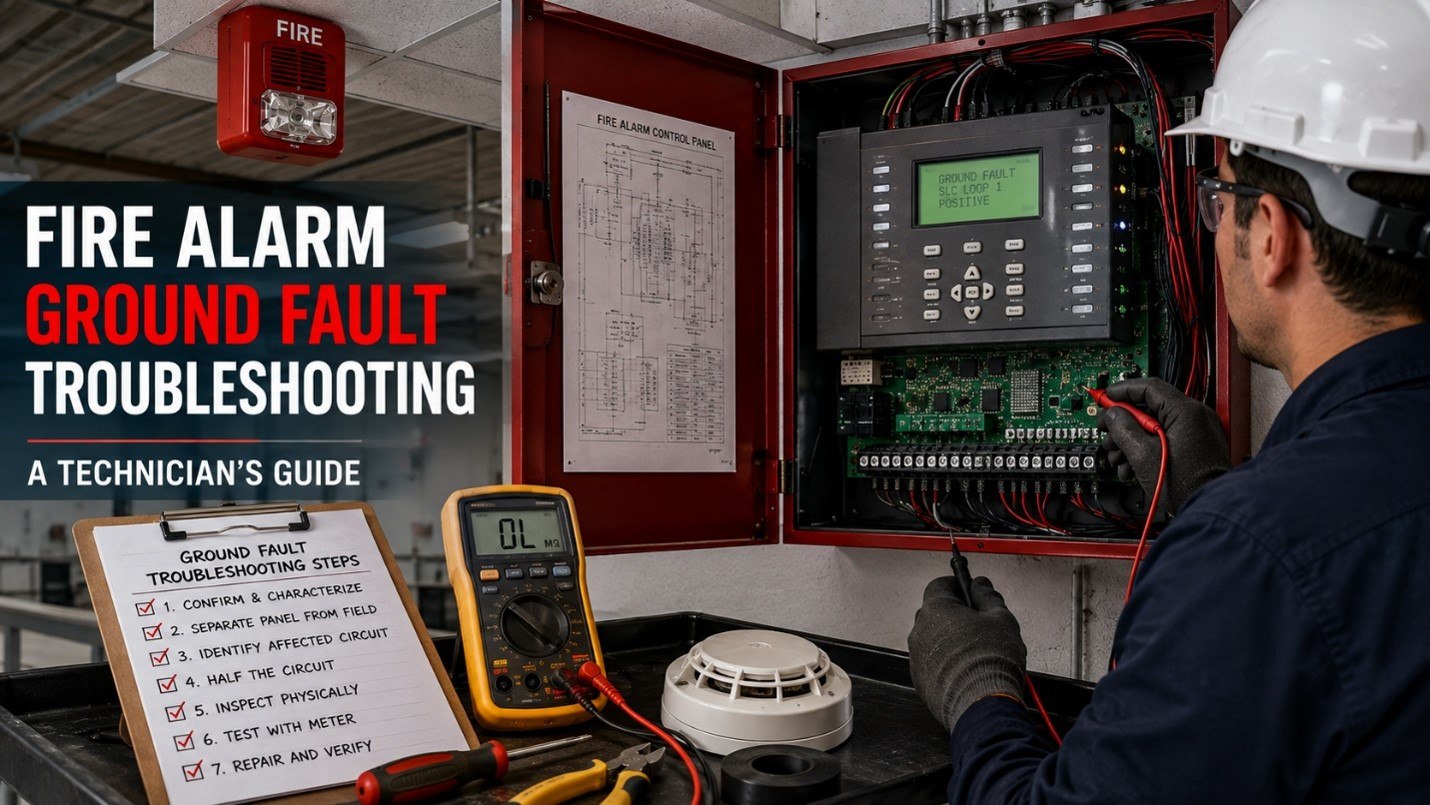
Of all the faults a commercial fire alarm panel can report, a ground fault is the one most likely to consume an entire day. The panel knows something is wrong. It usually cannot tell you where. And unlike a device that stops answering, the condition can be intermittent, weather-dependent, and caused by work that another trade did six weeks ago in a ceiling void nobody has opened since.
This is a field guide to fire alarm ground fault diagnosis: what the condition actually is, why it matters even when the system appears to work normally, and a systematic isolation method that gets you to the cause without rewiring a building on suspicion.
What a Ground Fault Actually Is
Fire alarm circuits are designed to float relative to earth. Neither conductor of an SLC or NAC circuit should have a low-resistance path to building ground. When one develops, the panel’s ground fault detection circuitry sees current where none should flow and reports the condition.
The critical point is what happens next. A single ground fault often causes no operational symptom at all – devices still poll, notification appliances still sound, the system passes a functional test. That is precisely why they get ignored.
The danger is the second fault. If a ground develops on the opposite conductor elsewhere in the system, current can flow between the two through the building structure, creating an unintended path that can hold a circuit in a false state, prevent alarm signals from propagating, or damage panel circuitry. A single ground fault is a warning; two grounds is a system failure waiting for a coincidence.
The Common Causes, Ranked
Physical damage to conductor insulation. By far the most frequent. Screws driven through cables, cable pulled hard over sharp conduit ends during installation, rodent damage in voids, and conductors pinched behind a device backbox as it was screwed home.
Water and moisture ingress. Roof leaks, condensation in exterior junction boxes, and water tracking along conduit. These produce the classic intermittent ground that appears after rain and clears three days later.
Field device failure. A detector, module, or notification appliance with an internal breakdown to its metal housing or mounting. Less common than wiring causes, but it happens.
Shield and drain wire terminations. Shielded cable drain wires terminated at both ends, or terminated where the design called for them to be isolated, create a deliberate path to ground that behaves exactly like a fault.
Other trades. Ceiling grid work, HVAC installation, and low-voltage cabling all take place in the same voids as fire alarm wiring. A ground fault appearing shortly after building work is very rarely a coincidence.
The Isolation Method
The method that works is binary halving. It feels slow and it is the fastest thing available.
Step 1 – Confirm and characterise. Note whether the panel reports positive or negative ground and record the event history. Establish whether the fault is constant or intermittent. An intermittent fault must be present at the moment you test, or the halving results will be meaningless.
Step 2 – Separate panel from field. Disconnect all field circuits at the panel terminals. If the ground fault clears, the problem is in the field wiring or a device. If it persists with everything disconnected, the fault is inside the panel – a power supply, a board, or the panel’s own earthing.
Step 3 – Reconnect one circuit at a time. Restore each loop or NAC individually and observe. This identifies which circuit carries the fault. If more than one circuit reports a ground, you have multiple faults and each must be worked separately.
Step 4 – Halve the affected circuit. Go to a junction point near the electrical midpoint of that circuit and disconnect. Which half retains the fault? Repeat within that half. Each halving cuts the search space in two, so even a long loop resolves in a handful of steps.
Step 5 – Inspect physically before testing further. Once you have narrowed to a segment, look before you meter. Water staining, crushed cable, a device backbox screwed onto a conductor, or a drain wire touching a box will usually be visible.
Step 6 – Confirm with a meter. Measure resistance from each conductor to a verified building ground. Readings well into the megohms are normal; low or steadily falling readings identify the faulted conductor.
Step 7 – Repair and verify. After repair, reconnect everything, allow the panel a full supervision cycle, and confirm the fault has cleared and stayed cleared. Re-test after any weather event if the original fault was intermittent.
One discipline makes the whole sequence faster on the next visit: write down what you disconnected, where, and in what order. Ground fault work involves opening the same junction boxes repeatedly, and a rough sketch of the loop with the halving points marked turns a second visit into a twenty-minute job rather than a repeat of the entire search.
Where Isolation Devices Change the Picture
Systems designed with fault isolation behave differently and, usefully, narrow the search for you. A line isolator module segments an SLC loop so that a fault in one segment does not take down the whole circuit. On a well-isolated loop, the panel’s reporting will often tell you which segment is affected before you touch a single terminal.
Isolators also matter after the repair. If a system has been extended over the years without maintaining the original isolation scheme, a fault that should have been contained to one segment can affect a whole loop, which is worth flagging to the building owner while you have the ceiling open.
Wiring Class and What It Changes
The circuit’s wiring class affects how the system behaves during a fault and how you approach the work. A Class A circuit’s return path means a single open does not necessarily remove devices from supervision; a Class B circuit’s does. Ground faults themselves are reported similarly on both, but the consequences of the fault progressing differ, and so does the isolation procedure at the panel. Our comparison of Class A vs Class B wiring covers what each configuration is doing and why the distinction matters during fault work.
Power supply grounding is the other structural factor. Where auxiliary power supplies or NAC boosters have been added to a system, each one introduces its own earth reference, and an incorrectly bonded booster is a recurring source of phantom ground faults. Check the power supply range documentation for the bonding arrangement the manufacturer specifies before assuming the installation is correct.
Traced the fault to a failed device or a damaged module? We stock isolators, monitor and control modules, detectors, and power supplies for most major panel platforms – including discontinued part numbers that OEM channels no longer supply. Check availability or call (833) 747-7845 and we will confirm what ships today.
The Intermittent Ground Fault
These deserve their own approach, because standard halving fails when the fault is not present during testing.
Work from the event history first. Timestamps reveal patterns that live testing cannot: faults that appear overnight point to temperature or condensation; faults after rainfall point to water ingress; faults during working hours point to something being moved, opened, or vibrated. Correlate the log against weather records and building activity before you climb a single ladder.
Where the pattern is environmental, inspect the exposed points of the system first – exterior devices, rooftop equipment, duct detectors in air handling units, and anything in an unconditioned space. These locations produce a disproportionate share of intermittent grounds relative to their device count.
Conclusion
Ground faults reward method and punish guesswork. Characterise the fault, separate panel from field, halve until the segment is small, then look before you meter. Almost every ground fault in a commercial building comes down to damaged insulation, water, a failed device, or a drain wire in the wrong place – and the halving method finds all four.
The part that most often gets skipped is the last one: verifying that the fault stayed cleared through a full supervision cycle and, for intermittent faults, through the conditions that originally triggered it. If the repair turns out to need a replacement device or isolator, browse the addressable modules range for the component that closes the job out.
Frequently Asked Questions
Can a fire alarm system operate normally with a ground fault present?
Often yes, which is what makes them dangerous. A single ground frequently produces no functional symptom. The risk is a second ground on the opposite polarity, which can create an unintended current path and interfere with alarm signalling.
How urgent is a ground fault compared to other troubles?
It should be treated as a genuine impairment requiring prompt repair, even where the system appears to work. The urgency comes from what a second fault would do, not from what the first one is currently doing.
Why does my ground fault come and go with the weather?
Almost always moisture. Water tracking into a junction box, condensation in an unconditioned space, or a roof leak reaching conduit creates a conductive path that dries out and returns. Check exterior devices and rooftop equipment first.
Can a smoke detector cause a ground fault?
Yes. A device with internal insulation breakdown to its housing or mounting hardware will present as a ground. It is less common than wiring damage, but substituting a suspect device on a narrowed segment is a valid diagnostic step.
Does a ground fault damage the panel?
A single fault normally does not. Two faults creating a current path through building structure can stress panel circuitry and, in some configurations, damage output circuits. This is another reason not to leave a single ground unresolved.
How do I test for a ground fault with a multimeter?
Measure resistance from each circuit conductor to a verified building ground with the circuit isolated from the panel. Healthy circuits read very high – typically megohms. Low or falling readings indicate which conductor is faulted.
Should the cable shield drain wire be grounded at both ends?
Normally no. Shield drains are usually terminated at one end only, per the system design and the manufacturer’s instructions. Terminating at both ends creates a deliberate ground path that the panel will report as a fault.
What if the ground fault is inside the panel itself?
If the fault persists with all field circuits disconnected, the cause is internal – commonly a power supply, an auxiliary device fitted inside the enclosure, or the panel’s own bonding. Work through internal connections systematically before condemning a board.