
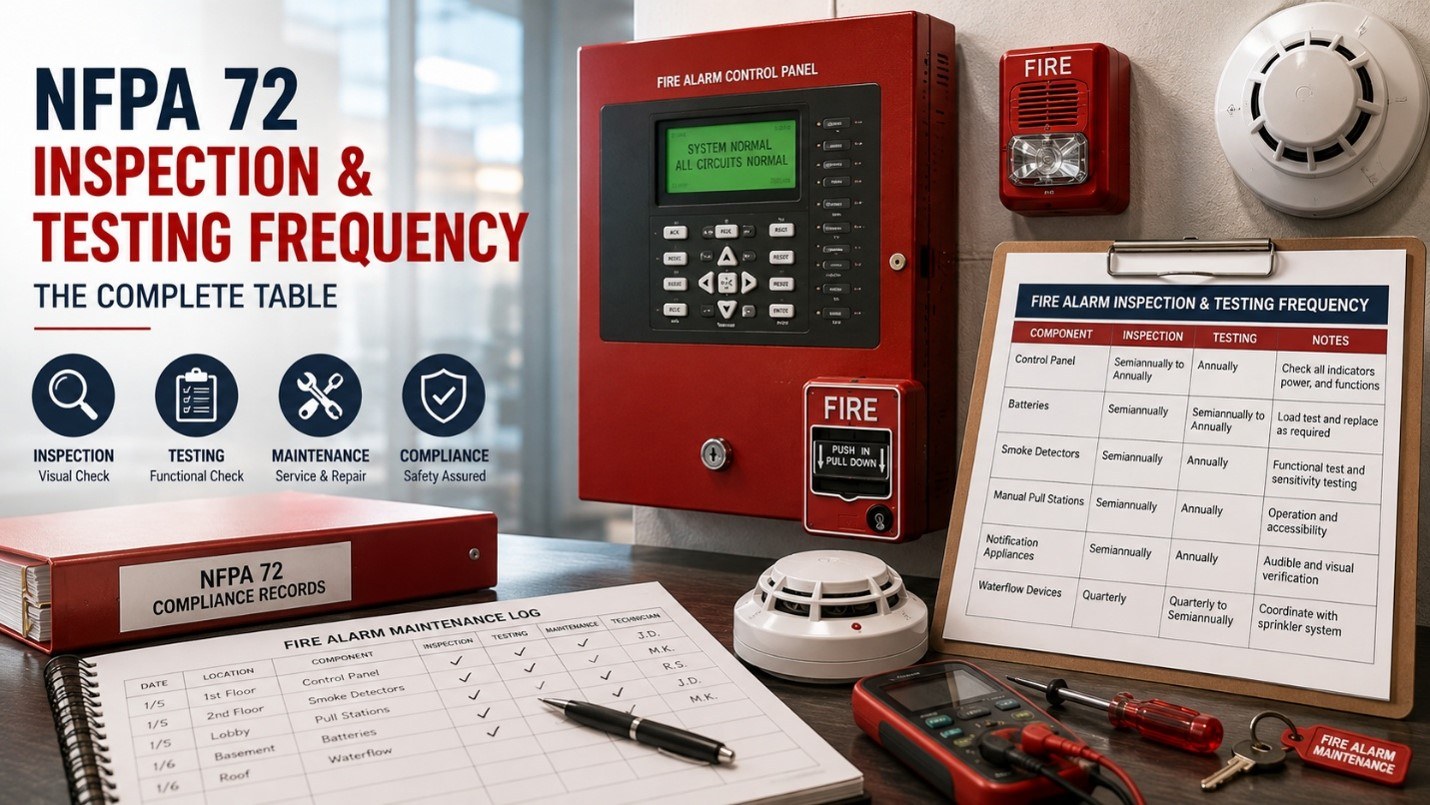
Understanding NFPA 72 Inspection and Testing Frequency is essential for maintaining commercial fire alarm systems and demonstrating that required inspection, testing, and maintenance activities have been completed. NFPA 72 Chapter 14 separates visual inspections from functional testing, and different devices can have different schedules. The authority having jurisdiction (AHJ) can also require more frequent activity than the baseline schedule.
For facility managers, building owners, fire alarm contractors, and safety professionals, knowing the correct interval helps prevent missed inspections and incomplete maintenance records. This guide explains the major frequencies, provides a practical reference table, and discusses documentation, smoke detector sensitivity, occupancy considerations, and common compliance questions.
What Does NFPA 72 Cover?
NFPA 72, the National Fire Alarm and Signaling Code, establishes requirements for fire alarm and signaling systems, including their installation, inspection, testing, and maintenance. Chapter 14 addresses inspection, testing, and maintenance activities.
One important point is that inspection and testing are not interchangeable terms. A visual inspection checks the physical condition and accessibility of equipment, while a functional test verifies that equipment actually performs its intended operation.
The NFPA 72 testing frequency therefore needs to be considered alongside the visual inspection schedule. A system may require a visual inspection at one interval and a functional test at another.
NFPA 72 Inspection and Testing Frequency: Quick Reference Table
The following table summarizes commonly encountered commercial fire alarm system requirements. It is intended as a practical reference rather than a substitute for the applicable NFPA 72 edition, manufacturer’s instructions, or AHJ requirements.
| Fire Alarm Component | Typical Visual Inspection | Typical Functional Testing | Important Consideration |
| Fire alarm control equipment | Semiannual or as specified by Table 14.3.1 | Annual | Monitoring status and equipment condition matter |
| Smoke detectors | Semiannual | Annual | Sensitivity has a separate schedule |
| Smoke detector sensitivity | Within 1 year after installation; generally every alternate year thereafter | May be extended to up to 5 years after qualifying tests | |
| Heat detectors | Per applicable inspection schedule | Annual for applicable devices | Restorable spot-type detectors have sampling requirements |
| Manual fire alarm boxes | Semiannual | Annual | Each device must be properly activated during testing |
| Notification appliances | Semiannual | Annual | Audible and visible functions require verification |
| Primary power supply | Per applicable inspection schedule | Annual | Verify proper operation |
| Batteries | Semiannual visual inspection for applicable systems | Frequency depends on battery type and requirements | Manufacturer instructions also apply |
| Remote annunciators | Semiannual | Annual where applicable | Verify condition and operation |
| Duct smoke detectors | Per applicable inspection schedule | Annual where applicable | Airflow and connected functions should be evaluated |
| Supervisory devices | Semiannual | Frequency specified for the device | Some supervisory functions have different requirements |
| Interface equipment | Annual or applicable schedule | Per applicable equipment standard | HVAC, elevator, door and other interfaces may have additional requirements |
The exact schedule should always be checked against the adopted edition of NFPA 72 and the requirements imposed by the AHJ. NFPA technical committee material identifies Table 14.3.1 for visual inspections and Table 14.4.3.2 for periodic testing in the relevant editions.
Visual Inspection vs. Functional Testing
A major source of confusion is treating an inspection as though it were a functional test.
A visual inspection generally confirms that equipment is present, accessible, properly located, physically undamaged, unobstructed, and appropriately oriented. It can also identify changes in building conditions, occupancy, device location, cleanliness, or environmental conditions that could affect system performance.
Functional testing goes further. The technician operates the device or equipment according to the applicable test method and verifies that the correct response is received.
For example, visually confirming that a manual fire alarm box is intact does not prove that it successfully sends an alarm signal to the control unit. Likewise, seeing a smoke detector installed on a ceiling does not verify its ability to respond correctly during an alarm test.
This distinction is fundamental when establishing an NFPA 72 Inspection and Testing Frequency schedule.
NFPA 72 Testing Frequency for Common Fire Alarm Devices
Smoke Detectors
Smoke detectors generally require periodic functional testing and separate sensitivity evaluation. NFPA technical committee material states that smoke detector sensitivity is checked within one year after installation and every alternate year thereafter, unless the provisions allowing a longer interval are satisfied. After two required calibration tests demonstrate that the detector remains within its listed sensitivity range, the interval may be extended to a maximum of five years under the applicable conditions.
A detector outside its listed sensitivity range generally needs to be cleaned and recalibrated or replaced, subject to the applicable provisions.
This means smoke detector replacement timing should not be based on a simple assumption that every detector must be replaced at exactly the same age. Condition, manufacturer requirements, sensitivity performance, listing, and the applicable code provisions all need to be considered.
Heat Detectors
Restorable fixed-temperature, spot-type heat detectors have specific testing provisions. NFPA technical material indicates that two or more detectors on each initiating circuit are tested annually, with different detectors selected each year, so that every detector is tested within five years. Records identifying the detectors tested are required.
Manual Fire Alarm Boxes
Manual fire alarm boxes are functionally tested to verify that activation produces the expected fire alarm signal. Visual inspections also help identify physical damage, obstruction, or accessibility problems.
Notification Appliances
Horns, speakers, strobes, and other notification appliances require inspection and functional testing according to the applicable schedules. Testing should verify the intended notification function rather than merely confirming that the appliance is physically present.
Batteries and Power Supplies
Power sources require particular attention because a fire alarm system must remain operational when normal utility power is unavailable. Battery inspection and testing intervals vary according to battery type and the applicable requirements.
For example, current NFPA 72 material includes specific provisions for primary dry-cell batteries, including replacement intervals and inspection for corrosion or leakage.
Fire Alarm Inspection Frequency by Occupancy Type
The phrase fire alarm inspection frequency by occupancy type can be misleading because NFPA 72 Chapter 14 generally establishes inspection and testing schedules by equipment and system characteristics rather than creating one universal frequency for every occupancy category.
Occupancy still matters.
A healthcare facility, educational building, high-rise property, industrial facility, assembly occupancy, or other specialized environment may be subject to additional requirements from the adopted fire code, other NFPA standards, state or local regulations, insurance requirements, or the AHJ.
For this reason, facility managers should not assume that an interval used in one building automatically applies to another building with a different occupancy classification.
The safest approach is to establish the baseline from NFPA 72 and then determine whether the AHJ or another applicable standard requires a more frequent schedule. NFPA technical material explicitly recognizes that testing is performed according to the AHJ or the applicable table, whichever is more frequent.
What Is the NFPA 72 Testing Schedule for Smoke Detector Sensitivity?
Smoke detector sensitivity testing deserves separate attention because it is not simply another annual functional test.
Under the provisions cited in NFPA technical committee material, sensitivity is checked within one year after installation and every alternate year thereafter. After the second required calibration test, the interval may be extended to a maximum of five years when the detector remains within its listed and marked sensitivity range and the applicable conditions are met.
If nuisance alarms increase in an area where the extended interval is being used, calibration testing may again be required.
This is why a documented history of sensitivity results is valuable. It provides evidence that the detector has remained within its listed range and helps identify developing maintenance problems.
Fire Alarm System Documentation Requirements
Proper records are an important part of a fire alarm maintenance program. The fire alarm system documentation requirements should provide enough information to demonstrate what was inspected or tested, when the activity occurred, what equipment was involved, and whether deficiencies were identified.
A useful documentation system should include:
- Date of inspection or test
- Identification of the building and fire alarm system
- Equipment or devices tested
- Test results and deficiencies
- Detector sensitivity results where applicable
- Identification of components requiring correction
- Corrective action performed
- Technician or responsible party information
- Relevant notes regarding system impairments or unusual conditions
For restorable heat detectors, for example, NFPA technical material specifically calls for records identifying which detectors have been tested.
Documentation should also be updated when building modifications, occupancy changes, device relocations, or environmental changes affect the fire alarm system.
How to Build a Practical Inspection Schedule
A well-organized inspection program starts with an inventory of all fire alarm equipment. The inventory should identify control equipment, initiating devices, notification appliances, power supplies, supervisory devices, interface equipment, and other connected components.
The next step is to assign each component its applicable inspection and testing interval. The schedule should then account for manufacturer instructions, the adopted NFPA 72 edition, other applicable standards, and AHJ requirements.
Recommended Maintenance Planning Process
- Create a complete device inventory with model numbers and locations.
- Assign each component its applicable inspection and testing interval.
- Track annual, semiannual, quarterly, and sensitivity-testing due dates.
- Record every deficiency and corrective action.
- Review the schedule whenever the building, occupancy, or fire alarm system changes.
This approach reduces the possibility of relying on memory or treating every fire alarm device as though it follows the same schedule.
When Should Smoke Detectors Be Replaced?
There is no universal rule that every smoke detector should automatically be replaced at a single age without considering the applicable requirements. The smoke detector replacement timing should be evaluated using manufacturer instructions, detector condition, sensitivity results, product lifecycle status, environmental exposure, nuisance-alarm history, and applicable code requirements.
A detector that repeatedly fails sensitivity testing or cannot be properly maintained may require replacement even if it is relatively new.
Conversely, a properly functioning detector may still need replacement when manufacturer instructions, listing limitations, system modernization, or other applicable requirements call for it.
Replacement should also account for system compatibility. Installing a newer detector without confirming compatibility with the fire alarm control unit can create a system problem rather than solve one.
What a Fire Marshal Inspection Checklist Should Include
A fire marshal inspection checklist can help organize the information needed during an inspection, but the exact checklist varies by jurisdiction and occupancy.
A practical checklist may cover the following areas:
- Fire alarm control panel condition and normal status
- Trouble, supervisory, and alarm signals
- Smoke and heat detectors
- Manual fire alarm boxes
- Notification appliances
- Power supplies and batteries
- Duct detector operation where installed
- Supervisory devices
- Monitoring and signal transmission
- Fire alarm documentation and previous deficiencies
- Changes to occupancy, layout, or building conditions
The checklist should complementnot replacethe applicable code, local requirements, and AHJ instructions.
Special Considerations for Monitored Systems
Fire alarm systems connected to supervising stations have additional requirements involving signal transmission and monitoring equipment. The testing process must verify that the appropriate alarm, supervisory, or trouble information is correctly transmitted.
The exact procedure depends on the system configuration and applicable provisions. Monitoring arrangements should therefore be included in the inspection program rather than treating the control panel as the only component requiring attention.
What Happens When Equipment Cannot Be Tested on Schedule?
NFPA 72 includes provisions for equipment that is inaccessible for safety reasons, such as continuous-process operations, energized electrical equipment, radiation, or excessive height. Under specified conditions, testing can occur during scheduled shutdowns when approved by the AHJ, with the extended interval limited to 18 months.
This is particularly relevant to industrial facilities where shutting down a process solely for testing may introduce operational or safety concerns.
The exception should not be treated as permission to indefinitely postpone required testing. The AHJ’s approval and applicable conditions remain important.
Why Professional Testing Matters
Fire alarm inspection and testing involves equipment that can affect life safety. Incorrect testing procedures can produce misleading results, damage equipment, create unnecessary alarms, or leave an important function unverified.
Qualified personnel should follow the manufacturer’s published instructions, applicable NFPA requirements, and local AHJ procedures.
When a deficiency is discovered, it should be documented and corrected appropriately rather than simply marked as a failed test without follow-up.
Frequently Asked Questions
1. How often does NFPA 72 require fire alarm systems to be inspected?
The interval depends on the equipment and applicable inspection schedule. Visual inspections and functional tests have different frequencies, and the AHJ can require more frequent activity.
2. What is the difference between NFPA 72 inspection and testing?
An inspection primarily evaluates the physical condition, location, accessibility, and visible status of equipment. Testing operates the equipment to verify that it performs its intended function.
3. How often should smoke detector sensitivity be tested?
Sensitivity is generally checked within one year after installation and every alternate year afterward. Under specified conditions, the interval can be extended to a maximum of five years.
4. Does occupancy change fire alarm inspection frequency?
Occupancy can affect applicable requirements, but NFPA 72 Chapter 14 schedules are generally organized around equipment and system characteristics. The AHJ and other applicable codes may impose additional or more frequent requirements.
5. What should be included in fire alarm testing records?
Records should identify the system, date, equipment tested, results, deficiencies, corrective actions, and responsible personnel. Sensitivity results and device-specific records should also be maintained when required.
6. Does NFPA 72 require smoke detectors to be replaced after a specific number of years?
Replacement depends on applicable code provisions, manufacturer instructions, product condition, sensitivity performance, listing, and system requirements. A detector should not be replaced solely according to an assumed universal age rule.
7. Who determines the final inspection frequency for a building?
The adopted code requirements, applicable NFPA standards, manufacturer instructions, and the authority having jurisdiction all influence the final schedule. Where requirements conflict, the more stringent applicable requirement may control.
Conclusion
Following the correct NFPA 72 Inspection and Testing Frequency is an essential part of a reliable fire alarm maintenance program. The process involves more than scheduling one annual visit. Visual inspections, functional tests, sensitivity measurements, power-supply checks, notification testing, documentation, and corrective actions all need to be coordinated according to the applicable requirements.
The NFPA 72 testing frequency should always be confirmed against the adopted edition of the standard, manufacturer instructions, system configuration, and AHJ requirements. Particular attention should be given to smoke detector sensitivity, smoke detector replacement timing, and complete fire alarm system documentation requirements.
For organizations maintaining commercial fire alarm systems, QuickShipFire provides access to fire alarm detectors, modules, panels, bases, and other life-safety equipment needed for maintenance and replacement projects. Visit QuickShipFire for fire alarm equipment and replacement parts
A properly maintained system is not only a compliance objectiveit is an important part of protecting occupants, property, and business operations.