

Understanding the fire alarm system documentation requirements for commercial buildings is one of the most overlooked responsibilities a property owner or facility manager carries. Most teams focus on installing the right fire alarm control panels and detectors, but the paperwork that proves your system was designed, installed, tested, and maintained correctly is just as critical the moment an inspector walks through the door. Without complete records, even a flawlessly functioning system can fail a compliance review, delay an occupancy permit, or void an insurance claim. This guide breaks down exactly which documents your building needs, what each one contains, how long to keep them, and how to build a recordkeeping process that keeps your property audit-ready year after year.
Why Fire Alarm System Documentation Matters for Commercial Buildings
Fire alarm documentation is not bureaucratic box-checking. It is the legal and operational backbone of your building’s life safety program. When the Authority Having Jurisdiction (AHJ) arrives for an inspection, the first thing they often ask for is your records, not a walk-through of the hardware. Three forces make thorough fire alarm system documentation requirements unavoidable for commercial properties.
First is code compliance. National and local fire codes mandate specific records, and missing them can mean failed inspections, fines, or a revoked certificate of occupancy. Second is insurance. Most commercial policies require proof of regular inspection and maintenance; without it, a denied claim after a fire becomes a very real risk. Third is liability. If an incident occurs, complete documentation demonstrates due diligence and shields ownership from negligence claims. There is also a practical, day-to-day benefit: organized records make servicing, upgrades, and ownership transfers dramatically faster, because the next technician or buyer inherits a clear history instead of guesswork. In short, your paperwork is what turns a working system into a defensible, compliant one.
Understanding NFPA 72 Documentation Requirements
In the United States, the foundation for fire alarm recordkeeping comes from NFPA 72, the National Fire Alarm and Signaling Code. The NFPA 72 documentation requirements specify what must be recorded at installation and throughout the system’s life, giving inspectors a consistent benchmark to measure your building against.
What NFPA 72 Requires
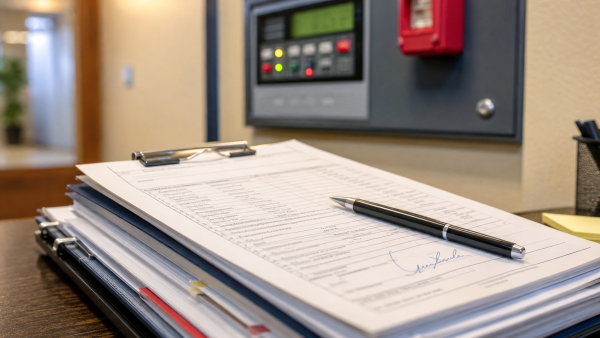
At a minimum, the NFPA 72 documentation requirements call for a record of completion, accurate system design documents, and detailed inspection and testing logs retained for review. The code also expects manufacturer data sheets, battery calculations, and a written sequence of operations explaining how the system responds when a device activates. Keeping these aligned with your actual installed equipment is essential; if you have recently upgraded panels or added devices, your records should reflect those changes. For a practical routine that supports these obligations, our fire alarm system maintenance checklist walks building owners through exactly what to verify and log.
Local Codes and the Role of the AHJ
NFPA 72 is the national baseline, but your local jurisdiction often layers additional rules on top. The AHJ, typically a fire marshal or building official, has final authority over what documentation your property must produce and how it should be formatted. Some jurisdictions require records on-site at all times; others accept secure digital copies. Because these expectations vary by city and county, confirming these requirements with your AHJ before an inspection is always the safest approach.
Core Documents Every Commercial Fire Alarm System Needs
Meeting the fire alarm system documentation requirements for your building comes down to maintaining a handful of essential records. Each serves a distinct purpose, and together they tell the complete story of your system from design to daily operation. The core documents include:
- Record of completion: certifies the system was installed and verified to code.
- As-built drawings: show the exact, final layout of all devices and wiring.
- System manuals and equipment records: capture model numbers, specifications, and operating instructions.
- Inspection and testing logs: prove the system is maintained on schedule.
Fire Alarm Record of Completion
The fire alarm record of completion is arguably the single most important document in your file. It is the official form, signed at the end of installation, confirming that the system was installed, programmed, and tested in accordance with code and the approved design. A proper fire alarm record of completion lists the system components, identifies the installing contractor, and is signed by both the installer and, often, the AHJ. If you replace a control board or expand the system, a new or amended record should be generated. Because these forms reference specific hardware, keeping documentation for components like your fire alarm boards ensures the record always matches what is physically installed.
Fire Alarm As-Built Drawings
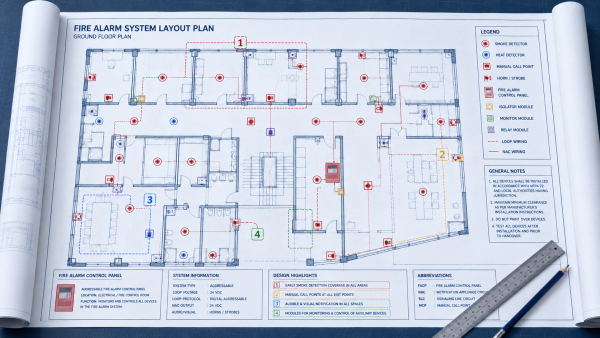
Fire alarm as-built drawings are the updated blueprints that reflect how the system was actually installed, not just how it was originally designed. They map every detector, pull station, notification appliance, and module, along with wiring routes and panel locations. Inspectors rely on them to verify device placement and to troubleshoot quickly during testing. Crucially, these drawings must be revised whenever the system changes; adding or relocating addressable modules without updating your fire alarm as-built drawings is one of the most common reasons buildings fall out of compliance.
System Manuals and Equipment Records
Beyond drawings and certifications, your file should hold the manufacturer’s operation and maintenance manuals, battery sizing calculations, and a running record of every installed device. These equipment records, including model numbers, serial numbers, and installation dates, make future service far simpler and help confirm warranty coverage. They also matter when sourcing replacements, since matching exact part numbers prevents compatibility issues that can compromise the entire system. This is especially important for older or discontinued systems, where an accurate device inventory may be the only reliable way to identify a like-for-like replacement before a fault leaves a zone unprotected. Keeping a master parts list alongside your manuals turns an emergency repair into a routine reorder.
Fire Alarm Inspection and Testing Records
Among all your fire alarm system documentation requirements, the most frequently updated are your inspection and testing records. NFPA 72 requires regular inspection, testing, and maintenance (ITM), and every one of those activities must be logged. Well-kept fire alarm inspection and testing records demonstrate that your system has been verified to function on the required schedule and that any issues were promptly corrected.

Each entry in your fire alarm inspection and testing records should capture:
- The date of the inspection or test and the technician’s name.
- The specific devices, zones, or circuits tested.
- The results, including any failures or trouble signals.
- Deficiencies found and the corrective action taken.
- The signature of the qualified inspector.
Detectors are among the most frequently tested devices, so maintaining clean records for your smoke detectors is especially important to a complete compliance history.
Inspection Frequency and Documentation
Different components require different testing intervals. Visual inspections may be monthly or quarterly, while a full functional test is typically annual and must be performed by a qualified technician. Each of these events feeds into your inspection log, building a continuous compliance trail. Skipping or failing to document even one scheduled test can break that chain and raise red flags during an AHJ review.
Must-Read: If your facility houses critical infrastructure, see our companion guide on Data Center Fire Protection: Early Warning Detection Systems Explained to understand the heightened detection and documentation standards these environments demand.
How Long Should You Keep Fire Alarm Documentation?
Retention is a key but easily forgotten part of your fire alarm system documentation requirements. Rules vary by jurisdiction, but a conservative approach protects you during audits and litigation. As a general guideline:
- Record of completion and as-built drawings: keep for the entire life of the system.
- Inspection and testing logs: retain at least one year, though many AHJs prefer the most recent few years on hand.
- Service and repair records: keep for the life of the affected equipment.
- System manuals and equipment data: retain as long as the device remains in service.
The industry is steadily moving toward digital recordkeeping, which makes long-term retention and fast retrieval far easier than managing paper files.
Common Fire Alarm Documentation Mistakes to Avoid
Even diligent building owners slip up on their recordkeeping. The most frequent documentation mistakes that lead to compliance problems include:
- Letting as-built drawings fall out of date after device changes.
- Missing, unsigned, or outdated record of completion forms.
- Failing to log device replacements and exact part numbers.
- Storing records in scattered locations with no central system.
- Ignoring updated local codes or new AHJ requirements.
Avoiding these pitfalls is far cheaper, and far less stressful, than a failed inspection or a denied insurance claim after an incident.
Building a Reliable Documentation System for Your Property
Staying ahead of your fire alarm system documentation requirements is much easier with a simple, repeatable process. Start by centralizing every record, completion forms, drawings, manuals, and logs, in one organized location that is backed up digitally. Assign clear ownership so a single person or team is accountable for keeping files current. Update documentation immediately after any installation, test, or repair rather than months later. It also helps to keep a short summary sheet at the front of the file listing the panel model, software version, monitoring details, and the date of the last inspection, so anyone can grasp the system’s status at a glance. Finally, review the full set annually, ideally alongside your scheduled maintenance, so nothing drifts out of date before your next inspection.
Conclusion
Meeting the fire alarm system documentation requirements for commercial buildings is not about generating paperwork for its own sake. It is about proving your life safety system is compliant, insurable, and ready to protect people when it matters most. From the record of completion to up-to-date as-built drawings and meticulous inspection logs, every document plays a role in keeping your property safe and audit-ready.
At QuickShipFire, we have supported safety professionals, facility managers, and building owners since 2017 with the equipment that keeps these systems compliant. We supply brand-new fire alarm panels, detectors, modules, and hard-to-find or obsolete components, all in original manufacturer packaging, backed by fast U.S. shipping and knowledgeable installation support. Whether you are upgrading an existing system or sourcing a discontinued part to keep your records accurate, request a quote or contact our team and we will help you find exactly what your building needs.
Frequently Asked Questions (FAQs)
1. What documentation is required for a commercial fire alarm system?
A commercial fire alarm system typically requires a record of completion, as-built drawings, manufacturer manuals, battery calculations, a sequence of operations, and ongoing inspection and testing logs. Local AHJ rules may add to this list, so always confirm the requirements for your specific jurisdiction.
2. What is a fire alarm record of completion?
It is the signed form certifying that the system was installed, programmed, and tested according to code and the approved design. The document lists the system components and installing contractor and is usually signed by both the installer and the AHJ.
3. How long do you need to keep fire alarm inspection records?
At minimum, inspection and testing records should be kept for one year, though many authorities prefer several years on hand. The record of completion and as-built drawings should be kept for the entire life of the system.
4. Does NFPA 72 require as-built drawings?
Yes. NFPA 72 requires accurate system documentation, and as-built drawings showing the final installed layout of devices and wiring are a core part of that. They must be updated whenever the system is modified or expanded.
5. Who is responsible for maintaining fire alarm documentation in a commercial building?
The building owner is ultimately responsible, though the duty is often delegated to a facility manager or a licensed fire alarm service provider. Regardless of who maintains the files, the owner must be able to produce them on request during an inspection.
6. What happens if a building fails to keep proper fire alarm documentation?
Incomplete documentation can lead to failed inspections, fines, a delayed or revoked certificate of occupancy, denied insurance claims, and greater liability exposure if an incident occurs. Strong records protect both occupant safety and the business itself.
7. How often must a commercial fire alarm system be inspected and documented?
Inspection frequency depends on the component and local code, but visual inspections are commonly monthly or quarterly, with a full functional test performed annually by a qualified technician. Every inspection and test must be documented.
8. What should be included in a fire alarm system manual?
A system manual should include manufacturer operation and maintenance instructions, device specifications and part numbers, battery sizing calculations, the sequence of operations, and guidance for routine testing and troubleshooting.