
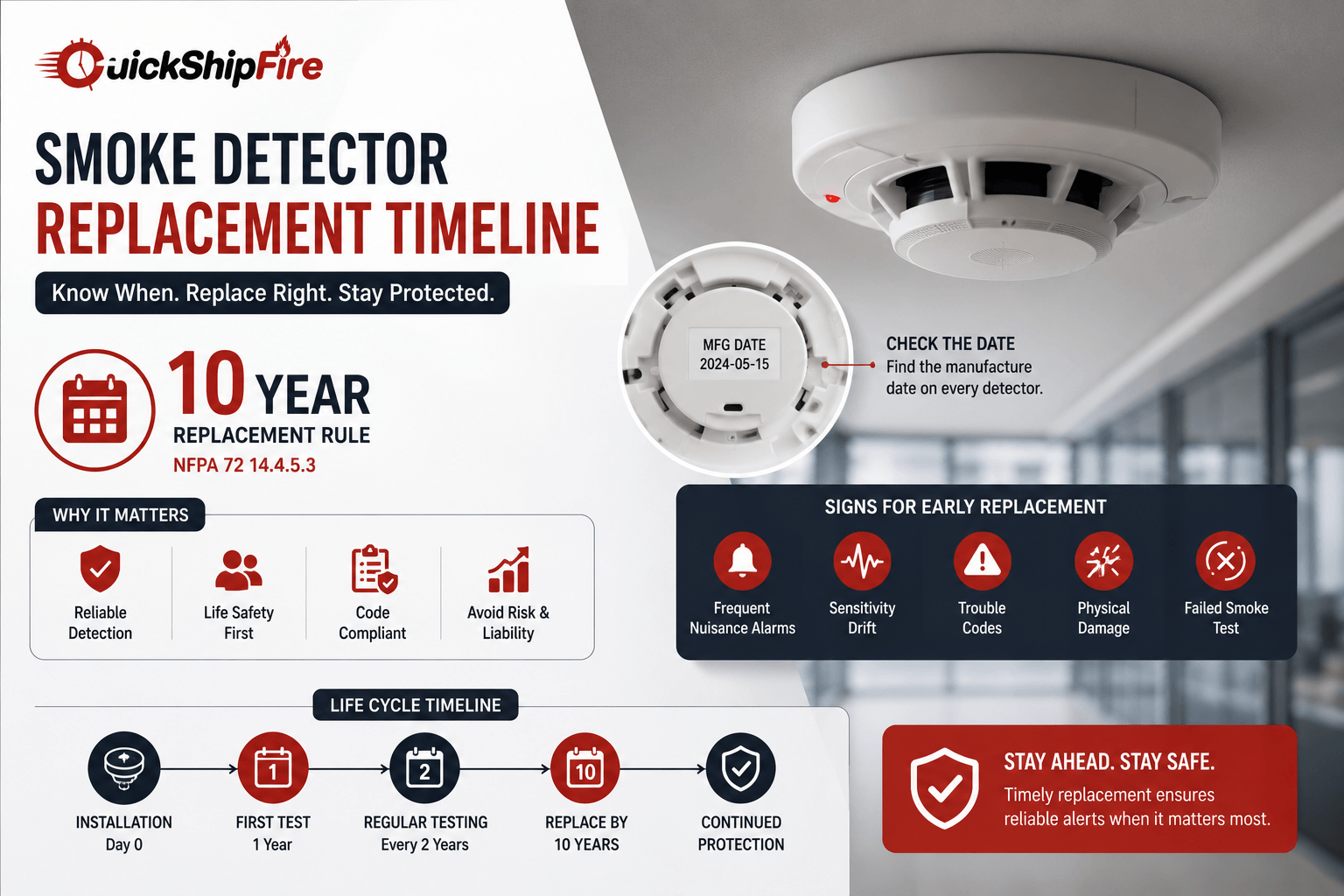
A commercial smoke detector that passes its annual test can still be a liability. Sensing chambers degrade with age regardless of whether a device responds correctly to a functional test, which is exactly why NFPA 72 sets a hard replacement timeline rather than leaving detector service life entirely up to testing results. This guide covers the code-mandated smoke detector replacement schedule, how to determine a device’s true age, the warning signs that indicate a detector needs attention before its scheduled replacement date, and how to plan a cost-effective replacement program across a commercial building or portfolio.
The NFPA 72 10-Year Smoke Detector Replacement Rule
Facility managers who inherit a building with an undocumented detector history often ask whether the 10-year rule is really enforced in practice. It is, and inspectors increasingly cross-reference manufacture-date labels during routine testing rather than accepting a passed function test as sufficient evidence of compliance. Treating the replacement date as a hard deadline, rather than a soft guideline, is the safer and ultimately less expensive approach for any commercial property.
NFPA 72 Section 14.4.5.3 sets the maximum service life for smoke detection devices at 10 years from the date of manufacture, not the date of installation. This distinction trips up a lot of facility teams: a detector that sat in a warehouse for a year before installation, or one installed midway through a larger construction project, is still measured against its manufacture date, and a device that passes its annual sensitivity test at year nine still has to come out of service at year ten regardless of test results. The manufacture date is printed directly on the detector housing, typically on the back or side of the unit, and every commercial fire alarm maintenance program should track this figure for each device rather than relying on installation records alone.
The rule exists because the failure mode for an aging smoke detector is invisible from the outside. Photoelectric chambers accumulate microscopic dust and contamination that calibration cannot fully correct, and ionization chambers rely on a radioactive source that decays gradually over time. Both failure modes reduce a detector’s actual sensitivity to real smoke long before the device would fail a basic function test, which is exactly the gap the 10-year rule is designed to close.
- NFPA 72 14.4.5.3 requires smoke detector replacement 10 years from the date of manufacture, not installation.
- The manufacture date, printed on the device housing, is what counts, regardless of when the detector was actually installed.
- A detector that passes its annual sensitivity test at year nine must still be replaced at year ten.
- Sensing chamber contamination and, in ionization units, radioactive source decay both degrade sensitivity invisibly over time.
- Non-restorable heat detectors carry a longer typical service life, often rated at 15 years by the manufacturer.
Testing Requirements Leading Up to Replacement
NFPA 72 Chapter 14 lays out a testing schedule that runs throughout a detector’s service life, not just at the point of replacement. System smoke detectors require sensitivity testing one year after installation, and every other year after that as long as readings stay within the listed and marked range. If a detector consistently tests within range, some jurisdictions allow the testing interval to extend to five years, though the 10-year hard replacement limit still applies regardless of how well a device has performed on testing.
Test buttons alone do not satisfy this requirement. NFPA 72 requires functional smoke testing using listed aerosols that actually verify the sensing chamber responds to real smoke particles, not just that the alarm circuit and sounder are electrically functional. Skipping proper sensitivity testing in favor of button tests is one of the more common documentation failures that shows up during commercial fire alarm inspections.
- Sensitivity testing begins one year after installation and repeats every other year if readings stay in range.
- Functional testing with listed aerosols is required; a test button alone does not verify sensing chamber performance.
- Detectors that drift outside the listed sensitivity range must be replaced or recalibrated immediately, regardless of age.
- All testing results must be documented and retained for a minimum of five years under NFPA 72 recordkeeping requirements.
- Addressable systems can report individual device sensitivity readings, simplifying ongoing monitoring across large buildings.
Warning Signs a Smoke Detector Needs Replacement Sooner
Not every detector makes it cleanly to its 10-year date, particularly in demanding environments. A smoke detector installed in a manufacturing area, a kitchen-adjacent zone, or a high-humidity space frequently shows signs of trouble well before its scheduled replacement, and recognizing those signs early prevents both nuisance alarm disruptions and, more importantly, a genuine detection gap.
- Frequent nuisance alarms are often the first sign of a contaminated sensing chamber that needs attention.
- Sensitivity drift reported by an addressable panel outside the listed range signals the device needs replacement or service.
- Recurring trouble codes tied to a specific address are the system communicating that one device needs attention.
- Visible discoloration or physical damage to the housing can indicate heat or chemical exposure beyond the device’s rating.
- Unresponsiveness to a functional smoke test, as opposed to just the electronic test button, is an immediate replacement trigger.
Smoke Alarm vs. System Smoke Detector Replacement Rules
| Factor | Standalone Smoke Alarm | System Smoke Detector |
| Replacement trigger | Mandatory at 10 years from manufacture | Recommended at 10 years; governed by sensitivity testing |
| Testing basis | Monthly test button check | Sensitivity testing at defined intervals plus function test |
| Connection | Standalone or interconnected household units | Connected to a fire alarm control panel via IDC or SLC |
| Typical setting | Residential dwelling units | Commercial, industrial, and institutional buildings |
| Documentation | Minimal; often self-managed by occupant | Formal ITM records retained for a minimum of five years |
Choosing Detector Technology at Replacement Time
Replacement is a natural point to reconsider detector technology rather than simply installing an identical unit. A photoelectric smoke detector generally responds faster to the smoldering, slow-developing fires responsible for the largest share of fatalities, and causes fewer nuisance alarms than an ionization unit in most commercial environments. Facilities upgrading from an older conventional zone system also frequently take the opportunity to move to addressable smoke detectors, which report individual device status and sensitivity directly to the panel rather than a generic zone, making both ongoing monitoring and future replacement planning considerably easier.
Products such as the TrueAlarm photoelectric sensor line illustrate this shift well: modern analog addressable photoelectric detectors report continuous sensitivity data back to the panel, which not only improves day-to-day reliability but also gives facility teams hard data to plan replacement cycles around actual device condition rather than a flat calendar assumption alone.
- Photoelectric detectors generally outperform ionization units on smoldering fires and produce fewer nuisance alarms.
- Addressable detectors report individual sensitivity readings, simplifying both testing and replacement planning.
- Duct-mounted detection needs its own replacement schedule, tracked separately from open-area smoke detectors.
- Specialty environments may call for speciality detectors rather than a standard photoelectric or ionization unit.
- Matching new detector bases to the panel’s addressing protocol avoids compatibility issues during a phased replacement.
Planning a Commercial Smoke Detector Replacement Program
For any building with more than a handful of devices, replacing detectors reactively as each one individually reaches its 10-year date is rarely the most efficient approach. Batch replacement, grouping detectors installed around the same time and replacing them together, is typically more cost-effective than sending a technician out repeatedly for single-device replacements spread across years. Maintaining a spreadsheet or CMMS record of manufacture dates by device address lets a facility team plan these replacement cohorts years in advance rather than reacting to individual trouble signals as they surface.
If a building’s detector ages are unknown, the safest and most conservative assumption is to treat those devices as approaching end-of-life and schedule replacement accordingly rather than gambling on an undocumented history. This is a common situation after a change in building ownership or fire alarm service provider, and it is worth resolving early rather than discovering a decade-old device during an unrelated fire alarm control panel inspection.
Every detector also needs a compatible detector base, and replacement projects sometimes overlook that older bases are not always compatible with a newer detector head, particularly when moving between manufacturers or between conventional and addressable protocols. Confirming base compatibility before ordering replacement detectors avoids a second trip to the same device location.
- Batch replacement of detectors installed around the same time is generally more cost-effective than one-off replacements.
- A documented manufacture-date record by device address lets facility teams plan replacement cohorts years in advance.
- Detectors of unknown age should be treated conservatively as approaching end-of-life rather than assumed compliant.
- Confirm detector base compatibility before ordering replacements, especially across manufacturers or protocols.
- Coordinate detector replacement with duct smoke detector service, since both run on the same overall testing calendar.
Whether you are replacing a handful of aging detectors or planning a full building-wide replacement cycle, QuickShipFire stocks addressable smoke detectors, heat detectors, duct detectors, and compatible detector bases from Notifier, Fire-Lite, System Sensor, Simplex, and other leading manufacturers, including hard-to-find models for older systems still in service. Request a quote and our team will help you plan and source the right replacement parts fast.
Conclusion
A commercial smoke detector’s useful life is governed by a hard 10-year manufacture-date limit under NFPA 72, not by whether it happens to pass its most recent functional test. Tracking manufacture dates by device, watching for early warning signs like nuisance alarms or sensitivity drift, and planning batch replacements rather than reacting device by device all combine to keep a commercial detection system both compliant and genuinely reliable. Replacement time is also a natural point to reconsider detector technology, since a modern addressable photoelectric detector often delivers better real-world performance than a like-for-like swap of the original device. Treat every smoke detector on the system as an asset with a known expiration date, not an indefinite fixture, and the replacement program will stay ahead of both compliance deadlines and real-world detection gaps.
Frequently Asked Questions About Smoke Detector Replacement
How often does a commercial smoke detector need to be replaced?
NFPA 72 Section 14.4.5.3 requires smoke detectors to be replaced 10 years from the date of manufacture, regardless of whether the device continues to pass its annual or biennial sensitivity testing.
Is smoke detector replacement based on installation date or manufacture date?
Manufacture date. The 10-year clock starts when the detector was made, not when it was installed, which means a detector that sat in inventory before installation has less usable service life once it is placed in service.
Can a smoke detector stay in service past 10 years if it keeps passing tests?
No. NFPA 72’s 10-year limit applies regardless of test results. A detector that passes its sensitivity test at year nine still has to be replaced at year ten under the code.
How do I find the manufacture date on a commercial smoke detector?
The manufacture date is printed directly on the detector housing, typically on the back or side of the unit after it is removed from its base or mounting plate. This date, not the installation date, is what determines replacement timing.
What is the difference between a smoke detector sensitivity test and a test button check?
A test button check confirms the alarm circuit and sounder are electrically functional, while a sensitivity test uses listed aerosols to verify the sensing chamber actually responds correctly to real smoke particles. NFPA 72 requires the latter for compliance, not just a button test.
Should I replace all my smoke detectors at once or one at a time?
For buildings with detectors installed around the same time, batch replacement is generally more cost-effective than replacing devices individually as each one reaches its 10-year date, since it consolidates labor and minimizes repeat service visits.
What should I do if I don’t know the age of my building’s smoke detectors?
Treat detectors of unknown age conservatively, assuming they are approaching or past their useful service life, and schedule replacement accordingly rather than relying on an undocumented history, particularly after a change in building ownership or service provider.