
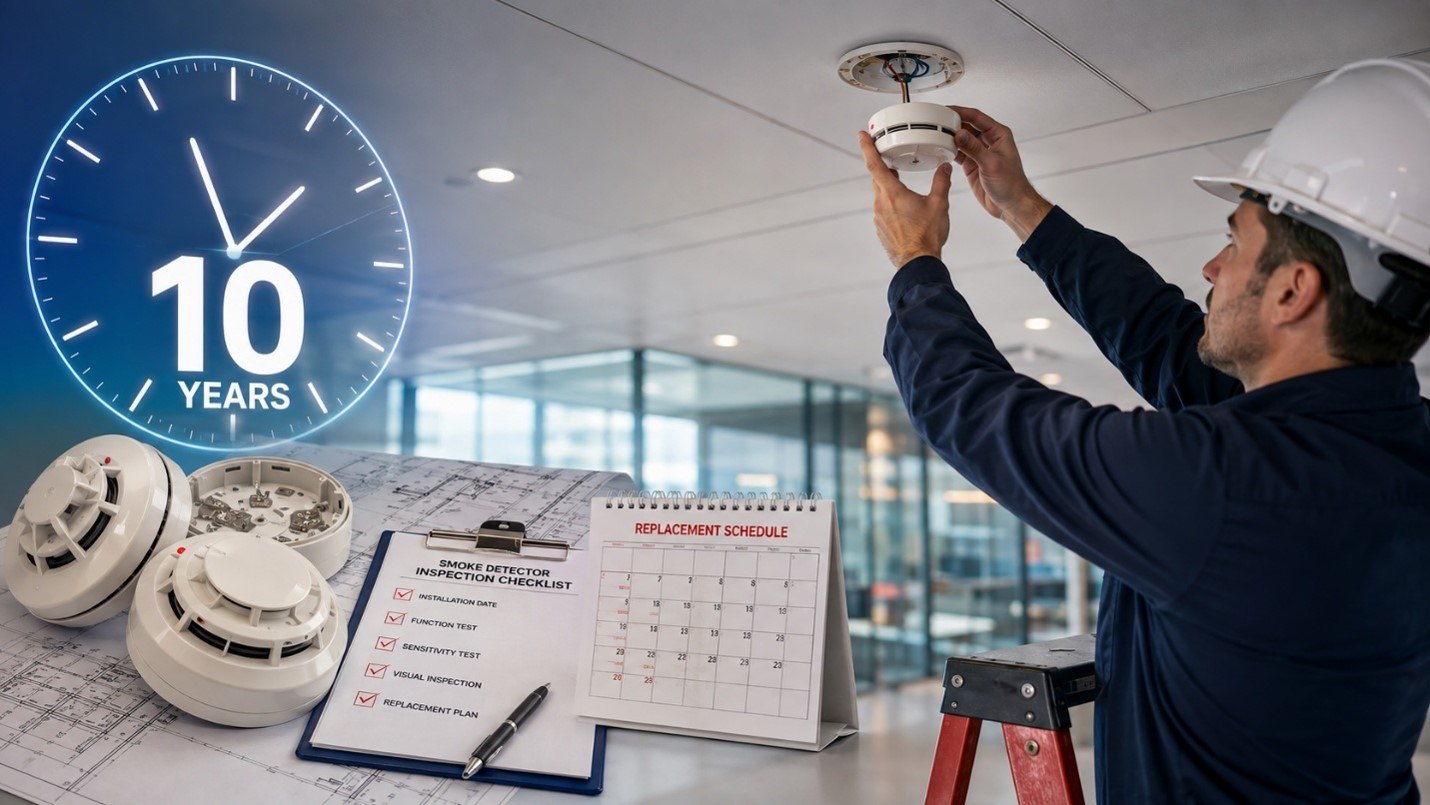
Ask three facility managers when their smoke detectors need replacing and you will get three answers: when they fail, when the inspector says so, and at ten years. Only the last one reflects how the industry actually treats detector lifespan and understanding the smoke detector replacement age rule properly is the difference between a planned capital line item and an unbudgeted emergency across an entire building.
The ten-year figure is real, but it is widely misunderstood. It is not a legal expiry date stamped on every device, and it is not the only trigger for replacement. This guide sets out where the number comes from, what actually forces a detector out of service, and how to plan a replacement programme that does not arrive all at once.
Where the Ten-Year Figure Comes From
Smoke detectors do not fail like light bulbs. What degrades is the sensing element’s ability to respond within its listed sensitivity range. In a photoelectric detector, the optical chamber accumulates contamination and the light source and receiver age. In an ionisation detector, the sensing element’s response characteristics shift over time.
Manufacturers publish a recommended service life for their detectors, and ten years has become the widely adopted benchmark across the commercial sector. Testing standards also require periodic sensitivity testing, and detectors that fall outside their listed range must be recalibrated, cleaned, or replaced – which in practice usually means replaced, because most commercial detectors are not field-recalibrated.
The result is a two-part rule that most buildings apply: replace at the manufacturer’s stated service life, and replace earlier if sensitivity testing says so.
The Four Triggers for Detector Replacement
| Trigger | What it means | Typical timing | Action |
| Service life reached | Manufacturer’s recommended in-service period expired | Around 10 years for most commercial detectors | Planned replacement programme |
| Sensitivity test failure | Device outside listed sensitivity range | Any time from year 5 onward | Immediate replacement of that device |
| Repeated drift or dirty troubles | Chamber degradation beyond cleaning | Usually late in service life | Replace rather than clean again |
| Standards or listing change | Device family no longer listed for new installation | Unpredictable, driven by standards revisions | Assess whole-family exposure |
That fourth trigger is the one that catches buildings out. A revision to detector testing requirements can retire an entire model line from production, which does not force removal of installed devices but does mean replacements must come from remaining stock or from a successor model.
Age Is Not the Only Signal
A detector that is eight years old and repeatedly reporting drift is a worse device than a ten-year-old detector passing every test. Addressable panels give you this information for free – most report sensitivity values and flag devices trending toward their limits before they fail outright.
Use that data. Pull the sensitivity report at each annual inspection, note which devices have moved, and rank replacement by trend rather than purely by install date. Our guide to detector drift compensation explains how panels compensate for gradual contamination and, importantly, at what point that compensation runs out.
Environment matters as much as age. Detectors in kitchens, loading bays, workshops, and any space with dust, humidity, or vehicle exhaust degrade faster than detectors in a carpeted office. Two identically aged devices in the same building can be years apart in effective condition.
Different Device Types, Different Lifespans
Not everything on the ceiling ages at the same rate, and treating the whole system as one replacement cycle overspends in some areas and underspends in others.
Photoelectric smoke detectors follow the standard service life pattern and are the largest population in most commercial buildings. Current-generation devices across the smoke detector range generally offer better nuisance immunity than the devices they replace, which is a secondary benefit worth counting when justifying the spend.
Heat detectors have no sensing chamber to contaminate and generally last longer, though mechanical types should still be tested and replaced per manufacturer guidance.
Duct smoke detectors sit in the harshest environment in the building – continuous airflow carrying dust straight through the sensing chamber. They frequently need replacement well before ceiling detectors of the same age. If your building has HVAC-mounted devices, review the duct detector range separately rather than folding them into the general programme.
Detector bases are often overlooked. They rarely fail, but corrosion, damaged terminals, and cracked housings are common in older installations, and replacing the base while the detector is already down costs almost nothing compared to a return visit. Check the detector bases range for sounder, relay, and isolator variants where the original design used them.
Planning a Replacement Programme
The worst version of this project is discovering that four hundred detectors all hit ten years in the same quarter, because they were all installed during the same fit-out. That is exactly what happens in most buildings, and it is why planning matters more than the rule itself.
Step one: inventory by install date. Pull the record of completion and any subsequent service records. If those do not exist, date codes on the devices themselves will tell you.
Step two: map the cliff. Plot how many devices reach service life in each of the next five years. Most buildings find one enormous spike rather than an even distribution.
Step three: phase deliberately. Split the spike across two or three budget years, working by loop or by floor. Prioritise areas with harsher environments and any device already showing drift.
Step four: confirm availability before you commit. Check that the successor device for your panel is current production and that the base you have will accept it. Discovering a compatibility problem mid-programme is expensive.
Step five: buy the phase, plus spares. Order slightly ahead of each phase so a failure during the programme does not stall it.
Working out which detectors are due and what replaces them? Send us your panel model and current detector part numbers and we will confirm the current equivalents, base compatibility, and real stock availability before you build the budget. Request a quote or call (833) 747-7845.
The Cost of Waiting
Deferring a detector programme feels like saving money and usually is not. Three costs accumulate quietly while you wait.
The first is emergency labour. Replacing forty detectors in one planned visit costs a fraction of replacing forty detectors one at a time across eighteen unscheduled call-outs. The second is parts risk: if the family you are running goes out of production during the delay, the replacement becomes a cross-reference exercise with base and firmware questions attached, rather than a like-for-like order. The third is inspection exposure, since a system with a growing list of devices failing sensitivity testing becomes progressively harder to defend at each annual visit.
None of these are dramatic on their own. Together they routinely turn a manageable capital line into a reactive maintenance drain.
What the Inspector Will Actually Ask
Authorities having jurisdiction rarely ask for a detector’s birth certificate. What they ask for is evidence that the system has been inspected and tested on schedule, that sensitivity testing has been performed at the required interval, and that devices failing those tests were addressed.
That means your documentation matters as much as your hardware. A building with ten-year-old detectors, current sensitivity test records, and a documented phased replacement plan is in a defensible position. A building with six-year-old detectors and no test records is not.
Conclusion
Ten years is a planning benchmark, not a legal deadline. The devices that actually need replacing are the ones failing sensitivity tests, trending toward their limits, sitting in harsh environments, or belonging to families no longer supported by available stock – and those categories rarely line up neatly with install dates.
Inventory what you have, use the sensitivity data your panel already produces, and phase the work before the cliff arrives rather than after. If you are also weighing whether the panel itself should be part of that plan, the fire alarm control panel buyer’s guide sets out where detector replacement and panel migration are better done together than separately.
Frequently Asked Questions
Is the ten-year smoke detector rule a legal requirement?
It is a manufacturer service life recommendation that the industry has adopted as a benchmark, not a universal statutory expiry date. What is enforceable is periodic inspection and sensitivity testing, and the requirement to address devices that fall outside their listed range.
How do I find out how old my commercial smoke detectors are?
Check the date code printed on the device body or label, cross-referenced against the system’s record of completion and service history. Where records are missing, the date codes on a sample of devices usually reveal the original fit-out period.
Can a smoke detector be cleaned instead of replaced?
Once, sometimes. Cleaning removes contamination from the sensing chamber and can restore a device reporting a dirty condition. A detector that returns to trouble after a proper clean has degraded rather than become dirty, and replacement is the correct answer.
Do duct smoke detectors need replacing more often than ceiling detectors?
Generally yes. They sit in continuous airflow carrying dust and particulates directly through the sensing chamber, so they degrade faster than a comparable device in still air. Assess them on their own schedule rather than folding them into the building-wide cycle.
What happens if I keep detectors in service past ten years?
Nothing automatic. The devices remain in service provided they pass sensitivity testing and the authority having jurisdiction is satisfied. The practical risk is that failure rates climb, replacement demand becomes unpredictable, and parts availability for older families may already be constrained.
Should I replace the detector base at the same time?
If the base is corroded, damaged, or the wrong type for the new detector, yes. Otherwise it is optional – but replacing a suspect base while the detector is already down is far cheaper than a second visit for a base fault six months later.
Does replacing detectors require reprogramming the panel?
Usually the device type needs confirming in programming even when the address is unchanged. Panels with auto-learn will pick this up during a re-learn; others need a manual change. Factor this into the phasing plan, since it requires qualified personnel.
How do I budget for a whole-building detector replacement?
Count devices by type, confirm current successor part numbers and unit pricing, add base replacement for a realistic proportion, then add labour and programming time. Splitting the total across two or three budget years is normally more achievable than a single capital request.