
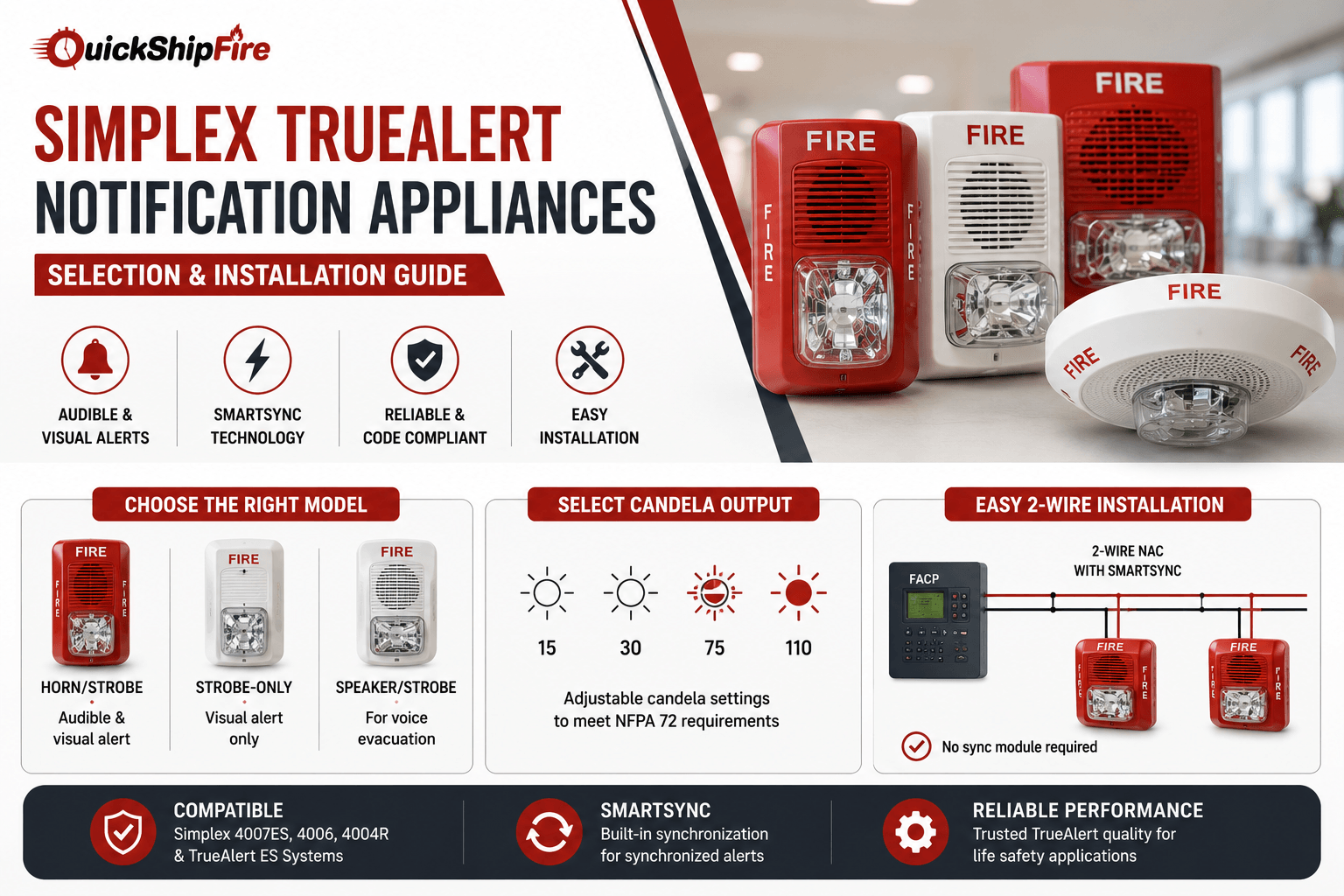
Simplex TrueAlert notification appliances are among the most widely installed horn, strobe, and speaker-strobe product lines in commercial fire alarm systems, found throughout hospitals, schools, universities, and office buildings running Simplex fire alarm control units. Selecting and installing the right Simplex TrueAlert notification appliance means matching candela output, synchronization protocol, and wiring configuration to the specific space and the panel driving it, details that are easy to get wrong on a retrofit or replacement project. This guide covers the Simplex TrueAlert notification product family, how to choose the right candela and mounting configuration, and the wiring and compatibility details that keep an installation code-compliant.
Why Simplex TrueAlert Notification Appliances Are So Widely Specified
Simplex TrueAlert notification appliances show up on so many commercial specifications for a practical reason: the two-wire SmartSync design genuinely simplifies both the initial installation and every future service call. A contractor wiring a floor of Simplex TrueAlert notification appliances does not need a separate synchronization module or a third conductor to keep every strobe in the building flashing together, which cuts both material cost and labor time compared to older synchronization schemes. That same simplicity carries through to maintenance, since a technician troubleshooting Simplex TrueAlert notification appliances years after installation is working with a well-documented, still-current product family rather than a discontinued legacy line.
For facility owners standardizing equipment across a portfolio of Simplex-equipped buildings, specifying Simplex TrueAlert notification appliances consistently also means service technicians only need to stock one family of replacement parts and one synchronization protocol, rather than reconciling several generations of notification hardware building to building.
What Is the Simplex TrueAlert Notification Appliance Family?
Simplex TrueAlert notification appliances are a family of horns, strobes, and horn/strobe combination devices designed to work on a supervised two-wire notification appliance circuit with independent control of audible and visual outputs on the same circuit. The line includes both non-addressable, conventional TrueAlert devices for standard NAC applications and TrueAlert ES, a fully addressable version that reports individually to the panel and supports field-programmable tone, volume, and candela settings without visiting the appliance in person.
Non-addressable Simplex TrueAlert notification appliances are compatible with a defined set of Simplex control units, including the 4007ES, 4006, and 4004R fire alarm control units, while multi-candela addressable variants require a TrueAlert Addressable Power Supply or a compatible IDNAC circuit on newer panel generations. Confirming which category applies to a given job, conventional TrueAlert or addressable TrueAlert ES, is the first decision point in any specification, since the two families are not interchangeable on the same circuit without the correct interface equipment.
- Conventional Simplex TrueAlert notification appliances operate on a standard two-wire NAC with independent horn and strobe control.
- TrueAlert ES is fully addressable, reporting individually to the panel and supporting remote configuration.
- Non-addressable TrueAlert devices are compatible with specific Simplex control units such as the 4007ES, 4006, and 4004R.
- Addressable multi-candela appliances require a TrueAlert Addressable Power Supply or compatible IDNAC circuit.
- Conventional and addressable TrueAlert product lines are not interchangeable without the correct interface hardware.
Choosing the Right Simplex TrueAlert Notification Model
Horn Strobes vs. Strobe-Only vs. Speaker Strobes
Simplex TrueAlert notification appliances come in horn/strobe, strobe-only, and speaker/strobe configurations. Horn/strobes are the standard choice for most commercial spaces needing both audible and visual notification. Strobe-only units are typically specified where a separate audio source, often a paging or voice system, already exists and only visual notification is needed at that location. Speaker/strobe combinations are the standard for buildings with voice evacuation, combining a UL-listed fire alarm speaker with a synchronized strobe in a single device, which reduces both device count and installation labor compared to mounting a separate horn and speaker.
Candela Selection
Multi-candela Simplex TrueAlert notification strobes typically offer field-selectable output, commonly 15, 30, 75, and 110 candela on standard units, with high-intensity variants offering 135, 177, and 185 candela for large open spaces. Candela selection is set via a jumper behind the strobe housing on conventional units, or programmed through the panel on addressable TrueAlert ES appliances, and the correct setting depends on room size, ceiling height, and ambient light levels per the coverage tables in NFPA 72. Specifying more candela than a space requires is not simply a safety margin; excessive strobe intensity in close viewing distances can be genuinely uncomfortable and is not what the code calls for.
Mounting Configuration
Simplex TrueAlert notification appliances are available in wall-mount and ceiling-mount configurations, and the housings are designed to fit standard single-gang, double-gang, or 4-inch square electrical boxes without requiring specialized backboxes in most applications. Weatherproof configurations are available for outdoor or exposed installations, and surface mount skirts are available for jobs where recessed boxes are not practical.
| Model Type | Candela Range | Typical Application |
| 4906 Multi-Candela Horn/Strobe | 15 / 30 / 75 / 110 cd | Standard commercial rooms and corridors |
| High-Intensity Strobe/Horn Strobe | 135 / 177 / 185 cd | Large open areas, warehouses, gymnasiums |
| Strobe-Only (V/O) | 15-110 cd, field selectable | Spaces with an existing separate audio source |
| Speaker/Strobe (S/V) | 15-110 cd, field selectable | Buildings with voice evacuation systems |
| TrueAlert ES Addressable | 15-185 cd, panel-programmable | Large addressable systems needing individual control |
Synchronization Requirements
NFPA 72 requires that any strobes visible from the same vantage point flash in synchronization, both to avoid disorienting occupants and to reduce the risk of triggering photosensitive seizures from unsynchronized flashing. Simplex TrueAlert notification appliances use the SmartSync protocol for two-wire synchronized operation, allowing horn and strobe outputs to be controlled independently on the same circuit without a separate synchronization module. When replacing an existing TrueAlert device or adding new appliances to an existing circuit, the replacement or added unit must support the same synchronization protocol as the rest of the notification appliance circuit; mixing SmartSync devices with a different manufacturer’s synchronization scheme on the same circuit, such as System Sensor notification appliances, will typically prevent proper synchronization even if both device types are otherwise electrically compatible.
- Any strobes visible from the same vantage point must flash in synchronization under NFPA 72.
- TrueAlert appliances use the Simplex SmartSync protocol for two-wire synchronized horn and strobe control.
- Replacement or added appliances must match the existing circuit’s synchronization protocol, not just its voltage and current.
- Mixing manufacturers’ synchronization protocols on the same circuit typically breaks synchronized operation.
- Horn silencing while the strobe continues flashing is supported on SmartSync-compatible circuits without additional wiring.
Wiring and Circuit Design Considerations
Simplex TrueAlert notification appliances are wired on supervised notification appliance circuits, and standard NAC design rules apply: total current draw at the lowest rated operating voltage has to be calculated for every device on the circuit, and a proper voltage drop calculation confirms the last appliance on the circuit still receives enough voltage to operate at its rated output. Speaker strobes add an additional layer of complexity, since audio frequency current on the circuit requires attention to speaker circuit impedance in addition to standard DC current calculations, and impedance should always be calculated per the specific Simplex panel’s guidelines rather than assumed from a general NAC calculation.
On addressable installations, TrueAlert ES appliances communicate over a signaling line circuit rather than a conventional NAC, with each appliance assigned a unique address via an onboard DIP switch or through panel-based programming, and up to 63 unique addresses supported per addressable circuit, though actual appliance loading is often limited by total current draw well before the address count becomes the binding constraint.
- Calculate total NAC current draw at the lowest rated appliance operating voltage, not the panel’s nominal voltage.
- Speaker strobes require a separate impedance calculation for the audio circuit in addition to standard DC current.
- TrueAlert ES addressable appliances support up to 63 unique addresses per signaling line circuit.
- Actual appliance loading per circuit is usually limited by total current draw rather than the address count.
- Confirm the fire alarm control panel generation supports the specific TrueAlert or TrueAlert ES model being specified.
Replacing an Existing Simplex TrueAlert Notification Appliance
When replacing a failed or damaged Simplex TrueAlert notification device rather than specifying a new installation, several details must match the original unit to remain code-compliant. Color, typically red or white, must match the rest of the installation for both ADA and code compliance. Device type, horn/strobe, strobe-only, or speaker/strobe, needs to match the original unless the entire circuit design is being reworked. Candela setting should match or exceed the originally installed setting rather than being reduced, and mounting configuration, wall or ceiling, needs to match the existing electrical box unless a new box is being installed as part of the repair.
- Match appliance color (red or white) to the rest of the installation for ADA and code compliance.
- Match device type, horn/strobe, strobe-only, or speaker/strobe, unless the circuit design is being reworked entirely.
- Match or exceed the originally installed candela setting rather than reducing coverage.
- Confirm the replacement supports the same synchronization protocol as the rest of the circuit.
- Verify the electrical box type matches wall-mount or ceiling-mount requirements for the specific replacement model.
Where an installation is expanding to include a formal mass notification system alongside standard fire notification, speaker/strobe Simplex TrueAlert notification devices are frequently the right foundation, since the same physical appliance can carry both fire evacuation tones and broader emergency communication messaging without doubling the device count throughout the building. Confirming the addressable fire alarm system platform and its associated power supplies can support the added audio load before finalizing a mass notification retrofit avoids a mid-project surprise.
Whether you are specifying Simplex TrueAlert notification appliances for new construction or sourcing an exact-match replacement for an aging Simplex system, QuickShipFire stocks Simplex-compatible notification appliances, power supplies, and modules alongside products from Notifier, Fire-Lite, and System Sensor. Request a quote and our team will help you confirm compatibility and get the right parts shipped fast.
Conclusion
Selecting and installing Simplex TrueAlert notification appliances correctly comes down to a handful of decisions that compound if any one of them is wrong: conventional versus addressable, the right candela for the space, matching synchronization protocol across the circuit, and a voltage drop calculation that confirms the last device on the run still performs to its rated output. Getting these details right the first time, whether for new construction or a like-for-like replacement, keeps notification reliable, code-compliant, and consistent across the entire building.
Frequently Asked Questions
What is the difference between TrueAlert and TrueAlert ES?
Conventional TrueAlert appliances are non-addressable devices wired on a standard NAC, while TrueAlert ES is fully addressable, reporting individually to the panel and supporting remote programming of tone, volume, and candela without a technician visiting each device.
What candela settings are available on Simplex TrueAlert notification strobes?
Standard multi-candela TrueAlert strobes typically offer 15, 30, 75, and 110 candela, while high-intensity variants offer 135, 177, and 185 candela for larger open spaces. The correct setting depends on room size, ceiling height, and ambient light per NFPA 72 coverage requirements.
Which Simplex panels are compatible with Simplex TrueAlert notification appliances?
Non-addressable TrueAlert appliances are compatible with specific Simplex control units, including the 4007ES, 4006, and 4004R. Addressable TrueAlert ES appliances require a compatible IDNAC circuit or TrueAlert Addressable Power Supply on supporting panel generations.
Can I mix TrueAlert appliances with another manufacturer’s strobes on the same circuit?
This is not recommended without careful verification. TrueAlert uses the Simplex SmartSync synchronization protocol, and mixing it with a different manufacturer’s synchronization scheme on the same circuit typically prevents proper synchronized flashing, even if both devices are otherwise electrically compatible.
Why do strobes need to be synchronized?
NFPA 72 requires strobes visible from the same vantage point to flash in synchronization to avoid disorienting occupants and to reduce the risk of triggering photosensitive seizures from unsynchronized flashing.
What should I match when replacing a single Simplex TrueAlert notification appliance?
Match the color, device type, candela setting (or exceed it), synchronization protocol, and mounting configuration of the original device to remain code-compliant and consistent with the rest of the installed circuit.
Do speaker strobes require different wiring than horn strobes?
Yes. Speaker strobes carry audio frequency current in addition to standard DC current, which requires a separate circuit impedance calculation per the specific Simplex panel’s guidelines, beyond the standard NAC voltage drop calculation used for horn strobes.