
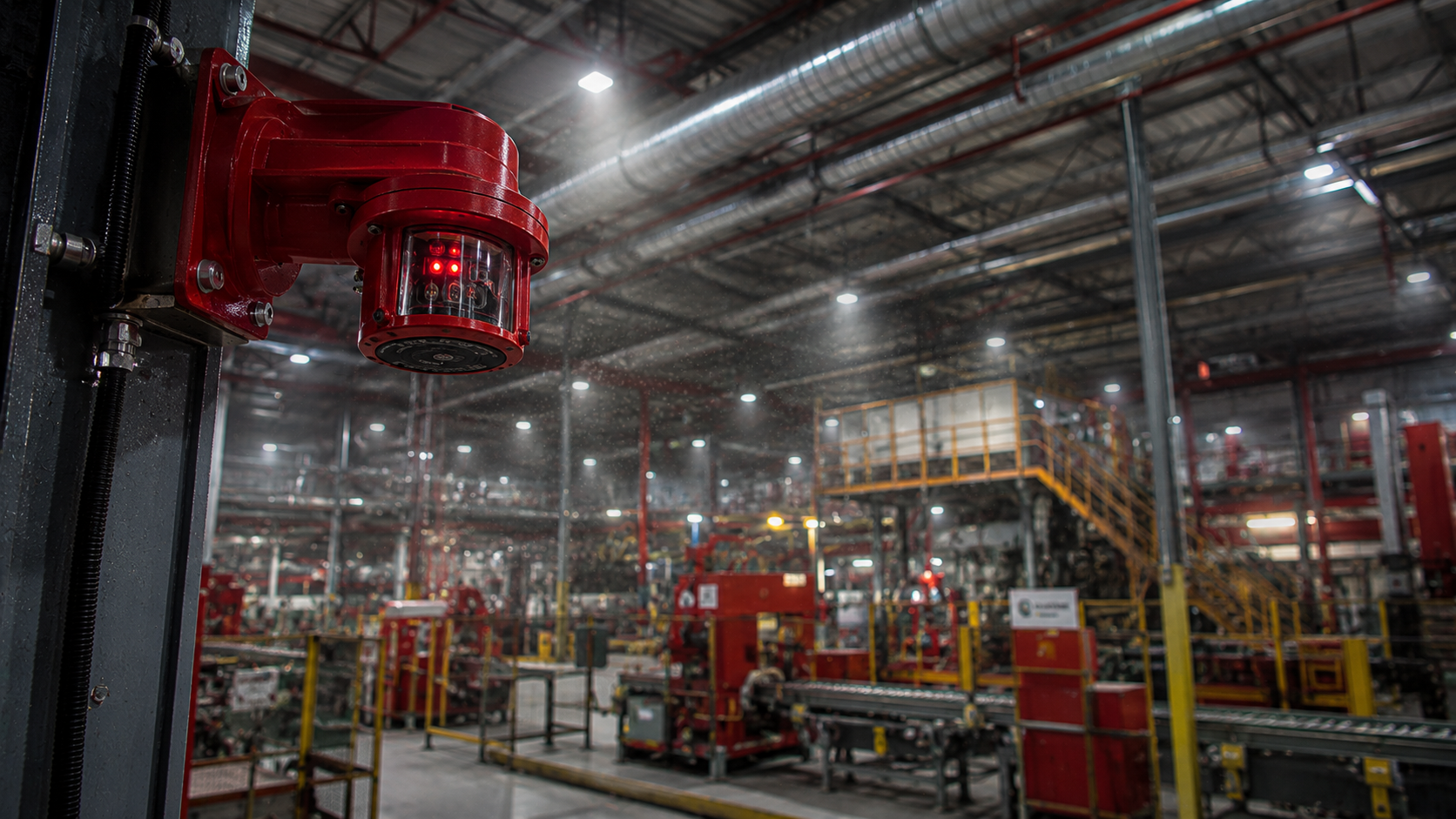
A manufacturing floor is nothing like an office building, and treating it like one during system design is how facilities end up with nuisance alarms, non-compliant equipment, and detection technology that fails exactly when it matters most. Fine airborne dust, flammable solvents, high ceilings, and continuous multi-shift operations all combine to create a risk profile that standard commercial detection was never built to handle. This guide walks through how fire protection actually needs to be engineered for a manufacturing environment: how to classify hazardous areas correctly, which detection technologies hold up in demanding industrial atmospheres, and how to build a layered strategy that keeps a facility both safe and compliant.
Why Manufacturing Facilities Need a Different Fire Protection Approach
A typical office design assumes clean air, moderate ceiling heights, and predictable occupancy. None of those assumptions hold on a production floor.
- Airborne particulate – Wood, metal, grain, plastic, and other process dusts can accumulate on equipment and in ductwork, creating both a nuisance-alarm problem and a genuine explosion risk if concentrations reach an ignitable level.
- Flammable liquids and vapors – Solvents, fuels, and process chemicals used in coating, cleaning, or finishing operations introduce vapor-ignition risks that a standard smoke detector was never designed to address.
- High-bay ceilings – Warehousing and heavy manufacturing spaces frequently exceed 30 to 40 feet, well beyond the effective range of a conventional spot-type smoke detector.
- Continuous operations – Multi-shift production runs mean detection and suppression equipment rarely gets a convenient maintenance window, so reliability and low nuisance-alarm rates matter more than in a nine-to-five office.
- High-value equipment concentration – A single fire event on a production line can halt output across an entire facility, making early warning and rapid, targeted response a financial priority as much as a life-safety one.
Each of these factors pushes fire protection requirements well beyond what a standard commercial code minimum assumes, which is exactly why a manufacturing floor needs its own design logic rather than a scaled-up office specification.
Building genuine fire protection into a facility like this starts long before the first detector is mounted; it starts with correctly classifying every hazardous space on the floor plan.
Understanding Hazardous Location Classification for Manufacturing
Before any detection equipment gets specified, every area of a manufacturing facility that handles flammable gases, dust, or ignitable fibers needs a formal hazardous location classification. This determines exactly what type of fire protection and electrical equipment, including detection devices, is legally permitted in that space.
Class, Division, and Group: The Core Framework
The National Electrical Code, referenced as NFPA 70, organizes classified areas using a Class and Division system.
- Class I covers locations where flammable gases or vapors may be present in ignitable concentrations, such as paint spray booths, solvent storage rooms, or areas near fuel dispensing.
- Class II covers locations where combustible dust is present, including grain handling, metal powder processing, and woodworking operations where fine particulate accumulates.
- Class III covers locations with ignitable fibers or flyings that are not normally suspended in the air in explosive concentrations, common in textile and some wood processing facilities.
- Division 1 indicates the hazardous condition exists under normal operating conditions or frequently due to routine maintenance, repair, or leakage.
- Division 2 indicates the material is confined within closed systems or containers and would only become airborne under an abnormal condition, such as equipment failure.
A qualified fire protection engineer typically performs this classification study using NFPA 499 for dust hazards or NFPA 497 for flammable chemicals, and the resulting document governs every future equipment purchase for that space going forward. Any device installed in a Division 1 or Division 2 area, including detectors and modules, must carry explosion-proof equipment listing for that specific classification; general-purpose hardware is not a legal substitute regardless of price or convenience.
Detection Technology Choices for Demanding Industrial Environments
Once an area’s classification is documented, the detection technology has to match both the hazard and the environmental conditions, not just the building code minimum.
Why Heat-Sensing Devices Often Outperform Smoke Sensors in Process Areas
In areas where normal operations already generate airborne particulate, diesel exhaust, or steam, a standard smoke sensor will nuisance-alarm constantly. A heat detector that responds to a fixed temperature threshold or a rapid rate-of-rise is frequently the more reliable choice for these specific zones, even though smoke detection remains the primary technology across the rest of the facility.
- Fixed-temperature devices activate once ambient temperature crosses a set threshold, making them immune to dust and smoke-like nuisance sources entirely.
- Rate-of-rise devices respond to a rapid temperature increase, typically 15 degrees per minute, catching a fast-developing fire without waiting for the fixed threshold to be reached.
- Multi-sensor detectors combine photoelectric smoke sensing with a heat element, letting the onboard logic cross-reference both readings before triggering an alarm.
- Beam and air-sampling detection cover the high-bay spaces where point detectors are impractical, using either a projected light beam or an active sampling network.
- Explosion-proof and dust-ignition-proof housings are required wherever the device itself sits inside a classified Division 1 or Division 2 area.
For high-ceiling production bays and critical process areas, aspirating smoke detection offers the earliest possible warning by actively drawing air samples through a network of pipes to a highly sensitive central chamber, catching a developing fire long before it produces enough smoke to trigger a conventional spot detector mounted 40 feet overhead. This early-warning approach also gives maintenance staff time to investigate a developing condition before it escalates into a full production-halting event. Matching detection technology this precisely to the actual hazard is central to any modern fire protection program, not an optional refinement reserved for the largest budgets.
Detection Technology Comparison for Manufacturing Environments
| Technology | Best Suited For | Dust/Hazard Tolerance |
| Fixed-temperature device | Boiler rooms, loading docks, dusty process zones | High |
| Rate-of-rise device | Areas needing fast response without smoke interference | High |
| Photoelectric smoke detector | Clean production areas, offices within the facility | Moderate |
| Multi-sensor (smoke + heat) | Mixed-use zones with occasional dust or steam | Moderate to high |
| Air-sampling (aspirating) detection | High-bay production, critical process lines | High, with proper pipe network design |
| Beam smoke detector | Open, high-ceiling manufacturing bays | Moderate |
HVAC and Duct Detection in Manufacturing Facilities
Air handling in a manufacturing facility does more than control temperature; it also moves particulate and process fumes through the building at high volume. A properly specified duct smoke detector shuts down air handling equipment automatically the moment smoke enters the airstream, preventing a localized event from spreading through shared ductwork into unaffected areas of the plant. This single control sequence is one of the most cost-effective fire protection measures available in a facility with shared air handling. In facilities generating heavy dust, sensitivity settings and cleaning intervals for these devices typically need to be more aggressive than a standard commercial installation, since particulate buildup on the sensing chamber accelerates baseline drift far faster than in a clean office environment.
Building a Compliant, Layered Fire Protection Strategy
Protecting a manufacturing facility correctly means layering detection, notification, and equipment shutdown together rather than treating any single device as a complete solution.
- Commission a formal classification study before specifying any detection equipment, and keep that documentation updated whenever a process or material changes.
- Match detector technology to the specific hazard in each zone, using heat-sensing or multi-sensor devices in dusty or steam-prone areas rather than defaulting to photoelectric smoke detection everywhere.
- Confirm every device, base, and wiring method installed inside a classified area carries the correct listing for that specific Class, Division, and Group.
- Wire critical process shutdowns, HVAC dampers, and suppression release through supervised control modules tied into the addressable fire alarm system rather than standalone relays outside the panel’s supervision.
- Increase cleaning and sensitivity-testing frequency in dusty zones well beyond the NFPA 72 minimum, since baseline drift accelerates significantly faster in a production environment than in a typical office building.
Sourcing correctly listed detection and interface hardware for a demanding industrial environment is not always straightforward, particularly for older installations or discontinued panel platforms. QuickShipFire stocks brand-new detectors, modules, and control panel components from System Sensor, Fenwal, Notifier, Fire-Lite, and other major manufacturers, and our team can help confirm the correct device listing for your facility’s specific hazard classification. Request a quote and we will help you source compliant fire protection equipment without slowing down your project.
Conclusion
A manufacturing facility carries a fundamentally different risk profile than a typical commercial building, and the fire protection strategy has to reflect that difference at every layer, from the initial hazard classification study through detector selection, HVAC integration, and long-term maintenance scheduling. Fine airborne dust, flammable process chemicals, high-bay ceilings, and continuous operations all push standard commercial detection technology past its practical limits. Getting the classification right first, then matching detection technology to each zone’s actual hazard rather than defaulting to a one-size-fits-all approach, is what separates a manufacturing fire protection program that performs reliably for decades from one that generates constant nuisance alarms or, worse, fails to respond when a real event occurs. A properly layered, correctly classified system protects people, equipment, and production continuity all at once, and it remains one of the highest-value investments a facility can make in its own uptime.
Frequently Asked Questions
What makes fire protection for a manufacturing facility different from a standard commercial building?
Manufacturing environments introduce fine airborne dust, flammable process chemicals, high-bay ceilings, and continuous multi-shift operations that standard commercial detection technology was not designed to handle. Formal hazard classification, specialized detection technology, and more aggressive maintenance schedules are typically required beyond what a standard office or retail building needs.
What does classifying a hazardous manufacturing area actually involve, and who performs it?
This is a formal engineering study that determines whether an area contains flammable gases, combustible dust, or ignitable fibers in concentrations sufficient to require specially listed electrical equipment under NFPA 70 compliance requirements. A qualified fire protection engineer typically performs the study using NFPA 499 for dust hazards or NFPA 497 for flammable chemicals, and the resulting classification becomes a permanent document guiding future equipment purchases.
Why do heat detectors work better than smoke detectors in some manufacturing areas?
In zones where normal operations generate dust, steam, or diesel exhaust, a smoke detector will frequently produce nuisance alarms because it cannot distinguish process particulate from actual combustion smoke. A device that responds only to an actual temperature increase is immune to those everyday nuisance sources while still providing reliable fire protection for that specific zone.
What is aspirating smoke detection and when is it used in manufacturing?
This technology actively draws air samples through a network of small-bore pipes to a highly sensitive central detection chamber, providing much earlier warning than a conventional spot detector. It is commonly specified for high-bay production areas, critical process lines, and spaces where the ceiling height makes conventional detector maintenance difficult or expensive.
Do fire alarm devices installed in hazardous areas need special certification?
Yes. Any detector, module, or wiring method installed inside a classified Division 1 or Division 2 area must carry explosion-proof or dust-ignition-proof listing specific to that area’s Class, Division, and Group designation. General-purpose commercial fire alarm equipment is not a legal substitute in a properly classified hazardous area.
How often should detectors be cleaned and tested in a dusty manufacturing environment?
Detectors in dusty zones accumulate baseline drift far faster than those in clean office environments, so cleaning and sensitivity-testing intervals typically need to be shorter than the NFPA 72 minimum schedule. Facility managers should track drift trends over time and adjust maintenance frequency for each specific zone rather than applying one blanket schedule facility-wide.
Can HVAC systems spread a fire between different areas of a manufacturing plant?
Yes. Shared ductwork can move smoke and combustion byproducts between otherwise separated areas of a facility unless duct smoke detectors are properly installed to shut down air handling equipment automatically. This is especially important in manufacturing facilities where ductwork also routinely carries process dust and fumes at high volume.