
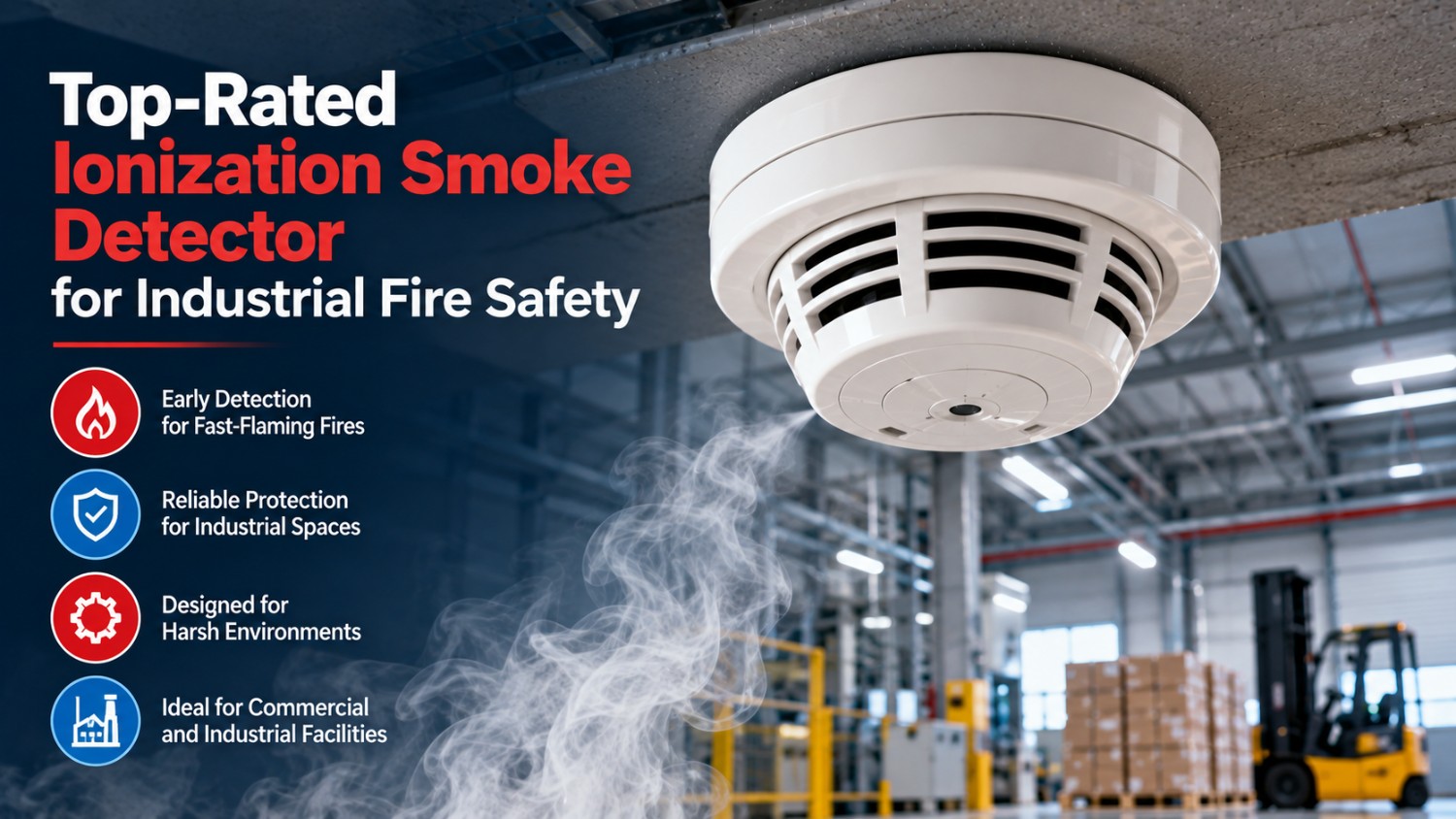
An ionization smoke detector senses the tiny combustion particles produced by fast-flaming fires, which makes it a common choice for commercial and industrial buildings where fire can spread quickly. This guide explains how the technology works, where it performs well, where it does not, and what to check when you select, place or replace a detector, so you can decide with realistic expectations.
How Ionization Detection Works
Inside the device, a small radioactive source ionizes the air between two electrically charged plates, creating a steady, measurable current. When combustion particles enter the chamber, they attach to the ions and reduce that current. The detector interprets the change as a possible fire and signals the control panel. A general overview of the smoke detector principle is available for readers who want the wider background.
Many designs compare a sensing chamber with a reference chamber so that gradual changes in humidity or air pressure are less likely to be mistaken for smoke, and electronics in the head convert the change in current into a signal the panel can act on. Because the chamber responds to very small particles, this design tends to react quickly to flaming combustion, where fuel burns rapidly and produces little visible smoke at first.
Ionization Fire Alarm Detector Types and Signalling
An ionization fire alarm detector is only one part of a larger system. Depending on the installation, detectors may be conventional, where a panel monitors a zone of devices, or addressable, where each device reports individually on a signalling line circuit. The sensing principle is the same, but the electronics, bases and wiring differ. When you compare any ionization fire alarm detector with another, look at the system it will connect to first, then at the sensing technology. An ionization fire alarm detector that suits one panel may be unsuitable for another, even when the two look alike.
Ionization Smoke Detector for Fast-Flaming Fires
Fast-flaming fires involve materials such as paper, flammable liquids or plastics that ignite and grow quickly. An ionization smoke detector for fast-flaming fires is valuable in areas where that scenario is realistic, such as storage rooms, utility spaces, electrical rooms and production areas. The same design is generally less responsive to slow, smoldering fires, which produce larger particles. That difference is why detector selection should follow the fire risks in each space, not a single preference. Wherever a rapid flame-driven fire would threaten people, stock or critical equipment, an ionization-based detector suited to fast-flaming fires deserves serious consideration alongside other options.
Ionization vs Photoelectric Smoke Detector
The choice between technologies is one of the most common decisions buyers face. Our comparison of ionization vs photoelectric smoke detector options covers commercial use in more detail. In summary:
| Factor | Ionization | Photoelectric |
| Sensing method | Detects small particles through changes in ionization current | Detects light scattered by smoke particles |
| Typical strength | Fast-flaming fires | Smoldering fires |
| Nuisance alarm exposure | Can be sensitive to cooking fumes and air disturbance | Can be sensitive to dust and steam in some environments |
| Best suited for | Areas where flaming fires are the main concern | Areas where smoldering fires are more likely |
Many facilities use a mix of technologies, or multi-criteria devices, so each area is protected according to its own hazards. The right balance depends on the materials stored, the way the building is used and the response required by the local authority. Document the reasoning behind each choice so future maintenance staff understand why a particular detector type was installed in a given room. This record also helps when a room changes use and the original assumptions no longer apply.
Commercial Ionization Smoke Detector Applications
A commercial ionization smoke detector is typically installed in offices, equipment rooms, corridors, storage areas and back-of-house spaces connected to a central fire alarm panel. The detector does not act alone. It reports to the panel, which activates notification devices and communicates the event according to how the system is configured. When evaluating a commercial unit of this type, confirm that its electrical and communication characteristics match your existing panel, because compatibility is determined by the system manufacturer.
Industrial Ionization Smoke Detector Considerations
An industrial ionization smoke detector must cope with harsher conditions than a typical office device. Air movement, dust, vapours, humidity and temperature swings all affect detector behaviour. Our guide to smoke detectors for warehouses and industrial facilities explains how environment influences selection.
Factors to Check Before Choosing a Detector
- Fire risk: identify whether flaming or smoldering fires are more probable in the space.
- Environmental conditions: consider dust, steam, fumes, ventilation and temperature.
- Ceiling height and layout: obstructions and airflow patterns affect where smoke will travel.
- Panel compatibility: verify detector type and base against the panel manufacturer’s documentation.
- Local requirements: confirm codes and the preferences of the authority having jurisdiction.
- Maintenance access: detectors that are hard to reach are often tested and cleaned less consistently.
Ceiling Mounted Ionization Smoke Detector Placement
A ceiling mounted ionization smoke detector normally sits on a mounting base that connects it to the alarm loop. Placement matters as much as the device itself. Detectors are generally kept away from supply air vents, dead air corners and heat sources, and spacing is defined by codes and manufacturer instructions rather than by rule of thumb. If you are pairing devices with compatible detector bases, check the base type against the detector model before ordering.
CPD-7051 Ionization Smoke Detector Overview
The CPD-7051 ionization smoke detector is listed by QuickShipFire under the Fenwal category. According to the product listing, it uses ionization sensing technology, is panel-powered, has LED status indicators and is ceiling mounted with a standard base. The listing describes applications in commercial buildings, industrial facilities and general-purpose areas. As with any part, confirm panel compatibility and base requirements before purchase. The CPD-7051 ionization smoke detector is one example of how legacy or hard-to-find detectors remain relevant for system upkeep.
Ionization Smoke Detector Replacement
Planning an ionization smoke detector replacement starts with identifying what is installed. Matching the model, base and panel is safer than substituting a similar-looking device. For Fenwal systems, the Fenwal product range is a practical starting point.
Replacement Checklist
- Record the existing model and base: photograph labels before removal.
- Confirm compatibility: check panel documentation or ask a qualified technician.
- De-energise or bypass the zone: follow site procedures and notify occupants and monitoring providers.
- Test after installation: functionally test the new device and confirm the panel reports correctly.
- Handle old units properly: ionization detectors contain a small radioactive source, so follow manufacturer and local disposal guidance.
Replacement work on life-safety systems is best carried out by qualified personnel.
Maintenance and Testing of Ionization Detectors
Detectors need periodic inspection, testing and cleaning as described in the manufacturer’s instructions and in standards such as NFPA 72, together with any local rules. Dust build-up, insects and corrosion can change detector behaviour, particularly in workshops and plant rooms. Detectors in industrial settings will usually need more frequent attention than those in a clean office, and units mounted high in a bay should be planned with safe access in mind. Keeping a simple log of device locations, models and test dates makes audits and replacements much easier. Recording who performed each test, and what was found, gives managers evidence of due diligence.
Common Mistakes When Specifying Ionization Detectors
The most frequent mistake is choosing one technology for a whole building. Another is ignoring the environment: placing a detector beside a kitchen pass, dock door or supply diffuser invites nuisance alarms. Some buyers assume that any base will fit any head, or that a similar model number guarantees panel compatibility. Others forget that an ionization detector still needs testing and documentation after installation. Finally, comparing ionization vs photoelectric smoke detector features without reviewing the actual hazard leads to decisions based on habit instead of risk.
Advantages and Disadvantages of Ionization Detection
Advantages
- Fast response to fast-flaming fires with small particles.
- Well established technology with wide use in commercial systems.
- Suitable for spaces where flaming fire is the primary hazard.
- Often practical for maintaining legacy systems designed around this device type.
Disadvantages
- Less responsive to smoldering fires than photoelectric technology.
- Can be prone to nuisance alarms in areas with cooking fumes or airflow disturbance.
- Contains a small radioactive source, which affects disposal.
- Not the best single solution for every occupancy or hazard.
Frequently Asked Questions
What is an ionization detector?
An ionization detector is a fire detection device that uses a small radioactive source to create a current between two plates. Smoke particles entering the chamber reduce that current, triggering an alarm signal. It is especially responsive to small particles from fast-flaming fires.
Is an ionization detector good for industrial use?
It can be suitable where fast-flaming fires are a realistic hazard and environmental conditions are suitable. Dust, steam, fumes and airflow can affect performance, so industrial buildings should assess each area individually and confirm code requirements before selecting detector technology.
What is the difference between ionization and photoelectric smoke detectors?
Ionization detectors sense small combustion particles through changes in electrical current and respond quickly to flaming fires. Photoelectric detectors sense light scattered by smoke and generally respond better to smoldering fires. Many facilities combine both technologies to cover different hazards.
Does an ionization detector detect smoldering fires?
It can, but it is generally less responsive to smoldering fires than photoelectric technology because smoldering combustion produces larger particles. If smoldering is a likely scenario, use photoelectric or multi-criteria detectors, or a combination suited to the area.
How do I choose an ionization smoke detector replacement?
Match the existing model, base and panel compatibility first. Check manufacturer documentation, confirm local code requirements and test the device after installation. When unsure, ask a qualified fire alarm technician to verify compatibility before you order.
Can the CPD-7051 be mounted on a ceiling?
Yes. The product listing states that the CPD-7051 is ceiling mounted with a standard base. Confirm that the base matches your system and that placement follows manufacturer instructions and local code requirements before installation.
Conclusion
Choosing an ionization smoke detector comes down to matching technology to hazard. It responds quickly to fast-flaming fires but is not ideal for every area, so review fire risks, environmental conditions, panel compatibility and local requirements together. Treat replacement as a documented, tested process rather than a like-for-like guess. A well-chosen detector, supported by correct bases, regular testing and clear records, gives a facility dependable early warning for the hazards it was chosen to address. Where the risk profile is mixed, pair it with other detection technologies rather than relying on it alone.
If you are maintaining an existing system or sourcing a hard-to-find part, note your current model numbers, base type and panel before you order. You can then browse the QuickShipFire ionization detector range or contact the team for help identifying compatible parts.