
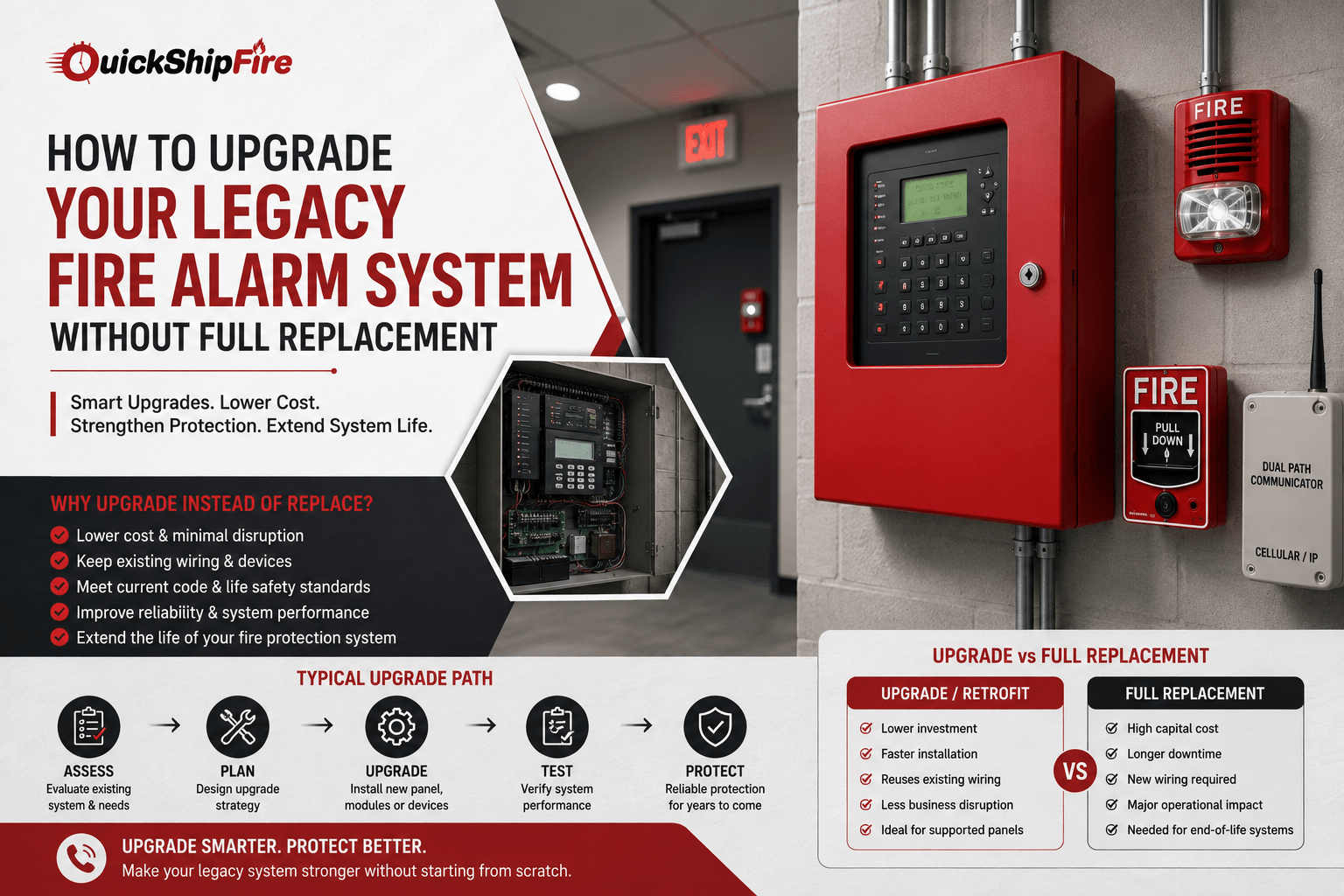
Not every aging fire alarm system needs to be torn out and replaced. A panel that is still supported by its manufacturer, still passes its annual NFPA 72 inspection, and still has replacement parts available is frequently a better upgrade candidate than a full rip-and-replace project, both financially and operationally. This guide walks through how to evaluate whether your fire alarm system is a good upgrade candidate, what a targeted upgrade typically involves, and where the line sits between an upgrade that extends a system’s useful life and a system that has genuinely reached the end of the road.
Upgrade vs. Replace: How to Decide
Every fire alarm system eventually faces this decision point, usually triggered by a failed component, a new code requirement, or simply the accumulated age of the installed fire alarm system equipment. Making that call correctly the first time saves real money, since committing to the wrong path, either over-investing in a system nearing genuine end-of-life or under-investing by patching a system that needs deeper intervention, tends to cost more in the long run than getting the initial assessment right.
The decision to upgrade rather than replace a fire alarm system comes down to a handful of concrete factors rather than age alone. A system that is 15 or even 20 years old can still be an excellent upgrade candidate if the manufacturer continues to support the platform and parts remain available; conversely, a much newer system built on a discontinued or orphaned product line may need full replacement sooner than its age would suggest. The real question is not how old the system is, but how much useful life remains in its core architecture.
Historically, fire alarm systems built before heavy reliance on integrated circuits and proprietary technology could last three or four decades in service. As panels became more capable and more software-driven, useful life spans compressed, and many systems now become functionally obsolete in 10 to 20 years as manufacturers retire product lines in favor of newer platforms. That trend makes the upgrade-versus-replace evaluation a recurring exercise rather than a one-time decision.
- The control panel is still supported by the manufacturer, with firmware updates or parts still available.
- Replacement detectors, modules, and notification devices for the installed product line are still in production or available through specialty suppliers.
- The system passed its most recent NFPA 72 inspection without major panel-level deficiencies.
- There is no major renovation planned that would already require re-routing conduit and rewiring regardless of panel condition.
- The building’s occupancy and code requirements have not changed enough to require capabilities the existing panel cannot support.
What a Fire Alarm System Upgrade Typically Involves
Retrofit Kits and Backward-Compatible Platforms
Several major manufacturers offer retrofit kits that let a facility upgrade to a current, code-compliant control platform while reusing the existing cabinet, backbox, and field wiring. These kits typically include a new backplate, updated electronics, and a new inner and outer door that mount directly into the old cabinet’s footprint, eliminating the cost of patching walls or replacing an entire enclosure. Because the retrofit reuses existing notification appliances and compatible detectors wherever possible, the labor and disruption involved is a fraction of what a full fire alarm system replacement requires.
Component-Level Replacement
For fire alarm systems that do not have a dedicated retrofit kit available, a more targeted approach replaces individual failed or aging components while keeping the panel and overall architecture intact. This might mean swapping a failing power supply, replacing a bank of aging conventional detectors with addressable smoke detectors compatible with the existing signaling line circuit, or sourcing a replacement main board for a fire alarm system that is otherwise performing well. This approach depends entirely on parts availability, which is why working with a supplier who stocks both current and legacy components matters more on an upgrade project than on new construction.
Monitoring and Communicator Upgrades
One of the most common and cost-effective upgrades on an older system is replacing an outdated communicator with a modern dual-path unit, since many legacy systems still rely on POTS copper telephone lines that are being retired across much of the country. Upgrading fire alarm monitoring communication hardware can often be done without touching the panel’s core electronics or field wiring at all, making it one of the lowest-disruption upgrades available on an aging fire alarm system.
- Manufacturer retrofit kits reuse the existing cabinet and backbox, avoiding wall patching and enclosure replacement.
- Component-level replacement targets specific failed or aging parts rather than the entire system.
- Communicator upgrades modernize fire alarm monitoring without touching the panel’s core electronics.
- Reused field wiring and compatible legacy devices significantly reduce labor cost compared to full replacement.
- A phased upgrade approach lets a facility spread cost across multiple budget cycles rather than one large capital expense.
Retrofit vs. Full Replacement: Quick Comparison
| Factor | Targeted Upgrade / Retrofit | Full Replacement |
| Typical cost | Fraction of full replacement cost | Significant capital expense |
| Disruption | Minimal; often completed room by room | Extensive; may require building closure or phasing |
| Existing wiring | Reused wherever code-compliant | Often re-routed or replaced entirely |
| Best for | Supported panels with available parts | End-of-life panels with no parts support |
| Compliance outcome | Brings system closer to current code | Full alignment with current code and UL editions |
Common Compatibility Issues When Upgrading
Not every component from an old fire alarm system carries forward cleanly into an upgrade. UL 864 has gone through multiple editions, and manufacturers have periodically made changes that break compatibility between older and newer product generations, even within the same brand. Before finalizing an upgrade scope, confirm that any reused fire alarm modules, detectors, and notification devices are listed as compatible with the new or updated control equipment, since mixing incompatible generations can create nuisance troubles or, in the worst case, prevent proper alarm reporting.
Notification appliances are a particularly common sticking point. Strobes from a different manufacturer than the one supplying the new panel or expansion devices may not synchronize correctly, and any two strobes visible from the same vantage point are required to flash in synchronization under NFPA 72, which has driven the replacement of many mismatched notification devices during otherwise minor upgrades. Incandescent strobes, in particular, are no longer manufactured, so any incandescent devices remaining in an older system will need to be replaced regardless of what else the upgrade scope includes.
- Confirm UL 864 edition compatibility before assuming any legacy device will work with new control equipment.
- Verify notification appliance synchronization compatibility across manufacturers before mixing product lines.
- Replace any remaining incandescent strobes, since they are no longer in production and cannot be sourced new.
- Check available zone or address capacity before committing to an upgrade that adds devices to an aging panel.
- Document which legacy components were reused versus replaced for the system’s permanent maintenance records.
Sourcing Parts for a Legacy Fire Alarm System
The hardest part of many upgrade projects is not the labor, it is finding the exact legacy part needed to keep an older fire alarm system compliant without triggering a full replacement. Discontinued detectors, obsolete fire alarm boards, and legacy notification devices become harder to source every year as manufacturers focus production on current product lines. Specialty suppliers that stock both new-old-stock components and Fire-Lite refurbished panels fill exactly this gap, letting facility teams keep a functioning legacy fire alarm system compliant for years longer than would otherwise be possible.
It is also worth confirming power supplies compatibility during any upgrade, since battery and charging requirements can shift between UL 864 editions, and a power supply that was compliant when the fire alarm system was installed may not meet current standby and alarm current requirements after devices are added.
When Full Replacement Becomes Unavoidable
Some systems genuinely have reached the end of their useful life, and pushing an upgrade path further at that point becomes false economy. A fire alarm control panel that the manufacturer has declared fully end-of-life, with no firmware support and no path to source critical components such as main boards or communication modules from any supplier, represents a hard stop rather than a temporary setback. Similarly, a fire alarm system that has failed multiple consecutive NFPA 72 inspections with panel-level deficiencies, or a major renovation that will re-route conduit throughout the building anyway, both tend to tip the economics toward full replacement rather than another round of component-level fixes.
- The panel has been declared fully end-of-life with no manufacturer firmware support or parts availability.
- Critical components, main boards, communicators, or power supplies, are unavailable from any supplier, new or refurbished.
- The fire alarm system has failed multiple consecutive inspections with panel-level, rather than device-level, deficiencies.
- A major renovation already requires re-routing conduit and rewiring throughout the affected area.
- The AHJ has issued a formal compliance notice requiring system modernization beyond what an upgrade can address.
Whether you are upgrading a supported panel, sourcing a discontinued module, or planning a full replacement, QuickShipFire stocks new and Fire-Lite refurbished panels, boards, modules, power supplies, and notification devices from Notifier, Fire-Lite, Silent Knight, Simplex, and other major manufacturers. Request a quote and our team will help track down the exact legacy or current part your project needs.
Conclusion
Upgrading a legacy fire alarm system without full replacement is a realistic path for any facility whose fire alarm system control panel is still supported, whose parts are still available, and whose recent inspections have not flagged major panel-level problems. Retrofit kits, component-level replacement, and communicator upgrades can each extend a system’s useful life at a fraction of the cost of tearing everything out and starting over. The key is an honest evaluation of the panel’s support status and parts availability before committing to a scope, since pushing an upgrade past the point of diminishing returns costs more in the long run than accepting that full replacement has become the right call.
Frequently Asked Questions
How do I know if my fire alarm system can be upgraded instead of replaced?
Check whether the manufacturer still supports the control panel with firmware and parts, whether replacement detectors and notification devices for the installed product line are still available, and whether the system passed its most recent NFPA 72 inspection without major panel-level deficiencies. If all three are true, an upgrade is usually the more cost-effective path.
What is a fire alarm retrofit kit?
A retrofit kit is a manufacturer-supplied upgrade package that fits inside an existing panel cabinet and backbox, replacing the internal electronics and door assembly with current, code-compliant equipment while avoiding the cost of wall patching or a new enclosure.
Can I reuse my existing detectors and notification appliances during an upgrade?
Often, yes, provided they are listed as compatible with the new or updated control equipment. Compatibility can break between UL 864 editions or product generations, so this needs to be verified device by device rather than assumed.
Why do strobes sometimes need to be replaced during a fire alarm system upgrade?
NFPA 72 requires any strobes visible from the same vantage point to flash in synchronization. Strobes from a different manufacturer than the new equipment may not synchronize correctly, and incandescent strobes are no longer manufactured, so both situations commonly require replacement during an upgrade.
When does a fire alarm system need full replacement instead of an upgrade?
Full replacement becomes the better option when the panel is declared fully end-of-life with no parts support, when the system has failed multiple inspections with panel-level deficiencies, or when a major renovation already requires re-routing conduit throughout the building.
How much does it cost to upgrade a legacy fire alarm system compared to full replacement?
Costs vary by system size and scope, but a targeted upgrade or retrofit kit is typically a fraction of the cost of full replacement, since it reuses existing wiring, cabinets, and compatible field devices instead of replacing them all.
Where can I find replacement parts for a discontinued fire alarm panel?
Specialty fire alarm equipment suppliers often stock new-old-stock components and refurbished panels for discontinued product lines that are no longer available directly from the original manufacturer, which can extend a legacy system’s service life significantly.