
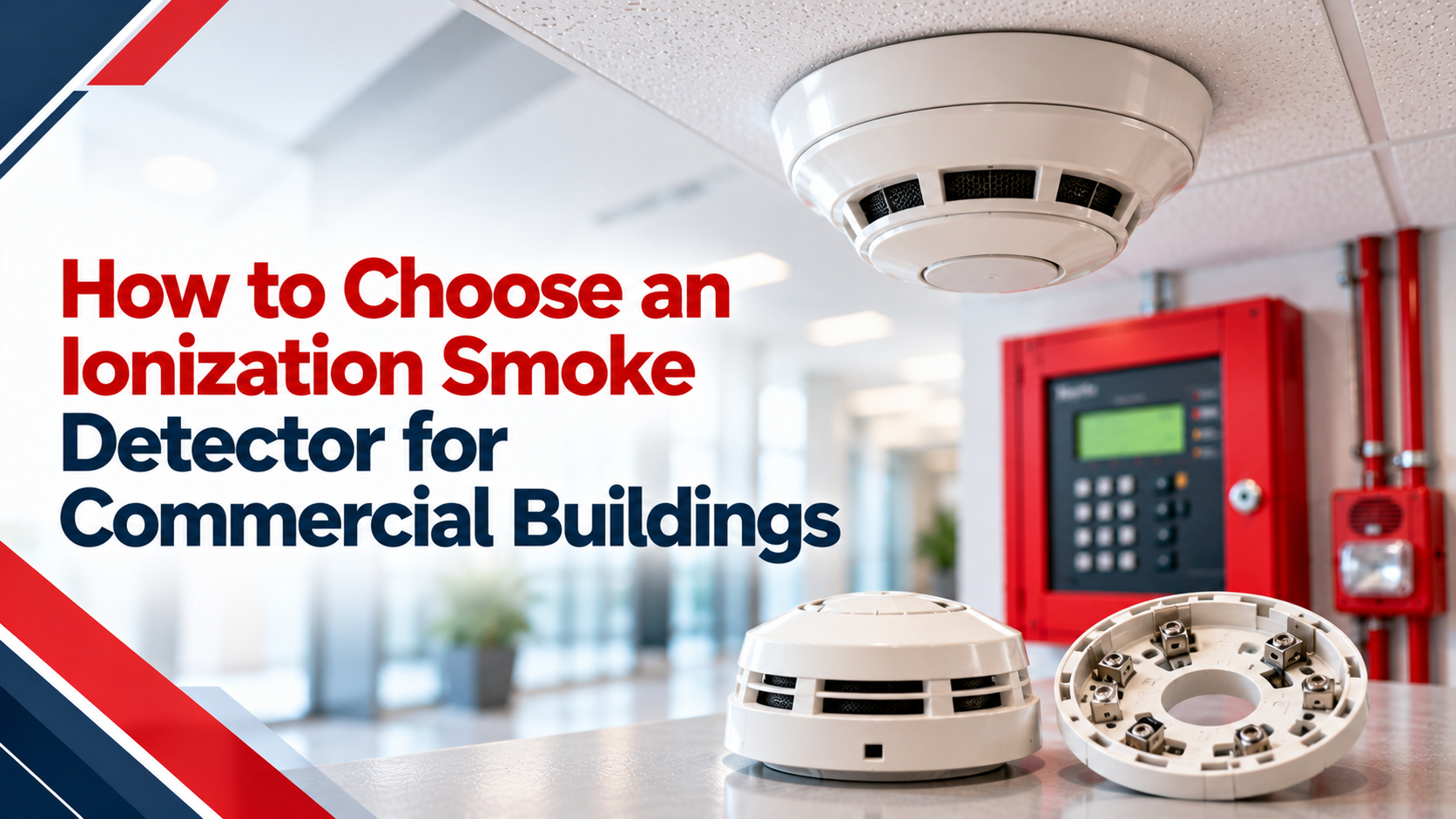
Choosing an ionization detector for a commercial building comes down to four questions: what fires you expect, which panel the detector must work with, which base it mounts on, and whether a replacement will match the existing device. This guide explains how an ionization smoke detector senses smoke, where it performs well, how it differs from photoelectric technology, and which specifications and compatibility points to verify before you buy.
How an Ionization Detector Works
Inside the sensing chamber, a small radioactive source ionizes the air between two electrodes, which allows a tiny, steady electrical current to flow. When combustion particles enter the chamber, they attach to the ions and reduce that current. The detector’s electronics notice the change and signal an alarm condition to the panel. The principle is covered in more detail in the smoke detector article on Wikipedia.
Because of this design, ionization detectors tend to respond quickly to the small particles produced by fast-flaming fires, such as burning paper, flammable liquids or similar fuels. They are generally less sensitive to the larger particles of slow, smoldering fires, which is where photoelectric technology has the advantage.
Where Ionization Detection Makes Sense
A commercial ionization smoke detector is typically considered in spaces where a flaming fire is the more likely scenario. Examples include areas with flammable liquids, storage of paper or plastics, or rooms with fast-burning contents. It is less suited to places with heavy cooking vapor, dust or drafts, which can trigger nuisance alarms.
The choice should be driven by a fire risk assessment, not habit. If your building was designed by a fire protection engineer, the original specification is the best starting point, and any change in detector technology should be reviewed with the engineer and the authority having jurisdiction.
Conditions That Favor Ionization
- Fast-flaming fire scenarios with limited smoldering potential.
- Clean environments with stable airflow.
- Existing installations where matching the original design is required.
- Spaces where the engineer specified ionization sensing.
Conditions That Call for Caution
- Kitchens, loading docks and areas with exhaust or vehicle fumes.
- Dusty, humid or high-airflow spaces.
- Areas where early warning of smoldering fires is a priority.
Ionization vs Photoelectric Smoke Detector: Key Differences
The comparison of an ionization vs photoelectric smoke detector is one of the most common questions buyers have. Neither technology is universally better. They detect different fire signatures, and each has strengths and weaknesses. A photoelectric detector uses a light source and sensor to detect light scattered by smoke particles, and it generally responds well to smoldering fires.
| Factor | Ionization | Photoelectric |
| Sensing method | Change in ionized current | Light scattered by smoke |
| Typical strength | Fast-flaming fires | Smoldering fires |
| Nuisance alarm sources | Cooking vapor, drafts, humidity | Dust, steam, insects |
| Radioactive component | Yes, a small source | No |
| Best suited for | Specific flaming-fire risks | General-purpose commercial detection |
Many modern facilities have moved toward photoelectric or multi-criteria detectors, and several manufacturers have reduced their ionization offerings. That trend makes it more important to confirm availability before you commit to a design.
Ionization Smoke Detector Specifications to Check
Reviewing ionization smoke detector specifications before ordering prevents costly mismatches. Use the manufacturer’s datasheet for exact values rather than relying on product titles.
Specification Checklist
- Operating voltage and current: Confirm the device operates within the panel or loop’s range.
- Device type: Conventional two-wire, addressable or analog, since they are not interchangeable.
- Sensitivity and listings: Check that the listing matches your jurisdiction’s requirements.
- Base type: Many detectors use a separate base, which must be compatible.
- Environmental limits: Review the temperature, humidity and airflow ranges.
- Visual indicators: Verify that the LED or remote output matches existing practice.
Ionization Fire Alarm Detector Compatibility
Ionization smoke detector compatibility is where most ordering mistakes happen. An ionization fire alarm detector may be designed for a specific panel family, and putting it on a different system can cause trouble signals or unreliable operation. For ionization smoke detector compatibility, verify these points together:
- The panel model and whether it supports conventional or addressable devices.
- The detector’s compatibility listing on the datasheet.
- The base number, since the base carries the wiring and may be proprietary.
- The detector’s address, if the device is addressable.
If any of these cannot be confirmed from the documentation, ask the supplier or manufacturer before installation. You can reach the team through the contact page with a model number and panel details.
Ionization Smoke Detector Replacement and Related Parts
Replacement is usually triggered by age, contamination, a failed sensitivity test or a facility upgrade. A careful ionization smoke detector replacement starts with the label on the existing device: record the part number, the manufacturer and the date code. If the device is obsolete, ask a supplier whether a direct replacement exists via the quote request form.
Do not overlook the surrounding hardware. Smoke detector replacement parts such as detector bases can wear, corrode or loosen over time, and a faulty base can cause intermittent trouble signals that look like a detector failure. Radioactive sources also have disposal considerations, so check local regulations and the manufacturer’s instructions before discarding old ionization detectors.
How Ionization Detectors Fit Into Commercial Fire Alarm System Detectors
Commercial fire alarm system detectors are rarely a single type. A facility may combine ionization, photoelectric, heat, duct and specialty detectors, each placed according to the hazard. A commercial ionization smoke detector is only one layer of that picture. Reviewing the complete range of commercial fire alarm system detectors helps you see where an ionization device fits and where another technology may serve better.
Brand matters here too. Fenwal, System Sensor, Fire-Lite, Notifier and Simplex each use their own device families, and detectors should be matched to the panel they connect to. A system that mixes technologies is not a problem as long as each device is compatible with the panel and installed according to code.
Common Mistakes When Choosing a Detector
- Selecting by price or appearance instead of part number and panel compatibility.
- Assuming ionization is always the faster choice without considering the likely fire type.
- Treating smoke detector replacement parts such as bases and wiring as an afterthought.
- Skipping testing and sensitivity checks after installation.
- Ignoring disposal rules for radioactive components.
Frequently Asked Questions
What is an ionization smoke detector?
This detector type uses a small radioactive source to ionize air in a sensing chamber and create a steady electrical current. When smoke particles enter, they disrupt that current, and the detector signals an alarm. It is generally most responsive to fast-flaming fires.
Ionization vs photoelectric smoke detector: which is better for commercial buildings?
Neither is universally better. Ionization detectors usually respond faster to flaming fires, while photoelectric detectors usually respond faster to smoldering fires. The right choice depends on the fire risk, the environment and the original system design, so confirm with a fire protection professional.
Are ionization detectors still available?
Yes. An ionization fire alarm detector is still offered by some manufacturers, though others have narrowed their ionization offerings as photoelectric and multi-criteria detectors have become more common. Availability depends on the brand and model, so confirm the part number with a supplier before planning a replacement or expansion.
Can I replace an ionization detector with a photoelectric one?
Sometimes, but only if the new detector is compatible with the panel and base, and the change is acceptable under your fire protection design and local code. Review the decision with your fire protection engineer and the authority having jurisdiction first.
How do I check ionization smoke detector compatibility with my panel?
Check the panel’s documentation for its list of compatible devices and compare it with the detector’s datasheet. Confirm the device type, base and addressing method. If anything is unclear, send the model numbers to a supplier or the manufacturer before installing.
How often should smoke detectors be replaced?
Replacement depends on the manufacturer’s service life, test results and condition rather than a single universal date. Follow the manufacturer’s instructions and the inspection and testing schedule in NFPA 72, and replace any detector that fails sensitivity tests or shows damage.
How should old ionization detectors be disposed of?
Because they contain a small radioactive source, disposal may be regulated. Check the manufacturer’s instructions and your local or national rules, or ask the manufacturer about take-back options, instead of discarding them with ordinary waste.
Conclusion
A well-chosen commercial ionization smoke detector matches the hazard, the panel and the base. Understand how it senses fast-flaming fires, compare it honestly with photoelectric technology, and review ionization smoke detector specifications and compatibility before ordering. Treat every ionization smoke detector replacement as a system change, and test the installed device afterward.
If you need to match or replace a detector, collect the model number, panel details and base type, then explore the QuickShipFire smoke detector replacement parts and detector range or ask the team to confirm the right part before you order.