
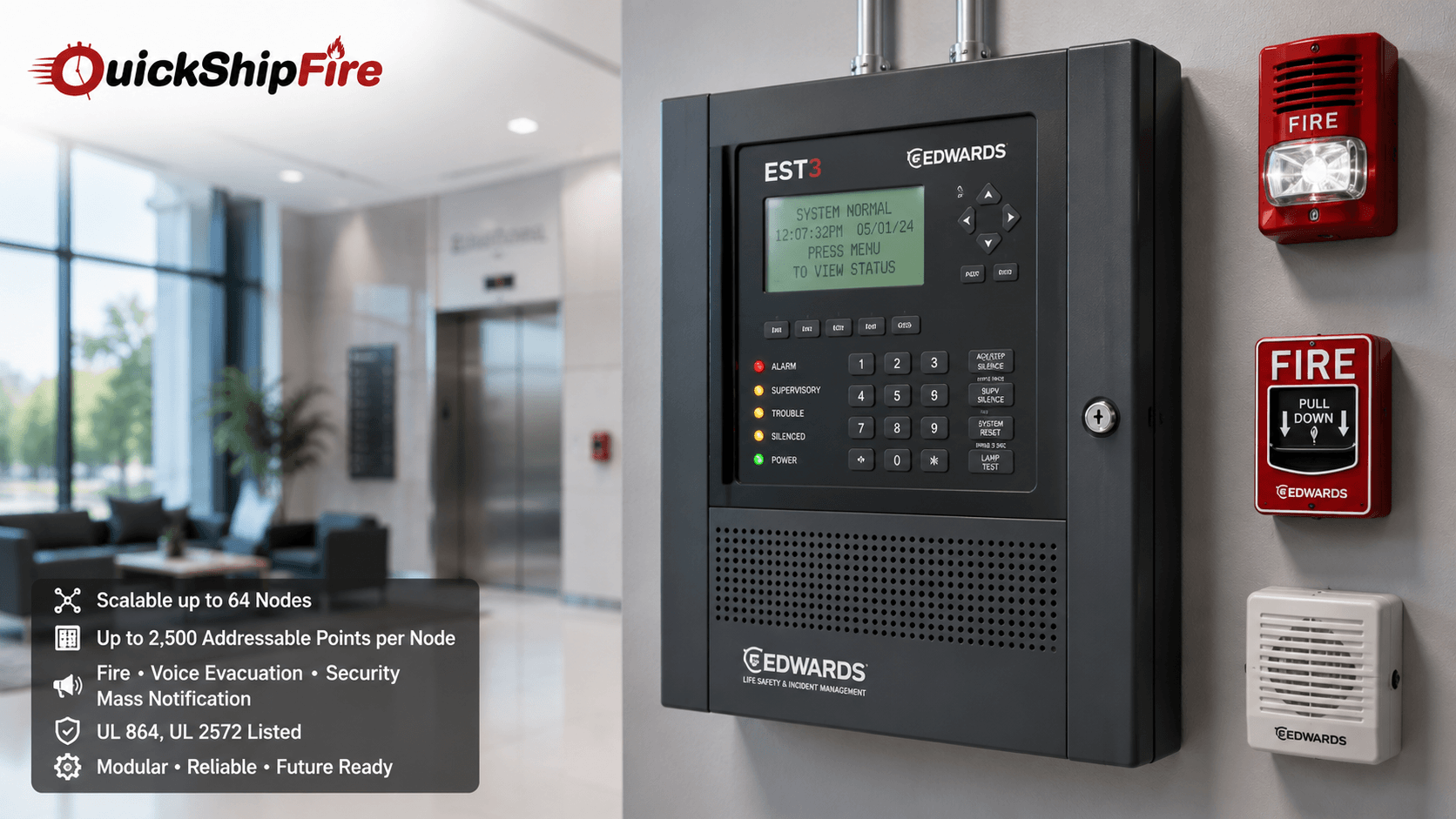
Few names come up as often in large commercial and institutional fire protection as the Edwards EST3. As a fire alarm panel, the EST3 platform was built to scale from a single standalone control unit up to a networked system spanning dozens of buildings, unifying fire alarm, voice evacuation, security, and mass notification on one modular architecture. It remains installed in thousands of hospitals, universities, high-rises, and campuses across North America. This overview covers how the EST3 fire alarm panel is built, what it can do, where it fits best, and what building owners need to know about its current life-cycle status as Edwards transitions customers toward the EST4 platform.
What Is the Edwards EST3 Fire Alarm Panel?
The EST3 is a modular, software-configurable fire alarm control platform manufactured by Edwards, a brand under the Carrier fire and security portfolio. Rather than shipping as a single fixed configuration, each EST3 fire alarm panel is built from an extensive catalog of plug-and-play local rail modules, allowing an integrator to tailor a single cabinet to a small standalone building or expand it into a networked system supporting up to 64 nodes, with each node handling as many as 2,500 addressable devices. That scalability is a big part of why the EST3 fire alarm panel shows up so frequently in phased construction projects, hospital campuses, and multi-building complexes where the fire alarm system needs to grow over time without a wholesale replacement.
Nearly every operating feature on the EST3 is software-controlled through a System Definition Utility program, which means operational changes, zone reassignments, and cause-and-effect programming can typically be updated without rewiring the field devices. Networked EST3 fire alarm panels communicate over a multi-priority, peer-to-peer token ring protocol across copper, multi-mode fiber, single-mode fiber, or a combination of all three, supporting total network runs in excess of 150,000 feet on some configurations.
Core Architecture and Capabilities
Modular, Plug-and-Play Rail Design
Every EST3 fire alarm panel is assembled from local rail modules covering signaling line circuits, notification circuits, audio amplification, network communication, and display/control functions. Because these modules snap into a common rail architecture, technicians can add capacity or swap a failed module without redesigning the entire cabinet, which keeps both installation and long-term service costs manageable on large systems.
Unified Fire, Voice, Security, and Mass Notification
One of the defining features of the EST3 platform is that fire detection, voice evacuation, access-adjacent security monitoring, and mass notification can all run through the same physical infrastructure. The system was among the first fire alarm control platforms listed to UL 2572 for mass notification, which allowed facilities to layer an emergency communication and mass notification system onto their existing fire alarm wiring instead of installing a separate, parallel system.
Networking and Survivability
For campus-scale deployments, EST3 fire alarm panel nodes link together over a token ring network engineered for fast alarm response even as the network grows. Multiple communication media are supported simultaneously, giving designers flexibility to route around physical obstacles or existing infrastructure while still meeting survivability requirements for critical signal paths between each networked fire alarm panel.
- A single fire alarm panel supports up to 64 networked nodes with as many as 2,500 addressable points per node.
- Plug-and-play local rail modules simplify both new installation and ongoing service.
- UL listed for fire, smoke control, security, and mass notification/emergency communication on a single platform.
- Software-defined operation through the System Definition Utility, reducing the need for field rewiring.
- Network media options include copper, multi-mode fiber, and single-mode fiber, individually or combined.
EST3 vs EST3X: Choosing the Right Configuration
| Attribute | EST3 Fire Alarm Panel (Full Network) | EST3X Fire Alarm Panel (Compact/Mid-Range) |
| Typical application | Large campuses, hospitals, high-rises, multi-building sites | Standalone buildings or smaller networks up to 8 nodes |
| Network integration | Up to 64 nodes across the full EST3 fire alarm panel network | Can operate standalone or join a larger EST3 fire alarm panel network |
| Voice evacuation | Full zoned, distributed, and banked amplifier options | Optional voice evacuation available |
| Mass notification | EST3-Sixty and UL 2572 listed capabilities | Displays security events; MNS via network integration |
| Best fit | Facilities needing maximum scale and redundancy | Mid-size buildings needing a cost-efficient path to network later |
Applications for the EST3 Fire Alarm Panel
The EST3 fire alarm panel is most often specified in facility types where scale, phased construction, or the need to unify multiple life-safety functions outweighs the cost of a simpler addressable fire alarm system. Hospitals rely on its ability to combine fire alarm, mass notification, and networked annunciation across multiple buildings on the same campus. Universities use it to expand coverage building by building as new construction comes online, without replacing existing infrastructure. High-rise and mixed-use developments benefit from its voice evacuation capability, which supports the phased or selective evacuation sequences many high-rise codes require.
- Hospital and healthcare campuses needing one fire alarm panel network for unified fire alarm and mass notification.
- University and higher-education campuses expanding fire alarm coverage across multiple construction phases.
- High-rise buildings requiring zoned or floor-by-floor voice evacuation sequences.
- Government and mixed-use facilities that need fire alarm and mass notification unified on one platform.
- Large industrial or commercial sites where network survivability across long cable runs between each fire alarm panel is a priority.
Field Devices and Circuits Supported
Like most large addressable platforms, the EST3 fire alarm panel supports signature-series addressable smoke and heat detectors, pull station initiating devices, input/output modules, and notification circuits, all reporting individually back to the panel rather than in generic zones. A signaling line circuit module handles communication with field devices on the addressable loop, while separate notification circuits drive horns, strobes, and speaker circuits for both local alarm and voice evacuation.
Because notification and detection are handled by distinct circuit types, designers can mix conventional and addressable notification appliances as needed for the project, and retrofit projects can frequently reuse existing field wiring when the new panel is code-compliant with the installed conductor gauge and circuit class.
- Signature Series addressable smoke, heat, and duct detectors reporting individual device status.
- Manual pull stations wired on addressable signaling line circuits for exact location reporting.
- Notification circuits supporting horns, strobes, and speaker/amplifier zones for voice evacuation.
- Input/output modules for interfacing with elevators, HVAC shutdown, and door-holder release.
- Fire alarm telephone handsets for firefighter communication on larger networked systems.
EST3 End-of-Life Status and Migration to EST4
Building owners evaluating the EST3 fire alarm panel today need to be aware that the platform has reached the end of its product life cycle, with Edwards directing new projects toward its successor, the EST4 control platform. For facilities that already operate an EST3 network, this does not mean immediate replacement is required; existing systems remain fully supportable, and Edwards has published a migration path to EST4 designed to preserve existing wiring and field devices where possible, reducing both cost and disruption. For new construction or major system replacements, however, most integrators are now specifying EST4 rather than adding new EST3 hardware, and it is worth factoring that into long-range capital planning for any campus still running EST3.
This kind of platform transition is a good reminder of why sourcing support matters just as much as the initial system design. Facilities with an existing EST3 investment often need specific replacement modules, addressable devices, or notification appliances rather than a full system swap, and finding those exact parts, especially for a platform nearing its production tail, can be the harder part of the project. Similar fire alarm system integration considerations apply to other addressable platforms nearing end of life, including some Fire-Lite and Silent Knight product lines.
Comparing the EST3 to Other Addressable Fire Alarm Panels
For projects that do not require EST3-scale networking, mid-size addressable panels such as the Fire-Lite ES-200X offer a more cost-effective path for single-building commercial projects that still need a reliable, code-compliant addressable fire alarm panel without the full networking and mass notification capability the EST3 was built for. Choosing between platforms usually comes down to the number of buildings involved, whether voice evacuation and mass notification are required, and how the project’s budget lines up against the long-term scalability a networked platform provides.
Whether you are maintaining an existing EST3 fire alarm panel, sourcing replacement modules for a legacy installation, or specifying a new addressable system for a different building type, QuickShipFire stocks panels, boards, modules, and detection devices from Edwards-compatible manufacturers alongside Notifier, Fire-Lite, Silent Knight, and Simplex. Request a quote and our team will help track down the exact part your project needs, including hard-to-find components for systems that are being serviced rather than replaced.
Retrofit and Replacement Part Considerations
Many EST3 projects today are retrofits rather than new construction: a hospital wing adding a node, a university replacing an aging control panel, or a facility team sourcing a failed rail module for a system that is otherwise performing well. In these cases, matching the exact fire alarm control panel revision, module part number, and firmware compatibility matters just as much as the original design intent. Mixing incompatible module revisions across an addressable loop can produce nuisance troubles or, worse, prevent proper alarm reporting, so verifying compatibility against the EST3 compatibility list before ordering parts is worth the extra step.
It also pays to plan the notification side of a retrofit carefully. Adding a new wing or floor typically means extending signaling line circuits and notification circuits to new pull station locations and additional horn/strobe coverage, and voltage drop across the added circuit length needs to be recalculated rather than assumed from the original design. A facility team working through this kind of expansion benefits from involving a supplier who can confirm part compatibility for an aging fire alarm control panel before a truck rolls to the job site.
Conclusion
The Edwards EST3 fire alarm panel earned its position as one of the most widely deployed large-building fire alarm platforms by combining a modular, plug-and-play architecture with the ability to unify fire alarm, voice evacuation, security, and mass notification on one network. It remains a capable, supportable platform for existing installations, even as Edwards steers new projects toward EST4. For facility managers and integrators working with an installed EST3 base, understanding its architecture, its field device options, and its migration path is essential to keeping a large campus system reliable for years to come.
Frequently Asked Questions About the Edwards EST3 Fire Alarm Panel
Is the Edwards EST3 fire alarm panel still supported?
Yes, existing EST3 installations remain supportable, and replacement parts and service are still available. However, the EST3 platform has reached end-of-life status for new projects, and Edwards is directing new installations toward the EST4 platform.
How many devices can an EST3 fire alarm panel support?
A fully networked EST3 system can support up to 64 nodes, with each node handling as many as 2,500 addressable devices, making it suitable for very large campuses and multi-building complexes.
What is the difference between EST3 and EST3X?
EST3X is a more compact, cost-efficient configuration that can operate standalone, network with up to eight nodes on its own, or integrate into a larger EST3 network of up to 64 nodes. The full EST3 platform is built for maximum scale and complex, campus-wide deployments.
Can the EST3 fire alarm panel support voice evacuation and mass notification?
Yes. The EST3 was one of the first fire alarm control platforms UL listed to UL 2572 for mass notification, and it supports zoned, distributed, or banked audio amplification for voice evacuation across networked buildings.
Can I migrate an existing EST3 system to EST4 without rewiring?
In many cases, yes. Edwards designed the EST3-to-EST4 migration path to preserve existing wiring and compatible field devices where possible, which reduces both installation cost and facility disruption compared with a full system replacement.
What field devices work with an EST3 fire alarm panel?
The EST3 supports Signature Series addressable smoke and heat detectors, manual stations, input/output modules, and both conventional and addressable horns and strobes, all wired through signaling line circuits and dedicated notification circuits.
Is the EST3 a good fit for a single, standalone building?
It can be, but for a smaller single-building project without a need for networking or mass notification, a mid-size addressable panel is often a more cost-effective choice, with the EST3 reserved for campuses and multi-building facilities that benefit from its networking scale.