
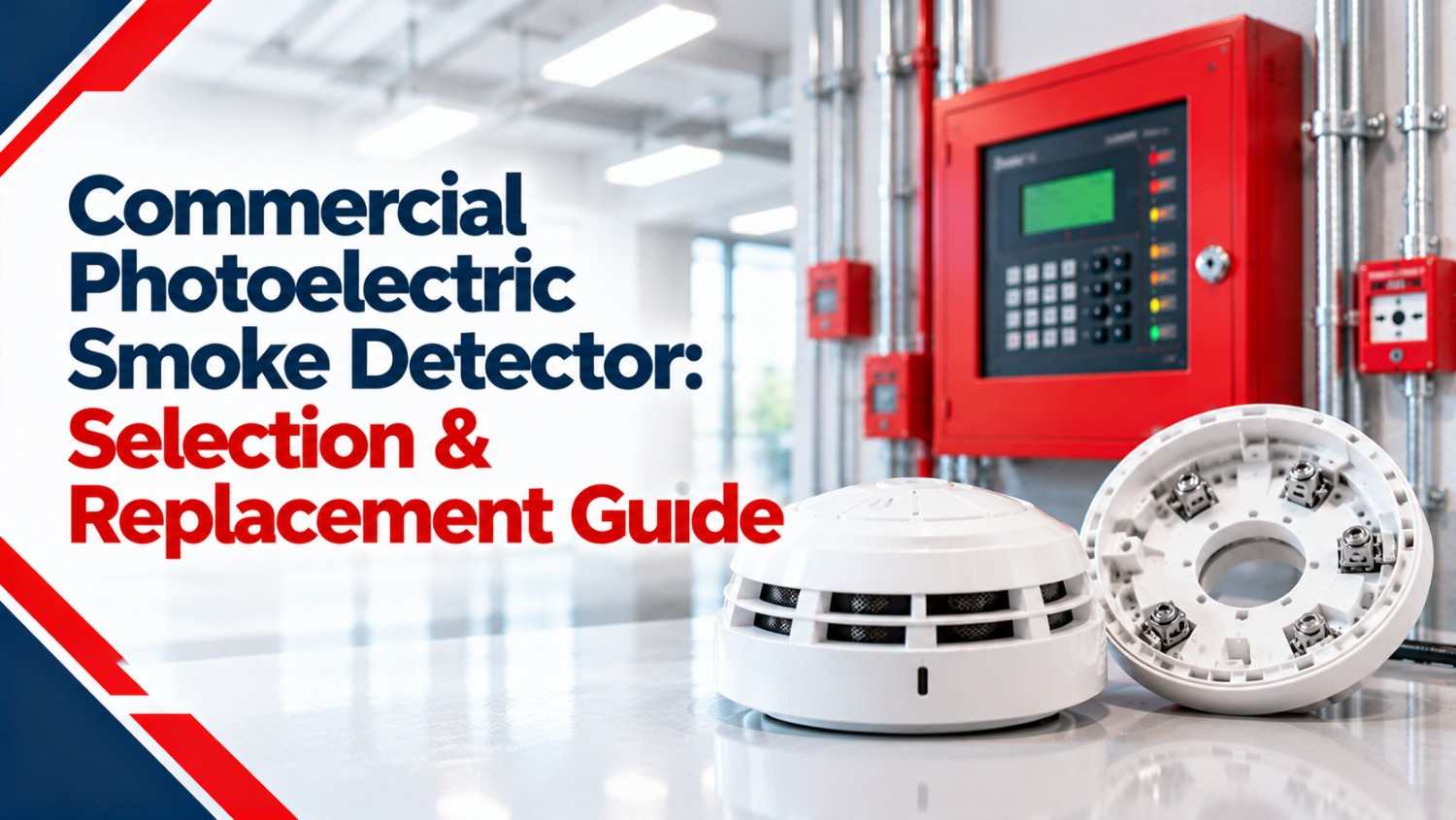
A photoelectric smoke detector is a common choice for general-area protection in commercial buildings, and selecting the right one depends on the panel it connects to, the base it mounts on and the space it protects. This guide explains how these detectors sense smoke, how to confirm that a replacement will work on your system, and which mistakes cause the most trouble during installation.
Replacing a failed or obsolete detector looks simple, but a unit that fits the base physically may still fail to communicate with the panel. Working through compatibility before you order protects the building and your budget.
How Photoelectric Detection Works
A photoelectric detector contains a light source and a sensor positioned so the sensor normally receives no light. When smoke particles enter the sensing chamber, they scatter light toward the sensor and the detector responds. This method is generally well suited to smoldering fires that produce visible smoke, which is one reason commercial photoelectric smoke detectors are widely specified for offices, corridors and similar spaces.
Ionization detectors use a different principle and tend to respond quickly to flaming fires, while multi-criteria devices combine smoke and heat sensing. This overview of smoke detector technology summarizes the main sensing methods if you want more background.
Addressable and Conventional Detectors
Conventional detectors report an alarm to the panel by zone. An addressable photoelectric smoke detector has a unique address on the loop, so the panel shows which device is in alarm and monitors its condition continuously. This helps technicians locate problems quickly in larger buildings.
| Factor | Conventional photoelectric | Addressable photoelectric |
| Panel communication | Zone-level alarm signal | Device-level status and alarm data |
| Identification | Technician searches the zone | Panel reports the specific address |
| Typical setting | Smaller or older buildings | Larger or multi-area buildings |
| Replacement concern | Matching base and zone circuit | Matching protocol, address and base |
Reading Addressable Smoke Detector Models
Addressable smoke detector models differ by manufacturer and protocol. The Fire-Lite SD365 and SD365T are listed as addressable units for commercial use, with the SD365T adding a thermal sensor. The Fenwal PSD7155 is listed as a ceiling-mount photoelectric unit, and Simplex offers TrueAlarm detectors such as the 4098-9601. These belong to different families and are not interchangeable simply because their function is similar.
Key Factors When Selecting a Detector
- Panel protocol: Confirm that the detector family is listed for your exact panel model.
- Environment: Dust, steam and cooking vapors can cause nuisance alarms, so some locations call for a different detector type.
- Settings and features: Some addressable detectors are configured from the panel or add thermal sensing, so confirm the panel supports those features.
- Base style: An addressable photoelectric smoke detector must be paired with a photoelectric smoke detector base listed for its family.
- Local requirements: The authority having jurisdiction may specify detector types for certain occupancies.
Photoelectric Smoke Detector Compatibility: What to Check
Photoelectric smoke detector compatibility depends on more than the model name. Communication protocol, base style, panel firmware and programming all play a part. A detector designed for one manufacturer’s loop is typically not recognized by another manufacturer’s panel, even when both are described as addressable. Compare the detector datasheet against the panel’s compatibility list before ordering.
Brand families are a practical starting point. Notifier and Fire-Lite devices belong to related but distinct lines, System Sensor supplies detectors used with many panel brands, and Simplex, Fenwal, Silent Knight and Gamewell-FCI each follow their own conventions. In every case, the listed combination matters more than similar appearance.
Choosing the Right Base
Every plug-in detector needs a matching base. A photoelectric smoke detector base supplies the terminals and mounting point, and some bases add a sounder or relay. If the base is wrong or damaged, a correct detector may still produce trouble signals. Simplex TrueAlarm detectors, for example, use Simplex sensor bases, such as the 2-wire sensor base listed on the QuickShipFire site.
Replacement: Matching the Old Unit to the New
When a unit fails, the safest approach is to install the same model or one the manufacturer lists as an equivalent. Photoelectric smoke detector replacement is straightforward only when the new unit uses the same protocol, address range and base footprint. Successor models are common, so check the datasheet rather than assuming.
Information to Collect Before Ordering
- The model number printed on the existing detector
- The control panel model and, where relevant, its revision
- The device address or loop position
- The base model and finish
- The quantity needed, plus a spare for future failures
Fire Alarm Smoke Detector Replacement Steps
Fire alarm smoke detector replacement should be done by a qualified technician. Notify the monitoring company and building occupants first, because removing a detector creates a trouble condition at the panel. After installation, set or confirm the address, check that the panel recognizes the device, and test it according to the manufacturer’s instructions and NFPA 72.
Planning Replacement in Larger Buildings
In a building with dozens of devices, replace units in a planned sequence rather than all at once. Document each address before removal, label the replacement units and update the as-built records when the work is finished. Staging the work by floor or zone limits the time any area spends without coverage and gives the monitoring company clear notice of what is affected. Keeping one tested spare of each model on site also means a single failure does not wait on shipping.
Common Replacement Mistakes
- Ordering a detector without confirming the existing base
- Mixing protocol families on one loop
- Forgetting to program or confirm the address
- Skipping a functional test after installation
- Treating a nuisance-alarm location as a detector-quality problem instead of an environment problem
Reducing Nuisance Alarms After Installation
A correct detector can still disappoint if it is placed poorly. Locations near kitchens, loading docks, shower areas or unfiltered air supply can expose a sensor to particles that resemble smoke. Before blaming the device, review where it is mounted, how air moves through the space and whether the area becomes dusty during construction or cleaning.
Maintenance matters as well. Dust inside the sensing chamber can raise the chance of unwanted alarms, so follow the manufacturer’s cleaning and testing guidance and keep records of recurring events. If one location generates repeated reports, consider relocating the device or choosing a different type for that room instead of replacing identical units again and again. Persistent problems may also point to wiring or base faults rather than the detector itself.
Commercial Fire Alarm Detectors Beyond General Areas
Commercial fire alarm detectors come in several types: photoelectric, ionization, heat, duct and specialty. Duct detectors monitor HVAC airflow, and aspirating systems such as VESDA actively sample air for very early warning. Match detector type to the hazard and the space, not to price alone. QuickShipFire’s guide to HVAC smoke detectors covers one of those specialty applications in more detail.
Frequently Asked Questions
How does a photoelectric detector work?
A photoelectric detector uses a light source and a sensor inside a sensing chamber. When smoke enters, particles scatter light onto the sensor, which triggers a response. This approach is generally effective for smoldering fires, and it is widely used for general-area protection in offices, corridors and other commercial spaces.
What is the difference between addressable and conventional detectors?
A conventional detector signals alarm by zone, so the exact device is not identified. An addressable photoelectric smoke detector reports from a unique address on the loop, letting the panel identify the device in alarm or trouble. Addressable detectors generally suit larger commercial buildings and multi-area layouts.
How do I check photoelectric smoke detector compatibility?
Start with the panel model, then compare the detector’s datasheet and the panel’s compatibility list. Confirm the protocol, base style and any firmware or programming requirements. Only manufacturer-listed combinations are reliable, so a similar appearance or matching connector is not enough to confirm that a detector will work.
When is photoelectric smoke detector replacement necessary?
Replace a detector when it fails testing, is physically damaged, repeatedly reports trouble or reaches the end of the service guidance in its datasheet. Clean, undamaged detectors that pass testing generally stay in service. Follow the manufacturer’s instructions and your local inspection requirements when deciding.
Do I need a new photoelectric smoke detector base when replacing the detector?
Not always. If the existing base is undamaged and listed for the replacement detector, it can usually stay. Replace the base when it is cracked, corroded, loosely wired or not listed for the new model, since a poor connection can cause trouble signals even with a correct detector.
Where are commercial photoelectric smoke detectors best used?
Commercial photoelectric smoke detectors suit general areas such as offices, corridors, meeting rooms and storage spaces where smoldering fires are a concern. They are less suited to locations with heavy steam, dust or cooking vapors, where nuisance alarms may occur and a different detector type may be more appropriate.
How do I compare addressable smoke detector models?
Compare the supported panel family, protocol, base compatibility and features such as thermal sensing. Then check the environment, availability and warranty terms. The best of the addressable smoke detector models is the one the manufacturer lists for your panel and that suits the space it protects.
Conclusion
Selecting the right detector comes down to a short list of confirmed facts: the panel model, the protocol, the base and the environment. Photoelectric smoke detector replacement succeeds when every item on that list matches, and fire alarm smoke detector replacement goes smoothly when the address is set and the unit is tested afterward. Commercial fire alarm detectors of every type depend on the same discipline of checking listings before ordering.
Before you buy, gather your panel model, the old detector’s part number and the base model. QuickShipFire lists detectors and bases from several manufacturer families, so you can browse the catalog, request a quote or contact the team to confirm a match before ordering.