
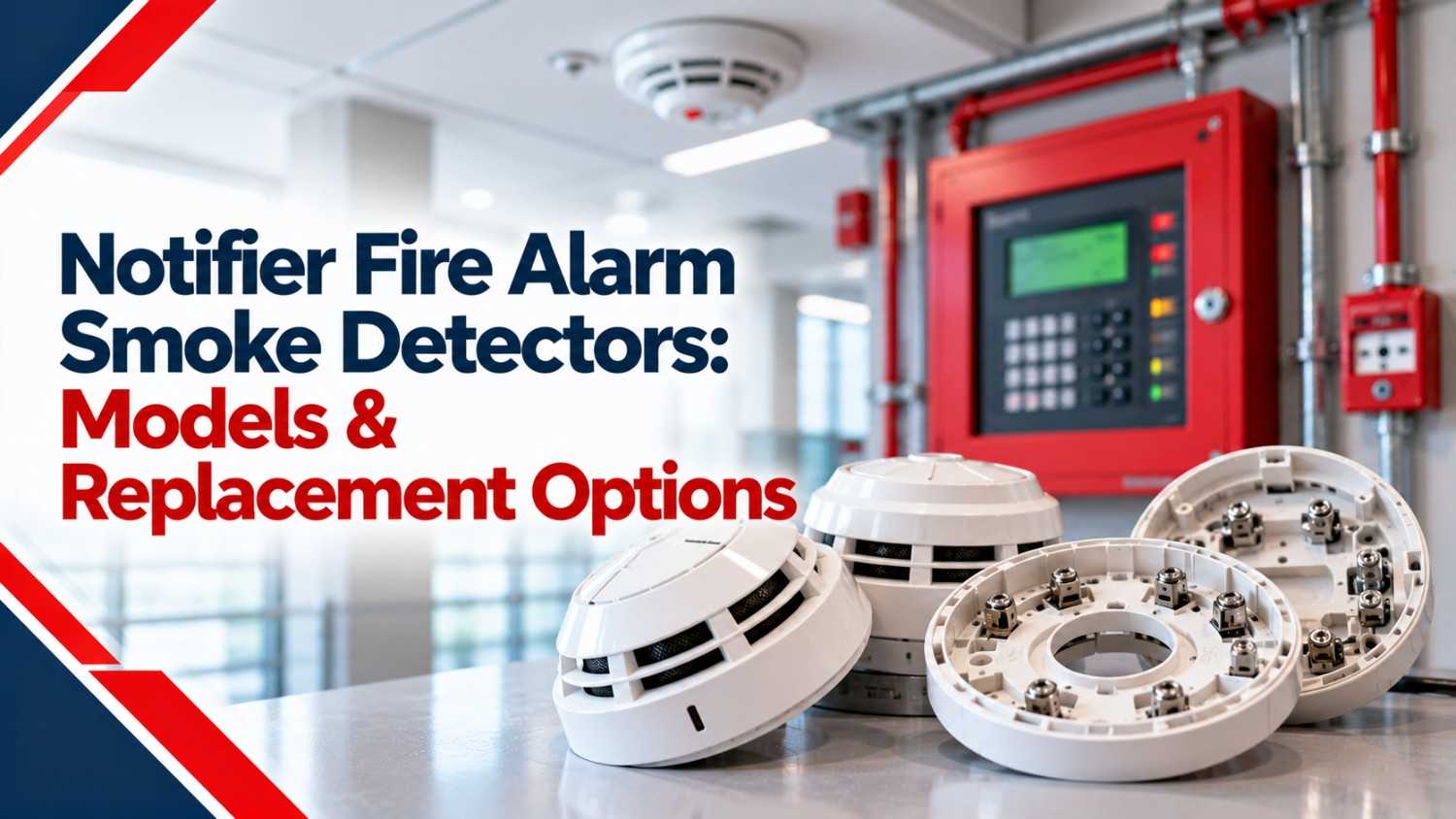
Notifier fire alarm smoke detectors are used in commercial buildings where the fire alarm panel needs detailed, reliable information from each detector. This guide explains the main detector types, how they communicate, which bases and parts go with them and what to confirm before replacing a unit, so you can order the right device the first time.
Understanding Notifier Fire Alarm Smoke Detectors
Notifier fire alarm smoke detectors are designed to work with Notifier control panels and communicate over the panel’s signalling line circuit. Each detector senses smoke, reports its condition and can be identified by address, which helps technicians locate a problem quickly. In a larger building, that identification is the difference between checking one ceiling tile and searching an entire floor.
A detector is only one part of a larger system that includes panels, modules, notification appliances and power supplies. For general background on how these systems fit together, see this overview of the fire alarm system.
Why Commercial Buildings Choose Notifier Fire Alarm Smoke Detectors
Facility managers often choose Notifier fire alarm smoke detectors because the devices report detailed status to the panel and fit into a documented, supportable system. Notifier fire alarm smoke detectors are commonly found in offices, schools, hospitals, hotels and industrial sites, where a single detector fault must be located quickly. The trade-off is that detectors, bases and panels need to be selected as a matched set, which makes accurate part numbers essential when ordering.
Notifier Addressable Smoke Detector Types
A Notifier addressable smoke detector has a unique address, so the panel displays the exact device in alarm or trouble. This contrasts with conventional detectors that report only at zone level. Addressable detectors also let technicians view status and, depending on the panel, detector sensitivity and maintenance information.
Notifier Photoelectric Smoke Detector
A Notifier photoelectric smoke detector uses a light source and a sensor to detect smoke particles that scatter light. Photoelectric sensing responds well to smouldering fires, which makes it common in offices, corridors and sleeping areas. The FSP-851 and FSP-951 series are well-known examples of this family, and some versions add a thermal element for heat sensing.
Notifier Intelligent Smoke Detector Features
A Notifier intelligent smoke detector goes beyond a simple alarm signal. It can report analogue smoke levels, compensate for dust build-up and support programmable sensitivity, which helps reduce nuisance alarms in dusty or variable environments. Intelligent detectors also give technicians information for maintenance planning. Always confirm the specific protocol and features supported by your panel model.
Key Features to Compare
- Sensing technology: photoelectric, ionization, thermal or multi-criteria options.
- Communication: protocol supported by your panel.
- Sensitivity control: whether sensitivity can be adjusted by the panel.
- Base type: standard, relay, sounder or isolator bases.
- Environment: dust, airflow and temperature conditions at the location.
Detector Bases and Installation
Notifier fire alarm smoke detectors depend on the base for their connection to the circuit. Notifier detector bases connect the detector to the circuit wiring and hold it in place on the ceiling or wall. A common base such as the B501 is used with many Notifier intelligent detectors, but the correct base depends on the detector series and the application. Some bases include features such as sounders or relays.
Notifier detector bases should be matched to the detector model, not chosen by appearance. A mismatch can prevent communication or leave the detector unsupported. Wiring should be checked before installation, and the detector address must be set according to the manufacturer’s method. Browse available detector bases and confirm the part number against the existing installation.
Comparing Detector Technologies
The table below compares common sensing approaches using qualitative factors only.
| Factor | Photoelectric | Ionization | Multi-Criteria |
| Responds best to | Smouldering fires | Fast, flaming fires | A range of fire types |
| Common location | Corridors, offices, sleeping areas | Selected commercial uses | Locations needing flexible response |
| Nuisance alarm risk | Lower in many cases | Can be higher in some areas | Depends on settings |
| Best suited for | General commercial spaces | Where specified | Environments needing combined sensing |
Use the table as a starting point only, and confirm choices against local code and your fire protection designer’s requirements.
Notifier Smoke Detector Replacement
When planning the work, remember that Notifier fire alarm smoke detectors are installed on a live life-safety circuit, so the process should be planned and tested. Notifier smoke detector replacement is usually needed when a detector fails a sensitivity test, is physically damaged, triggers repeated false alarms or reaches the end of its service life. Because detectors sit on a signalling circuit, replacement should follow a defined process: record the existing model and address, install the compatible detector, set the address, test the unit and confirm the panel shows it correctly.
Replacement Steps and Precautions
- Note the model, base type and address of the existing detector.
- Silence or disable the affected device through the panel as required, and notify monitoring.
- Install the replacement and confirm the address.
- Perform a functional test and return the system to normal.
Notifier Compatible Smoke Detectors
Notifier compatible smoke detectors are those listed for your panel and its protocol. A detector from another brand does not simply plug into a Notifier loop, even if it looks similar. Check the panel’s device list, the detector series and the base before ordering. Notifier compatible smoke detectors should also be matched to the environment, since an area with heavy dust may need a different choice than a clean office.
Notifier Fire Alarm Detector Parts and System Components
Notifier fire alarm detector parts include detector heads, bases, trim rings, covers and mounting accessories. Small parts are often easier to replace than the whole unit, but only when the model is exactly right. Notifier fire alarm detector parts should be sourced with the model and series on hand.
Beyond detectors, Notifier fire alarm system components cover panels, modules, notification appliances, power supplies and annunciators. QuickShipFire lists Notifier fire alarm system components alongside other brands, which is useful for buildings with mixed equipment. When you plan a project, list every one of your Notifier fire alarm system components in one place so that replacements stay consistent. Mixed-brand buildings should document each manufacturer’s equipment separately, because rules for compatibility and testing differ.
How Notifier Compares With Other Brands
Several manufacturers serve commercial buildings, and Notifier fire alarm smoke detectors sit among them as a choice for larger, networked sites. Fire-Lite is generally used for smaller systems, while Notifier is associated with larger and networked installations. Simplex offers TrueAlarm detectors designed for Simplex panels, and Silent Knight and Gamewell-FCI each have their own device lines. System Sensor is a widely used detector manufacturer whose products appear across several panel families. Simplex TrueAlarm photoelectric detectors such as the 4098-9601 are one example of a brand-specific design. Because each brand uses its own signalling approach, devices are generally not interchangeable, and substituting a different brand can create faults or unsupported conditions.
Common Mistakes to Avoid
- Ordering a detector without checking the panel model and protocol.
- Choosing a base that does not match the detector series.
- Ignoring the environment, such as dust or airflow.
- Skipping a functional test after replacement.
Frequently Asked Questions
What are Notifier fire alarm smoke detectors?
Notifier fire alarm smoke detectors are smoke detection devices designed for Notifier control panels. Most are addressable, so the panel identifies the exact detector in alarm or trouble. They are used in commercial buildings and come in photoelectric, thermal and multi-criteria options.
What is a Notifier addressable smoke detector?
A Notifier addressable smoke detector has a unique address on the signalling line circuit, allowing the panel to show exactly which detector is in alarm or trouble. It communicates using the panel’s protocol, so it must match the panel and base.
What does intelligent mean for a smoke detector?
An intelligent smoke detector reports analogue smoke levels and status to the panel instead of just an alarm signal. Many support sensitivity adjustment and dust compensation. A Notifier intelligent smoke detector needs a compatible panel to use these features.
Why choose a photoelectric detector?
A Notifier photoelectric smoke detector responds well to smouldering fires and is commonly used in offices, corridors and sleeping areas. It senses visible particles through light scatter. Selection should follow local code and your fire protection design.
Do I need a specific base for each detector?
Yes. Notifier detector bases must match the detector series and application, since some bases include relays or sounders. Using an incorrect base can prevent communication. Check the part number of the existing base before ordering a new detector.
How do I know when to replace a smoke detector?
Replace a detector when it fails testing, shows physical damage, causes repeated false alarms or reaches the end of its service life. Notifier smoke detector replacement should use a compatible model, correct address and a functional test before the system returns to service.
Can other brands’ detectors be used with Notifier fire alarm smoke detectors?
Generally no. Notifier compatible smoke detectors are those listed for the panel and protocol. Detectors from other brands use different signalling and are not normally interchangeable. Always verify compatibility by model number against the panel’s documentation.
Conclusion
Choosing among Notifier fire alarm smoke detectors comes down to matching the sensing type, protocol, base and environment to your panel and building. Verify compatibility for Notifier fire alarm smoke detectors by model number, plan replacements with a clear test procedure and keep a record of each detector’s address and base for future service. For a mixed-brand system, treat each manufacturer’s detectors as a separate family with its own rules.
When you are ready to order, collect your panel model, existing detector model and base type. You can browse the range on QuickShipFire, or contact the team to confirm that the detectors, bases and parts you choose match your system.