
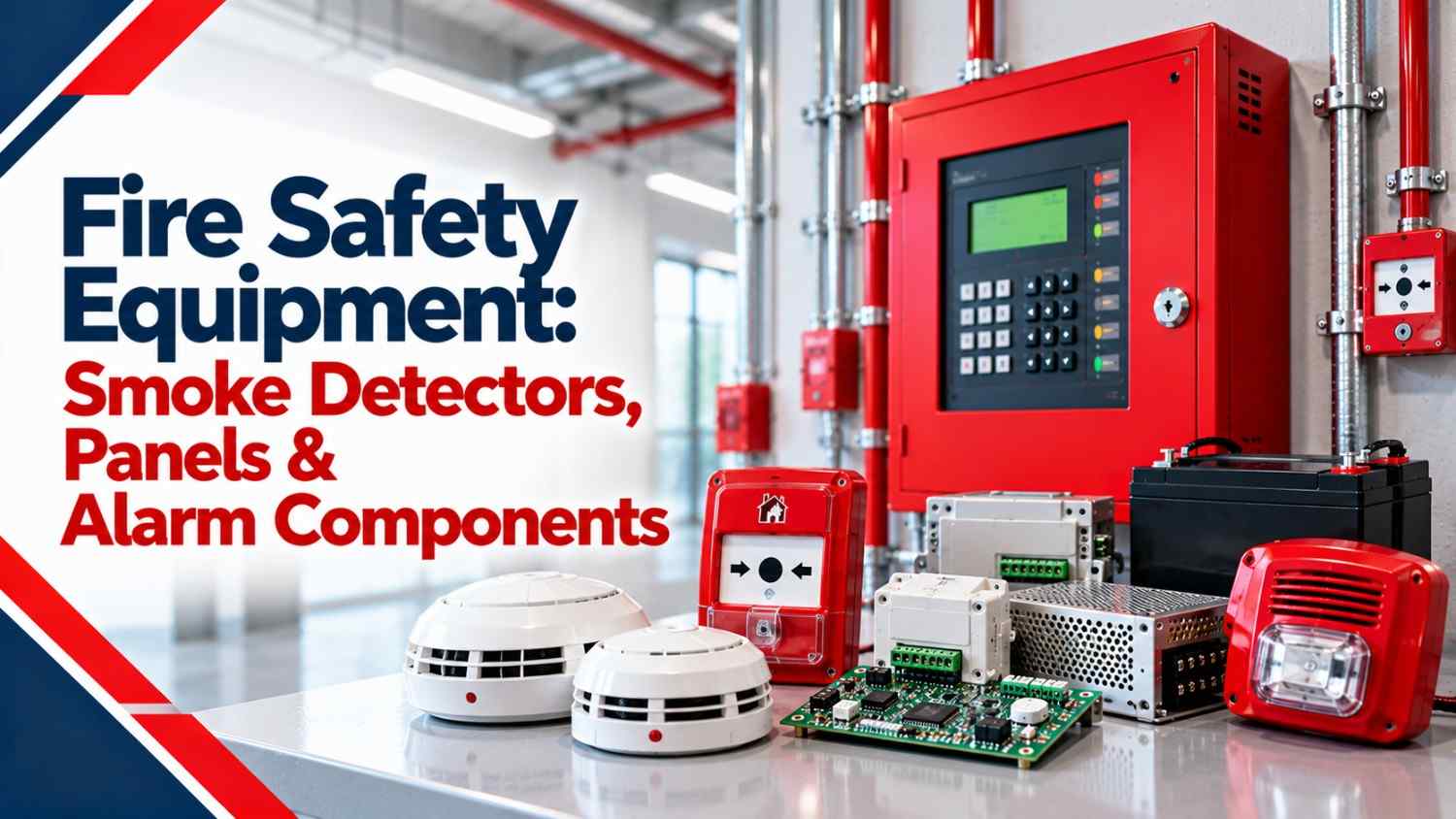
Selecting fire safety equipment for a commercial building means matching detectors, control panels, modules and notification devices so they operate as a single system. This guide explains what each component does, how the parts depend on one another, and what to verify before you replace a device or plan an upgrade.
A fire alarm system is only as dependable as its weakest part. A detector that cannot communicate with its panel, or a module that does not suit the loop protocol, can leave a zone unprotected even when every device looks new. Good fire safety equipment is chosen as a system, not a shopping list, and knowing the role of each component helps you avoid costly returns.
What Counts as Commercial Fire Safety Equipment?
Commercial fire safety equipment covers every device that detects a fire, reports it and alerts occupants. In most buildings the core group includes smoke and heat detectors, manual pull stations, a control panel, power supplies, and horns or strobes. The panel supervises all of them and decides how the system responds.
Fire safety equipment is separate from firefighting equipment. Extinguishers and sprinklers suppress a fire, while the alarm system detects it, warns occupants and can trigger actions such as shutting down air handlers. Both matter, but they are specified, installed and maintained differently.
Requirements for the alarm side are set largely by NFPA 72, which covers the application, installation, performance, inspection, testing and maintenance of fire alarm systems and their components. Enforcement rests with the local authority having jurisdiction, so confirm which edition and amendments apply to your building before buying or installing anything.
How Fire Alarm System Components Work Together
Think of the system as a chain: devices sense, the panel decides, and notification appliances respond. The fire alarm system components you choose must suit one another at each link, not merely share a general category.
Detectors and Initiating Devices
Commercial smoke detectors sense smoke or heat and report to the panel. Photoelectric models respond well to smoldering fires, while ionization models respond quickly to flaming fires. Manual pull stations let occupants raise an alarm, and duct detectors monitor air moving through HVAC systems. Specifying commercial smoke detectors for each space, rather than one type everywhere, reduces nuisance alarms.
Control Panels
Fire alarm control panels receive signals from every initiating device and classify each event as an alarm, trouble or supervisory condition. Capacity matters: the Fire-Lite ES-50X is listed as a 50-point addressable system for small commercial buildings, while the ES-200X is listed at 198 points for mid-size buildings. Some fire alarm control panels also include a built-in communicator for off-site notification, as the ES-50X listing describes. Choose a panel that covers today’s device count with room to grow.
Modules and Accessories
Fire alarm modules and accessories connect devices that cannot talk to the panel directly. Monitor modules read contacts such as flow switches, control modules switch circuits for horns or door holders, and adapter modules link notification appliances to the loop. Because modules are protocol-specific, they are a frequent source of ordering errors.
Key Factors to Consider Before Buying Fire Safety Equipment
- Protocol and manufacturer family: Devices must speak the same language as the panel. Identify the panel model first, then confirm each device in its datasheet.
- Addressable or conventional: Addressable loops identify each device individually, while conventional zones report only the zone.
- Building use: Offices, warehouses, kitchens and mechanical rooms stress detectors differently, so detector type should follow the environment.
- Documentation: Review fire alarm modules and accessories alongside the panel, and keep model numbers, device addresses and drawings together. A common mistake is ordering from a photograph instead of a model number.
Addressable and Conventional Devices Compared
Modern commercial buildings increasingly rely on addressable fire alarm devices because each device on the loop reports its own status and location. Conventional zones remain common in smaller or older buildings and still work well when the layout is simple.
| Factor | Conventional devices | Addressable devices |
| Reporting | Reports by zone | Reports each device individually |
| Troubleshooting | Technician searches the zone | Panel identifies the device needing attention |
| Wiring | Typically one circuit per zone | Devices share a loop |
| Expansion | Adding zones may mean new circuits | Devices added to an existing loop within panel capacity |
| Best suited for | Small buildings with simple layouts | Larger or multi-area commercial buildings |
The table describes general design differences only. Loop capacity for addressable fire alarm devices and wiring rules vary by manufacturer, so rely on the panel’s installation manual.
Understanding Manufacturer Families
Most fire safety equipment belongs to a manufacturer ecosystem. Notifier, Fire-Lite, System Sensor, Simplex, Silent Knight, Gamewell-FCI and Fenwal each offer distinct device lines and communication methods. A Simplex TrueAlarm detector and a Fire-Lite addressable detector, for instance, are not interchangeable, even though both are addressable. Keep replacements within the same family unless a datasheet states otherwise.
Sourcing Fire Alarm Panel Replacement Parts
Manufacturers retire models, but the buildings they protect remain in service. When a board, power supply or module fails, fire alarm panel replacement parts may no longer be easy to find through standard channels. The usual options are a current-generation substitute, new old stock, or a refurbished unit. Whichever route you take, the replacement must still meet the standards that applied to the original fire safety equipment.
Refurbished fire alarm parts can be a practical route when a discontinued board is unavailable new, particularly if replacing the whole panel would mean rewiring and reprogramming. They should be labeled clearly as refurbished and supported by stated warranty and return terms.
What to Verify Before Ordering
- The exact panel model and, where applicable, its revision
- The part number printed on the failed component
- Whether the item is new, new old stock or refurbished
- The warranty and return terms
- Whether your contractor or the authority having jurisdiction must approve the change
Mistakes That Cause Delays
- Ordering by appearance instead of part number
- Mixing devices from different protocol families on one loop
- Replacing a detector without checking its base
- Skipping testing after the replacement
- Accepting refurbished fire alarm parts without written warranty terms
- Assuming “compatible” means “identical”
Maintaining Fire Safety Equipment Over Time
Even well-chosen fire safety equipment needs routine attention. Detectors collect dust, standby batteries age and connections loosen, so a documented inspection and testing program is part of owning the system. Record each device’s location, model and test date so recurring problems become visible.
Replacement planning matters too. Commercial smoke detectors that repeatedly cause nuisance alarms or fail testing should be replaced rather than silenced, and fire alarm control panels that no longer have available parts may need a staged upgrade. Keeping a short list of critical commercial fire safety equipment spares, such as detectors, bases and modules, shortens any outage.
Frequently Asked Questions
What is fire safety equipment in a commercial building?
Fire safety equipment in a commercial building is the set of devices that detect a fire, report it and warn occupants. It typically includes smoke detectors, heat detectors, pull stations, a control panel, power supplies, modules and notification appliances, all supervised by the panel and designed to work as one system.
What are the main fire alarm system components?
The main fire alarm system components are initiating devices such as detectors and pull stations, the control panel, notification appliances like horns and strobes, power supplies with batteries, and modules that interface other equipment. The panel supervises each part, so every component must suit the panel’s protocol and model.
What is the difference between addressable and conventional devices?
Conventional devices report to the panel by zone, so a technician must search the zone to find the source. Addressable fire alarm devices each have a unique address on a loop, so the panel can show exactly which device is in alarm or trouble. Addressable systems generally suit larger or multi-area buildings.
Are refurbished fire alarm parts safe to use?
Refurbished items can be a workable choice for fire safety equipment when a part is obsolete, provided the item is clearly identified as refurbished, matches your panel model and carries stated warranty and return terms. Confirm the exact part number, check compatibility with your panel, and have a qualified technician test the system after installation.
Can I mix fire alarm devices from different manufacturers?
Usually not on the same loop. Each manufacturer family uses its own communication protocol, so a detector, module or base from one family may not be recognized by another family’s panel. Only mix brands when the installation manual or device datasheet explicitly lists the device as compatible.
How do I find the right fire alarm panel replacement parts?
Start with the panel’s model number and the part number on the failed component, then compare both against the manufacturer’s documentation. Fire alarm panel replacement parts must match the revision and protocol of your system. If the original is obsolete, ask the supplier about equivalent or refurbished options.
How often should fire safety equipment be tested?
Testing frequency depends on the device type, the system and local rules. NFPA 72 sets inspection, testing and maintenance requirements, and the authority having jurisdiction enforces them. Work with a licensed fire alarm contractor to build a schedule, and keep written records of every test and repair.
Conclusion
Dependable fire safety equipment is the result of compatible parts, accurate documentation and consistent maintenance rather than any single product. Detectors, control panels, fire alarm modules and accessories, and notification devices must share a protocol and suit the building’s layout, and when older components fail, verified replacement options keep the system in service without unnecessary rework. Before you buy, record your panel model, list the part numbers you need and confirm whether each item is new or refurbished.
If you are replacing a device or planning an upgrade, send your panel model and part numbers for review. Browse the QuickShipFire catalog, request a quote, or contact the team for help locating hard-to-find components.