
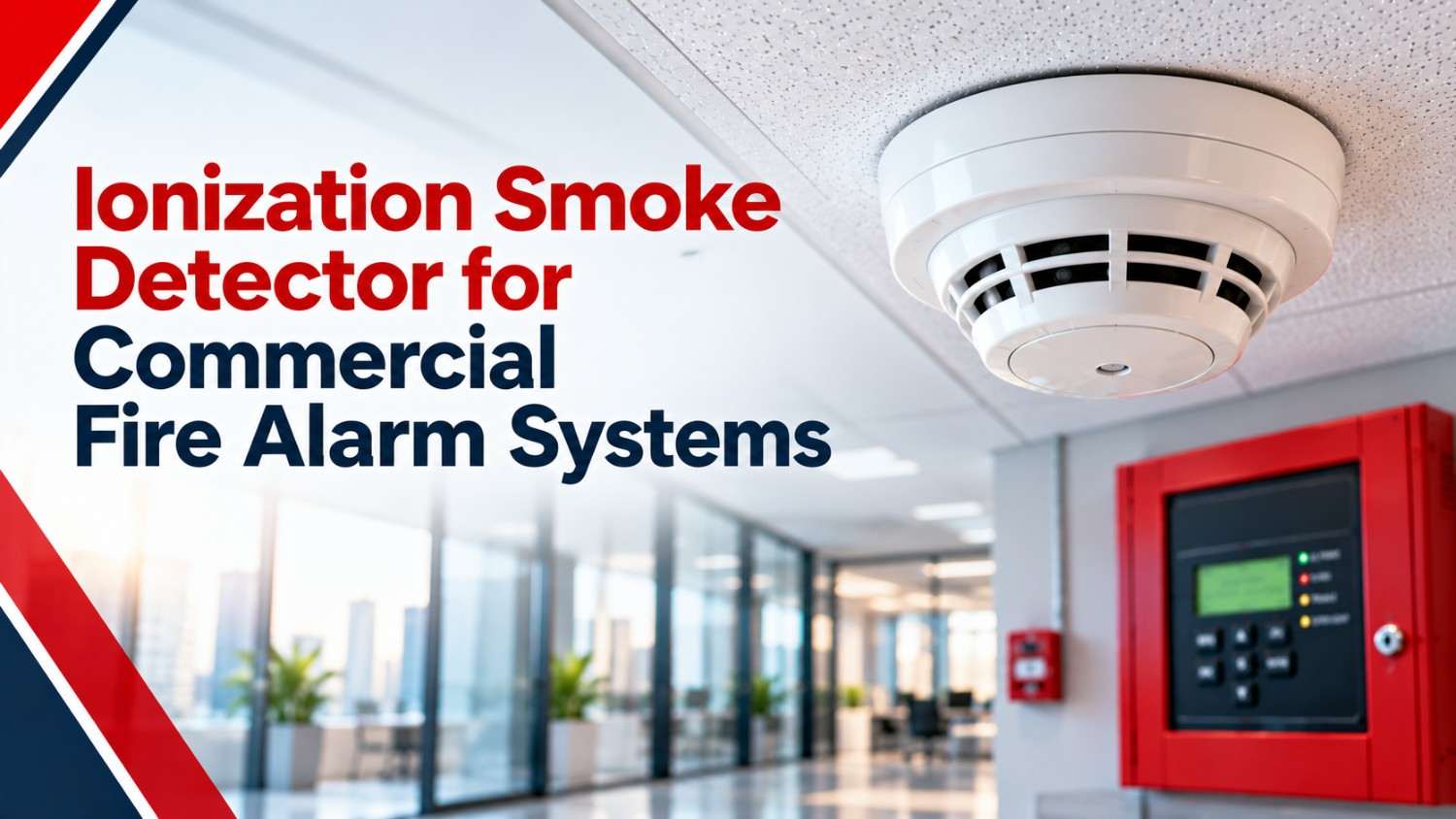
An Ionization Smoke Detector senses the tiny combustion particles produced by fast-flaming fires, which is why it still appears in many commercial buildings. This guide explains how the technology works, where it performs well, how it compares with photoelectric sensing, and what to verify before you replace a detector in an existing system.
How an Ionization Smoke Detector Works
Inside the sensing chamber, a small radioactive source ionizes the air and creates a minute electrical current between two electrodes. When smoke particles enter, they disrupt that current, and the electronics register the change as a possible fire. This is why the technology responds well to the very small particles released by flaming combustion.
The source is typically americium-241, present in a very small quantity and sealed inside the chamber. Disposal should follow the manufacturer’s instructions and local regulations. For a general description of sensing methods, see this overview of the smoke detector.
Commercial Ionization Smoke Detector Applications
A commercial ionization smoke detector is most relevant where fast-developing flaming fires are the main concern. Examples listed for the CPD-7051 on the QuickShipFire site include storage and utility spaces, commercial buildings and industrial facilities, always on a ceiling with a standard base.
Where the hazard is a smoldering fire in furniture, bedding or plastics, photoelectric sensing is generally the stronger choice. Many modern designs therefore rely on photoelectric or multi-criteria detectors, which combine sensing methods to cover both fire types. This technology remains common in legacy systems, in matching existing devices and in spaces whose fire risk favors rapid flame detection.
Where an Ionization Detector Can Struggle
Ionization sensing can be more prone to nuisance alarms from cooking fumes, steam, aerosol sprays and dusty or humid air. Placement near kitchens, bathrooms, loading docks and diesel exhaust should be reviewed with a designer. These limits do not make the technology unsafe, and many nuisance alarms are solved by relocating or changing the device type, but they do mean that location and environment matter as much as the device itself.
Ionization Fire Alarm Detector Basics
An ionization fire alarm detector used in a commercial system is a different product from a battery-operated household alarm. It is powered and supervised by the control panel, mounts on a compatible base and reports its condition through the panel. The CPD-7051 listing describes it as panel-powered with LED status indicators, which is typical for an ionization fire alarm detector in a supervised system.
A commercial ionization smoke detector must also match the panel it connects to. Conventional and addressable systems use different communication methods, so confirm the detector type before purchase.
Ionization Smoke Alarm vs a Fire Alarm Detector
People often search for an ionization smoke alarm when they mean a detector in a commercial system. The terms overlap, but the difference matters. An ionization smoke alarm is typically a self-contained unit that sounds on its own. A commercial detector sends a signal to a control panel, which then drives horns, strobes and monitoring. If you are unsure which you have, check the device label or ask for help.
Photoelectric vs Ionization Smoke Detector: A Practical Comparison
The photoelectric vs ionization smoke detector question is common, and the honest answer is that each technology has strengths. Photoelectric sensing detects visible smoke particles by light scattering, while ionization responds to smaller particles. Neither is best everywhere, which is why the photoelectric vs ionization smoke detector decision should follow a hazard review.
| Factor | Ionization | Photoelectric |
| Responds fastest to | Fast-flaming fires | Smoldering fires |
| Typical particle size | Very small | Larger, visible |
| Nuisance alarm tendency | Higher near cooking and steam | Higher with dust in some designs |
| Common commercial use | Legacy systems, flaming-fire risks | Offices, hotels, sleeping areas |
| Main caution | Environment and placement | Fast flaming fires |
For many projects, a mixed approach or a multi-criteria detector is the better answer. Your fire protection designer and the authority having jurisdiction should decide which detector types are acceptable.
How Other Brands Handle This Choice
Fenwal supplies the CPD-7051 ionization unit and the PSD7155 photoelectric unit listed on the site. Other manufacturers, including System Sensor, Notifier and Simplex, offer photoelectric and multi-criteria detectors within their own product families. The practical point is that detector types are tied to the panel and base, so a comparison across brands is useful for understanding technology but not for swapping devices.
The CPD-7051 Ionization Smoke Detector
The CPD-7051 ionization smoke detector is listed as a ceiling-mounted unit for fast flaming fire detection in commercial buildings. Key points from its listing:
- Technology: ionization sensing for rapid response to flaming fires.
- Power: panel-powered, with LED status indicators.
- Mounting: ceiling-mounted on a standard base.
- Application: commercial buildings, industrial facilities and general-purpose areas.
- Condition: sold new in original manufacturer packaging, per the site’s policy.
Always confirm that the base and panel are compatible with the CPD-7051 ionization smoke detector before ordering. If you are not sure, send the existing detector label to a supplier and ask for a compatibility check.
Placement and Spacing Considerations
Placement drives real-world performance. Detector spacing, ceiling height, airflow and obstructions are set by NFPA 72 and the system designer, not by the detector alone. Avoid positions directly beside supply diffusers, where moving air can dilute smoke, and keep sensors away from dead-air corners. In older buildings, previous renovations may have moved walls without moving detectors, so a walk-through before swapping any detector is worthwhile.
Environmental conditions change over time. A storeroom that once held boxes may become a workshop with dust and fumes. Revisit detector selection whenever a space changes use, because the right device for yesterday’s room may cause nuisance alarms tomorrow.
Ionization Detector for Fire Alarm Systems: Installation and Bases
An ionization detector for fire alarm systems plugs into a base that carries the wiring. The base usually stays on the ceiling when the detector head is replaced, so inspect it for corrosion, loose terminals and damage while the head is off. A quick check at this stage prevents callbacks. Treat each ionization detector for fire alarm systems as part of a base, wiring and panel assembly, not as a standalone part.
Ionization Smoke Detector Replacement Checklist
An ionization smoke detector replacement is straightforward when planned, and risky when rushed. Before an ionization smoke detector replacement is ordered, confirm these points:
- The exact model, series and manufacturer printed on the existing detector.
- The base type and the panel’s list of compatible devices.
- The environment, including humidity, dust, cooking exhaust and air movement.
- Whether a photoelectric or multi-criteria detector would suit the space better.
- The condition, warranty and return terms offered by the supplier.
Common Replacement Mistakes
Frequent mistakes include assuming a similar-looking head will work, forgetting to notify monitoring, leaving dust covers installed after construction and skipping a functional test. Replacing one with a different technology without design review can also change how the system responds to fire. QuickShipFire states it is an independent reseller, not an authorized distributor of the brands it stocks, so check terms before purchase.
A commercial smoke detector program should include cleaning, sensitivity checks and testing under NFPA 72 and local requirements. Each commercial smoke detector should be recorded by location and install date.
Frequently Asked Questions
What is an ionization smoke detector?
It uses a small radioactive source to ionize air in a sensing chamber and create a tiny electric current. Smoke particles disrupt that current and trigger an alarm. This design is especially sensitive to the small particles produced by fast-flaming fires.
Is ionization or photoelectric better for commercial buildings?
Neither is better everywhere. Ionization detectors respond faster to flaming fires, while photoelectric detectors respond faster to smoldering fires in most cases. Many commercial designs now use photoelectric or multi-criteria detectors, with ionization retained for legacy systems and specific hazards. Your designer and local authority should set the requirement.
Where should an ionization detector not be installed?
Avoid locations with heavy cooking fumes, steam, aerosol sprays, dust or strong air movement, because these can cause nuisance alarms. Kitchens, bathrooms, garages and loading areas usually need a different detector type. Follow manufacturer instructions, the approved design and your designer’s detector layout.
Do ionization detectors contain radioactive material?
Yes. They typically contain a very small, sealed amount of americium-241 inside the sensing chamber of the detector head. It is considered safe in normal use while sealed, but disposal should follow manufacturer instructions and local regulations rather than ordinary household trash.
Can I replace an ionization detector with a photoelectric one?
Sometimes, but only if the new detector is compatible with the panel and base, and the change is acceptable to the designer and authority having jurisdiction. Different technologies respond differently to fire types, so review the space, the hazards and the approved design before changing the detector type, and test it afterward.
How often should commercial smoke detectors be tested?
Testing and inspection intervals are set by NFPA 72, adopted local codes and the authority having jurisdiction in your area. A qualified fire alarm contractor should follow those requirements and document results, including functional tests, sensitivity checks and cleaning where required.
Are ionization detectors still used in new commercial buildings?
They are used less often in new designs, where photoelectric and multi-criteria detectors are common, but they remain in many existing systems and in some fast-flaming hazard areas. Selection depends on the designer, the local code and the approved fire protection plan.
Conclusion
An Ionization Smoke Detector is a specialist tool that is effective against fast-flaming fires but sensitive to environment. Choose it for the right spaces, compare it with photoelectric and multi-criteria options, and match every replacement to the base and panel.
If you need to replace or source a detector, send your model label, base type and panel details to QuickShipFire, or request a quote for the ionization and photoelectric detectors your system requires.