
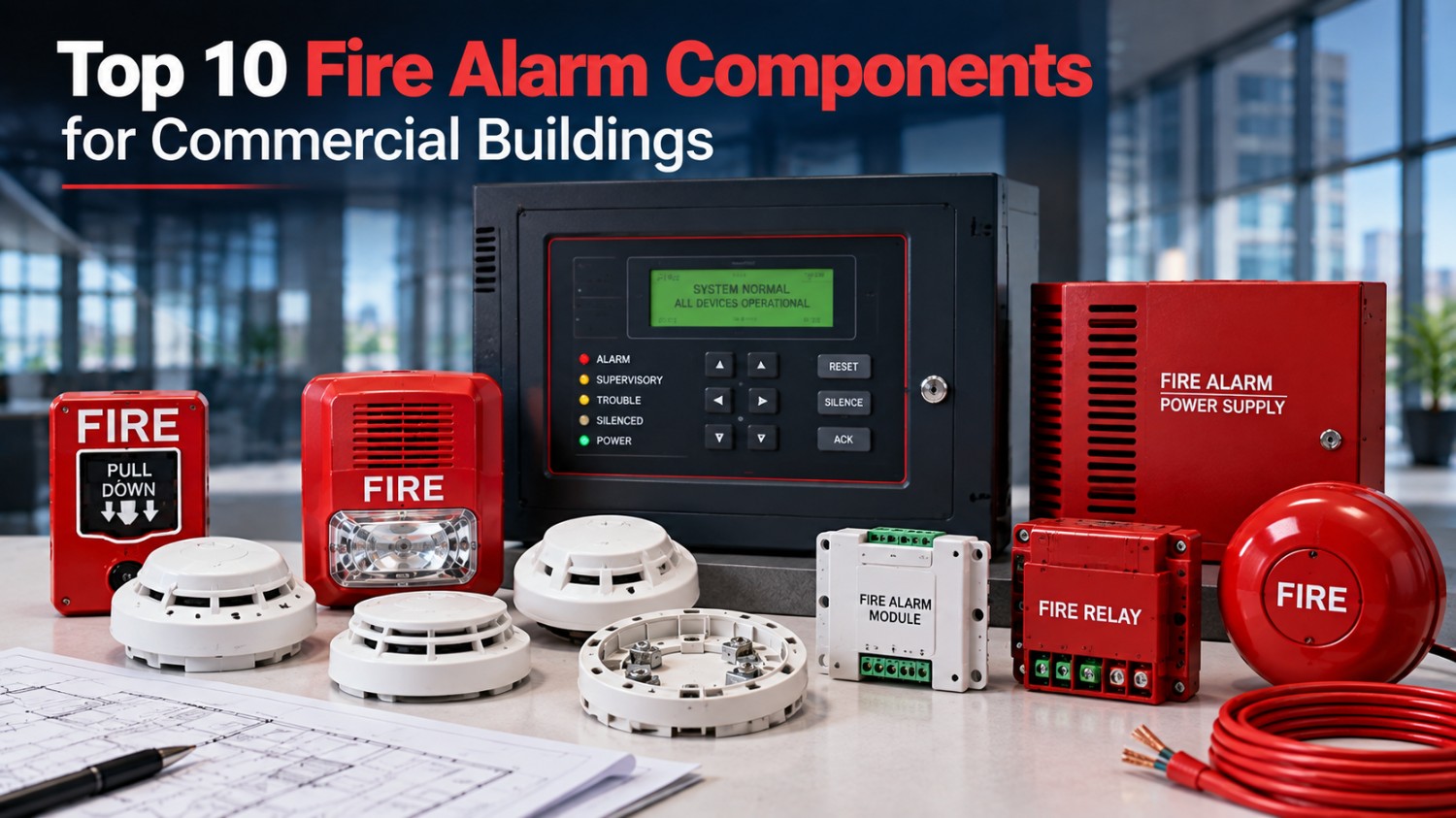
Understanding fire alarm components makes every later decision easier budgeting a retrofit, diagnosing a trouble signal, or ordering the right replacement the first time. A commercial system is not one product but a set of devices that detect, decide, signal and power, each with its own failure modes and compatibility rules. This guide walks through the ten devices found in almost every commercial building, explains what each one does, and covers how addressable and conventional architectures differ before you select or replace anything.
What Are Fire Alarm Components?
Fire alarm components are the individual devices that together form a monitored life safety system. They fall into four functional groups: initiating devices that detect a fire condition, a control panel that processes those inputs, notification devices that alert occupants, and the power and interface hardware that keeps everything running and connected.
Every device is part of a listed system, so components are not freely interchangeable. A head that fits a base mechanically may still be wrong for the protocol, and a notification appliance that powers up may still fail to synchronise. Compatibility is a documented property, not an assumption which is why the model numbers already installed are the starting point for any replacement. Background on how the central device operates is covered in the reference entry on the fire alarm control panel.
Top 10 Fire Alarm Components for Commercial Buildings
1. Fire Alarm Control Panel
The panel is the decision-making element. It monitors every circuit, processes alarm and trouble conditions, operates notification circuits and communicates with monitoring services or building systems. Fire alarm control panels come in conventional and addressable forms and are sized by point capacity, so replacing one is a design exercise rather than a swap. Fire alarm control panels set the protocol everything else follows, which is why the panel is the first thing to identify when sourcing any other component.
2. Smoke Detectors
Smoke detectors provide the earliest warning in most commercial buildings. Photoelectric sensing responds well to smouldering fires and dominates general-purpose applications; ionization sensing reacts faster to fast-flaming fires; combination heads add thermal confirmation. Detector sensitivity, spacing and siting relative to airflow matter as much as the technology chosen.
3. Heat Detectors
Heat detectors respond to temperature rather than smoke, using fixed-temperature elements, rate-of-rise sensing or both. They are slower than smoke detection by nature, so they are specified where smoke detection would be unreliable kitchens, boiler rooms, loading docks, dusty plant areas and vehicle bays. They supplement smoke detection in most designs rather than replacing it.
4. Detector Bases
Detector bases hold the detector head and terminate the field wiring. They are matched to the head and the protocol, and several variants exist: standard bases, relay bases that switch an auxiliary contact, sounder bases that add local audibility, and isolator bases that protect the loop from a short circuit. Ordering a head without confirming the base is one of the most common sourcing mistakes.
5. Manual Pull Stations
Manual pull stations let occupants initiate an alarm directly. They are installed on egress routes and at exits, in single-action or dual-action formats, and addressable versions report their own location to the panel. Because they are the one component the public touches, tamper covers and clear identification are routine additions in schools and public buildings.
6. Fire Alarm Notification Appliances
Notification appliances deliver the alarm signal to occupants: horns, strobes, horn/strobes, speakers and speaker/strobes. Strobe candela output and audible levels come from the system design, and strobes within one field of view must flash in step, which makes synchronisation a specification issue rather than a detail. Appliances from different manufacturers generally do not synchronise together.
7. Fire Alarm Modules
Fire alarm modules connect the panel to devices and systems that are not native to the loop. Monitor modules bring conventional circuits, sprinkler flow switches and tamper switches onto an addressable system; control modules drive notification circuits or output functions. These modules make interfaces to lifts, dampers and door hold-open devices possible without separate control wiring.
8. Fire Alarm Relays
Fire alarm relays provide the dry contacts that let the system operate other equipment recalling lifts, releasing magnetic door holders, shutting down air handling plant or signalling a building management system. Fire alarm relays are often supplied as addressable control relay modules, so the same device appears in both the module and relay categories depending on the manufacturer’s naming.
9. Fire Alarm Power Supplies
Fire alarm power supplies and notification booster units provide supervised, battery-backed power when panel capacity is exceeded. Any system with long notification circuits or a large device count relies on them. Battery capacity is sized for the required standby and alarm periods, and batteries remain a scheduled replacement item rather than a fit-and-forget component.
10. Duct Smoke Detectors
Duct smoke detectors sample air inside ventilation ductwork and shut down or control air handling equipment when smoke is detected, preventing the ventilation system from distributing smoke through the building. They do not provide area coverage, so they supplement ceiling detection rather than replacing it, and sampling tubes must be sized and oriented to the duct.
Addressable vs. Conventional Fire Alarm Components
| Factor | Conventional | Addressable |
| Device reporting | By zone | By individual device |
| Fault location | Search the zone | Identified at the panel |
| Sensitivity control | Fixed at the device | Programmable at the panel |
| Wiring | Separate zone circuits | Loop architecture |
| Interfacing | Relays and separate wiring | Modules on the loop |
| Typical use | Small buildings, simple layouts | Most commercial and multi-storey buildings |
Neither architecture is obsolete. Conventional systems remain appropriate for small buildings, and many are maintained for years using replacement parts that are still available. Larger sites benefit from addressable reporting, since identifying one faulty device across a large floor plate is otherwise slow work.
How to Choose the Right Fire Alarm Components
Selection is mostly about compatibility and context:
- Start with the panel. Fire alarm control panels determine, by manufacturer and protocol, which detectors, modules and bases can be used at all.
- Match the head to the base. Confirm both part numbers together, including whether a relay, sounder or isolator base is required.
- Suit the environment. Dust, humidity, temperature and airflow decide whether optical, thermal or specialist detection is appropriate.
- Check notification circuit capacity. Adding devices increases current draw, so fire alarm power supplies may be needed before the circuit is extended.
- Confirm availability of exact parts. Where a device is discontinued, use the manufacturer’s cross-reference rather than a visually similar alternative.
- Keep a device schedule. An accurate list of installed fire alarm components shortens every future order and inspection.
Major manufacturers Notifier, Simplex, Silent Knight, Gamewell-FCI, System Sensor, Fire-Lite and Edwards each maintain their own protocols and device ranges. Mixing brands within one system is rarely possible beyond interface points, so identify the ecosystem before shortlisting fire alarm components.
Installation, Inspection, and Maintenance
- Place the system in test and notify the monitoring service before any work begins.
- Record existing device addresses and settings before removing anything.
- Verify polarity and supervision after replacing initiating or notification devices.
- Clean detector heads on schedule; contamination shifts sensitivity long before an alarm occurs.
- Test batteries and supplies at the required intervals, since power failures surface only under load.
- Update as-built documentation after every change so the next inspection starts from accurate information.
The most avoidable failures come from undocumented changes. A device replaced with a near-equivalent part, an address reused without updating the schedule, or a notification circuit extended without recalculating load will all pass a casual visual check and fail when the system is needed.
Frequently Asked Questions
What are the main fire alarm components in a commercial building?
The core fire alarm components are the control panel, smoke and heat detectors, bases, manual pull stations, notification appliances, modules, relays, power supplies and duct smoke detectors. Together they detect, process, signal and power the system.
What is the difference between addressable and conventional systems?
Conventional systems report alarms by zone, while addressable systems identify each device individually and allow sensitivity to be programmed at the panel. Addressable architecture suits larger buildings; conventional remains practical for small, simple layouts.
Can I mix fire alarm components from different manufacturers?
Generally no. Detectors, bases and modules use manufacturer-specific protocols, and audible and visible devices use brand-specific synchronisation. Interfacing between systems is normally done through modules and relays rather than mixing devices on one loop.
Do detector bases need to match the detector?
Yes. Heads and bases are matched components, and the base type also determines added functions such as relay contacts, sounder output or short-circuit isolation. Always confirm both part numbers before ordering.
What do fire alarm modules actually do?
Fire alarm modules connect the panel to devices outside the loop. Monitor modules bring conventional circuits and switches into the system, while control modules operate notification circuits or auxiliary equipment.
Are duct smoke detectors required in every building?
Not universally. They are required where mechanical air handling could distribute smoke, with the applicable code and system capacity determining the threshold. They supplement, rather than replace, area smoke detection.
How do I source obsolete fire alarm components?
Start with the model number and revision on the device label, then check the manufacturer’s cross-reference for a current equivalent. Suppliers holding legacy stock can often identify or supply a direct replacement for discontinued parts.
Conclusion
A commercial fire alarm system performs only as well as its weakest link, and every one of these fire alarm components carries part of that responsibility. Detection decides how early a fire is found, the panel decides what happens next, notification decides how quickly occupants respond, and modules, relays and power supplies decide whether the rest of the building reacts correctly. When selecting or replacing fire alarm components, identify the panel and protocol first, match heads to bases, recalculate circuit loads, and document what you install those four habits prevent most of the compatibility problems facilities encounter.
If you are planning a replacement or building a spares list, record the panel manufacturer, protocol, device part numbers and base types already installed before ordering. Browse the QuickShipFire range of panels, detectors, bases, modules and power supplies, or send your device details for help identifying compatible parts, including obsolete models.