
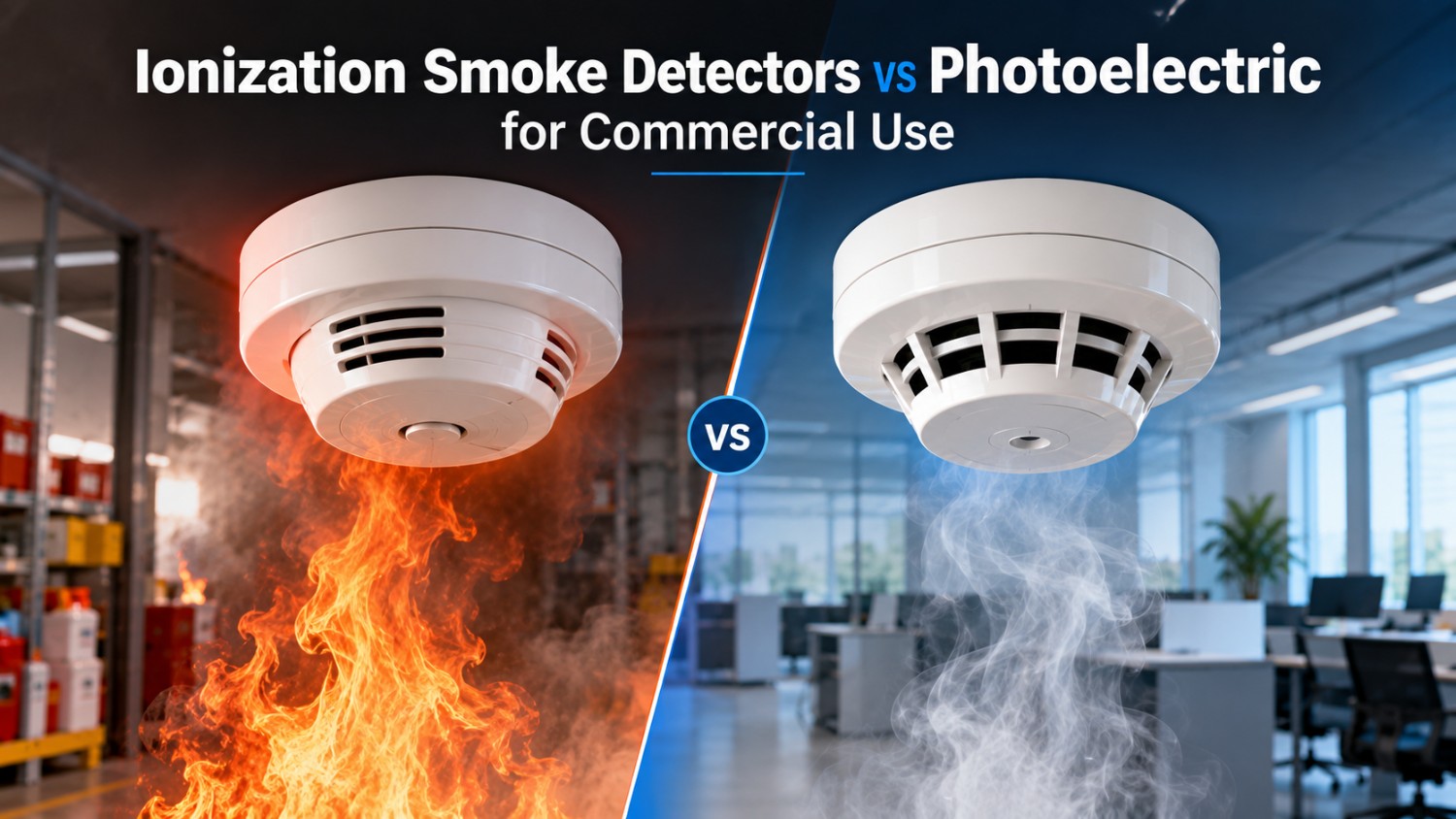
Specifying an ionization smoke detector for a commercial building is a decision about which fire you expect to catch first. Ionization sensing responds quickly to fast-flaming fires, while photoelectric sensing responds earlier to smouldering ones, and the hazard present in the protected space determines which behaviour matters. This guide explains how each technology works, where an ionization smoke detector still has a role, how the two compare in real commercial conditions, and how to select and maintain detectors so the system performs as designed.
What Is an Ionization Smoke Detector?
An ionization smoke detector uses a small quantity of radioactive material to ionise the air inside a sensing chamber, creating a steady current between two electrodes. When combustion particles enter the chamber they attach to ions and disrupt that current. The detector interprets that drop as smoke and signals an alarm, which is why an ionization smoke detector reacts so quickly to a developing flame.
The important characteristic is particle size. Ionization sensing responds strongly to the very small, often invisible particles produced by rapid, flaming combustion, which makes an ionization detector quick to react to solvent fires and fast-developing paper or wood fires. The same sensitivity to fine particles explains why an ionization smoke alarm can react to cooking aerosols or exhaust fumes, which is the source of most nuisance activations attributed to this technology.
Because it contains a radioactive source, an ionization smoke detector is subject to disposal requirements and is specified less often in new commercial installations than it once was. Ionization units remain in service in large numbers, and replacements are still needed when a device fails or a system is partially refurbished.
What Is a Photoelectric Smoke Detector?
A photoelectric detector works optically. A light source and a photodetector sit at an angle inside the chamber so the beam does not normally reach the receiver. Smoke particles entering the chamber scatter the light onto the receiver, and the detector alarms when scattering exceeds its threshold.
Larger, visible particles scatter light more effectively, so photoelectric sensing responds earlier to smouldering fires overheated cable insulation, upholstery, dust deposits on hot surfaces and slow-burning materials. This is the profile of most commercial fires that develop overnight or inside concealed spaces, which is why photoelectric detection has become the default in offices, hospitality, education and healthcare.
Ionization vs Photoelectric Smoke Detectors: Key Differences
The ionization vs photoelectric comparison is about response profile rather than overall quality. Both technologies are listed, both are used in commercial systems, and both detect fire. The question is whether an ionization smoke detector or an optical head sees the expected fire sooner.
| Factor | Ionization | Photoelectric |
| Sensing principle | Ionised air chamber, current disruption | Light scattering in an optical chamber |
| Responds fastest to | Fast-flaming fires with fine particles | Smouldering fires with larger visible particles |
| Typical nuisance sources | Cooking aerosols, exhaust, steam | Dust accumulation, insects, heavy humidity |
| Contains radioactive source | Yes, small quantity | No |
| Disposal requirements | Regulated disposal | Standard electronic waste handling |
| Common commercial use today | Targeted applications and replacements | General-purpose default |
| Maintenance sensitivity | Affected by airborne contaminants | Affected by chamber contamination |
Where Each Technology Fits
- Ionization sensing suits spaces where flammable liquids, solvents or other fast-flaming fuels are present and flaming fire detection matters more than smouldering response.
- Photoelectric sensing suits offices, corridors, storage areas, sleeping accommodation and electrical spaces where smouldering fires are the more likely starting point.
- Dual-technology sensing suits mixed-use areas where both fire profiles are credible and a single device must cover them.
- Aspirating or beam detection suits high ceilings, cold stores and large volumes where spot detection struggles to see smoke at all.
Which Smoke Detector Is Right for Commercial Buildings?
The honest answer is that the hazard decides, not the catalogue. A commercial ionization detector makes sense in a paint store, a fuel handling area or a process room where fast flaming fire detection is the priority, and a commercial ionization detector is still specified for exactly those rooms. In a general office floor, an ionization smoke detector offers no advantage over photoelectric sensing and introduces avoidable nuisance-alarm exposure near kitchens and loading doors. That is the core of the specification question for most buildings: a commercial ionization detector earns its place through the hazard, not through habit.
Where both risks exist, a dual sensor detector combining two sensing methods in one housing covers a wider range of fire profiles from a single device address. Combination smoke and heat units work the same way, using thermal sensing to confirm conditions the optical chamber alone would treat cautiously, and they reduce the number of device types a facility team must stock.
Ionization vs Photoelectric for Commercial Fire Alarm Systems
Sensing technology is only one part of the specification. The device also has to suit the system it connects to.
Conventional systems report by zone: any detector on the circuit puts the whole zone into alarm, so a nuisance activation from an ionization smoke detector in one room is harder to trace. Addressable systems report by individual device, allow panel-programmed sensitivity and apply drift compensation as the chamber accumulates contamination useful for any smoke detection technology, and particularly for heads in demanding locations. On an addressable loop, a single problematic location can be identified, adjusted or re-sited without disturbing the rest of the system.
Manufacturer ecosystems matter too. Notifier, Simplex, Silent Knight, System Sensor and Gamewell-FCI each run their own addressable protocols, and detectors are generally not interchangeable across them. When replacing an ionization smoke alarm or any other head on an existing loop, match the manufacturer and protocol first, then confirm the base is compatible. General background on how these devices operate is covered in the reference entry on the smoke detector.
Installation, Inspection, and Maintenance Considerations
Detector performance in service depends as much on placement and upkeep as on the chosen smoke detection technology. An ionization smoke detector fitted in the wrong location will generate more complaints than data.
- Keep detectors clear of supply air diffusers, doorways and other airflow paths that dilute or divert smoke before it reaches the chamber.
- Observe minimum distances from walls and from the ceiling apex on pitched ceilings, where a dead air space can delay entry of smoke.
- Avoid siting any ionization smoke detector close to kitchens, loading bays, generator exhausts or vehicle traffic.
- Clean or replace heads on the manufacturer’s schedule; contamination shifts sensitivity in both directions.
- Test after changes to the space, since partitions, new equipment and altered ventilation change how smoke travels.
- Record replacements so the as-built device schedule stays usable at the next inspection.
Two common mistakes are worth naming. The first is treating a nuisance alarm as a sensitivity problem when the real cause is location. The second is replacing a failed head with whatever is available rather than the correct type swapping an ionization smoke alarm for an optical head, for instance which quietly changes the detection profile designed for that space.
How to Choose a Commercial Smoke Detector
Work through these checks before ordering:
- Identify the fire profile. What materials are present, and would a fire there flame quickly or smoulder for a long period? Fast-flaming fire detection points towards ionization or dual sensing.
- Check the panel and protocol. The detector must match the addressable protocol or conventional circuit already installed.
- Confirm the base. Detector heads and bases are matched components, and sounder or relay bases change the part required.
- Consider the environment. Dust, humidity, temperature extremes and airflow all narrow the suitable options.
- Plan for maintenance access. Heads that cannot be reached safely rarely get cleaned on schedule.
- Check availability of the exact part. Obsolete heads may need a documented cross-reference rather than a like-for-like order.
Frequently Asked Questions
What is an ionization smoke detector best at detecting?
An ionization smoke detector responds fastest to fast-flaming fires producing very small combustion particles, such as solvent, flammable liquid and rapidly burning paper or wood fires. It is the traditional choice where flaming fire detection is the priority. It is less responsive to slow smouldering fires than photoelectric sensing.
Is photoelectric better than ionization?
Neither is universally better. Photoelectric sensing detects smouldering fires earlier and suits most general commercial spaces, while ionization sensing reacts faster to open flaming fires. The correct choice depends on the fuels present in the protected area.
Can I replace an ionization detector with a photoelectric one?
Only with a design review. Changing smoke detection technology alters the detection profile for that space, so the replacement should be confirmed against the system design, the panel protocol and the base already installed.
Why do ionization detectors cause more nuisance alarms?
These heads are sensitive to fine particles, so cooking aerosols, steam and engine exhaust can trigger them. Siting away from kitchens, loading areas and exhaust paths prevents most of these activations.
What is a dual sensor detector?
A dual sensor detector combines two sensing methods, commonly photoelectric and thermal or photoelectric and ionization, in one housing. It covers a wider range of fire profiles from a single device address.
Do ionization detectors need special disposal?
Yes. An ionization smoke alarm contains a small radioactive source, so disposal follows the manufacturer’s instructions and applicable local regulations rather than general electronic waste routes.
How often should commercial smoke detectors be tested?
Follow the applicable code and the manufacturer’s schedule, typically annual functional testing with periodic cleaning. Sensitivity testing intervals depend on detector type and the panel’s monitoring capability.
Conclusion
Choosing between an ionization smoke detector and a photoelectric device comes down to matching the sensing method to the fire you realistically expect, then confirming that the part suits the panel, protocol and base already installed. An ionization smoke detector remains valuable where fast-flaming fires are credible; photoelectric sensing covers the smouldering profile that dominates most commercial buildings; dual technology bridges the two where both risks exist. Whichever you specify, placement and maintenance determine whether the smoke detection technology actually performs in service.
If you are replacing detectors or reviewing coverage, record the panel type, protocol, base model and existing device part numbers before ordering. Browse the smoke detector range at QuickShipFire or send your device details for help identifying the right head, including obsolete and hard-to-find models.