
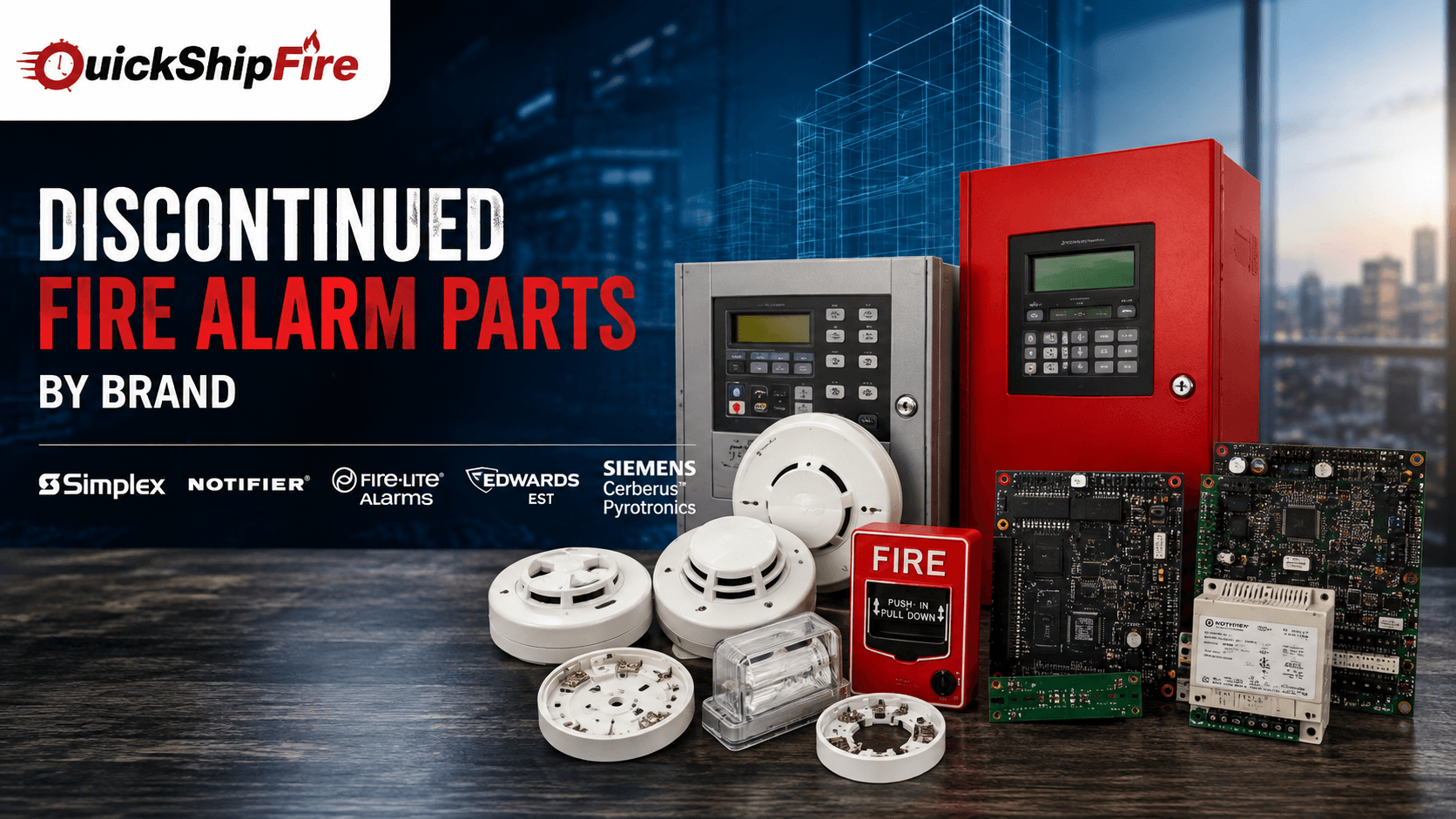
Every major fire alarm manufacturer handles the end of a product line differently, and those differences decide how hard your next replacement part will be to find. A discontinued Fire-Lite module and a discontinued Simplex sensor are not the same sourcing problem, even though both technically fall under the heading of discontinued fire alarm parts. One trades openly on the secondary market; the other sits inside a restricted distribution channel that most contractors cannot access directly.
This guide breaks the five brands you are most likely to encounter in North American commercial buildings into brand-specific sourcing realities: what tends to go obsolete first, how the aftermarket behaves, and what to check before you order.
Why Brand Matters More Than Part Age
Two factors drive availability, and neither is how old the part is.
The first is installed base size. A device fitted to tens of thousands of buildings generates enough replacement demand that resellers actively accumulate it. A device fitted to a few hundred buildings never develops a liquid secondary market at all.
The second is distribution policy. Where a manufacturer sells panel-level equipment only through authorized, factory-trained dealers, independent contractors are pushed to the aftermarket even for current-production items. That policy inflates aftermarket demand and, with it, aftermarket price.
Brand Sourcing Comparison at a Glance
| Brand | Typical obsolescence pattern | Aftermarket depth | Main sourcing challenge |
| Simplex | Long product cycles, then abrupt platform retirement of whole panel families | Deep for detectors and modules, thinner for CPU boards | Restricted OEM distribution pushes buyers to independents |
| Notifier | Steady generational replacement of detectors and loop devices | Deep, very large installed base | Version and protocol overlap between similar part numbers |
| Fire-Lite | Frequent panel generation changes with clear successor models | Deep for modules, moderate for panel boards | Matching module revision to panel firmware |
| Edwards / EST | Platform-level transitions retire large device sets together | Moderate, patchier by region | Whole-family availability gaps, limited independent stock |
| Siemens / Cerberus Pyrotronics | Legacy lines fully retired with no direct successor | Thin, especially for older Cerberus Pyrotronics devices | Genuine scarcity; migration often the only route |
Simplex
Simplex systems dominate large institutional buildings hospitals, universities, and municipal campuses which means their installed base skews toward buildings that replace slowly and repair often. TrueAlarm sensors, addressable interface modules, and pull stations are the parts most frequently hunted, because they fail or get damaged at predictable rates across large device counts.
The complicating factor is distribution. Panel-level Simplex equipment is tightly controlled, so building owners routinely find that the manufacturer will not sell them a board directly. That is why the market in obsolete Simplex fire alarm parts is unusually active it serves demand that the official channel does not.
What to check before ordering: the sensor or module part number including suffix, the loop protocol the panel uses, and whether the base you already have accepts the sensor you are buying. Simplex sensor and base pairings are specific, and ordering the sensor without confirming the base is the most common ordering error in this brand.
Notifier
Notifier’s installed base is one of the largest in the United States, which is good news for parts availability and bad news for ordering accuracy. Detector families evolve generationally, and part numbers between generations often differ by a single character while behaving differently on the loop.
The most common confusion sits between the current and previous photoelectric detector generations, where physical form is similar but electronic addressing and remote-test capability are not identical. If you are ordering replacement detectors across a large building, verify against the panel’s compatibility list rather than against what looks visually the same on the ceiling. Our overview of Notifier fire alarm parts covers the current device families and where they overlap.
What to check before ordering: the panel model and firmware revision, whether the detector needs remote-test capability, and whether the base carries a sounder or relay function you must preserve.
Fire-Lite
Fire-Lite sits in small-to-mid commercial buildings retail units, offices, small schools, light industrial. Panels turn over faster here than in the institutional market, so the brand has produced several generations of addressable panel in a relatively short span, and each generation stranded a set of modules and detectors behind it.
The practical consequence is that Fire-Lite obsolescence is usually solvable by cross-reference rather than by hunting dead stock. Successor devices are generally well documented, and many legacy detectors have a designated modern equivalent that mounts on the same base. Where cross-reference does not work is at the module level, where revision-to-firmware matching becomes important. Our catalogue of Fire-Lite alarm parts is organised around exactly these legacy-to-current mappings.
What to check before ordering: panel generation, module revision letter, and whether your panel firmware supports the newer device. A module that is electrically compatible but not recognised in programming will read as a missing device.
Edwards / EST
EST equipment appears heavily in institutional and higher-education buildings. The brand’s obsolescence pattern is platform-level: when a panel platform is retired, its associated device family goes with it, rather than individual part numbers dropping out over time.
That makes EST sourcing lumpy. Either the family you need is still reasonably available, or almost nothing from it is. Independent stock is patchier than for Notifier or Fire-Lite, and regional availability varies more. For buildings on a retired EST platform, the realistic options are secondary-market accumulation for critical spares plus a planned migration timeline. Browsing the Edwards brand range is a reasonable starting point for identifying what is still moving.
What to check before ordering: the panel platform generation first, then the device. Working the other way around wastes time on EST systems.
Siemens and Cerberus Pyrotronics
This is the hardest of the five. Legacy Cerberus Pyrotronics lines are fully retired with no direct successor devices, and the installed base while genuinely significant in older commercial and industrial buildings is small enough that the aftermarket never developed real depth.
If you maintain one of these systems, treat every serviceable spare you can find as strategic inventory. Buy them when you see them, not when you need them. Current Siemens fire alarm equipment will not generally interoperate with the legacy Cerberus loop, so the migration conversation usually arrives sooner on these systems than on any other brand in this list.
What to check before ordering: condition and provenance above all. In a market this thin, disclosure quality separates the suppliers worth using from the ones that are not.
Working on a brand we have not listed, or a part number you cannot find anywhere? Send us the number and the panel it belongs to. We will confirm honestly whether it is on our shelf, sourceable, or better handled by cross-reference no obligation. Request a quote here or call (833) 747-7845.
Building a Brand-Specific Spares Strategy
Whatever brand you maintain, the approach is the same in structure and different in urgency. Inventory the devices actually installed, flag anything the manufacturer has announced as end-of-life, and rank spares by consequence of failure rather than by unit cost. A twelve-dollar isolator that takes an entire loop offline outranks an expensive device that only affects one room.
Then match urgency to brand. On Fire-Lite and Notifier you can generally afford to buy reactively, because supply exists. On EST and especially on legacy Siemens platforms, buy proactively waiting turns a sourcing task into a capital project. Simplex sits in between: parts exist, but the channel does not always want to sell them to you. If you are still deciding whether to repair or replace at panel level, the fire alarm control panel buyer’s guide sets out the cost thresholds worth using.
Conclusion
There is no universal answer to a discontinued fire alarm part, only a brand-specific one. Simplex demands channel workarounds, Notifier demands ordering precision, Fire-Lite rewards cross-referencing, EST requires platform-level planning, and legacy Siemens and Cerberus Pyrotronics reward opportunistic buying above everything else.
Start with an honest device inventory of the building, then apply the right strategy per brand. If you already know what you need, browse the full parts catalogue or send the part number over and we will check availability against real stock.
Frequently Asked Questions
Which fire alarm brand has the worst parts availability?
Legacy Cerberus Pyrotronics lines are generally the most difficult, because production ended entirely and the installed base was never large enough to sustain a deep aftermarket. Older EST platform families come second for similar reasons.
Can I use a Notifier device on a Fire-Lite panel?
Not reliably, despite both brands sitting under the same corporate parent. Loop protocols and device addressing differ between the product lines. Always confirm against the panel’s published compatibility documentation rather than assuming corporate relationship implies interoperability.
Why can’t I buy Simplex panel boards directly from the manufacturer?
Panel-level equipment for several major brands is sold through authorized dealers who hold current factory training. Building owners and non-authorized contractors are typically outside that channel, which is why independent resellers serve a large share of this demand.
Is a refurbished board acceptable to an AHJ?
Generally yes, if the device is genuine, correctly listed for its application, and functioning as designed. Authorities are concerned with listing validity and system performance rather than with whether a board is new. Keep documentation of what was installed.
How do I find out if my specific part is discontinued?
Check the manufacturer’s current catalogue and any published end-of-life notices, then cross-check availability across two or three independent suppliers. If nobody current-production stocks it and resellers do, it is discontinued in practice regardless of formal status.
Should I standardise on one brand across a multi-building portfolio?
Where you have the choice, yes. Single-brand portfolios simplify spares holding, technician training, and cross-reference work considerably. Mixed portfolios need per-brand spares strategies, which is where most facility teams get caught out.
What paperwork should I keep after fitting a discontinued part?
Keep the supplier invoice, the packaging or label showing the part number and listing marks, and a note in the system record of completion. If an inspection later questions the component, that file answers it in minutes.