
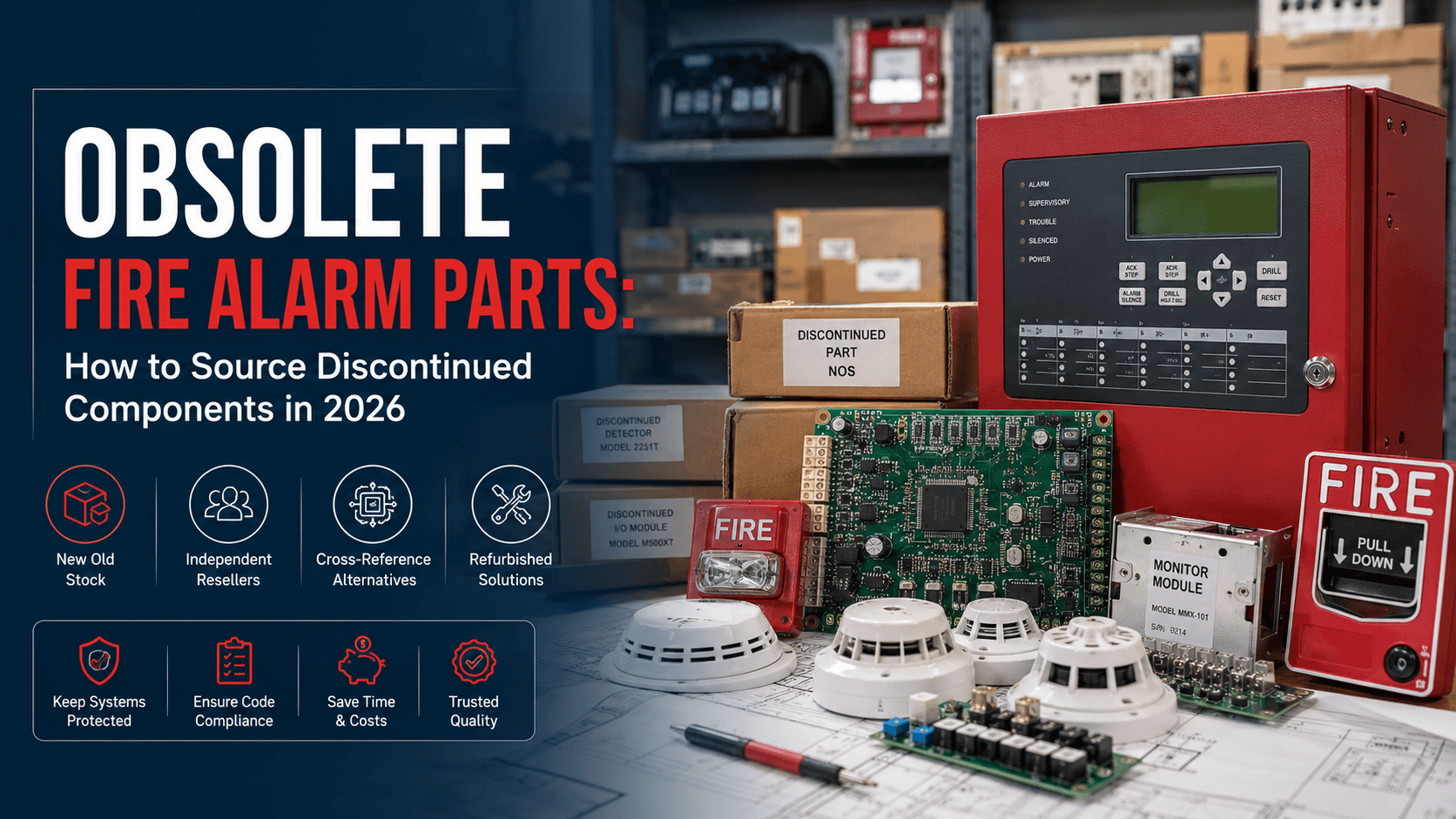
A twenty-year-old addressable panel in a medical office building is sitting in trouble, the service contractor has traced the fault to a single monitor module, and the manufacturer’s answer is that the module was discontinued eleven years ago. The building cannot legally sit unprotected over the weekend, and a full panel replacement is a six-figure capital project that nobody budgeted for. This is the everyday reality behind the market for obsolete fire alarm parts. Fire alarm systems are designed to last twenty to thirty years in the field, but the components inside them are manufactured on a commercial cycle that rarely exceeds ten. The gap between those two timelines is where most sourcing problems live. This guide explains why parts disappear, the four practical routes to replacing one, and how to verify what you are buying before money changes hands.
Why a Working Part Disappears From the Market
Nothing about a discontinued component means it stopped working. Understanding the actual reason it left the catalog tells you which sourcing route will succeed.
Manufacturer end-of-life cycles
Manufacturers retire product families to consolidate platforms, move to newer communication protocols, or drop lines with thinning margins. Once a line is declared end-of-life, remaining stock flows through distribution over roughly twelve to twenty-four months, and after that the only supply is whatever sits on a shelf somewhere.
Standards changes that strand entire model lines
Revisions to detector testing standards have retired whole detector families in a single stroke. When a listing requirement changes, manufacturers cannot continue producing the old design for the US market even if demand exists. This is the most abrupt form of obsolescence and it usually affects detectors rather than modules or boards.
Component-level supply failures
A single discontinued microcontroller or optical chamber assembly can force a board out of production long before the manufacturer intended. These cases are unpredictable, and they explain why some parts vanish with no advance notice.
Distribution restrictions
Some manufacturers restrict sales of panel-level equipment to authorized dealers holding current factory training. The part still exists but is functionally unavailable to independent contractors and building owners, which pushes them toward the secondary market for what are effectively discontinued fire alarm parts from a buyer’s point of view.
The Four Routes to Replacing a Discontinued Component
Route one: new old stock
New old stock, or NOS, is unused factory-packaged inventory that never got installed. It comes from cancelled projects, closed contractors, overbought jobs, and distributor clearances. NOS is the ideal outcome for legacy systems because it drops in with no programming changes, no compatibility testing, and no re-acceptance testing of adjacent devices. The catch is that supply is finite and unpredictable. Anyone holding new old stock fire alarm inventory is sitting on a diminishing asset, which is why prices on scarce NOS often exceed the original list price. That premium is usually still cheaper than the alternative.
Route two: independent resellers with obsolete inventory
Independent resellers aggregate stock from decommissioned buildings, contractor surplus, and estate purchases. This is the deepest source of genuinely dead part numbers. Depth varies enormously by brand — obsolete Simplex fire alarm parts are more widely traded than, say, discontinued Cerberus Pyrotronics components, simply because the installed base is larger.
Route three: cross-reference to a current equivalent
Many discontinued devices have a designated successor that the manufacturer intended as a drop-in. Detectors are the most common case: newer generations frequently work on the same base and the same loop protocol. This route is often the cheapest and the most future-proof, but it requires care. “Compatible” and “drop-in” are not the same claim, and a successor may need a base change, a different addressing method, or a panel firmware revision.
Route four: refurbished boards and panels
For panel CPUs and main boards, refurbished units are frequently the only realistic option. A properly refurbished board has been bench-tested, reset to factory defaults, and warrantied. This route carries the most variability in quality between suppliers, so the questions in the next section matter most here. Ask specifically whether the board was tested under load rather than simply powered up, and whether any programming passcode has been cleared before shipment — an installed board you cannot get into is no better than a dead one. Our guide comparing new versus refurbished fire alarm panels walks through where each option makes financial sense.
Identify Exactly What You Need Before You Search
Most failed sourcing attempts start with an incomplete part number. Before contacting any supplier, capture the following from the device itself rather than from the as-built drawings, which are frequently out of date:
- The full part number including any suffix. A colour or trim suffix can change the SKU entirely.
- The revision letter, often printed on a board’s silkscreen or a detector’s label.
- The panel make, model, and firmware version the device will report to.
- The protocol the loop runs, since two devices with near-identical numbers may use different addressing schemes.
- Quantity needed now versus quantity needed over the next twenty-four months.
That last point is the one most buyers skip. When you locate a scarce part, buying only the one you need today guarantees you will repeat the search in eighteen months at a higher price against a smaller supply. Sourcing spares for the remaining service life of the system is almost always the better economic decision for legacy fire alarm system parts.
Verify Before You Buy
Scarcity attracts bad actors. Counterfeit and grey-market fire alarm devices exist, and an uncertified detector in a life safety system is both a liability and a code violation. Ask any supplier these five questions:
- Is the item new in original manufacturer packaging, refurbished, or used? A supplier that will not answer plainly is answering plainly.
- What is the listing status of the part, and does that listing still apply for my jurisdiction?
- What is the return path if the part does not resolve the fault?
- What warranty applies, and is it the supplier’s or the manufacturer’s?
- Can you confirm real stock on hand, or is this a listing against a sourcing promise?
Reputable independent resellers answer all five without hesitation. Keep the invoice and packaging documentation on file — an authority having jurisdiction reviewing a system after a repair may ask what was installed and where it came from.
Need a part number nobody else can find? Send us the details and we will tell you honestly whether we have it on the shelf, can source it, or whether a cross-reference is the smarter move. Request a quote or call (833) 747-7845 — most enquiries get a real answer the same business day.
When Sourcing Is the Wrong Answer
Chasing parts has a limit. If a panel is failing repeatedly across different subsystems, if replacement boards are commanding more than a third of a new panel’s cost, or if the system can no longer meet current code without extensive workarounds, migration is the better spend. The honest test is a three-year total cost comparison rather than a comparison of today’s invoice. A stack of scarce addressable modules bought at a premium to keep a failing panel alive can quietly exceed the cost of a planned replacement.
Conclusion
Obsolescence in fire alarm equipment is a scheduling problem disguised as an emergency. The buildings that handle it well are the ones that identify their end-of-life devices during a planned inspection, stock critical spares before scarcity bites, and keep an accurate device inventory so that when a fault does appear the search takes minutes rather than days. The buildings that handle it badly find out on a Friday afternoon.
Start by documenting what is actually installed, then decide brand by brand whether NOS, secondary-market stock, cross-referencing, or migration fits. If you already know the part number and just need to know whether it exists somewhere, get in touch and we will check the shelf.
Frequently Asked Questions
Is it legal to install a discontinued fire alarm part?
Yes, provided the part carries a valid listing for its application and the authority having jurisdiction accepts it. Discontinued does not mean delisted. What matters is that the component is genuine, appropriately listed, and compatible with the panel it reports to.
What is the difference between obsolete, discontinued, and end-of-life?
End-of-life is the manufacturer’s announcement that production will stop. Discontinued means production has stopped but support may continue. Obsolete generally means production and support have both ended and the only supply is secondary market or new old stock.
How long do manufacturers support a fire alarm panel after discontinuation?
Support windows vary by manufacturer and are typically stated as a number of years after the last production date, often around seven to ten. Parts availability usually dries up well before formal support ends, so treat the announcement date as your planning trigger.
Can I mix new devices with an older panel?
Sometimes. Compatibility depends on the loop protocol and the panel firmware, not on the age of the device. Always confirm against the panel’s compatibility documentation before ordering quantity.
Why do obsolete parts cost more than the original list price?
Because supply is fixed and shrinking while demand continues for as long as the installed base exists. The premium reflects scarcity, not condition. It is still usually a fraction of the cost of the panel replacement it defers.
Should I buy spares for a system I plan to replace in three years?
Usually yes, in small quantity. A handful of critical spares protects against an unplanned outage during the period when your capital project is still being approved and scheduled.
What should I do with surplus fire alarm parts from a decommissioned building?
Do not scrap them. Unused devices in original packaging have real value to buildings still running that platform, and resellers actively buy this inventory. It is one of the main ways NOS re-enters the market.
How do I tell a genuine part from a counterfeit?
Check packaging quality, label printing consistency, listing marks, date codes, and board silkscreen against a known-good unit. Buy from suppliers who disclose condition and provenance in writing, and be sceptical of pricing that sits far below every other source.