
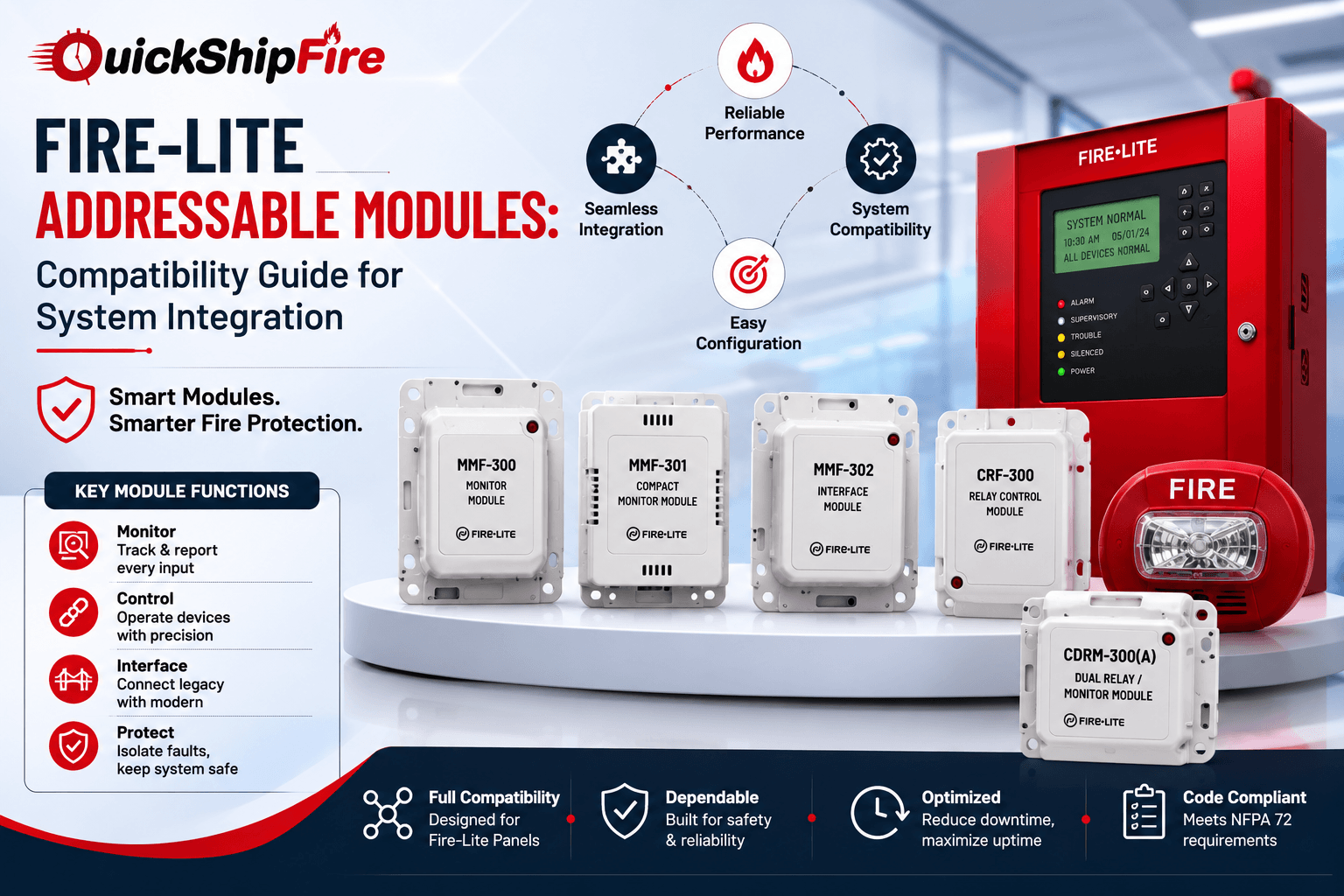
Fire-Lite addressable modules are the interface layer between a Fire-Lite panel and the non-detector devices on a job, initiating contacts, relays for door holders and fan shutdown, and conventional detector zones being bridged onto an addressable loop. Getting module selection and compatibility right is just as important as detector selection, and it is an area where integrators frequently run into avoidable trouble: a module that looks interchangeable on paper but is not actually listed compatible with a given panel generation. This guide walks through the major Fire-Lite addressable module families, what each one does, and the compatibility details that matter most on a real integration project.
Why Fire-Lite Addressable Modules Matter for System Design
It is tempting to treat modules as an afterthought compared to panel and detector selection, but Fire-Lite addressable modules are frequently what determines whether a design actually fits within a job’s budget and schedule. Choosing the correct module family up front avoids rework, and standardizing on a consistent set of Fire-Lite addressable modules across a portfolio of buildings simplifies training for service technicians and shortens the time needed to diagnose a trouble condition in the field. Because every Fire-Lite addressable module reports its own type and status back to the panel, a well-planned module layout also gives facility staff far more actionable information than a conventional, zone-based approach ever could.
What Fire-Lite Addressable Modules Do
On an addressable fire alarm system, every device needs its own address on the signaling line circuit so the panel can identify exactly which device reported an event. Detectors handle this natively, but manual stations, sprinkler contacts, door holders, and relay-controlled equipment are not addressable devices on their own. Fire-Lite addressable modules bridge that gap, giving these conventional, dry-contact, or relay-driven devices an address on the SLC loop so the panel can monitor or control them individually rather than lumping them into an unaddressed zone.
- Monitor modules give an individual address to normally-open contact devices such as manual stations and sprinkler contacts.
- Relay control modules let the panel operate external equipment such as door holders, fans, and dampers.
- Dual relay/monitor modules combine both functions in a single addressable device to save space and cost.
- Interface modules bridge entire zones of conventional two-wire detectors onto an addressable signaling line circuit.
- Isolator modules protect the SLC loop from a single short taking down the entire circuit.
Fire-Lite Monitor Modules: MMF-300 vs MMF-301 vs MMF-302
The MMF-300 series is the standard-sized family of Fire-Lite addressable modules for monitoring, typically mounted to a 4-inch square electrical box, and it supervises either a Style D (Class A) or Style B (Class B) circuit of dry-contact input devices. It is a direct upgrade path for older M300 modules in existing systems, and it identifies itself automatically to the panel as a monitor module through built-in type identification, which simplifies programming considerably compared to older, manually-configured module generations.
The MMF-301 is a compact monitor module designed to mount inside a single-gang junction box directly behind the device it monitors, commonly a pull stations or similar dry-contact device. Its smaller footprint makes it a popular choice for retrofit projects where a standard 4-inch box is not practical. The MMF-302, by contrast, is an interface module rather than a simple monitor module: it allows an addressable panel to interface with and monitor an entire zone of two-wire conventional smoke detectors, transmitting the collective status of that zone back to the panel as a single addressable point, which is especially useful when integrating legacy conventional detection into a newer addressable loop.
| Module | Function | Typical Application |
| MMF-300 | Standard monitor module, Style D/B (Class A/B) | General dry-contact device monitoring, replaces M300 |
| MMF-301 | Compact monitor module, single-gang mount | Manual stations, sprinkler contacts in tight spaces |
| MMF-302 | Interface module for conventional detector zones | Bridging legacy two-wire detector zones onto SLC |
| CRF-300 | Relay control module, Form C output | Elevator recall, fan shutdown, door holder release |
| CDRM-300(A) | Dual relay/monitor module | Combined monitoring and control in one addressable device |
Relay and Control Modules
The CRF-300, one of the more common Fire-Lite addressable modules for control applications, activates external devices based on commands from the fire alarm control panel, using a Form C (SPDT) relay output that supports both normally open and normally closed circuits depending on the application. It operates over the same two-way addressable communication as Fire-Lite’s monitor modules, and it is commonly specified for elevator recall, HVAC fan shutdown, smoke damper control, and door-holder release, functions where the panel needs to actively control equipment rather than simply monitor a contact.
For projects that need both monitoring and control at the same location without dedicating two separate modules, the CDRM-300(A) dual relay/monitor module combines two individual relay outputs and two Class B monitor inputs in a single addressable device, which reduces both material cost and the physical footprint required in a crowded junction box.
- CRF-300 relay modules use a Form C output, supporting both normally open and normally closed control circuits.
- CDRM-300(A) combines two relay outputs and two monitor inputs, reducing device count on space-constrained jobs.
- Relay modules are powered directly from the SLC loop and require no separate external power source.
- Install relay modules close to the equipment they control to minimize wiring runs and simplify troubleshooting.
- LED status indicators on most Fire-Lite modules provide quick visual confirmation during commissioning and service.
Panel Compatibility: What to Check Before Ordering
Fire-Lite addressable modules are only supported on listed, compatible fire alarm control panel platforms, and manufacturer installation instructions explicitly warn against connecting modules to unlisted or incompatible panels. Most current Fire-Lite addressable modules address directly on MS-9600 series panels using a two-digit direct-dial address from 01 through 159, while some legacy panel families support only 01 through 99, which affects how a large job needs to be zoned and addressed during design. Confirming the exact addressing range and supported module list for the specific panel generation in use, rather than assuming universal compatibility across the Fire-Lite product line, prevents a rejected submittal or a failed inspection.
This compatibility check matters most on retrofit and expansion projects, where an older panel such as a refurbished MS-9200UDLS panel may support a narrower module list than a current-generation panel such as the Fire-Lite ES-200X panel. Mixing module generations across a system without verifying compatibility is one of the most common sources of nuisance troubles during commissioning.
- Confirm the specific panel model and firmware revision support the exact module part number being specified.
- Check the addressing range supported by the panel; some legacy panels support only 01-99 rather than 01-159.
- Verify Class A versus Class B wiring support matches the project’s code requirements before finalizing module selection.
- Review the manufacturer’s current compatibility list rather than relying on a prior project’s bill of materials.
- Test module communication and addressing during commissioning before closing up walls or ceilings around the device.
Common Integration Scenarios
The most frequent use case for Fire-Lite addressable modules is bringing non-addressable initiating devices onto an addressable loop. A waterflow switch on a sprinkler riser, for example, is a simple dry-contact device that needs a monitor module to report its status individually to the panel rather than as part of a larger, less specific zone. The same logic applies to tamper switches, elevator recall stations, and any other contact-based device that needs individual identification during an alarm event.
Retrofit projects frequently use interface-type Fire-Lite addressable modules to bridge existing conventional detector zones rather than replacing every detector with an addressable model immediately, which spreads the cost of a full addressable conversion across multiple budget cycles. Control modules, meanwhile, are what let a fire alarm system actively manage building equipment beyond simple notification appliances, extending the system’s role from detection and notification into building-wide life safety control.
- Bridging legacy conventional detector zones onto a new addressable loop without full detector replacement.
- Giving individual addresses to sprinkler flow and tamper switches and other supervisory devices.
- Controlling door holders, dampers, and fans through relay modules tied to specific alarm zones or events.
- Adding elevator recall and firefighter’s smoke control station functions to an existing addressable system.
- Expanding monitored point count on a job without adding a second signaling line circuit where capacity allows.
Whether you are specifying modules for new construction or sourcing a compatible replacement for an aging addressable system, QuickShipFire stocks Fire-Lite addressable modules alongside compatible panels, detectors, and notification appliances. Request a quote and our team will help confirm compatibility and get the right parts shipped fast, including hard-to-find modules for legacy panel generations.
Stocking and Sourcing Fire-Lite Addressable Modules
Because Fire-Lite addressable modules span multiple generations and part numbers, service contractors who support a mix of building vintages benefit from keeping a stocked assortment of the most common Fire-Lite addressable modules on hand rather than special-ordering a single unit every time a device fails in the field. Monitor modules and relay modules both see steady attrition from field damage, water intrusion, and simple end-of-life failure, and having compatible Fire-Lite addressable modules already in inventory can be the difference between a same-day repair and a building running with an open trouble condition for days while a part ships.
For new construction, ordering Fire-Lite addressable modules in the correct quantity and mix up front, rather than reactively as the job progresses, also reduces the number of separate shipments and simplifies coordination with the electrical contractor pulling wire to each device location.
Conclusion
Fire-Lite addressable modules are what turn a collection of initiating devices and controlled equipment into a fully integrated, individually addressable fire alarm system. Choosing the right module family, monitor, relay, dual, or interface, comes down to what the device on the other end needs to do, while compatibility with the specific panel generation on the job determines whether that module will actually integrate cleanly. Verifying panel compatibility, addressing range, and wiring class before ordering avoids the nuisance troubles and rejected submittals that come from assuming universal compatibility across a product line that has evolved significantly over multiple generations.
Frequently Asked Questions About Fire-Lite Addressable Modules
What is the difference between a Fire-Lite monitor module and a relay module?
A monitor module gives an individual address to a dry-contact input device, like a pull station or waterflow switch, so the panel can identify it individually. A relay module does the opposite: it lets the panel control an external device, such as a door holder or fan, based on commands from the panel.
Can Fire-Lite addressable modules be used with any Fire-Lite panel?
No. Modules must be connected only to listed, compatible control panels, and addressing ranges vary between panel generations. Always confirm the specific module is listed compatible with the exact panel model and firmware in use before ordering.
What is the MMF-302 module used for?
The MMF-302 is an interface module that allows an addressable Fire-Lite panel to monitor an entire zone of conventional two-wire smoke detectors as a single addressable point, which is commonly used when integrating legacy conventional detection into a newer addressable system.
How many addresses can a Fire-Lite addressable module support?
Most current modules support direct-dial addressing from 01 to 159 on MS-9600 series panels, while some other compatible panel families support only 01 to 99, so the supported range should always be confirmed against the specific panel in use.
Do Fire-Lite addressable modules need external power?
No. Most Fire-Lite addressable modules, including monitor and relay modules, are powered directly from the signaling line circuit loop and do not require a separate external power supply.
Can I mix module generations on the same Fire-Lite addressable system?
It depends on panel and firmware compatibility. Mixing module generations without verifying compatibility against the panel’s current supported device list is one of the more common causes of nuisance troubles during commissioning, so this should always be checked before mixing product generations.
What is the CDRM-300(A) module used for?
The CDRM-300(A) is a dual relay/monitor module that combines two individual relay control outputs and two Class B monitor inputs in one addressable device, useful for projects that need both monitoring and control at the same location without installing separate modules for each function.