
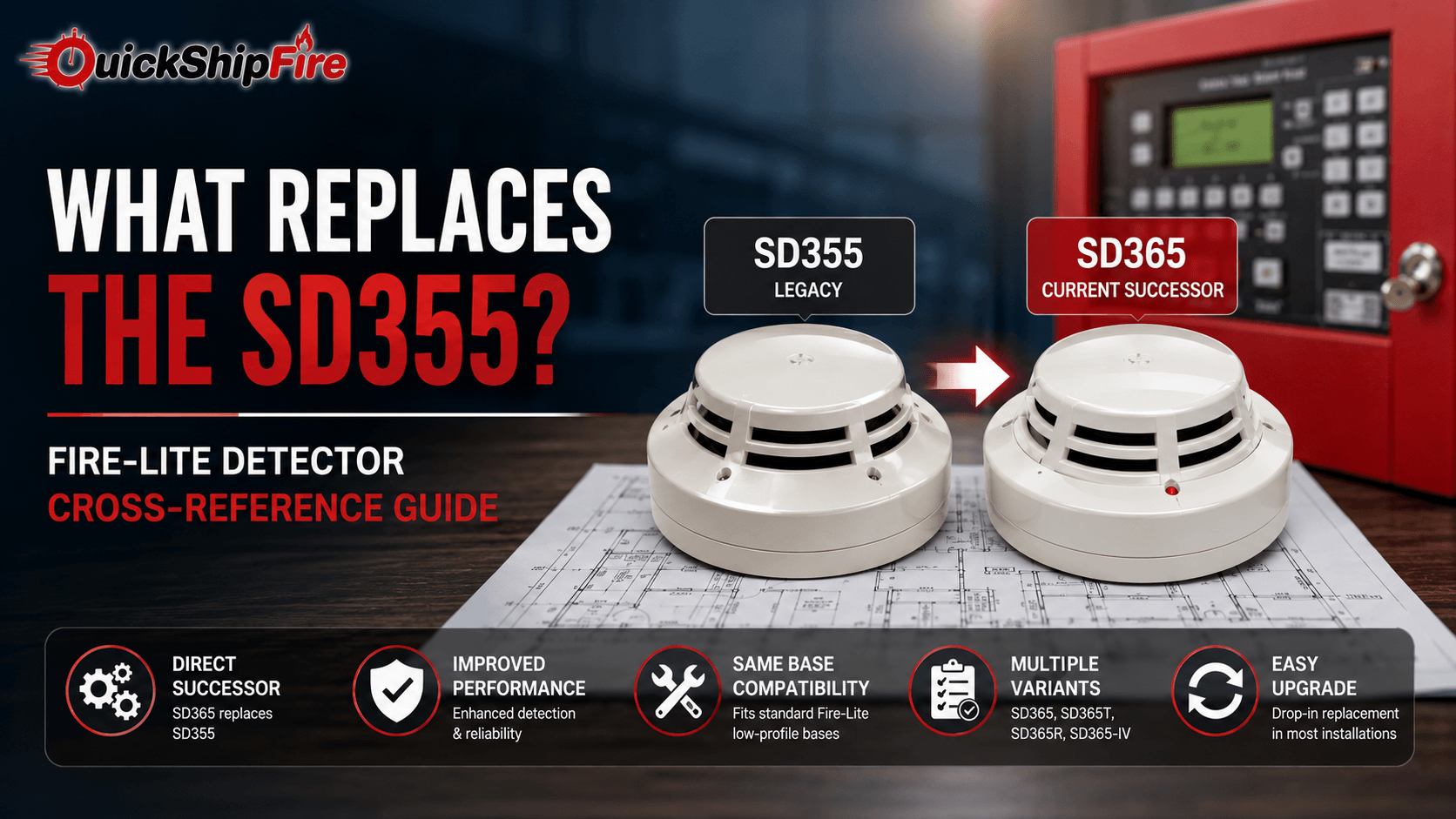
Short answer: the SD365. If you are holding a failed Fire-Lite SD355 photoelectric detector and need the modern equivalent, the SD355 replacement is the SD365, which was designed as the direct successor in the same addressable detector family and mounts on the standard low-profile base.
That is the answer most technicians came here for. The rest of this guide covers the parts that are less obvious: which SD365 variant you actually need, what changes when you swap, when the base has to change too, and how to handle a mixed-generation loop during a phased replacement.
Why the SD355 Was Replaced
The SD355 belonged to an earlier generation of Fire-Lite addressable photoelectric detectors. Its successor family was introduced with improved detection electronics and better resistance to nuisance conditions, alongside changes that brought the line in step with contemporary detector testing requirements.
That last point matters for planning. When detector standards are revised, the affected devices leave production regardless of demand, which is why SD355 supply thinned quickly rather than tapering off over several years. If you still have SD355 units in service, they are running on a supply of new old stock and reseller inventory that will not be replenished.
First, Confirm You Actually Have an SD355
Before ordering anything, verify the device rather than trusting the drawings. Take the detector off the base and read the printed label on the body part number, any suffix, and the date code. Panel device descriptions are unreliable because they carry forward from earlier programming and often describe a device type generically rather than by model.
Two things to note while the detector is in your hand. First, whether the base beneath it is a plain base or one with a sounder, relay, or isolator function, since that decides part of your order. Second, the date code, which tells you how far through its service life the rest of the building’s detectors are likely to be. If one SD355 has failed at fifteen years, its neighbours installed the same week are not far behind, and that changes the conversation from a single replacement to a phased programme.
SD355 vs SD365: What Actually Changes
| Attribute | SD355 (legacy) | SD365 (current successor) |
| Detection type | Addressable photoelectric | Addressable photoelectric |
| Panel families | Fire-Lite addressable panels of its generation | Current and recent Fire-Lite addressable panels |
| Base | Standard Fire-Lite low-profile bases | Standard Fire-Lite low-profile bases |
| Combination smoke/heat option | Separate legacy part number | SD365T |
| Remote test capability | Not on the base model | SD365R variant |
| Colour options | Limited | Includes SD365-IV ivory |
| Current production | No – discontinued | Yes |
The practical takeaway is that the swap is mechanically simple and electrically straightforward in most installations. The decisions that need attention are variant selection and panel firmware.
Choosing the Right SD365 Variant
Ordering the base SD365 when the original device was a combination or remote-test unit is the single most common mistake on this cross-reference.
SD365 – standard addressable photoelectric detector. This is the direct like-for-like swap for a plain SD355.
SD365T – photoelectric with an integral thermal element. Specify this where the original device was a combination smoke and heat detector, typically in areas with elevated ambient temperature or where a heat element was specified for faster response to flaming fires.
SD365R – the remote-test capable variant. If the building uses a magnetic or remote test method for detectors in high or difficult-to-reach locations, this is not optional. Retrofitting the wrong variant here means a technician needs a lift for every annual test.
SD365-IV – ivory finish, functionally identical to the standard SD365. Cosmetic, but relevant in finished spaces where the specification called for a particular colour.
Confirm which variant you are replacing by reading the label on the removed device rather than the panel’s device description, which is frequently generic or inherited from an earlier programming session.
Does the Base Need to Change?
In most cases, no. The successor detectors are designed to fit the same standard Fire-Lite low-profile base family, which is what makes this a genuine drop-in rather than a rewire.
The exceptions are worth knowing:
- Sounder bases. If the original installation used a sounder base for local audibility, the replacement base must preserve that function. Fitting a plain base removes a notification device from the system.
- Relay bases. Common where a detector controls a door holder, damper, or elevator recall function. Losing the relay silently breaks an ancillary function that may not show as a trouble.
- Isolator bases. Used to protect loop segments from short circuits. If the design included isolation, keep it.
- Physically damaged or corroded bases. Cheap to replace while the detector is already off the ceiling, and far cheaper than a second visit.
Where any of these apply, order the matching base at the same time from the detector bases range rather than assuming the existing hardware will carry over.
Panel Firmware and Protocol Compatibility
This is the step that turns a fifteen-minute swap into a callback. A newer detector on an older panel can fail to be recognised even when it is wired correctly and addressed correctly, because the panel’s firmware does not know the device type.
Before ordering quantity:
- Note the panel model and its firmware revision from the panel display or the printed label inside the enclosure.
- Check the panel’s published compatibility documentation for the detector family you are fitting.
- If the panel is at an older firmware revision, establish whether an update is available and who is authorised to apply it.
- Test one detector on one loop before committing to a full building changeover.
That last step costs almost nothing and prevents the scenario where two hundred detectors arrive on site and none of them report. Across the wider range of Fire-Lite addressable detectors, the compatibility question is nearly always about panel generation rather than about the device itself.
Handling a Phased Replacement
Few buildings replace every detector at once. A mixed loop with legacy and current detectors is normal during a phased programme, and it works provided both device types are supported by the panel firmware and each device is correctly typed in programming.
Two practical rules make phased work go smoothly. First, replace by loop rather than by floor it keeps programming changes contained and makes verification simpler. Second, record the address, device type, and installation date of every replacement as you go. Two years into a phased programme, nobody remembers which ceiling tiles have been done, and an accurate record turns the remaining work into a list rather than a survey.
Need SD365 detectors, or still running SD355 units you want to stock spares for? We hold both current-production successors and hard-to-find legacy Fire-Lite stock. Check availability and pricing or call (833) 747-7845 we will confirm the right variant against your panel before you order.
What If You Want to Keep the SD355?
Sometimes the right decision is to keep the existing detectors running a little longer a building with a scheduled panel replacement eighteen months out, for example, has little reason to fund a full detector changeover first.
In that case, buy SD355 spares now rather than later. Discontinued stock does not get cheaper or more available with time, and holding three or four units against a two-hundred-detector building is inexpensive insurance. The one thing not to do is nothing: discovering there are no spares available on the day a detector fails is how unplanned outages happen.
Conclusion
The SD355 to SD365 cross-reference is one of the cleaner legacy-to-current mappings in commercial fire alarm equipment. The detector swaps onto the same base family, the panel side is usually straightforward, and current production means supply is not a constraint. The three things that catch people out are variant selection, special-function bases, and panel firmware check all three before ordering in volume.
If you are working through a wider list of legacy Fire-Lite devices rather than just this one part number, our guide to discontinued Fire-Lite modules covers the module-side equivalents and the revision matching they require.
Frequently Asked Questions
Is the SD365 a direct drop-in replacement for the SD355?
In most installations, yes. It fits the same standard low-profile base family and serves the same function on the loop. Confirm your panel firmware supports the newer detector family and that you have selected the matching variant before ordering quantity.
Do I need to reprogram the panel after fitting an SD365?
Usually the device type needs to be confirmed or updated in programming even though the address stays the same. Panels that auto-learn devices will pick this up during a re-learn; others require a manual programming change.
Can I mix SD355 and SD365 detectors on the same loop?
Yes, provided the panel firmware supports both device types. Mixed loops are normal during phased replacement programmes. Keep an accurate record of which addresses hold which generation.
What is the difference between SD365 and SD365T?
The SD365T adds an integral thermal sensing element to the photoelectric chamber. Specify it where the original device combined smoke and heat detection, or where ambient conditions favour a combination device.
Will my existing sounder base work with an SD365?
Sounder, relay, and isolator bases from the standard Fire-Lite family are generally compatible, but confirm the specific base part number against the detector’s documentation. If the base is damaged or corroded, replace it while the detector is already down.
Are SD355 detectors still legal to keep in service?
Being discontinued does not delist a device or make it non-compliant. Existing SD355 units may remain in service provided they pass sensitivity testing and the authority having jurisdiction is satisfied. What ends is the ability to buy new ones.
How do I know if a detector is at the end of its service life?
Sensitivity testing results outside the listed range, repeated dirty or drift-related troubles, and age approaching the manufacturer’s stated service life are the three signals. Any one of them justifies replacement planning rather than another cleaning cycle.
Where does the SD365-IV fit in?
It is the ivory-finish version of the standard SD365, functionally identical to the white unit. Specify it where the original installation used ivory devices and visual consistency matters in finished spaces.