
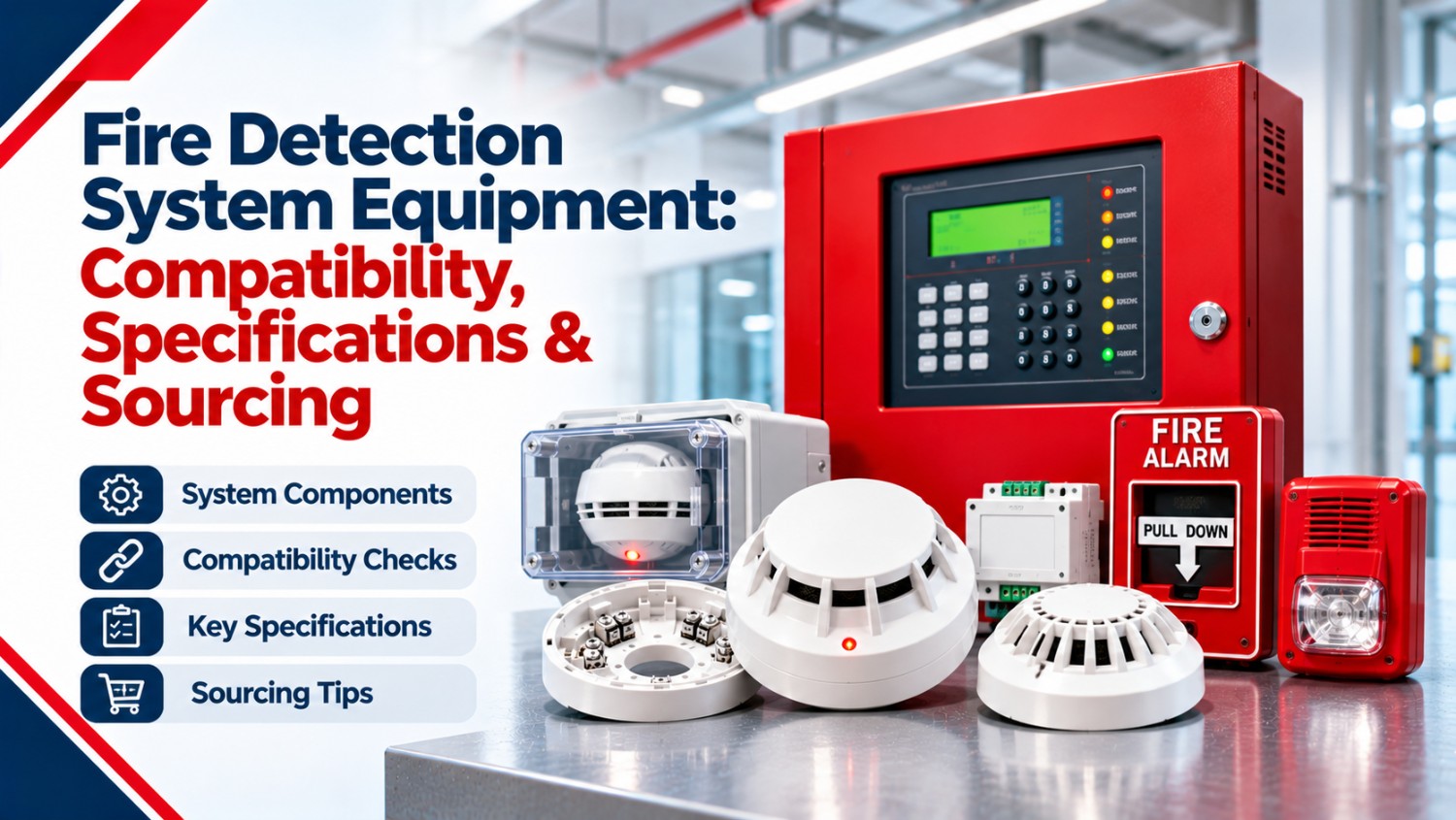
Fire detection system equipment covers every device that senses a fire, reports it and triggers the building’s response: detectors, control panels, modules, power supplies, manual stations and the bases and wiring that connect them. Whether you are upgrading an older building or maintaining an existing installation, this guide explains what each part does, which compatibility and specification checks matter, and how to source equipment without introducing mismatches.
A fire alarm system performs well only when its parts agree with one another. A detector that suits one panel may not communicate with another, and a module that fits a loop on paper may not be supported by the installed firmware. Understanding how fire detection system equipment fits together is the quickest way to avoid wasted orders and failed commissioning tests.
What Fire Detection System Equipment Includes
Every installation of fire detection system equipment shares the same building blocks. Knowing the role of each one helps when you are reading a drawing, writing a parts request or comparing quotes.
Core Fire Alarm System Components
- Control panel: the central unit that monitors every device, interprets signals and activates outputs.
- Initiating devices: smoke detectors, heat detectors, duct detectors, aspirating detectors and manual pull stations that start an alarm.
- Detector bases: the wired mounting parts that connect plug-in detector heads to the circuit.
- Modules: addressable interfaces that monitor contacts, control outputs or operate relays.
- Notification appliances: horns, strobes and speakers that warn occupants.
- Power supplies and batteries: the primary and standby power that keep the system working during an outage.
Each of these fire alarm system components has its own specifications, and the panel normally determines what the others must be.
How Commercial Fire Detection Equipment Works Together
Commercial fire detection equipment is arranged around a simple flow. A device detects a condition, sends a signal over the circuit to the control panel, and the panel responds according to its programming by sounding alarms, notifying a monitoring station or operating a relay for fan shutdown, door release or elevator recall. In an addressable system, the panel also knows which device sent the signal, which speeds up response and troubleshooting.
The table below summarises the main categories of fire detection system equipment and what to check for each.
| Equipment category | Role in the system | What to check before buying |
| Control panel | Monitors devices and runs the programming | Loop capacity, protocol, communicator and power needs |
| Smoke and heat detectors | Sense fire conditions in an area | Series, base compatibility, panel support |
| Detector bases | Mount the head and connect the wiring | Base family, required function, terminal layout |
| Modules | Monitor inputs or control outputs | Module type, protocol, mounting arrangement |
| Duct detectors | Detect smoke in HVAC airflow | Housing, signal type, relay needs |
| Power supplies | Supply and back up system power | Capacity, outputs, battery requirements |
| Pull stations | Allow manual alarm activation | Addressable or conventional, action type |
Addressable Fire Detection System vs Conventional
An addressable fire detection system gives each device its own identity on the loop, so the panel shows exactly which detector, module or pull station was activated. A conventional system groups devices into zones, which is simpler and less costly but less precise. For larger commercial buildings, addressable designs are widely used because they make location, testing and maintenance easier.
The tradeoff is that addressable devices must be matched to the panel’s protocol. The article on addressable fire detection system compatibility explores how bases and panels relate, and it is a useful companion when planning a mixed or upgraded installation.
Fire Detection Control Panels: The Compatibility Anchor
Fire detection control panels set the rules for the whole system. They define which detectors, modules and notification devices can be connected, how many devices a loop can carry and how the system communicates with a monitoring station. For that reason, any decision about fire detection system equipment should begin with the panel model.
As examples of how panels are described, the Fire-Lite ES-50X is a 50-point addressable system for small commercial buildings and the ES-200X is a 198-point addressable system for mid-size commercial buildings. Point capacity, communicator options and expansion needs differ between models, so match the panel to the building’s current size and likely growth. Panels are also expected to be listed for fire alarm use, commonly to UL 864 in the United States, and the authority having jurisdiction (AHJ) must approve the final installation.
Commercial Smoke Detectors and Their Bases
Commercial smoke detectors come in photoelectric, ionization, heat and combination designs, and the right type depends on the space and the fire risks. Photoelectric detectors are common in offices and corridors, while heat and multi-sensor designs may suit areas where dust or steam would cause nuisance alarms. Commercial smoke detectors are typically listed to UL 268.
Remember that the detector head and its base are a pair. Replacing a head without checking the base family is a frequent cause of failed installations, and changing the base function, such as moving from a standard base to a relay or sounder base, changes what the device can do at that location.
Fire Alarm Modules and Accessories
Fire alarm modules and accessories are the small devices that extend a system’s reach. Monitor modules read contacts from sprinkler flow switches, valve tamper switches and other equipment. Control modules operate notification circuits. Relay modules switch auxiliary functions such as door holders and fan shutdown. Because each module is tied to a specific panel family and protocol, the model number and manufacturer should be confirmed before ordering.
Accessories such as backboxes, trim rings, test devices and mounting kits can look interchangeable but are often specific to a device series. Add fire alarm modules and accessories to the parts list from the beginning so the installation is not delayed.
Fire Detection System Equipment Specifications to Verify Before You Order
Specifications on a datasheet decide whether a part works in your system. Verify the following before placing an order for any fire detection system equipment.
Key Technical Checks
- Manufacturer and series: devices from different manufacturers are not generally interchangeable, even when they look similar.
- Protocol and loop type: confirm that the device speaks the same language as the panel’s signaling line circuit.
- Capacity: check the panel’s point limits, power supply capacity and battery requirements.
- Function: decide whether the device must monitor, control, sound or isolate.
- Environment: consider temperature, humidity, dust and outdoor exposure.
- Listings and approvals: confirm that the equipment carries the listings the AHJ expects.
NFPA 72 is the national code for fire alarm installation, inspection and testing, and local amendments may add further requirements.
Planning Fire Alarm System Replacement Parts
Fire alarm system replacement parts are easiest to source when the existing installation has been documented. Many buildings run on panels that are no longer in production, and parts for those systems can be scarce. A clear record of what is installed shortens the search and reduces the risk of ordering an item that almost fits.
Information to Gather for a Parts Request
- The manufacturer and model of the control panel.
- The part numbers printed on the devices that need replacement.
- The quantity required and the locations in the building.
- Whether the parts must be new, or whether clearly labelled refurbished items are acceptable.
- Photos of nameplates, labels and wiring terminals.
- Any lead-time or shipping constraints for the project.
Where an item has been discontinued, ask whether the supplier can locate new old stock or recommend a current equivalent that the manufacturer supports for your panel.
Choosing Fire Detection Equipment Suppliers
The quality of a supplier affects how reliable the finished fire detection system equipment turns out to be. When comparing fire detection equipment suppliers, look beyond price and delivery date.
Ask whether the commercial fire detection equipment is new and in the original manufacturer packaging, or whether refurbished or surplus items are included and how they are labelled. Ask about warranty and return terms in writing. Ask whether the company is an authorized distributor of a brand or an independent reseller, because that affects warranty and technical-support expectations. Finally, test their knowledge: a good supplier will ask for your panel model and device part numbers before confirming a match, not after.
Common Mistakes to Avoid
Most errors in buying fire detection system equipment come from assumptions. Buyers choose a device by its appearance and discover that the protocol differs. Others order a detector head without checking the base, or treat modules from different brands as interchangeable. Some forget accessories until installation day, or fail to confirm panel capacity before adding devices. Projects can also stall when no one verifies that the supplier can deliver the exact model rather than a similar one. A short checklist covering panel model, device part numbers, protocol, function and accessories prevents the majority of these problems.
Frequently Asked Questions
What is fire detection system equipment?
Fire detection system equipment includes the devices that detect a fire and report it, such as smoke and heat detectors, pull stations, modules, bases and control panels. It also covers the power supplies and wiring that allow the system to operate and alert occupants or a monitoring station.
What are the main components of a fire alarm system?
The main fire alarm system components are the control panel, initiating devices such as detectors and pull stations, detector bases, modules, notification appliances and power supplies with backup batteries. The panel monitors every device and decides how the system responds to an alarm, fault or supervisory condition.
What is the difference between addressable and conventional systems?
An addressable system identifies each device individually, so the panel shows the exact location of an alarm or fault. A conventional system groups devices into zones and reports only the zone. Addressable systems are common in larger commercial buildings because they simplify testing and maintenance.
Can I mix fire alarm equipment from different manufacturers?
Generally no. Fire detection system equipment must be compatible with the panel’s protocol and listed for use with it. Mixing brands on an addressable loop is usually unsupported unless the panel manufacturer documents the device as compatible. Confirm compatibility in writing before purchasing.
How do I find replacement parts for an obsolete fire alarm panel?
For fire alarm system replacement parts on an obsolete panel, record the panel model and the part numbers of the devices you need, then contact a supplier experienced with discontinued fire alarm components. They may be able to locate new old stock or suggest a supported equivalent. Photos of nameplates and labels help confirm the match.
What should I ask a fire detection equipment supplier?
Ask whether the equipment is new and in original packaging, how refurbished items are labelled, what the warranty and return terms are, and whether the company is an authorized distributor or an independent reseller. Provide your panel model so they can confirm compatibility.
Do commercial fire alarm devices need to be listed?
Yes, fire detection system equipment is normally expected to carry listings suited to its function, such as UL 864 for control units and UL 268 for smoke detectors in the United States. The authority having jurisdiction decides what is acceptable for a specific building, so confirm approvals before ordering.
Conclusion
Reliable fire detection system equipment starts with the choice among fire detection control panels and works outward: detectors and bases that match the panel, modules that suit the protocol, power supplies sized for the load and accessories planned in advance. The most useful habits are simple. Record model and part numbers, verify compatibility in writing, and test the system after every change.
If you are planning an upgrade or searching for a discontinued part, collect the panel model, device part numbers and photos, then contact one of the trusted fire detection equipment suppliers such as QuickShipFire for a quote, and the team can help confirm each item before you order.