
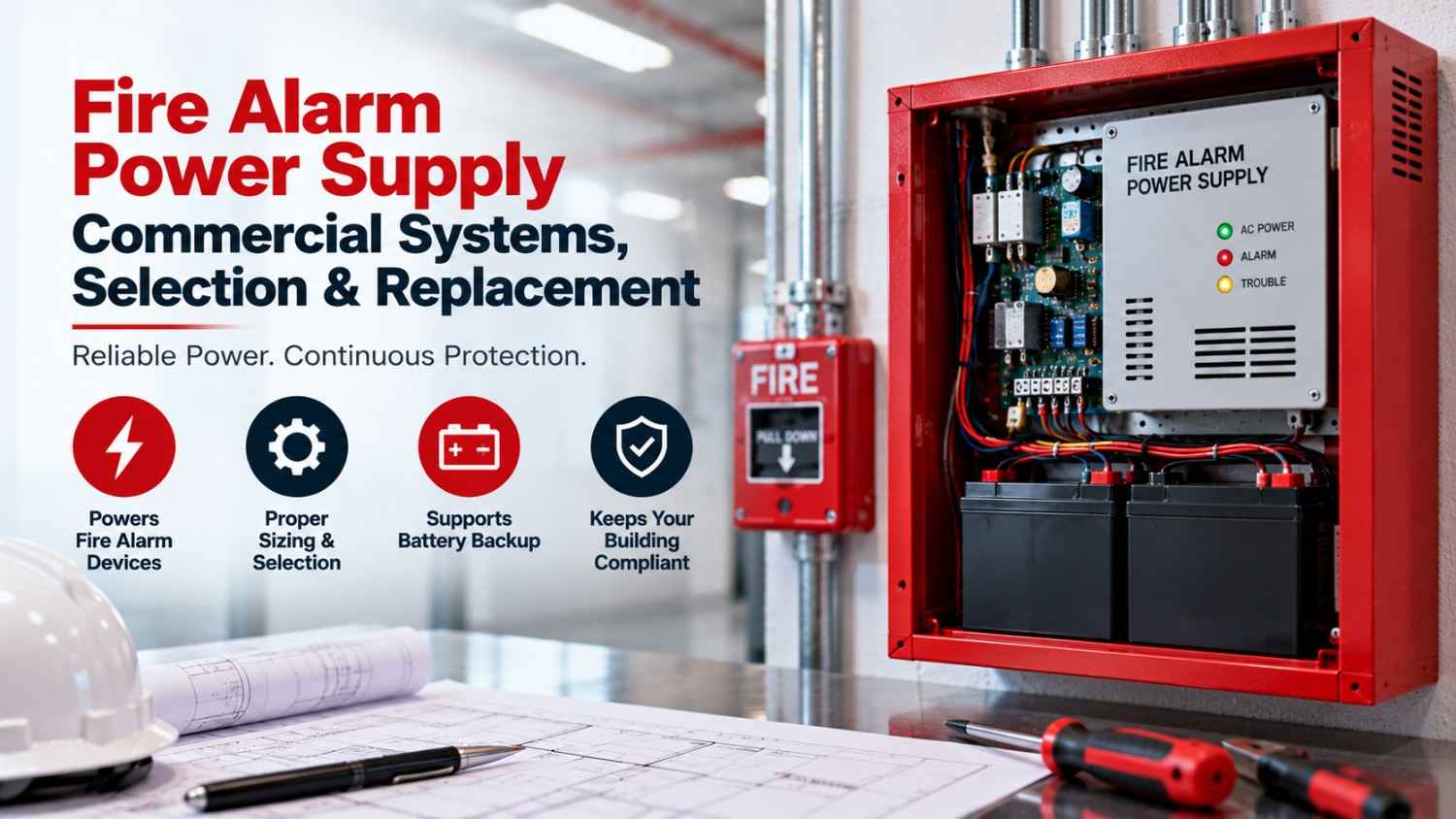
A fire alarm power supply keeps notification circuits, detectors and communicators running during alarms, faults and power outages. This guide explains how commercial units work, how to select and size one, when replacement makes sense and what to verify before buying, so you can compare options with a clear technical picture.
How a Fire Alarm Power Supply Works in Commercial Systems
Every fire alarm power supply performs three jobs: it converts AC building power into regulated 24-volt DC, charges the standby batteries and distributes current to connected devices. Most panels include an internal supply, but a large building with many horns, strobes and speakers can exceed its capacity. Auxiliary units, usually called NAC boosters or expanders, add current so each notification appliance circuit stays within its rating.
Sizing a unit for a commercial building begins with a load calculation. Each device draws a small current in standby and more in alarm, and the supply and batteries must cover both. NFPA 72, the national fire alarm code, generally calls for secondary power to carry 24 hours of standby followed by five minutes of alarm, with longer periods for some voice systems. Your local authority having jurisdiction makes the final call. The fire alarm control panel monitors every device, and its power supply keeps that hub alive when the building loses utility power.
Key Factors to Consider Before Selecting a Unit
- Output current: Match the unit’s amperage to the total alarm load of the notification appliances, and leave margin for future devices.
- Battery charging: Confirm the charger can restore the required battery capacity within the time your local requirements allow.
- Compatibility: Check synchronization, circuit wiring class and whether the unit works with your panel and appliance brand.
- Listing: Look for a listing suited to fire protective signaling and confirm acceptance with the authority having jurisdiction.
Sizing a Fire Alarm Power Supply: Load and Battery Basics
A practical sizing check has three steps. First, add the standby current of every panel, module and detector. Second, add the alarm current of every horn, strobe and speaker on the circuits the unit will serve. Third, calculate battery capacity from those figures and confirm the charger can restore it within the time local requirements allow. A unit that passes the current check but fails the battery check will still fail an inspection.
Wire length matters as well. Long runs reduce the voltage reaching the last appliance, so designers verify end-of-line voltage instead of trusting the nameplate rating alone. When a building adds tenant space, recalculating the load before adding devices is far cheaper than correcting an overloaded fire alarm power supply after a failed acceptance test.
Choosing the Best Fire Alarm Power Supplies for Commercial Use
The best fire alarm power supplies for commercial use are not simply the highest-amperage models. They are the units that fit your existing panel, your load calculation and your maintenance plan. An undersized fire alarm power supply causes voltage drop and repeated trouble signals, while an unsupported model can be difficult to service later.
QuickShipFire’s power supply category currently lists an 8-amp Wheelock PS-8-LP PowerPath and a 10-amp VPS-100US-120 notification supply, both described as NAC boosters for commercial systems. The table shows where an auxiliary unit differs from the supply built into a panel.
| Factor | Built-in panel supply | Auxiliary NAC supply |
| Primary use | Powers the panel, loops and limited notification circuits | Adds current for extra horns, strobes and speakers |
| Capacity | Fixed by panel design | Set by the unit’s amperage rating |
| Expansion | Limited | Units can be added as the load grows |
| Best suited for | Smaller or lightly loaded systems | Large floors, tenant build-outs and retrofits |
Brand ecosystems matter too. Panel makers such as Notifier, Fire-Lite, Gamewell-FCI and Edwards publish their own supplies and extenders, while Wheelock and Altronix are known for listed notification power products. The panel manufacturer’s own unit is usually the simplest route to compatibility, and a third-party unit suits a job when its listing and installation instructions explicitly cover your panel.
Fire Alarm Power Supply Replacement: Signs, Steps and Mistakes
A failing supply rarely announces itself dramatically. It shows up as persistent trouble signals, and a proper fire alarm power supply replacement starts by confirming the diagnosis instead of swapping parts and hoping.
Signs a Replacement May Be Due
- Repeated AC-fail or ground-fault troubles that wiring checks do not resolve
- Output voltage that sags when notification devices sound
- A charger that no longer maintains the batteries
- Heat discoloration, corrosion or a discontinued model that cannot be repaired
Match the replacement to the original in voltage, current rating and mounting, document the change and have a qualified technician perform and test the work.
Timing deserves planning too. Any fire alarm power supply replacement takes part of the system out of service, so coordinate with the building owner and the monitoring company, and follow your jurisdiction’s impairment procedures. Keep the old unit’s model number, label data and wiring photos on hand so the new unit is connected and configured the same way.
Common Mistakes to Avoid
- Choosing by amperage alone and skipping the battery calculation
- Mixing incompatible synchronization protocols on one circuit
- Ignoring voltage drop on long wire runs
- Buying unverified units without original packaging or warranty
- Skipping acceptance testing after installation
Fire Alarm Power Supply Price, Availability and Delivery
The fire alarm power supply price depends on amperage, brand and whether the unit is new or refurbished, so compare like with like. QuickShipFire shows current pricing on every product page, and items are sold new in original manufacturer packaging. Availability changes, so check whether a listing shows as ready to order before planning an install date.
Sourcing is the next question. QuickShipFire is an independent reseller rather than an authorized manufacturer channel, so judge any distributor on condition, warranty and support. You can review the company background before ordering. The published shipping policy describes standard domestic delivery of roughly three to six business days, so confirm current terms at checkout. For project quantities, request a quote for wholesale pricing.
What to Confirm Before Ordering
- New condition, original packaging and the exact model and revision you need
- Return and warranty terms
- Shipping method, timing and freight cost, including whether free shipping applies
- Whether the seller is an authorized distributor or an independent reseller
Frequently Asked Questions
What does a fire alarm power supply do?
A fire alarm power supply converts AC power to regulated 24-volt DC, charges standby batteries and delivers current to the panel, detectors and notification appliances. It keeps the system operating during utility outages and adds capacity when built-in panel power cannot carry every horn, strobe and speaker.
How do I know which size I need for a commercial building?
Total the standby and alarm current of every connected device, add a margin for expansion and choose a unit whose rating and battery charging capacity exceed it. Then confirm panel compatibility, listing and local code acceptance with your authority having jurisdiction.
What affects fire alarm power supply price?
Price varies mainly with amperage, brand, number of outputs and whether the unit is new or refurbished. Compare listings by specification and condition rather than by headline price alone.
Are units in stock ready to ship?
Stock changes, so check the product page for current availability. New items are typically packed within one to three business days according to the published shipping policy, though delivery estimates are not guaranteed.
Do power supplies come with free shipping?
Not automatically. It depends on the seller’s current terms, so check the shipping policy and checkout page, or ask the team directly. Faster options can be requested by email.
Can I get wholesale pricing?
Project buyers can request quantity pricing through a quote form. Provide model numbers, quantities and delivery location so the seller can confirm availability and current pricing.
When should a fire alarm power supply replacement be scheduled?
Replace it when persistent troubles, sagging voltage, a failed charger or physical damage point to a fault that repairs cannot fix, or when the model is discontinued. Confirm compatibility first, and have a qualified technician install and test the new unit.
Conclusion
A dependable fire alarm power supply is the quiet foundation of every commercial system: it sustains detection and notification when the building loses utility power. Size the unit from a real load and battery calculation, favor compatibility over headline amperage, replace only after confirming a fault, and compare sellers on condition, warranty and shipping terms.
Before selecting a unit, list your connected devices, battery requirements and panel model. Then explore QuickShipFire’s power supply range, or request a quote for project quantities along with a technical check on compatibility.