
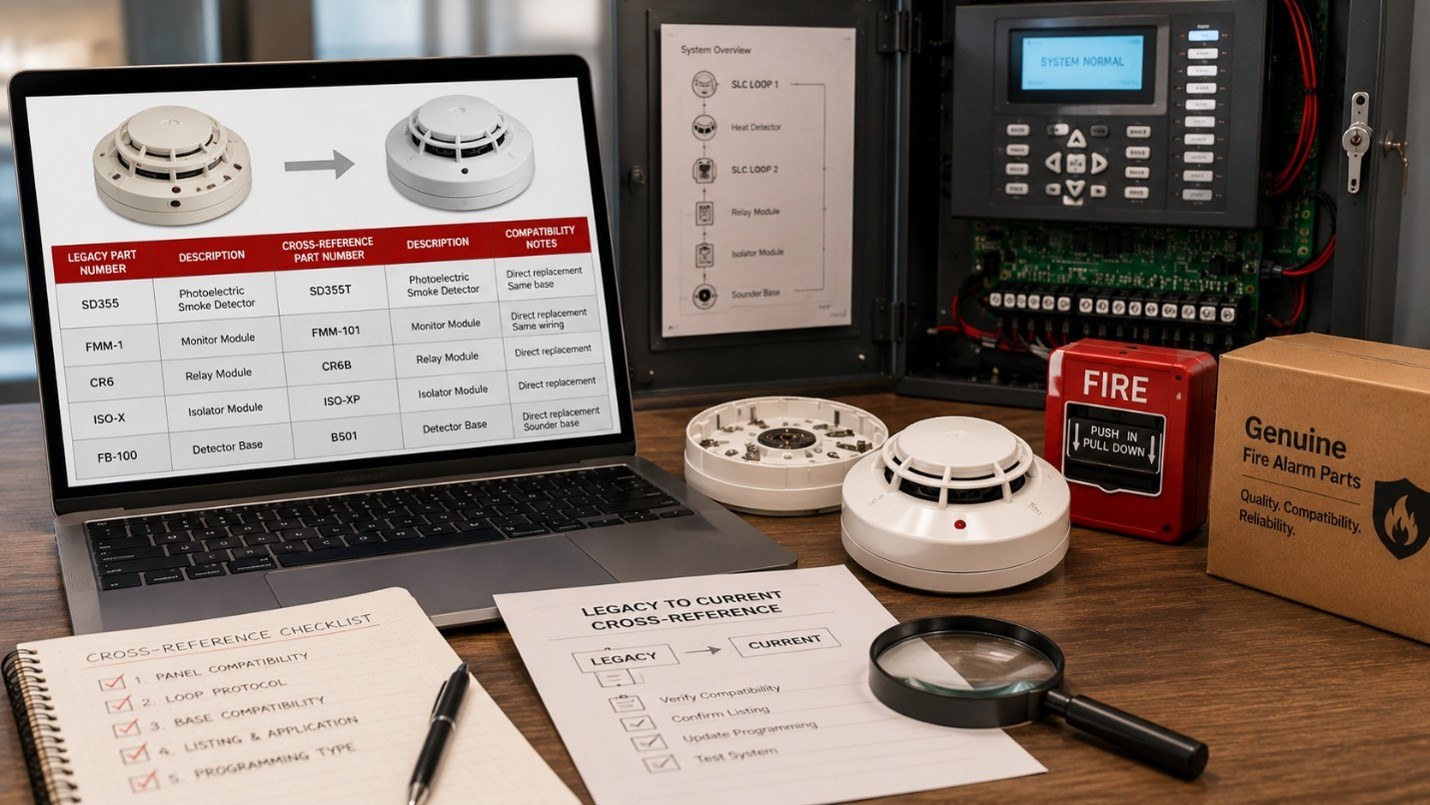
Replacing an aging fire alarm component can be more complicated than simply finding a product with similar specifications. A Fire Alarm Part Cross-Reference helps identify modern equivalents when an original detector, module, relay, or panel component is no longer manufactured. For commercial facilities, the right cross-reference process can reduce replacement delays, avoid compatibility problems, and support a safer, more manageable fire alarm system.
Fire alarm systems often remain in service for many years. During that time, manufacturers introduce newer product families, discontinue older components, and change communication technologies. As a result, facility managers and technicians may encounter obsolete part numbers that are difficult to source. A structured Fire Alarm Part Cross-Reference makes it easier to determine what product should be evaluated as a replacement.
What Is a Fire Alarm Part Cross-Reference?
A Fire Alarm Part Cross-Reference is a method of matching an existing fire alarm component with a current or recommended replacement. The process considers more than the physical appearance of the device. It evaluates system compatibility, communication protocol, electrical characteristics, installation requirements, manufacturer compatibility, and the intended application.
For example, an older smoke detector may have a current replacement that looks nearly identical but uses a different communication protocol. Installing that component without verifying compatibility could result in trouble conditions, communication failures, or an improperly functioning detection circuit.
A useful cross-reference should therefore answer several questions:
- What is the original manufacturer part number?
- Is the original component active, discontinued, or obsolete?
- What current product is designed to replace it?
- Is the replacement compatible with the existing control panel and system protocol?
- Does the replacement require a new base, module, programming change, or other accessory?
The goal is not simply to locate a newer-looking product. The objective is to identify a technically appropriate replacement that can be evaluated for the specific fire alarm system.
Why Fire Alarm Components Become Obsolete
Fire alarm equipment is subject to continuous technological development. Manufacturers may replace older detectors and modules with newer generations that provide improved sensing, diagnostics, communication, or system integration.
A component can become difficult to source for several reasons. The manufacturer may discontinue the product because of technology changes, production costs, regulatory requirements, or the introduction of a new product family. Older control panels may also reach the end of their supported lifecycle.
This creates a common challenge for commercial facilities: the existing system may still operate correctly, but one failed component can become difficult to replace.
Searching only by the original part number may produce limited results. In some cases, distributors may list the part as obsolete, discontinued, or unavailable. A Fire Alarm Part Cross-Reference provides a more practical approach by connecting the older component with a potential modern equivalent.
How a Fire Alarm Part Cross-Reference Works
The cross-reference process begins with identifying the exact part installed in the system. The model number should be recorded directly from the device whenever possible. Product labels, installation documents, panel programming records, and maintenance documentation can provide additional information.
The next step is to determine the product family and system technology. A detector used on one addressable protocol may not be interchangeable with a detector designed for another. Similarly, a relay module may have a similar function to another manufacturer’s module but still be incompatible with the control panel.
A professional Fire Alarm Part Cross-Reference should evaluate several technical factors before a replacement is selected.
1. Identify the Original Part
Start with the manufacturer’s name, complete model number, device type, and any suffix or revision information. Small differences in model numbers can indicate important variations.
For example, two detectors may share a similar product family name while supporting different sensing technologies or control-panel platforms.
2. Determine System Compatibility
The control panel is one of the most important factors in replacement selection. The panel determines which communication protocol, device family, and addressing method the replacement must support.
An apparently suitable detector should not be considered interchangeable simply because its voltage rating or physical dimensions match the existing unit.
3. Verify the Replacement Family
Manufacturers frequently publish documentation identifying newer devices that replace older products. These documents may include compatibility information, required bases, programming requirements, and installation limitations.
A Fire Alarm Part Cross-Reference should use this information as part of the evaluation rather than relying exclusively on visual similarity or marketplace listings.
4. Check Accessories and Installation Requirements
A replacement detector may require a different mounting base. A new module may have different wiring requirements. Some replacements may also require panel programming or configuration changes.
This is particularly important when replacing equipment in a large commercial installation where hundreds of devices may be connected to the same fire alarm system.
Common Examples of Fire Alarm Replacement Challenges
Older detectors and modules are among the most frequently encountered replacement issues. A facility may have a detector that has been installed for many years, while its manufacturer has already moved to a newer generation.
The SD355 replacement is one example of the type of component search that requires careful evaluation. When an older detector is no longer readily available, the replacement should be selected based on system compatibility and manufacturer documentation rather than simply choosing another conventional-looking detector.
The same principle applies to obsolete Simplex fire alarm parts. Simplex systems can include numerous generations of addressable devices, modules, bases, and sensors. A replacement must be matched to the appropriate system architecture before installation.
Another challenge involves discontinued Fire-Lite modules. Older modules may have newer equivalents, but the correct replacement depends on the panel family, module function, wiring arrangement, and programming requirements.
Common Replacement Categories
A Fire Alarm Part Cross-Reference can be useful across several categories of fire alarm equipment.
Smoke Detectors
Smoke detectors are commonly replaced because of age, contamination, damage, or product discontinuation. When selecting a modern detector, the sensing technology and panel compatibility should be confirmed.
A newer photoelectric detector may offer updated sensing and diagnostic capabilities, but that does not automatically mean it can communicate with an older panel.
Addressable Modules
Addressable modules connect field devices and control functions to the fire alarm control panel. Replacement selection should consider the module’s specific function, such as monitoring an input, controlling a relay, or supervising another circuit.
Detector Bases
A replacement sensor may require a compatible base. Therefore, the detector and base should be evaluated together when the manufacturer specifies a particular combination.
Control Panels
Panel replacements are considerably more complex. Replacing an obsolete panel can involve device compatibility, programming, notification appliances, power supplies, batteries, network connections, and regulatory considerations.
Comparing an Original Component With a Modern Equivalent
The purpose of a Fire Alarm Part Cross-Reference is to establish whether a newer product is a suitable candidate for further evaluation.
| Evaluation Factor | Original Component | Modern Equivalent |
| Manufacturer | Existing brand | Same or approved compatible family |
| Model | Legacy part number | Current/replacement part number |
| Communication | Existing protocol | Must support required protocol |
| Application | Existing installation | Same intended application |
| Base/Accessories | Existing accessories | Verify compatibility |
| Programming | Existing configuration | Confirm requirements |
| Documentation | Legacy specifications | Current installation documentation |
| Approval | Existing listing | Verify applicable approvals |
This comparison helps prevent a common mistake: treating a replacement as interchangeable solely because the product has the same general function.
Why Manufacturer Documentation Matters
Product documentation is one of the most valuable resources when performing a Fire Alarm Part Cross-Reference. Datasheets, compatibility guides, installation manuals, technical bulletins, and product lifecycle notices can reveal information that is not visible from a product listing.
Documentation can identify whether a product is a direct replacement, a recommended alternative, or simply a component with similar functionality.
For example, the FSP-951 photoelectric detector belongs to a newer generation of detection technology and may be appropriate for specific compatible systems. However, the correct application must still be confirmed against the applicable control panel, base, and system documentation.
Similarly, when researching obsolete Simplex fire alarm parts, technicians should distinguish between a true manufacturer-recommended replacement and a third-party product that merely appears similar.
Fire Alarm Cross-Referencing vs. Generic Product Substitution
A generic substitution focuses primarily on function. If the original product detects smoke, the assumption may be that any smoke detector can replace it.
Fire alarm systems require a much more controlled approach.
A Fire Alarm Part Cross-Reference considers the complete system relationship. The replacement needs to communicate correctly with the panel, operate within the required electrical parameters, fit the intended application, and satisfy applicable installation requirements.
This distinction is especially important for addressable systems. Addressable devices communicate specific information to the control panel, including device identity and status. A replacement that cannot communicate using the correct protocol is not an appropriate substitute simply because it performs the same basic physical function.
A Practical Cross-Reference Workflow
A consistent process can make replacement research faster and reduce errors.
Step 1: Record the Existing Device
Write down the complete part number, manufacturer, device type, and any visible revision information. Photographing the product label can also help preserve important details.
Step 2: Identify the Control Panel
Record the exact control-panel model and system family. This information is essential for determining device compatibility.
Step 3: Research Product Lifecycle Status
Determine whether the original part is active, legacy, discontinued, or obsolete. Do not assume that an old product is still supported simply because it appears on an online marketplace.
Step 4: Locate the Recommended Replacement
Use manufacturer documentation and reliable distributor information to identify potential replacement products.
Step 5: Verify the Complete System
A Fire Alarm Part Cross-Reference should conclude with a compatibility review that includes the panel, device, base, wiring, programming, and application.
Step 6: Confirm Installation Requirements
Before replacement, verify current installation instructions and applicable requirements. Fire alarm equipment should be installed and configured by qualified personnel following the manufacturer’s documentation and applicable codes.
How Cross-Referencing Helps Facility Managers
For facility managers, replacement research is often performed under time pressure. A failed detector or module may create a maintenance issue that needs to be resolved without unnecessarily replacing an entire system.
A reliable Fire Alarm Part Cross-Reference can help organize the decision-making process by separating three different situations: a direct replacement, a compatible newer-generation device, and a component that requires broader system modernization.
This distinction can also support maintenance budgeting. If a component is discontinued but a suitable current replacement exists, the facility may only need targeted device replacement. If no compatible replacement exists, the facility can begin planning a larger modernization project instead of repeatedly searching for increasingly scarce legacy parts.
When a Full System Upgrade May Be Better
Not every obsolete component should be replaced individually. If a fire alarm system contains a large quantity of discontinued devices, limited manufacturer support, or aging control-panel hardware, repeated part-by-part replacement may become increasingly difficult.
In such circumstances, a Fire Alarm Part Cross-Reference can help reveal the extent of the compatibility problem. If multiple device families are obsolete, a system upgrade may provide better long-term support than continuing to source legacy components.
An upgrade should be evaluated based on the facility’s operational requirements, existing infrastructure, manufacturer support, applicable codes, and project budget.
Finding Compatible Fire Alarm Parts With QuickShipFire
When researching replacements, buyers need accurate product information and a reliable source for current fire alarm equipment. QuickShipFire provides fire alarm and life-safety products for commercial applications, including detectors, modules, panels, bases, and related equipment.
If you are replacing an older component, use the Fire Alarm Part Cross-Reference approach to identify the original part and verify the required system compatibility before selecting a replacement.
Frequently Asked Questions
1. What is a Fire Alarm Part Cross-Reference?
A Fire Alarm Part Cross-Reference matches an older or discontinued fire alarm component with a current product that may serve as its replacement. Compatibility must be verified before installation.
2. How do I find an SD355 replacement?
Start by identifying the complete existing model number and control-panel family. An SD355 replacement should be selected only after confirming system, base, communication, and application compatibility.
3. Can obsolete Simplex fire alarm parts be replaced with newer devices?
Potentially, but the replacement must be compatible with the specific Simplex system architecture. Obsolete Simplex fire alarm parts should be evaluated using manufacturer documentation and system information.
4. What should I do with discontinued Fire-Lite modules?
First identify the exact module and Fire-Lite control panel. Discontinued Fire-Lite modules may have newer equivalents, but compatibility, wiring, programming, and intended function should be confirmed before replacement.
5. Is the FSP-951 photoelectric detector compatible with every fire alarm panel?
No. The FSP-951 photoelectric detector is designed for compatible systems and should not be treated as a universal replacement for every photoelectric detector. Always verify the applicable panel and device documentation.
6. Can I replace an addressable detector with any addressable detector?
No. Addressable devices use specific communication protocols and system architectures. A detector must be compatible with the control panel and associated accessories, even when both devices are described as addressable.
7. When should I consider replacing the entire fire alarm system?
A complete upgrade may be appropriate when multiple critical components are obsolete, manufacturer support is limited, or compatible replacement devices are no longer available. A qualified fire alarm professional should evaluate the system.
Conclusion
A Fire Alarm Part Cross-Reference is an important resource when maintaining aging commercial fire alarm systems. Instead of relying on appearance or basic device function, cross-referencing evaluates the original part number, control-panel compatibility, communication protocol, accessories, programming, and installation requirements.
Whether the issue involves an SD355 replacement, obsolete Simplex fire alarm parts, discontinued Fire-Lite modules, or newer devices such as the FSP-951 photoelectric detector, careful verification is essential before installation.
For businesses seeking dependable fire alarm equipment, QuickShipFire provides access to a broad selection of fire detection and life-safety products. Using accurate product information and compatibility-focused replacement research can help facility managers make better purchasing decisions while supporting the long-term reliability of their fire alarm systems.dition, not a substitute part. Boards rarely cross-reference at all, which is why same-family refurbished stock is often the only route on older panels.