
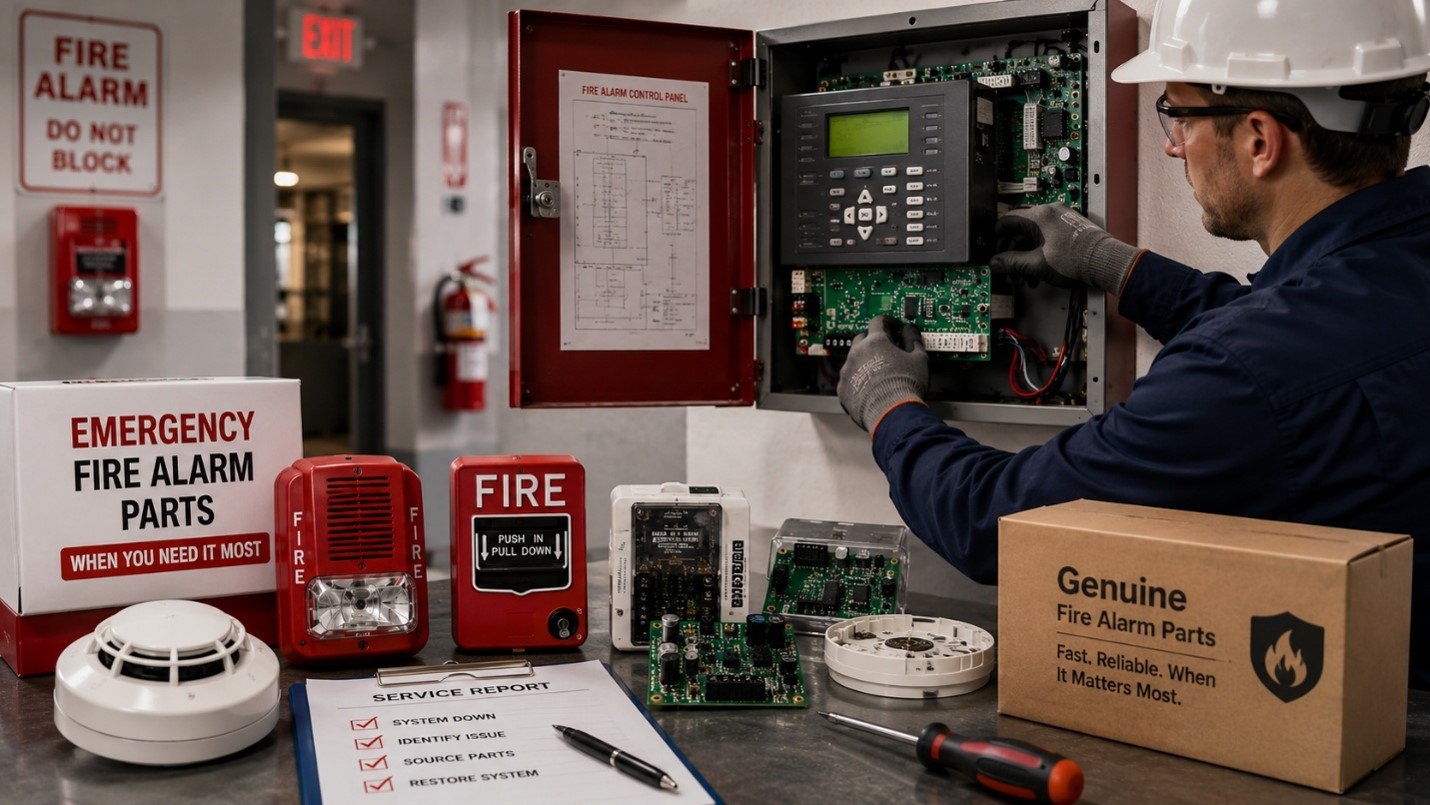
A fire alarm system that cannot detect or notify is not an inconvenience. Depending on occupancy, it can mean a fire watch, a suspended certificate of occupancy, a halted construction handover, or a hospital wing that cannot admit patients. The clock starts the moment the system goes down, and every hour after that costs money in ways that dwarf the price of the component you need.
Sourcing emergency fire alarm parts under that pressure is a different discipline from routine procurement. This guide covers the first hour, how to identify the failed component accurately when you have no time to be wrong, and how to get it moving the same day.
The First Hour: Stabilize Before You Source
Before anyone starts looking for a part, three things need to happen.
Establish what is actually impaired. A single failed detector is not a system outage. A failed loop card that removes supervision from an entire floor is. Determine precisely which areas have lost detection, which have lost notification, and whether the panel is still able to transmit to monitoring. The answer changes both the urgency and the interim measures required.
Implement interim protection. Where detection or notification is genuinely lost, an impairment procedure applies — typically notification of responsible parties, the monitoring company, and often the authority having jurisdiction, plus a fire watch or equivalent measure until the system is restored. Our guide to fire alarm system impairment procedures sets out the notifications and documentation this involves.
Document from minute one. Time of failure, panel display text, event history, actions taken, and who was notified. This record protects the building later and, practically, contains most of the information a parts supplier will ask you for.
Only then does sourcing begin. Skipping the stabilisation step to chase a part faster is how buildings end up with an unlogged impairment and an awkward conversation at the next inspection.
Identify the Part Correctly the First Time
Under time pressure, the temptation is to describe the part rather than identify it. Resist it. A wrong part shipped overnight costs a full day and solves nothing.
Gather these five items before you call anyone:
- The panel make, model, and firmware revision — from the label inside the enclosure, not from memory or drawings.
- The exact part number of the failed component, including any suffix or revision letter, read from the device itself.
- The panel display text and event history relating to the fault.
- What has already been ruled out — wiring checked, device substituted, circuit isolated.
- Quantity needed, including whether you want spares while the part is confirmed available.
Photographs of the device label and the panel display are worth more than any verbal description. Most suppliers who deal with urgent trade enquiries would rather see the label than hear a description of it.
Where Emergency Sourcing Usually Stalls
Three failure modes account for most delays.
The part is discontinued and nobody said so. Distribution channels will often quote a lead time rather than admit a part is out of production, and the lead time never resolves. Ask directly whether the item is current production, and if not, whether the supplier has physical stock or is quoting against a sourcing promise.
The channel will not sell to you. Panel-level equipment for several brands is restricted to authorized dealers. Building owners and non-authorized contractors frequently discover this at the worst possible moment. Independent resellers exist substantially to serve this gap, and browsing available fire alarm boards directly is often faster than working the official channel.
Nobody checked for a cross-reference. A discontinued device with a designated current successor can often be resolved same day, but only if someone asks the question. On aged systems, the obsolete Simplex fire alarm parts and legacy Fire-Lite and Notifier families are the ones where cross-referencing most often saves the day.
A fourth stall is self-inflicted: chasing the cheapest price while the building sits under a fire watch. The maths rarely supports it. A fire watch costs money every hour it runs, a suspended handover costs more, and the difference between the cheapest and the fastest source for a single component is almost always smaller than one day of either. Buy the fastest genuine source now and optimise procurement cost on the restock, not on the emergency.
What Makes a Supplier Useful in an Emergency
Not every supplier is built for this. The ones that are share four characteristics.
They answer the phone. A quote form that returns a response in two business days is not an emergency channel. If a supplier’s only route is a web form, they are not set up for down-system work.
They tell you what is physically on the shelf. “In stock” that means “our supplier says three weeks” is worse than an honest no, because it stops you looking elsewhere.
They know the cross-references. A supplier who can say “that one’s dead, but this current part drops onto the same base and works on your panel generation” saves days.
They ship the same day with a real cutoff time. Ask what the cutoff is and what carrier options exist. A part that ships tomorrow morning is not an emergency solution.
System down right now? Call (833) 747-7845 and speak to someone who can check real stock while you are on the phone. If you would rather send details, use our quote request form with the panel model, part number, and a photo of the device label — urgent enquiries get a same-day answer on availability, cross-reference options, and shipping cutoff.
When the Right Answer Is a Temporary Fix
Sometimes the correct component genuinely cannot arrive fast enough. There are legitimate interim measures, and they are worth knowing before you need them.
Devices can sometimes be reconfigured to maintain coverage while a single failed point is bypassed — but only where the design permits it, and always with the disablement logged and dated. A failed addressable module controlling a non-life-safety ancillary function may be tolerable to defer; one supervising a sprinkler flow switch is not.
Two rules apply to every temporary measure. It must be documented, and it must have an end date attached. Undocumented temporary fixes have a habit of becoming the permanent condition, which is exactly what inspectors find and exactly what creates liability.
Prevent the Next Outage
Every emergency sourcing event is a failure of spares planning that happened months earlier. The buildings that never make these calls do three unremarkable things.
They keep an accurate device inventory, so identification takes minutes rather than a site visit. They hold critical spares — ranked by consequence of failure rather than by cost, which means isolators, loop cards, and commonly failing modules before expensive but non-critical devices. And they flag end-of-life devices during annual inspection rather than discovering obsolescence during an outage.
Where a panel is already past its supported life, the full parts catalogue is a reasonable place to check what remains obtainable for your platform before you need it urgently.
Conclusion
A down fire alarm system is a compliance problem first and a procurement problem second. Stabilise the building, document the impairment, identify the component precisely, then source from someone who will tell you honestly what is on the shelf.
The single biggest determinant of how long an outage lasts is not shipping speed — it is whether the part still exists and whether anyone knows where. That is decided long before the failure, by whether the building holds spares and knows what it has installed. If you are not sure what your system depends on, get in touch and we will help you work out which parts are worth stocking before you need them at two in the morning.
Frequently Asked Questions
Does a fire alarm system failure have to be reported?
Generally yes. Impairment procedures typically require notifying building management, the monitoring company, and in many jurisdictions the authority having jurisdiction, with interim measures such as a fire watch in place until restoration. Requirements vary locally — confirm what applies to your occupancy and jurisdiction.
How fast can emergency fire alarm parts actually ship?
For items physically in stock, same-day dispatch with overnight delivery is realistic if you meet the supplier’s cutoff time. The variable is almost never shipping speed — it is whether the part exists on a shelf, which is why confirming real stock rather than quoted availability matters most.
Can I install a fire alarm part myself to get the system back up?
Component replacement, wiring work, and programming changes should be carried out by qualified fire alarm service personnel, and many jurisdictions require certification. Building staff can typically read the panel, silence audibles, and coordinate the impairment response.
What if the failed part is completely discontinued?
Three routes remain: new old stock held by independent resellers, a cross-reference to a current successor device, or a refurbished equivalent at board level. Ask a supplier to check all three rather than only the first one you thought of.
Is a fire watch always required when a system is down?
Not always — it depends on the extent of the impairment, the occupancy type, and local requirements. Partial impairment affecting one area is treated differently from total loss of detection. Establish the scope of the impairment before deciding what interim measures apply.
Should I buy a spare while I have the failed part identified?
For anything discontinued or hard to find, yes. The search you just completed will be harder next time and the supply smaller. This is the cheapest moment you will ever have to buy that spare.
What information should I have ready when calling a parts supplier?
Panel make, model, and firmware revision; the exact part number with suffix from the device label; the panel’s fault message; what you have already ruled out; and quantity. A photo of the device label answers most follow-up questions before they are asked.
How do I know if a supplier actually has stock or is just quoting a lead time?
Ask the question directly: is this physically on your shelf today, and what is your shipping cutoff? Suppliers set up for urgent trade work answer both immediately. Vague answers to either question usually mean the item is being sourced rather than held.