
Introduction
The duct detector is one of the most frequently misunderstood and most critically important components in any complete commercial fire alarm and HVAC fire protection system. While space smoke detectors protect building occupants from fires originating in occupied areas, duct detectors serve a distinct and equally vital purpose: detecting smoke within HVAC ductwork before the air handling system distributes it throughout an entire building. A correctly installed duct detector can save lives and minimize property damage by shutting down air handling equipment and activating smoke dampers before a single-origin smoke condition escalates into a building-wide emergency. This comprehensive guide covers everything contractors, facility managers, and engineers need to know about duct detector installation requirements, applicable code standards, and best practices for HVAC fire protection.
What Is a Duct Detector and How Does It Work?
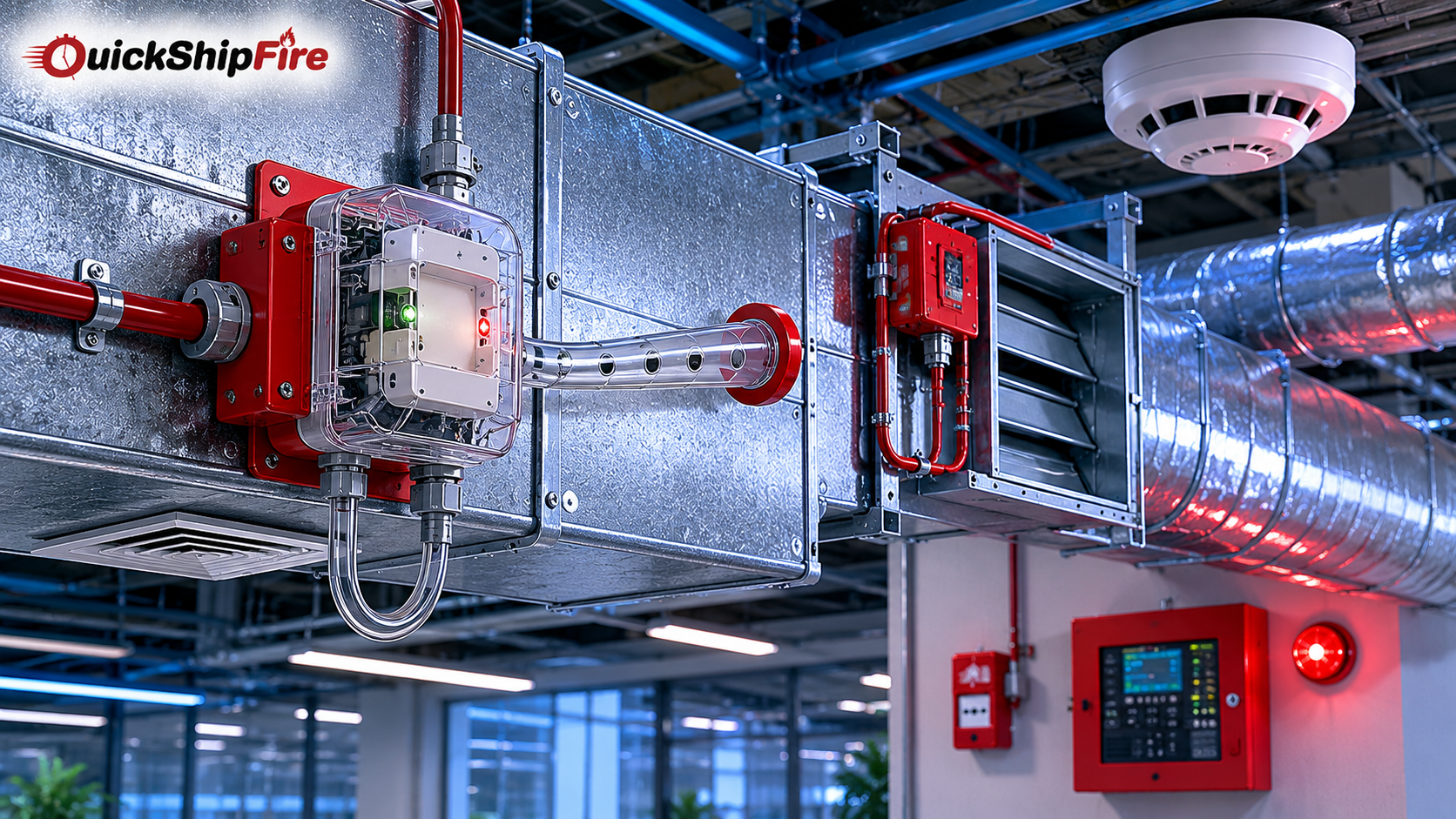
A duct detector is a smoke detection device specifically engineered to monitor the air moving through an HVAC duct. Unlike passive ceiling-mounted spot detectors that sample the ambient air of an occupied room, a duct detector actively extracts an air sample directly from the duct airstream using a sampling tube that protrudes through the duct wall into the moving air column.
The extracted air sample is drawn across the detector’s sensing chamber, where the presence of smoke particles is measured. When smoke concentration exceeds the detector’s alarm threshold, it triggers a series of protective responses through the connected fire alarm system: shutting down the air handling unit (AHU), sending an alarm or supervisory signal to the fire alarm control panel, activating fire or smoke dampers in the duct system, and alerting building occupants and emergency responders.
One critical point that installers and facility managers must clearly understand: a duct detector is not intended to provide early warning of a fire originating in an occupied space. That role belongs to space-protection smoke detectors. The duct detector’s mission is to prevent a functioning HVAC system from becoming an active accelerant that distributes smoke and toxic gases throughout a building once a fire event is already underway.
Why Duct Detectors Are Required by Code
The primary code authority governing duct detector installation in the United States is NFPA 72: National Fire Alarm and Signaling Code, interpreted in conjunction with NFPA 90A: Standard for the Installation of Air-Conditioning and Ventilating Systems, and the International Mechanical Code (IMC). NFPA 90A defines when duct detectors must be installed and specifies the locations and airflow conditions that trigger the requirement.
In addition to national model codes, state and local building codes and the authority having jurisdiction (AHJ) in each specific locality may adopt these standards with local amendments that impose additional requirements. Always verify the specific code edition and local amendments applicable to your project with the local AHJ before beginning the design or installation of any HVAC fire protection system.
Where NFPA 90A Requires Duct Detectors
NFPA 90A specifies that duct smoke detectors are required in the following conditions:
- Supply air systems over 2,000 CFM serving multiple floors: A duct detector must be installed in the supply air plenum of any air-handling unit with a rated capacity exceeding 2,000 cubic feet per minute that serves more than one story of a building.
- Return air systems rated 15,000 CFM or greater: Return air duct detectors are mandatory in systems with a total return airflow of 15,000 CFM or higher, regardless of the number of floors served.
- Multi-floor return air configurations: When a return air system draws from multiple floor levels, duct detectors are required to prevent smoke detected on one level from recirculating to other occupied floors through the shared return air path.
- Special occupancy requirements: Healthcare facilities governed by NFPA 101: Life Safety Code, high-rise buildings, and other occupancy types with heightened life-safety requirements may mandate duct detectors in additional locations beyond NFPA 90A minimums.
- Fan-powered VAV terminal units: Some jurisdictions and AHJs require duct detectors at fan-powered variable air volume (VAV) terminal boxes in addition to the primary air handling unit, particularly in healthcare and assembly occupancies.
Duct Detector Placement Within the Duct System
Supply Side Placement
On the supply side of an air handling unit, the duct detector must be installed downstream of the air filter and heat exchanger but upstream of any branch duct connections. This location ensures that the detector samples the complete conditioned airflow leaving the AHU before it is divided and distributed through branch ducts to individual zones and spaces.
Return Side Placement
On the return air side, duct detectors should be positioned upstream of any outside air connection points and upstream of the air filter. This placement ensures that air returning from occupied spaces which may carry smoke from a developing fire is sampled before it re-enters the AHU and is reconditioned and redistributed throughout the building.
Required Distance from Obstructions
NFPA 72 and all major duct detector manufacturer installation guides require that duct detectors be located a sufficient distance from bends, junctions, dampers, humidifiers, coils, and other duct obstructions to guarantee representative, turbulence-free airflow across the sampling tubes. As a general standard, detectors should be placed a minimum of three to five duct diameters downstream of any elbow or obstruction though specific manufacturer installation requirements must always govern final placement decisions.
Sampling Tube Selection and Correct Installation
The sampling tube is the component that extends through the duct wall into the airstream and draws representative air samples to the detector’s sensing chamber. Correct sampling tube selection and installation are critical determinants of duct detector performance.
- The sampling tube must span approximately two-thirds of the duct width to sample airflow across the duct’s full cross-section, not just the low-velocity edge regions
- Sampling tubes are available in standard lengths to accommodate different duct widths always select the tube length specified by the manufacturer for your measured duct dimension
- The intake holes on the sampling tube must face directly into the oncoming airstream to capture representative moving air samples
- The exhaust tube which returns sampled air back into the duct downstream of the sampling point must be correctly installed to maintain continuous airflow through the detector housing and sensing chamber
- All sampling tube and exhaust tube penetrations through the duct wall must be properly sealed to prevent conditioned air from bypassing the detector or creating false differential pressure readings
Step-by-Step Duct Detector Installation Process
Step 1: Verify Code Requirements and HVAC System Specifications
Before purchasing or installing any duct detector, verify the applicable code requirements for your jurisdiction, confirm the rated CFM capacity of each air handling unit in the building, and review the HVAC system drawings to identify every location where detectors are required. Coordinate closely with the mechanical contractor and the fire alarm system designer to ensure correct integration and proper relay wiring for AHU shutdown and damper control.
Step 2: Select the Correct Duct Detector Model
Duct detectors are available in conventional (two-wire or four-wire) and addressable configurations. For systems connected to a modern addressable fire alarm control panel, an addressable duct detector is strongly preferred it reports its precise location, real-time sensitivity readings, and diagnostic status directly to the panel. QuickShipFire stocks duct detectors from System Sensor and other leading manufacturers for immediate shipping across the United States.
Step 3: Cut the Duct Opening and Mount the Detector Housing
Mark and cut the duct opening using the manufacturer’s supplied template to ensure correct dimensions. The detector housing mounts to the exterior surface of the duct with only the sampling tube and exhaust tube penetrating through the duct wall. Mount the housing level and secure on a structurally stable section of duct, and seal all penetrations per the manufacturer’s installation instructions to prevent air leakage.
Step 4: Install Sampling and Exhaust Tubes
Insert the sampling tube and exhaust tube through their respective duct penetrations, verifying that the sampling tube’s inlet holes face directly into the oncoming airstream. Confirm there is no physical restriction of either tube. Secure tubes per manufacturer requirements and verify full insertion depth to the correct duct position.
Step 5: Wire the Duct Detector to the Fire Alarm System
Connect the duct detector to the fire alarm control panel per the manufacturer’s wiring diagram and NFPA 72 wiring requirements. Assign the device address for addressable detectors at this stage. Carefully wire the relay output contacts that control the AHU shutdown signal and any associated smoke or fire damper actuators, verifying contact polarity and relay configuration.
Step 6: Functional Testing and System Commissioning
After all wiring is complete, perform a comprehensive functional test of each duct detector. Introduce listed aerosol test smoke into the sampling tube inlet and verify alarm activation, AHU shutdown, correct alarm or supervisory signal at the fire alarm control panel, and proper operation of all relay output functions including damper activation. Document all commissioning test results as required by NFPA 72 and the AHJ.
5 Common Duct Detector Installation Mistakes to Avoid
- Placing the detector too close to duct bends or junctions: Turbulent airflow near transitions causes erratic sampling conditions, producing unreliable detection performance and potential nuisance alarms.
- Selecting the wrong sampling tube length: A tube that is too short fails to sample across the duct’s full cross-section, creating dead zones where smoke-laden air can pass undetected.
- Failing to properly seal duct penetrations: Air leakage around the detector housing distorts the sampled air stream and can allow smoke to bypass the detector entirely during an actual fire event.
- Incorrect AHU shutdown relay wiring: If the relay contact is wired in the wrong configuration normally open vs. normally closed the AHU may fail to shut down on alarm, defeating the primary life-safety purpose of the duct detector installation.
- Ignoring maintenance access requirements: Duct detectors require periodic inspection, sensitivity testing, and chamber cleaning. Installing detectors in locations that are inaccessible without major structural disassembly creates long-term compliance and maintenance problems.
Source Duct Detectors and HVAC Fire Protection Components
QuickShipFire stocks duct detectors from System Sensor, Game well-FCI, and other leading manufacturers, along with compatible detector bases, modules, and power supplies needed for complete HVAC fire protection installations. We ship fast across the U.S. and specialize in hard-to-find components. Request a quote or call +(833) 747-7845 our team is ready to help you source the exact duct detector your project requires.
Ongoing Maintenance Requirements for Duct Detectors
NFPA 72 requires that duct detectors be inspected and functionally tested at the same intervals as all other fire alarm system components generally annually at minimum. Each annual test must verify that the detector’s sensing chamber is clean and within sensitivity specifications, that the sampling and exhaust tubes are clear and undamaged, and that the AHU shutdown relay operates correctly on alarm. In high-dust or high-particulate environments, more frequent cleaning of the sampling tubes and detection chamber is advisable. For replacement duct detectors and maintenance components, browse the full duct detector product selection at QuickShipFire.
Conclusion
Duct detector installation is a technically precise discipline governed by NFPA 72, NFPA 90A, the International Mechanical Code, and local AHJ requirements. Selecting the correct detector model, placing it in the precise required location within the ductwork, installing sampling tubes at the correct length and orientation, properly sealing all duct penetrations, and correctly wiring the AHU shutdown and damper control relays are all essential steps for a duct detector to fulfill its life-safety mission.
A correctly designed, installed, and maintained duct detector system is a powerful layer in any building’s overall fire protection strategy preventing the HVAC infrastructure from becoming an accelerant that amplifies a localized fire into a building-wide catastrophe. Invest in quality components, work with licensed and qualified professionals, maintain the system diligently, and document everything thoroughly.
Frequently Asked Questions (FAQs)
Q1: What is the difference between a duct detector and a smoke detector?
A smoke detector is designed to detect smoke in the ambient air of an occupied room and provide early warning to building occupants. A duct detector is specifically engineered to sample airflow within an HVAC duct and prevent the air handling system from distributing smoke throughout a building. They serve complementary but fundamentally different protective functions, and both are required in most commercial fire alarm systems.
Q2: At what CFM rating does NFPA 90A require a duct detector?
NFPA 90A requires duct smoke detectors on supply air systems serving more than one floor with a rated capacity greater than 2,000 CFM. For return air systems, detectors are required at 15,000 CFM or higher. Local building codes and the AHJ may impose more stringent requirements than these NFPA 90A minimums, so always confirm local requirements before finalizing the system design.
Q3: Does a duct detector automatically shut off the HVAC system when it alarms?
Yes, in the vast majority of commercial installations. A duct detector is wired with relay output contacts that send a shutdown signal to the air handling unit when smoke is detected in the ductwork. This prevents the HVAC system from distributing smoke-contaminated air throughout the building. In many configurations, the duct detector also triggers fire or smoke damper actuators to isolate sections of the duct system and contain smoke spread.
Q4: Can a duct detector replace space smoke detectors?
No. NFPA 72 explicitly states that duct smoke detectors are not designed to provide early warning of fire to building occupants that function is the exclusive role of space-protection smoke detectors. Duct detectors and space smoke detectors serve complementary protective roles in a layered fire alarm system design, and neither can substitute for the other.
Q5: How is the correct sampling tube length determined?
The sampling tube must extend approximately two-thirds across the duct width to ensure representative airflow sampling across the duct’s full cross-section. Manufacturers provide sampling tubes in multiple standard lengths and include selection tables in their installation documentation. Always follow the specific manufacturer’s instructions for tube length selection based on your measured duct dimensions using an incorrect tube length is a common and consequential installation error.
Q6: How frequently must duct detectors be tested?
NFPA 72 requires duct detectors to be inspected and functionally tested annually at minimum, with all test results documented and maintained. Each test must verify correct alarm activation at the specified smoke concentration, proper AHU shutdown relay operation, correct signal receipt at the fire alarm control panel, and satisfactory performance of all associated damper control outputs. In high-particulate environments, more frequent cleaning and sensitivity verification between annual tests is strongly advisable.
Q7: Do duct detectors need to be addressable to be code-compliant?
Conventional (non-addressable) duct detectors remain code-compliant when installed on conventional fire alarm systems, but addressable duct detectors are strongly recommended for all systems connected to an addressable fire alarm control panel. Addressable duct detectors report their precise system location, real-time analog sensitivity values, and diagnostic condition directly to the panel enabling faster maintenance response, proactive sensitivity drift alerts, and more accurate trouble isolation compared to conventional devices.