
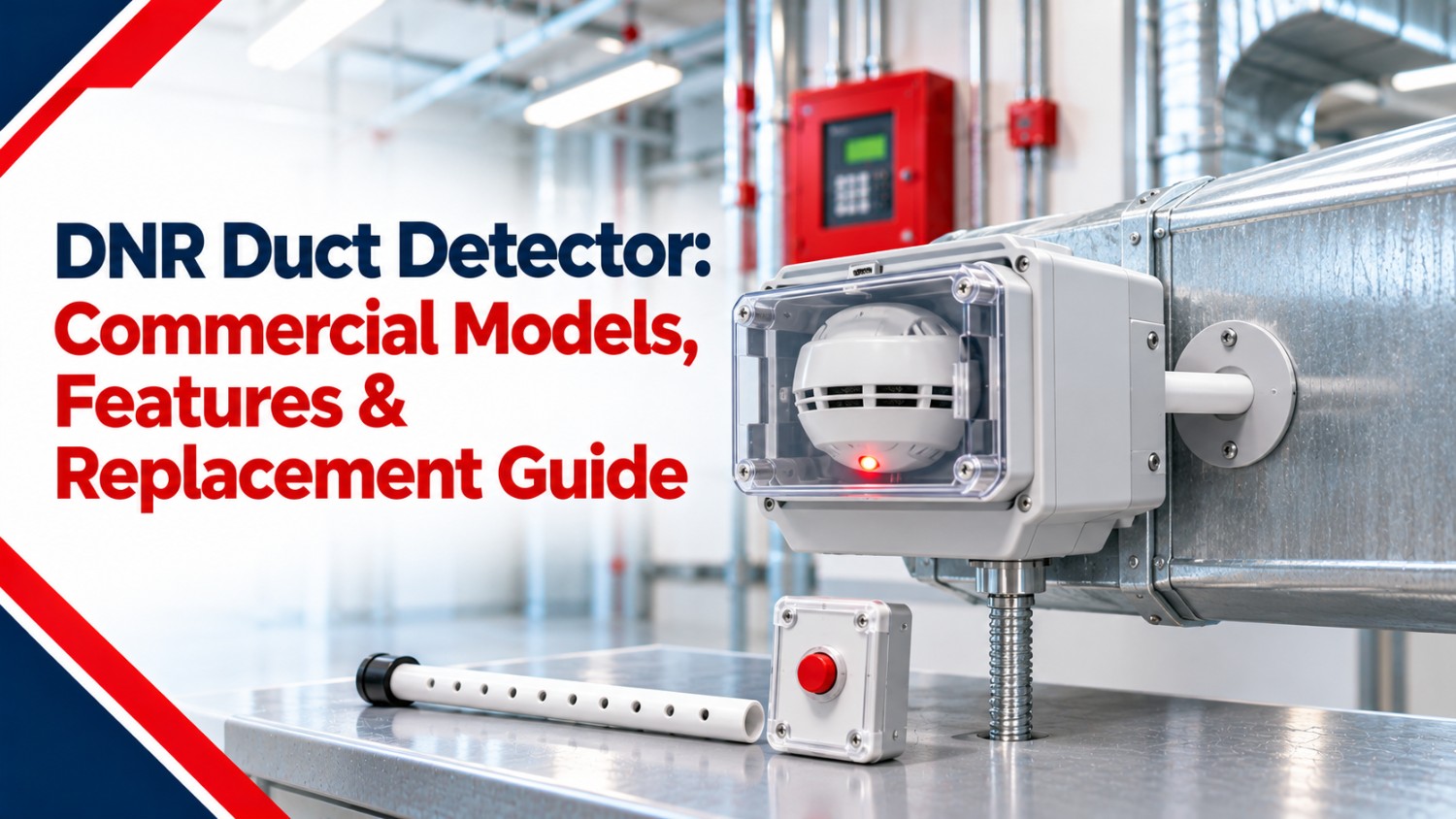
A DNR duct detector is a System Sensor duct smoke detector built to monitor air moving through an HVAC duct and signal the fire alarm panel when smoke is carried along the airstream. If you need to understand what it does, which version suits your building, or what a like-for-like swap involves, this guide covers the features, the checks to make before buying, and the mistakes that most often cause failed installations.
Duct detectors are often confused with ordinary ceiling smoke detectors, yet they serve a different purpose. They do not replace area detection in occupied rooms. Their job is to recognise smoke inside the air-handling system and trigger the response that keeps it from spreading, usually fan shutdown or damper control through the fire alarm panel.
What a DNR Duct Detector Does in a Commercial Building
How Duct Smoke Detection Works
A DNR duct smoke detector uses a photoelectric sensing chamber inside an enclosure mounted on the outside of the duct. A sampling tube passes through the duct wall and across its width, pulling a portion of the moving air back to the sensor. If smoke particles reach the chamber, the detector reports an alarm condition to the control panel, which then carries out whatever the project requires: fan shutdown, damper closure or a supervisory signal to building staff.
Because the sensor reads air that is already moving, performance depends on airflow, tube placement and a sealed installation as much as on the detector itself.
Why Commercial HVAC Systems Need Duct Detection
A commercial HVAC smoke detector matters because an air-handling system can carry smoke from the room of origin to every zone it serves. Codes such as NFPA 90A address smoke spread through air-conditioning and ventilation systems, and the airflow thresholds that trigger duct detection depend on the codes your jurisdiction has adopted. Confirm the requirement with the authority having jurisdiction (AHJ) before specifying equipment. NFPA 72 then governs how the detector connects to the alarm system and how it is tested.
Features That Matter in Commercial Duct Applications
Beyond basic smoke sensing, the features that make a duct detector practical in service are the ones that reduce maintenance effort. Look for clear status indication, remote alarm and test capability where the unit is hard to reach, relay outputs that match the shutdown plan, and an enclosure suited to the location. A detector placed above a ceiling grid or on a rooftop unit is only useful if technicians can reach it for routine testing, so access should be judged as carefully as the sensor itself. When comparing DNR duct detector specifications between models, weigh these service features alongside the electrical details.
DNR Duct Detector Specifications to Confirm Before Ordering
DNR duct detector specifications vary between versions, so the exact part number on the existing unit or the project submittal should decide the purchase. Treat the manufacturer’s current datasheet as the final authority and verify the following.
Key Specifications Checklist
- Signal type: confirm whether the unit is addressable or conventional and that it matches the panel’s loop protocol. The DNR-AUS, for example, is an intelligent, addressable photoelectric model.
- Sensing technology: photoelectric sensing responds to visible smoke particles, which is why it is the common choice for duct applications.
- Airflow range: duct velocity must fall within the range stated on the datasheet, or the detector may not sample reliably.
- Environment: check the permitted temperature and humidity range and whether the location is indoors or exposed to weather.
- Outputs and accessories: confirm relay or auxiliary contacts, remote indicators and test devices needed for fan shutdown.
- Listing: duct detectors should be listed for duct applications (UL 268A) and acceptable to the AHJ.
DNR Duct Detector Models and Housing Options
Several related products are commonly used alongside DNR detectors. The table below describes their general roles only; confirm exact fit against the datasheet and your panel.
| Product type | Primary use | Typical location | Key consideration |
| DNR-AUS addressable duct smoke detector | Intelligent photoelectric detection on an addressable loop | Indoor air-handling ducts | Panel protocol must match |
| DNRW watertight duct housing | Weather-resistant enclosure for exposed ductwork | Rooftop units and outdoor ducts | Mounting and sealing must be done carefully |
| Simplex 4098-9755 duct sensor housing | Enclosure for a compatible Simplex sensor | Systems built around Simplex panels | Sensor and housing must be the same family |
| Silent Knight SD505-DUCT / SD505-DUCTR | Addressable duct detector with housing; the R version adds a relay | Silent Knight addressable systems | Relay version suits direct fan shutdown |
Duct Smoke Detector Compatibility
Duct smoke detector compatibility starts at the control panel. A detector can fit the duct physically and still fail to communicate with the panel, which is the most common reason replacements are rejected at commissioning. Check three layers: the panel brand and loop protocol, the detector or sensor family, and the housing and accessories.
Treat duct smoke detector compatibility as a documented check rather than an assumption, particularly on older systems where the panel may no longer be in production. Mixing manufacturers on an addressable loop is generally unsupported unless the panel maker publishes the device as compatible. If documentation is missing, gather the panel model and the part numbers of the devices already installed before asking a supplier to confirm a match.
DNR Duct Detector Installation Requirements
DNR duct detector installation requirements come from three sources: the manufacturer’s installation instructions, the NFPA standards and the local mechanical and fire codes. The points below apply to most duct installations, but the installation manual and the AHJ take precedence. Any commercial HVAC smoke detector should also be installed where the airflow it samples actually represents the system it protects.
Placement and Mounting Checklist
- Choose a straight duct section with steady airflow. Avoid spots immediately after bends, transitions or dampers where turbulence disturbs sampling, and follow the clearances in the manual.
- Size the sampling tube to the duct width using the manufacturer’s chart, with the intake holes facing upstream.
- Seal the duct penetration and housing gasket so leaking air does not distort readings.
- Leave room to open the cover, clean the chamber and test the unit; ducts above fixed obstructions are a frequent access problem.
- Use a watertight housing for outdoor or exposed locations rather than improvising protection.
- Wire relay outputs to the fan control according to the engineered shutdown sequence, and test the result.
DNR Duct Detector Replacement: What to Gather First
A DNR duct detector replacement goes smoothly when the existing installation is documented before anything is removed. Reviewing the original DNR duct detector installation requirements at the same time, including tube length and housing orientation, helps the new unit perform like the old one. Specifiers and facility teams who skip this step often discover a mismatch only after the old unit is already disconnected.
Information to Collect Before Ordering
- The part number, series and date code printed on the existing detector and housing.
- The panel model, loop protocol and the detector’s programmed address, if the system is addressable.
- The duct width, so the correct sampling tube length can be confirmed.
- Whether the unit has a relay, remote indicator or test station attached.
- Any site constraint, such as outdoor exposure or limited access.
Once the match is confirmed, follow the facility’s impairment procedure: notify the monitoring station and occupants, take the device out of service, swap the unit, restore the sampling tube and seal. After installation, run a functional test, confirm the panel shows the correct device and verify that fan shutdown works as designed, following the manufacturer’s instructions and NFPA 72 testing requirements. If the original model is hard to locate, a supplier experienced with discontinued fire alarm components can often identify a direct replacement.
Maintenance and Testing After Installation
A DNR duct smoke detector works in dusty, moving air, so it needs regular attention. Dust can accumulate in the sensing chamber and around the sampling tube, which affects sensitivity and can cause nuisance trouble signals. Schedule functional tests and cleaning in line with the manufacturer’s instructions and NFPA 72, and record the date, the result and the person who performed the work.
Retest the detector after any change to the HVAC system, such as filter changes, fan replacement or rebalancing, because altered airflow can affect how well smoke reaches the sampling tube. Confirm each time that the panel receives the signal and that the intended fan or damper responds. A unit that was correct at commissioning can drift out of compliance simply because the building around it changed.
Common Mistakes to Avoid
The most frequent problems are avoidable. Buyers order by appearance instead of part number, overlook the sampling tube length, or assume a detector from another brand will communicate on their loop. Installers reuse a cracked gasket, mount the unit where turbulence upsets airflow, or forget to test the relay that shuts down the fan. Facility managers sometimes treat the duct detector as a substitute for rom detection, which it is not, or skip the impairment notice and trigger a false dispatch. A short written checklist, completed before and after installation, prevents nearly all of these.
Frequently Asked Questions
What is a DNR duct detector?
A DNR duct smoke detector is a System Sensor duct detector that samples air moving through an HVAC duct using a photoelectric sensor. When it detects smoke, it signals the fire alarm panel, which can then shut down fans or operate dampers to limit smoke spread through the building.
Where is a duct smoke detector required?
Requirements depend on the codes your jurisdiction has adopted, including NFPA 90A and the local mechanical code, which typically set thresholds based on the airflow capacity of the system. The authority having jurisdiction makes the final decision, so confirm the requirement before specifying equipment.
Can a duct detector replace ceiling smoke detectors?
No. A duct detector monitors air inside the duct to stop smoke from spreading through the HVAC system. It is not intended to provide early warning for occupied rooms. Area smoke detectors are still needed wherever codes require general detection in the space.
How do I choose the right replacement duct detector?
Start with the part number on the existing unit, then confirm the panel model, loop protocol, housing type, relay needs and duct width. A replacement should match all of these. If any detail is unclear, send the information to your supplier for verification before ordering.
Are all duct detectors compatible with every fire alarm panel?
No. Compatibility depends on the panel brand, its loop protocol and the manufacturer’s published device lists. A detector may mount correctly yet not communicate with the panel. Always confirm compatibility in the panel documentation or with the manufacturer before purchasing.
How often should a duct detector be tested and cleaned?
Testing intervals are set by NFPA 72 and the manufacturer’s instructions, and many facilities test at least annually. Cleaning frequency depends on conditions, so units in dusty or dirty airstreams may need attention more often. Record every test and cleaning in the system’s inspection log.
Can a DNR duct detector be installed outdoors?
A DNR duct smoke detector can be used outdoors only with the right enclosure. Outdoor and exposed ductwork calls for a weather-resistant housing such as the DNRW watertight type, installed and sealed according to the manufacturer’s instructions. Always check the rated temperature and humidity range against the actual site conditions.
Conclusion
A DNR duct detector protects a building by catching smoke inside the air-handling system, where it can travel quickly to every zone. The key points are straightforward: confirm the requirement with the AHJ, confirm duct smoke detector compatibility and signal type against your panel, install the sampling tube and housing as the manual directs, and test the fan shutdown after any change. Careful documentation before a swap saves far more time than it costs.
If you are planning a commercial HVAC smoke detector retrofit, record the part number, panel model and duct width first, then send those details to the QuickShipFire team to request guidance on DNR duct detector replacement and have a match verified before you order.