
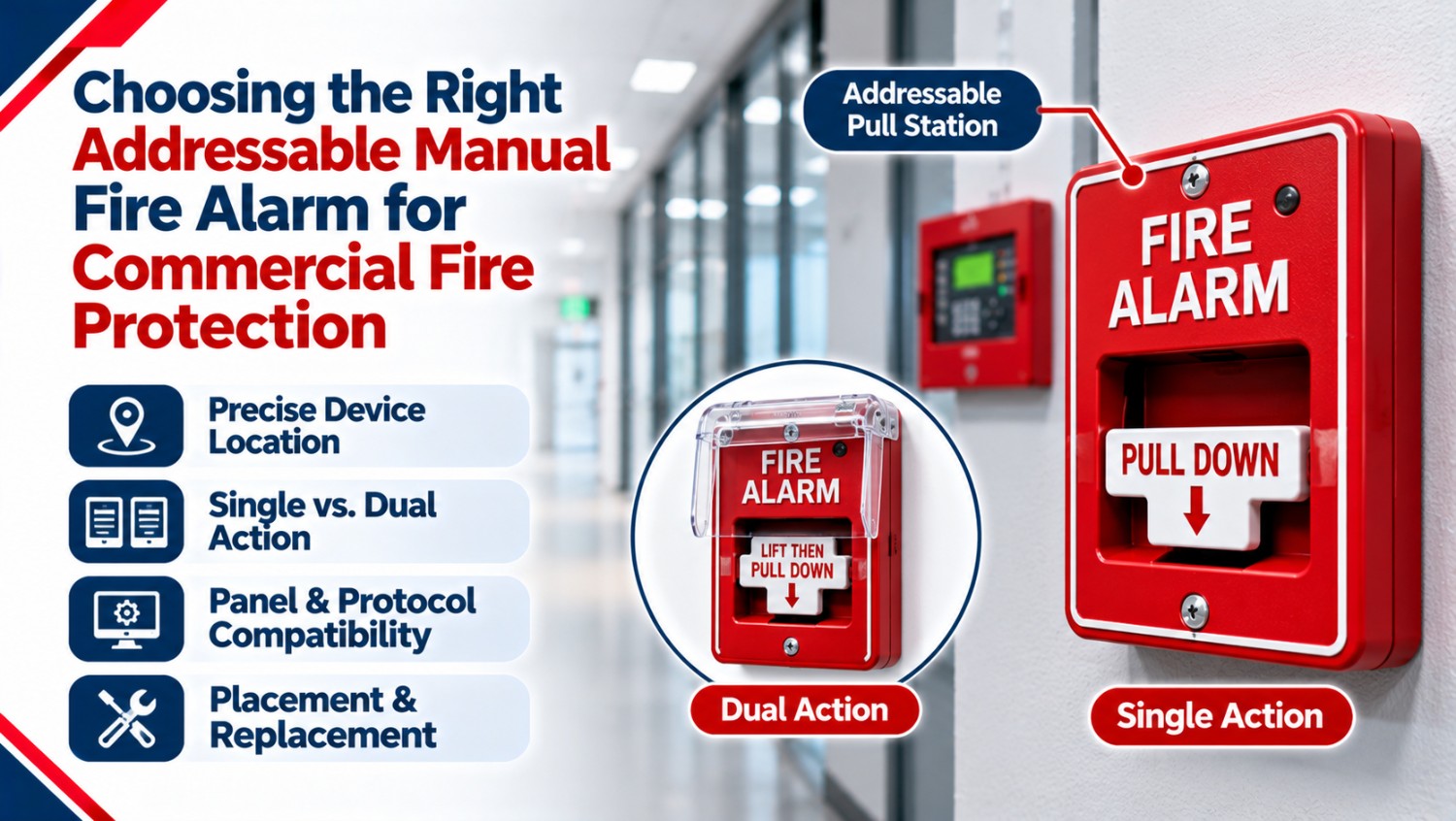
Choosing the right addressable manual fire alarm involves more than selecting a red station that fits on the wall. The device decides how quickly the panel can pinpoint where someone raised the alarm, how well the unit resists accidental activation, and whether it will communicate properly with the system already installed. This guide explains how an addressable manual fire alarm works, how single and dual action designs differ, and what to check before buying or replacing one for a commercial property.
It is written for facility managers, fire alarm technicians, contractors and purchasing teams. The guidance is general. The manufacturer’s instructions, the edition of NFPA 72 adopted locally and the authority having jurisdiction (AHJ) always take precedence over anything stated here.
What Is an Addressable Manual Fire Alarm?
A manual fire alarm station is a device that a person operates by hand to start an alarm. In North America it is usually called a pull station, while elsewhere the same function is described as a manual call point, a term that appears throughout the general reference on manual fire alarm activation. An addressable manual call point differs from older designs because it has its own electronic address on the system’s signalling line circuit. When someone operates it, the control panel receives a signal that names that exact device.
In practical terms, an addressable manual pull station lets responders see a location such as “East stairwell, second floor” instead of a general zone. That precision shortens the time it takes to find the origin of an alarm, which matters most in large, multi-storey or sprawling commercial buildings.
How an Addressable Manual Fire Alarm Differs From a Conventional Station
A conventional station is wired into a zone and simply closes a circuit when operated. The panel knows that something in the zone has been activated, but not which device. An individually addressable fire alarm station reports itself. Every device on the loop is polled by the panel, so the system can also detect when a device is missing, damaged or not responding, rather than waiting for a test to reveal the fault.
The Simplex 4099-9001 is an example of an individually addressable fire alarm station described as a single action unit for commercial buildings. Whatever the brand, the underlying idea is the same: an addressable manual fire alarm gives the panel more information than a conventional device can.
Key Benefits of an Addressable Manual Fire Alarm
- Precise location: an individually addressable fire alarm station identifies itself, so the panel knows exactly which one was operated and responders can act faster.
- Device supervision: the panel can tell when a station stops communicating, so faults surface sooner.
- Flexible wiring: devices share a loop, which can simplify cabling in larger buildings.
- Easier expansion: adding a station often means giving it an address and programming it into the panel.
- Better records: each device can be named and documented, which helps with testing and maintenance.
Single Action vs Dual Action Addressable Pull Stations
An addressable manual fire alarm comes in two operating styles. A single action station needs one movement, typically pulling a handle down, to activate. A dual action station needs two, such as lifting a cover or pushing in a panel before pulling, which makes it harder to trigger by accident. A dual action addressable pull station is often chosen where accidental or malicious activation has been a problem, while single action units are common where speed of operation is the priority.
The QuickShipFire range includes both styles. For example, the SK-Pull-SA is listed as an addressable fire alarm pull station in single action form for Silent Knight systems, and the SK-Pull-DA is the dual action equivalent. Which one is appropriate depends on your building, your occupants and local requirements.
| Factor | Single action | Dual action |
| Operation | One movement activates the alarm | Two movements are required |
| Accidental activation | More susceptible | Better resistance |
| Speed of use | Quickest to operate | Slightly slower, which can matter in an emergency |
| Typical settings | Offices, general commercial areas | Schools, public areas, places with false alarm history |
| Main consideration | Higher risk of nuisance activation | Occupants must understand the two-step action |
Neither style of addressable manual fire alarm is better in every case. The choice should reflect the building’s use, its false alarm history and any requirements set by the AHJ.
What to Check Before Buying a Commercial Manual Fire Alarm Station
A commercial manual fire alarm station must work with the panel it connects to, which is why compatibility sits at the top of any buying checklist for an addressable manual fire alarm. Addressable devices communicate using manufacturer-specific protocols, so a station from one family will not necessarily operate on another family’s loop. Match the device to the panel brand, the protocol and the programming approach.
- Protocol and panel: confirm the station is made for the panel and loop it will join.
- Action type: decide between single action and dual action based on the building and the AHJ.
- Listing: manual stations are evaluated to the UL 38 standard in the United States, so confirm the model is listed for your application.
- Mounting: check that the new station fits the existing back box and mounting style.
- Environment: an indoor unit is not suitable for wet or exposed locations without suitable protection.
- Condition and packaging: ask whether the item is new and in original manufacturer packaging.
Placement and Installation Considerations
Where a station is mounted matters as much as which one is chosen. NFPA 72 and the local building and fire codes govern the placement of every addressable manual fire alarm, and the usual expectation is that stations are easy to see, unobstructed and located along the path of egress, including near exits. Mounting height is commonly given as 42 to 48 inches (1.07 to 1.22 metres) from the floor to the operable part, and accessibility requirements also apply. Always check the edition and amendments adopted in your area.
Addressing is the other installation task for any addressable fire alarm pull station. The address is set using the method the manufacturer specifies and must match the panel’s programming. Record the address, the location and the device type, and label the station so that the information stays aligned with the panel. A well-installed addressable manual fire alarm that is poorly documented can still slow down a response.
Fire Alarm Pull Station Replacement: A Practical Guide
An addressable manual fire alarm takes a lot of physical abuse. Handles crack, covers discolour, and older models may no longer be available. Planning a fire alarm pull station replacement around the existing system keeps the work simple and avoids reprogramming surprises. Start by recording the model and manufacturer of the station that is installed, then confirm the panel and loop it belongs to.
- Model number and manufacturer from the label on the station
- Panel make and model, and the protocol the loop uses
- Whether the existing unit is single action or dual action
- The current address of the device and its location label
- Condition of the back box, wiring terminals and mounting points
When you replace an addressable manual fire alarm, the new device must be given the same address as the one it replaces, or the panel must be updated. After installation, test the device and confirm that the panel displays the correct location. The station is only one of many addressable fire alarm system components on the loop, alongside detectors, modules and sounders, so check that anything new is compatible with the rest of that equipment.
Many sites rely on equipment that manufacturers have retired. A specialist supplier can often find a compatible unit, which allows a stable system to continue operating without a full upgrade. Choose a supplier that sells new products in original packaging and publishes clear return and warranty terms.
Common Mistakes to Avoid
Most problems with an addressable manual fire alarm come from compatibility and documentation oversights rather than faulty hardware.
- Fitting a conventional station on an addressable loop: the device will not communicate correctly.
- Ignoring protocol differences: two addressable manual pull station models may look alike but belong to different families.
- Forgetting to update the panel: a new addressable fire alarm pull station must be programmed or addressed to match the system.
- Swapping single and dual action without a plan: the change affects behaviour and may need approval.
- Skipping the functional test: always operate the station and confirm the panel shows the correct device.
Frequently Asked Questions
What is an addressable manual fire alarm?
An addressable manual fire alarm is a hand-operated station, usually a pull station, that has its own electronic address on the fire alarm loop. When someone activates it, the control panel identifies the exact device and location, which helps responders reach the source of the alarm faster than a zone-level conventional system.
What is the difference between a conventional and an addressable pull station?
A conventional pull station reports only at zone level, so the panel knows the zone but not the device. An addressable pull station has a unique address and is monitored by the panel, which shows the exact station that was operated and can also detect communication faults with that device.
When should I choose a dual action addressable pull station?
A dual action station requires two movements, making accidental activation less likely. It is often chosen for schools, public areas and buildings with a history of false alarms. The decision should reflect occupancy, risk and local requirements, so confirm what the AHJ expects before specifying one.
How high should a manual pull station be mounted?
Mounting height is commonly specified as 42 to 48 inches (1.07 to 1.22 metres) above the floor to the operable part, and stations should be visible and unobstructed along the path of egress. Requirements depend on the edition of NFPA 72 and local amendments, so verify them with your AHJ.
Can I use any addressable manual pull station with any fire alarm panel?
No. Addressable devices use manufacturer-specific communication protocols, so a station, like all addressable fire alarm system components, must be designed for the panel and loop it will join. Check the panel brand, model and protocol before ordering, and supply those details to your supplier so they can confirm that the station is compatible.
Is an addressable manual call point the same as a pull station?
Yes, in function. An addressable manual call point is simply the term commonly used outside North America for the device that Americans call a pull station. Both are operated by hand to start a fire alarm, although the design, standards and mounting rules can differ between regions, so check the requirements that apply where you are.
What do I need for a fire alarm pull station replacement?
Gather the model and manufacturer of the existing station, the panel make and model, the loop protocol, the device address and whether it is single or dual action. Photos of the label and back box help. With these details a supplier can confirm a compatible commercial manual fire alarm station before you order.
Conclusion
An addressable manual fire alarm gives commercial buildings a faster, more precise way for occupants to raise an alarm and for responders to locate it. The most reliable choices come from matching the station to the panel and protocol, deciding between single and dual action based on real building conditions, and placing and documenting each device, and the other addressable fire alarm system components around it, carefully. Supplier checks, such as new stock and clear return terms, complete the picture.
If you are adding stations or planning a replacement, compile the model numbers, panel details and addresses first. You can then browse the pull stations range at QuickShipFire, read the guide to dual action pull station options for commercial buildings, or contact the team for help selecting the right addressable manual fire alarm.