
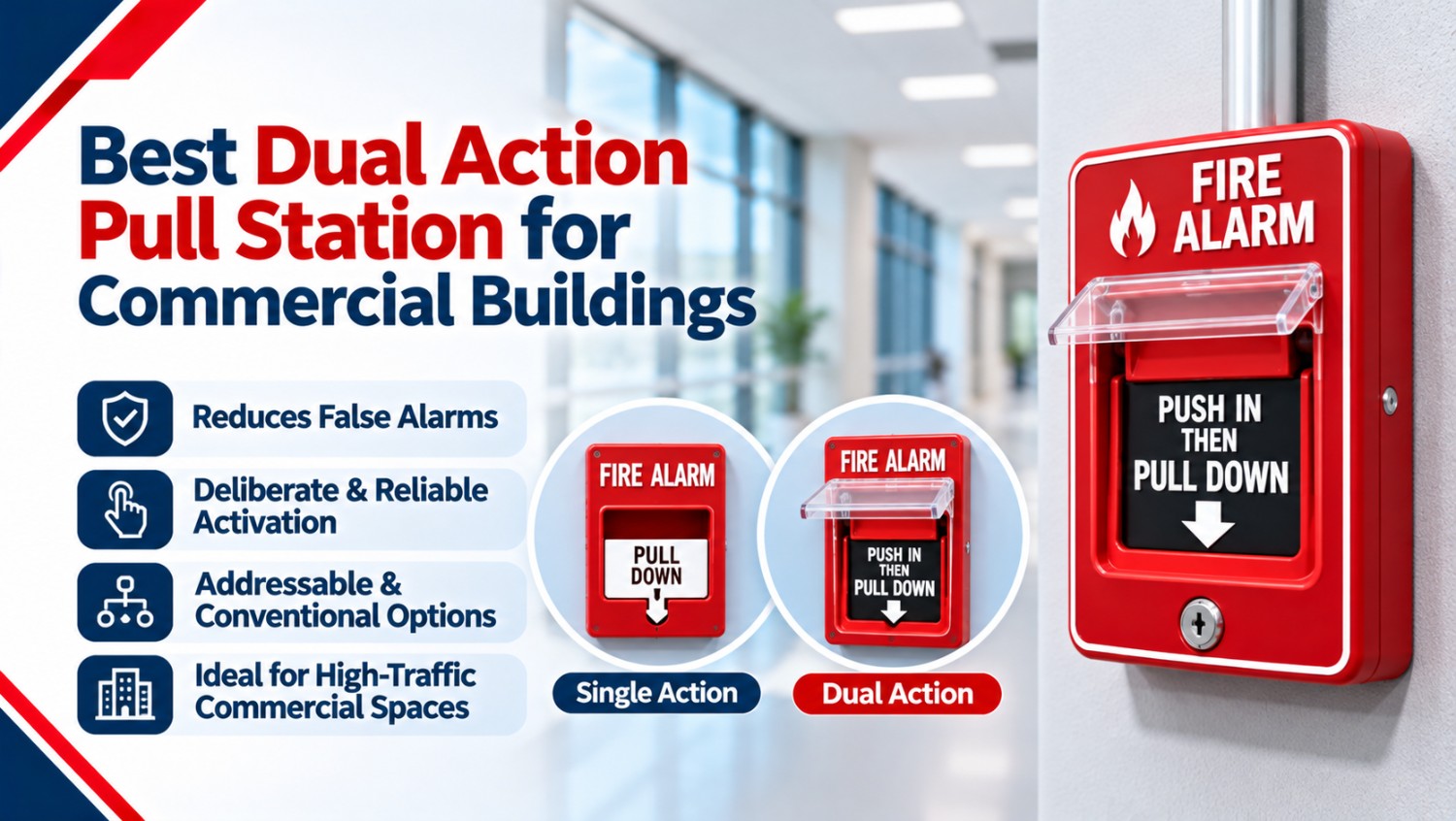
A dual action pull station requires two deliberate motions before it sends an alarm, which makes it a common choice in buildings where accidental activations are disruptive and costly. This guide explains how these devices work, how addressable and conventional models differ, what to verify before a replacement, and which mistakes most often cause compatibility problems.
Manual pull stations are the one part of a fire alarm system that depends entirely on a person, so their design, wiring and placement deserve more attention than they usually receive. The sections below follow a practical order, moving from how the device operates to how to buy, replace and maintain it.
How a Dual Action Pull Station Works
A manual pull station is a wall-mounted initiating device that lets an occupant report a fire without waiting for a detector to sense smoke or heat. The manual fire alarm pull station is normally located along exit routes so that people leaving a building can activate it on the way out. The general concept is also covered in this overview of manual fire alarm activation.
On a single action unit, one motion, usually pulling a handle downward, activates the device. A dual action design adds a first step, such as lifting a hinged cover or pressing a panel inward, before the handle can be pulled. That extra step is simple enough for an occupant under stress to complete, yet deliberate enough to discourage casual, accidental or mischievous activation.
Once activated, the station closes a contact that the control panel interprets as an alarm. On a conventional system, the panel only knows which zone the signal came from. On an addressable system, the station reports its own unique address, so the panel can show exactly which device was operated. Most stations also latch in the activated position and must be reset with a key or tool, which helps staff and responders confirm which device was used.
Why Commercial Buildings Choose Dual Action Pull Stations
False alarms are more than an inconvenience. They interrupt operations, trigger evacuations and can bring a fire department response. Schools, hotels, retail centers, healthcare facilities and industrial plants all have high foot traffic, public access or moving equipment that can bump a wall-mounted device. A dual action pull station reduces the likelihood of those accidental activations without making the device difficult to use in a real emergency.
A commercial dual action pull station is therefore often specified where the building is open to the public or where occupants may include children. It does not eliminate false alarms, and it does not replace occupant training, but it removes one of the most common causes.
Requirements are not universal. Some jurisdictions and facility types specify one style over the other, and a design approved for your building may call for a particular device. Confirm the rules with the authority having jurisdiction before ordering.
Dual Action vs. Single Action: A Quick Comparison
| Factor | Single Action | Dual Action |
| Activation steps | One motion, usually a pull | Two motions, such as lift or press, then pull |
| Resistance to accidental activation | Lower | Higher |
| Operation in an emergency | Fastest to operate | Slightly more deliberate, still quick |
| Typical settings | Areas where local rules allow a simpler device | Public-facing, high-traffic or sensitive occupancies |
| Panel compatibility | Conventional and addressable versions exist | Conventional and addressable versions exist |
| Replacement concern | Match protocol and back box | Match protocol and back box, confirm local rules |
Neither design is universally better. When evaluating any commercial dual action pull station, the decision depends on occupancy, the local code environment and how likely accidental activation is. QuickShipFire’s pull station selection shows how closely the two styles are paired: the Silent Knight SD500-PS is a single action addressable station, while the SD500-PSDA is its dual action counterpart for Silent Knight commercial systems.
Addressable vs. Conventional Dual Action Pull Stations
Conventional stations are simple switches wired to a zone circuit. They are easy to understand, but the panel can only identify the zone, so locating the activated device takes more effort in a large building.
An addressable dual action pull station communicates over a signaling line circuit with its own address. The control panel then displays the specific device and location, which speeds up the response and makes troubleshooting easier. For multi-floor or multi-tenant buildings, that precision is usually worth the extra care in programming.
The important point for buyers is that addressable devices are protocol-specific. A station built for one manufacturer’s panel will not necessarily communicate with another’s. Even a basic addressable fire alarm pull station must match the control panel’s brand and series, and the address must be set so that it does not duplicate another device on the loop.
Key Factors to Consider Before Buying
- Panel compatibility: confirm the manufacturer, panel series and signaling protocol before selecting any addressable dual action pull station or other addressable device.
- Action type: check whether the approved design or local rules call for single action, dual action, or either.
- Environment: indoor stations are not automatically suitable for outdoor, damp or dusty locations, so verify the rating or enclosure required.
- Mounting: confirm the back box type, surface or flush mounting, and accessible mounting height for your location.
- Reset method: know whether the station uses a key or a tool, and keep spares on hand for facility staff.
Where Dual Action Pull Stations Make the Most Sense
The value of a second action depends on how the building is used. A commercial dual action pull station is generally most useful in settings where accidental contact is likely or where false alarms carry a high operational cost.
Typical Commercial Applications
- Schools and campuses: large numbers of students and frequent activity near exits make unintended activations more likely.
- Healthcare and assisted living: evacuations are complex, so avoiding unnecessary ones protects patients and staff.
- Hotels and multi-tenant buildings: many unfamiliar occupants share the same corridors and exits.
- Retail and public assembly: crowds and carts increase the chance of accidental contact.
- Industrial and warehouse spaces: forklifts, pallets and moving equipment can strike devices mounted near aisles.
Local rules still decide what is permitted, so treat this list as a starting point for discussion with your fire alarm contractor rather than a specification.
Fire Alarm Pull Station Replacement: What to Check
Replacement is routine in commercial buildings. Each manual fire alarm pull station is exposed to impact, vandalism and age, so stations are damaged, wear out, or belong to a product line that is no longer easy to find. A fire alarm pull station replacement is simplest when the new device is an exact match, and more complicated when the original model is obsolete. In that case, a supplier that specializes in hard-to-find fire alarm components can save considerable time.
Replacement Checklist
- Read the existing markings: record the manufacturer, model and part number printed on the device or its housing.
- Identify the type: determine whether the station is conventional or addressable, and note its protocol.
- Record the address: write down the address setting or programmed location before removing an addressable device.
- Check the back box: confirm that the new station fits the existing box and mounting style.
- Coordinate with monitoring: place the system in the appropriate test mode and notify the monitoring company to avoid an unwanted dispatch.
- Test after installation: operate the station, verify the panel annunciates the correct device, then reset and document the result.
Common Mistakes to Avoid
Frequent Buying and Installation Errors
- Mixing protocols: installing an addressable fire alarm pull station from a different brand than the panel is the most common cause of a device that never appears on the loop.
- Ordering conventional for an addressable loop: the wiring may look similar, but the electronics are not interchangeable.
- Duplicate addresses: two devices with the same address create trouble signals and make fault-finding harder.
- Ignoring local requirements: swapping single action for dual action, or the reverse, without checking the approved design can cause inspection problems.
- Skipping the post-install test: a station that is mounted but never operated has not been verified.
- Treating stations as maintenance-free: every manual fire alarm pull station still need inspection and testing on the schedule required by the applicable code.
Frequently Asked Questions
What is a dual action pull station?
A dual action pull station is a manual fire alarm device that requires two separate motions to activate, usually lifting or pushing a cover and then pulling a handle. The extra step reduces accidental activations while still allowing occupants to report a fire quickly.
What is the difference between single action and dual action pull stations?
A single action station activates with one motion, typically pulling a handle. A dual action station requires a preliminary step first, such as lifting a cover. Both signal the control panel in the same way, but the dual design is more resistant to accidental or mischievous activation.
Is a dual action pull station addressable?
It can be. Dual action pull stations are made in both conventional and addressable versions. An addressable dual action pull station reports a unique address to the control panel over the signaling line circuit, so the panel identifies the exact device, while a conventional model only reports the zone.
Can I replace a single action pull station with a dual action one?
Often yes, provided the new station matches the panel’s protocol and fits the existing back box. Confirm local code requirements, update the device records, and test the station with the panel afterward. Check with the authority having jurisdiction first if the change affects an approved design.
Where should manual pull stations be installed?
Manual pull stations are normally placed along exit routes and near exit doors, at heights and spacing set by NFPA 72, the building code and the local authority having jurisdiction. Requirements vary by occupancy and location, so confirm them against the approved fire alarm design before installing.
Are pull stations from different manufacturers interchangeable?
Not for addressable systems. Each manufacturer uses its own signaling protocol, so an addressable fire alarm pull station must match the control panel brand and series. Conventional stations are simpler, but the contact configuration and back box should still be verified before substituting another brand.
How often should pull stations be tested?
Testing and inspection intervals are set by NFPA 72 and local requirements, and manual stations are typically tested on a recurring schedule, commonly once a year. Your fire alarm service provider and the authority having jurisdiction can confirm the exact interval and documentation your building needs.
Conclusion
Choosing the right dual action pull station comes down to a few practical decisions: whether the building benefits from a second deliberate action, whether the device must be addressable, and whether it matches the control panel’s manufacturer and protocol. Add accurate record keeping during fire alarm pull station replacement and regular testing afterward, and the station remains reliable for years. Treat dual action pull station selection as part of the overall fire alarm design rather than a last-minute purchase.
If you are specifying or replacing manual stations, start by confirming your panel model, the existing device part numbers and any local requirements. You can then browse the available pull stations or contact the QuickShipFire team for help locating a compatible or hard-to-find device. Note that QuickShipFire is an independent reseller, so confirm brand and model compatibility with your fire alarm contractor before ordering.