
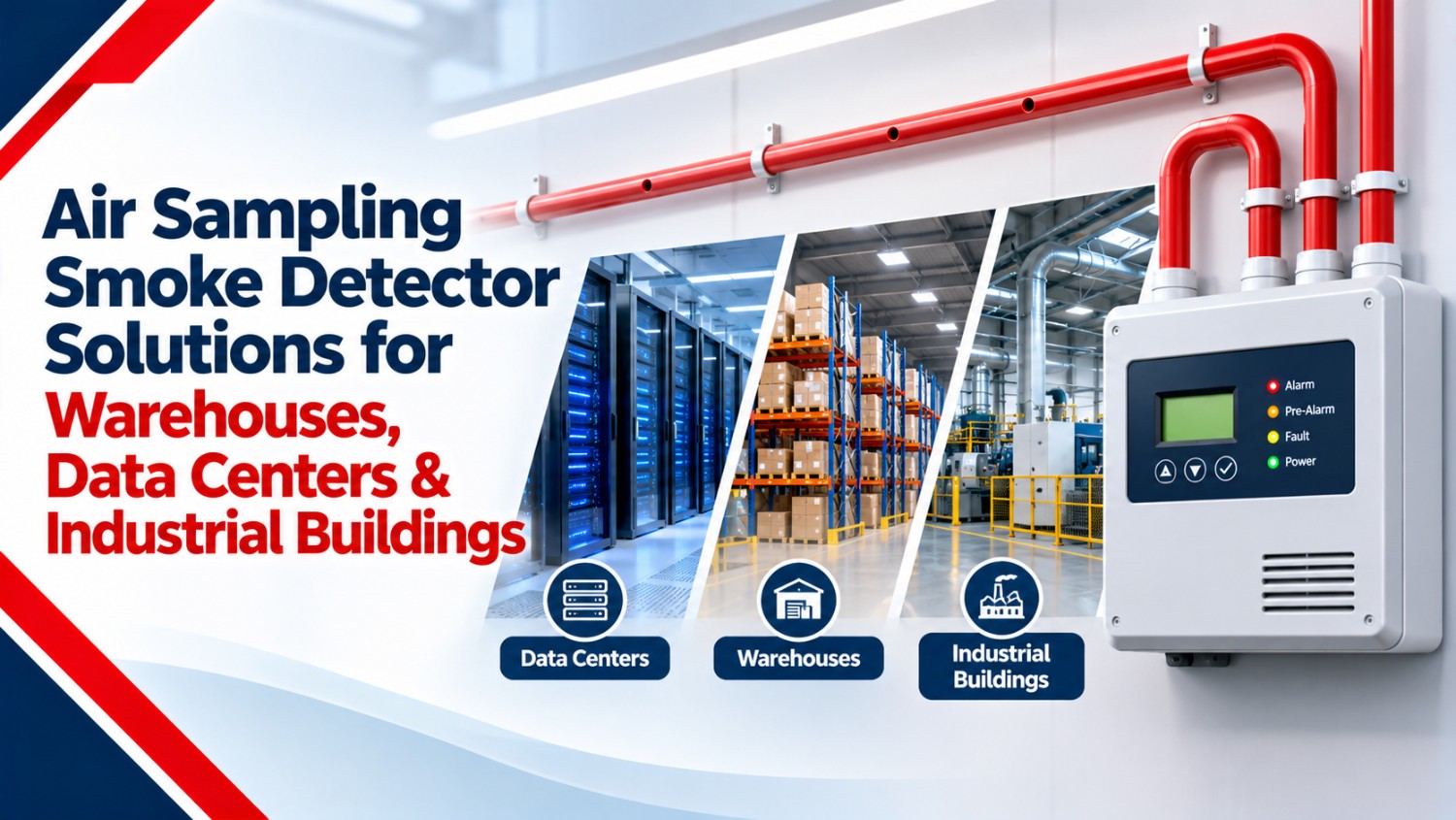
An air sampling smoke detector continuously draws air through a network of pipes to a central detection unit, so it can identify the earliest traces of smoke in places where ordinary ceiling detectors respond too slowly or are hard to maintain. This guide explains how the technology works, where it fits in warehouses, data centers and industrial buildings, and what to confirm when you specify, compare or replace a unit.
Standard spot-type detectors wait for smoke to reach the device itself. In a tall warehouse, a high-airflow server hall or a dusty production area, that may take longer than the facility can afford. An air sampling smoke detection system reverses the approach: the detector pulls the air to the sensor, which changes both how quickly a problem is recognised and how the system is designed.
How an Air Sampling Smoke Detector Works
The Pipe Network and Detection Unit
An air sampling smoke detection system has two main parts. The first is a pipe network with small sampling holes placed throughout the protected space. The second is a detection unit containing an aspirator, or fan, that draws air through those pipes. Filters remove dust before the sample reaches the sensing chamber, where smoke particles are measured. Most designs also monitor airflow, so a blocked pipe or a leak raises a fault instead of leaving the system silently impaired.
Why It Detects Smoke Earlier
Because an air sampling smoke detection system actively samples the air and measures particle levels, it can respond to very low concentrations of smoke. As a high sensitivity smoke detector, many aspirating designs provide several alarm levels, from an early alert to a full alarm, giving staff time to investigate before a fire develops. The exact thresholds and sensitivity settings differ by manufacturer and model, so confirm them in the datasheet and the design documentation.
Air Sampling vs. Conventional Smoke Detectors
The two approaches are complementary, and the table below compares them in general terms.
| Factor | Air sampling smoke detector | Conventional spot-type detector |
| Detection method | Draws air through pipes to a central sensing unit | Waits for smoke to reach the device |
| Early warning | Designed for very early detection | Responds once smoke reaches the head |
| Installation | Requires a designed pipe network | Mounted individually on the ceiling |
| Maintenance access | Detector can be placed in an accessible location | Each device must be reached where it hangs |
| Typical use | Data centers, clean rooms, high ceilings, sensitive assets | General offices, corridors, rooms |
| Upfront cost | Generally higher per protected area | Generally lower |
Where an Air Sampling Smoke Detector Is Most Useful
Environments That Benefit
- Data centers and server rooms: strong airflow dilutes smoke, so actively sampled air helps identify trouble sooner. This is the reason air sampling smoke detectors for data centers are widely discussed in the industry.
- Warehouses with high ceilings: pipes can be run where smoke is expected to travel, rather than relying only on devices mounted far overhead.
- Clean rooms and laboratories: sensitive processes and equipment benefit from very early warning, with fewer ceiling devices to disturb the space.
- Cold storage and harsh areas: the detection unit can often sit outside the difficult environment while the pipes sample inside it.
- Heritage and hard-to-access spaces: sampling points are less intrusive than ceiling-mounted devices and easier to service.
In each case the benefit depends on correct design. NFPA 72 includes requirements for air sampling-type detectors, and the NFPA 72 code page is the right place to start for the national framework, with local codes and the authority having jurisdiction (AHJ) deciding what applies to your building.
Air Sampling Smoke Detectors for Data Centers
For air sampling smoke detectors for data centers, the priorities are early detection, minimal disruption and reliable signaling. Equipment rooms contain expensive, interdependent systems, and a small incident can interrupt operations long before flames appear. A high sensitivity smoke detector can alert staff to overheating cables or failing components while the situation is still manageable.
Two VESDA VLF models illustrate the difference. The VLF-250 is described as a standard aspirating unit for small rooms, server rooms and sensitive environments, while the VLF-500 is described for server rooms, data centers and clean rooms. Always confirm coverage limits, pipe length allowances and communication options in the manufacturer’s current documentation before choosing between them.
NFPA 75, which addresses information technology equipment, is often referenced in these spaces as well. The responsible designer should confirm which standards apply to the specific facility.
VESDA Smoke Detection System and Aspirating Technology
A VESDA smoke detection system is one of the best-known examples of aspirating technology and is commonly specified where early warning is a priority. The brand name is widely used as shorthand, but the principle applies to the whole category: sampling pipes, an aspirator, filtration, a sensing chamber and a connection to the fire alarm control panel.
If you are comparing products, an aspirating smoke detector should be judged on the details that affect your building: the area it can cover, how many sampling holes the pipe network can support, how alarm levels are configured and how the unit reports faults. The model number alone does not answer these questions, so ask for the design documentation and the pipe layout.
Industrial Smoke Detection System Considerations
An industrial smoke detection system must handle dust, temperature swings, vibration and large open volumes. Air sampling can suit these conditions, but filters and pipe networks require regular maintenance. Dust-heavy processes can clog filters faster than office spaces, and temperature extremes affect how air moves through the pipes. Plan for access to filters, scheduled inspections and clear records of settings.
Factors to Weigh When Selecting a Commercial Air Sampling Smoke Detector
A commercial air sampling smoke detector should be chosen against the actual space, not a catalog description. Consider these points:
- The size and shape of the protected area, including ceiling height and obstructions.
- Airflow patterns from HVAC systems, which influence where sampling holes should be located.
- The environment around the detector unit, including temperature, dust and humidity.
- The communication method between the detector and the fire alarm control panel.
- Service access for filter changes, testing and settings review.
- The qualifications of the designer who will prepare the pipe network layout.
Aspirating Smoke Detector Replacement: Planning Considerations
Aspirating smoke detector replacement is not simply a matter of swapping one box for another. The pipe network was designed around the performance of the original unit, so a different model may require the design to be recalculated and approved. A like-for-like replacement is usually simpler, but even then the settings, alarm thresholds and connections should be checked and documented.
Information to Gather Before Replacing a Unit
- The exact model and serial information on the existing detector.
- The original pipe network drawings or design report, if they exist.
- Current alarm thresholds, delay settings and relay assignments.
- How the unit connects to the panel and what signals it sends.
- The condition of filters, pipe joints and sampling holes.
- The date of the last commissioning or acceptance test.
If the original documentation is missing, a qualified technician can often reconstruct the settings from the unit, but it is better to confirm them before the old detector is removed. After installation, the system should be commissioned and tested, including a smoke test and a check of airflow and fault conditions. If the original model is difficult to source, a supplier familiar with hard-to-find fire alarm components can help identify what is available before you commit to a design change.
Common Mistakes to Avoid
The most expensive errors happen before installation. Buyers choose a detector by name and discover that it does not match the pipe design. Designers place sampling holes without considering HVAC airflow. Owners treat an industrial smoke detection system as maintenance-free, then find that clogged filters or damaged pipes have reduced performance. Technicians replace a unit and forget to restore the original thresholds or relay settings. Some facilities also assume air sampling removes the need for any other detection, when the design and local code decide what additional devices are required. Written commissioning records and a defined maintenance schedule prevent most of these problems.
Frequently Asked Questions
What is an air sampling smoke detector?
An air sampling smoke detector draws air through a pipe network to a central unit that measures smoke particles. Because it actively samples the air, it works as a high sensitivity smoke detector that can detect smoke at very low levels, which makes it useful for data centers, warehouses and other environments where early warning matters.
How is an aspirating smoke detector different from a normal smoke detector?
A conventional detector waits for smoke to reach it, while an aspirating smoke detector pulls air to a central sensing unit through pipes. This allows earlier detection and lets the detector sit in an accessible location. It also requires a designed pipe network and regular filter maintenance.
Is VESDA the same as an air sampling smoke detector?
A VESDA smoke detection system is built on a well-known brand of aspirating detection equipment, so it is one example of an air sampling smoke detector rather than the whole category. Other manufacturers make comparable products, and the right choice depends on the protected space, the design and panel compatibility.
Why are air sampling smoke detectors used in data centers?
Data centers have strong airflow that can dilute smoke, and their equipment is costly and critical. Air sampling smoke detectors for data centers can recognise very small amounts of smoke early, giving staff time to respond before a minor fault escalates into downtime.
Can an air sampling system be used in a warehouse?
Yes, it can be a good fit for tall or large warehouses where ceiling-mounted detectors may respond slowly. The pipe layout should be designed for the building, taking into account ceiling height, storage arrangements and airflow, and approved by the authority having jurisdiction.
Can I replace an aspirating detector with a different model?
Sometimes, but not automatically. The pipe network was designed around the original unit, so a different model may need the design reviewed or recalculated. Confirm compatibility with the manufacturer or designer, then commission and test the system after installation.
How often do air sampling systems need maintenance?
Maintenance intervals are set by the manufacturer’s instructions and applicable codes such as NFPA 72. Filters, airflow and fault monitoring need regular checks, and dusty or harsh environments may require more frequent attention. Keep dated records of every inspection and test.
Conclusion
An air sampling smoke detector offers early warning in places where conventional devices struggle: data centers, clean rooms, high-bay warehouses and industrial buildings. Its value depends on a well-designed pipe network, a detector chosen for the space, and a maintenance routine that keeps filters, airflow and settings in good order. Choosing a commercial air sampling smoke detector therefore starts with the building, not the brochure. When replacement time comes, documentation of the existing system is the best protection against design mismatches.
If you are considering new equipment or planning an aspirating smoke detector replacement, gather the model number, pipe drawings, current settings and panel details first. Then send those details through the aspirating smoke detector replacement request page so the QuickShipFire team can help you review options before ordering.