
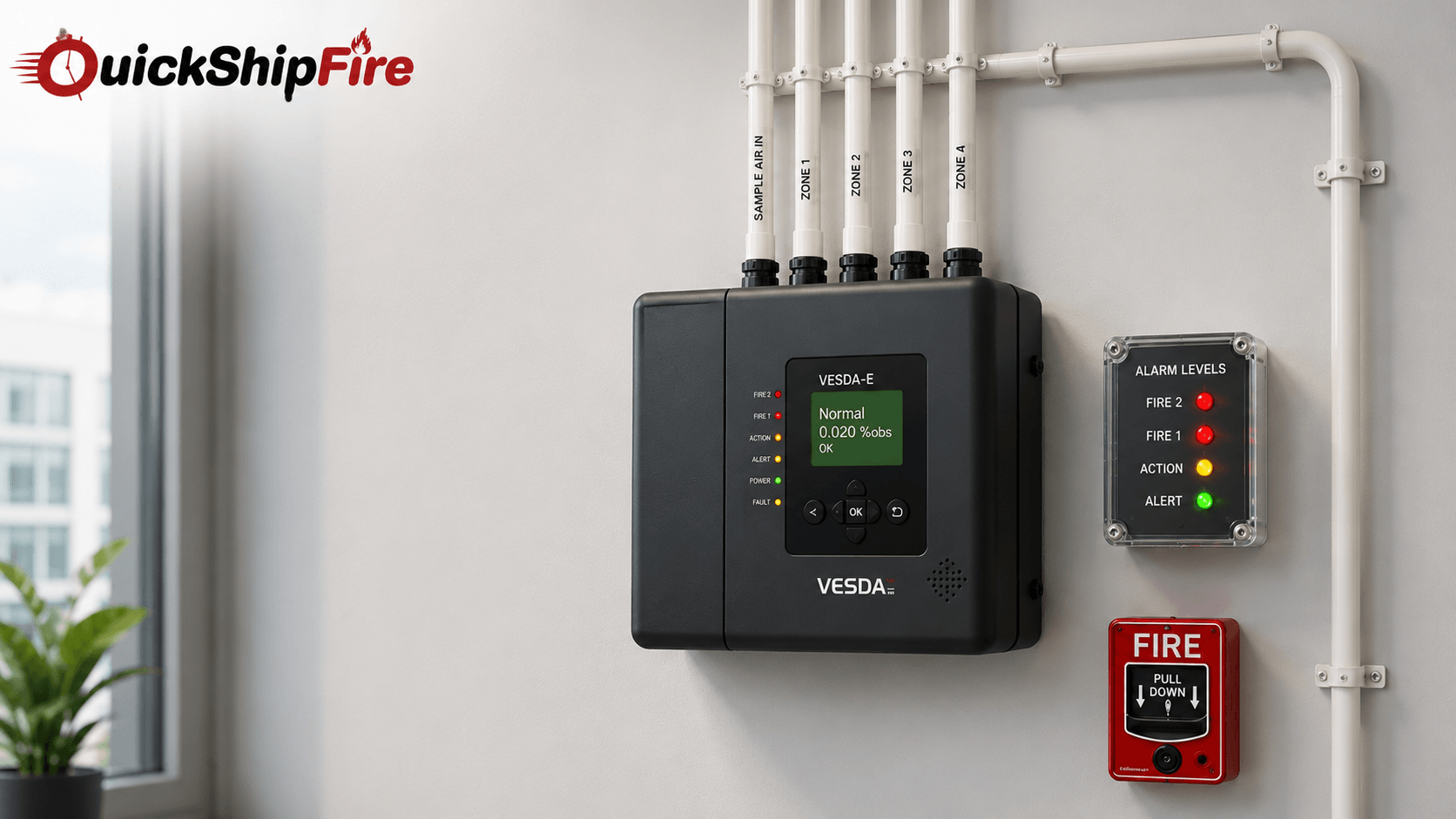
Most fire alarm systems are designed to react once smoke has already accumulated enough to reach a spot-type detector on the ceiling. In a data hall, clean room, or archive full of irreplaceable material, that delay can be the difference between a minor equipment fault and a facility-wide loss. Air sampling smoke detection, commonly known by the VESDA brand name, takes a different approach: it continuously draws air from the protected space through a network of pipes and analyzes it for combustion particles long before visible smoke or a conventional alarm threshold would ever trigger. This article walks through how air sampling smoke detection works, where it earns its cost in high-value facilities, and what to consider when specifying a system alongside your existing fire alarm control panel.
Facilities that fall into this category share one trait: the cost of an undetected, slow-developing fire far outweighs the cost of the detection system itself. That is the core economic argument for air sampling smoke detection, and it is why insurers and design engineers increasingly specify it for any space that houses critical infrastructure or irreplaceable assets.
What Is Air Sampling Smoke Detection?
Air sampling smoke detection, also called aspirating smoke detection, uses a high-efficiency aspirator to pull air continuously through a network of small-bore pipes drilled with sampling holes positioned throughout the protected area. The sampled air passes through a dual-stage filter, first removing dust and larger particulate, then delivering clean air to a laser-based detection chamber. Because the system is actively sampling rather than waiting for smoke to drift up and trigger a passive sensor, it can identify combustion byproducts at concentrations far below what a conventional photoelectric or ionization detector can register. A single detector head, depending on the model, can cover anywhere from roughly 2,500 to 20,000 square feet through a single pipe network, with multiple sampling points feeding back to one analysis unit.
The result is a graduated alarm response rather than a single trip point. Most air sampling smoke detection systems report through several thresholds, typically labeled Alert, Action, Fire 1, and Fire 2, giving facility staff time to investigate and resolve an early-stage issue, such as an overheating component, before it escalates into a fire that trips notification appliances and evacuates the building.
How Air Sampling Smoke Detection Differs from Conventional Detection
A conventional spot-type or duct smoke detector works well in typical office and commercial environments, but it has real limitations in specialized spaces. High airflow, common in data centers and cleanrooms, can dilute smoke before it ever reaches a passive sensor. High ceilings in atriums, warehouses, and arenas allow smoke to stratify before it descends far enough to trigger a spot detector. And in spaces where aesthetics or contamination control matter, exposed detector heads on every ceiling tile are often undesirable.
Air sampling smoke detection addresses all three problems. The pipe network can be routed above ceiling tiles, into return air plenums, or directly through server cabinets, so sampling holes reach the areas where smoke is most likely to originate rather than waiting for it to migrate to a fixed detector location. Because the pipe network is largely hidden, the visible footprint in the protected space is minimal, which is one reason air sampling smoke detection is common in museums, historic buildings, and other aesthetically sensitive environments.
- Detects combustion particles at concentrations far below the threshold of a conventional spot detector.
- Performs reliably in high-airflow environments where a standard sensor may under-report smoke concentration.
- Covers large or oddly shaped spaces through a single pipe network instead of dozens of individual detector heads.
- Provides multiple alarm thresholds, giving staff time to investigate before an evacuation-level event occurs.
- Keeps the visible footprint low, which matters in museums, archives, and other aesthetically sensitive interiors.
Applications for High-Value and Mission-Critical Facilities
Data Centers and Server Rooms
Data centers are the most common application for air sampling smoke detection, and for good reason. Server rooms run high-volume cooling airflow that can overwhelm conventional detectors, and the cost of downtime, let alone the cost of the equipment itself, makes very early warning extremely valuable. A VESDA aspirating smoke detector can identify the off-gassing associated with an overheating component or a failing power supply well before it produces enough smoke to trigger a spot detector, giving operations staff a chance to shut down or replace the failing hardware before a fire event occurs.
Clean Rooms and Healthcare Environments
Clean rooms, operating rooms, and other environments with tightly controlled and filtered airflow present a challenge for standard smoke detection, since the very air-handling systems designed to keep the space sterile also dilute and redirect smoke before it reaches a fixed sensor. Air sampling smoke detection is engineered to work within these controlled airflow conditions without requiring changes to the room’s pressurization or filtration design.
Museums, Archives, and Cultural Institutions
Museums and archives protect items that cannot be replaced or restored after fire or water damage. Aspirating detection’s combination of very early warning and minimal visible hardware makes it a natural fit for galleries and storage vaults, where a conventional sprinkler or water-based response to a delayed alarm could itself damage the collection.
Industrial and Hazardous Environments
Manufacturing plants, warehouses, and other industrial sites often combine high ceilings, dusty or humid air, and high-value equipment, all factors that push designers toward air sampling smoke detection as part of a broader hazardous environment fire protection strategy. In these environments, filtration and pipe routing become especially important, since the system needs to tolerate ambient dust and temperature swings without generating false alarms or clogging the sampling network.
- Data centers and telecom facilities where downtime carries a direct financial cost.
- Cleanrooms, operating rooms, and pharmaceutical manufacturing spaces with controlled airflow.
- Museums, archives, and libraries protecting irreplaceable physical collections.
- High-ceiling spaces such as warehouses, arenas, and atriums where smoke stratifies before reaching a fixed detector.
- Industrial and hazardous environments where a broader early detection system reduces both life-safety and asset risk.
Air Sampling Smoke Detection vs. Conventional Detection: A Quick Comparison
| Factor | Air Sampling Smoke Detection | Conventional Spot Detection |
| Detection sensitivity | Detects particles far below visible smoke threshold | Triggers only after smoke reaches the sensor chamber |
| Performance in high airflow | Actively draws and samples air; unaffected by dilution | Can under-report smoke concentration in fast-moving air |
| Coverage per unit | Up to roughly 20,000 sq ft through one pipe network | Each detector head covers a single fixed radius |
| Visible hardware | Minimal; sampling holes only, pipe network is concealed | Detector head visible on every covered ceiling area |
| Alarm staging | Multiple thresholds: Alert, Action, Fire 1, Fire 2 | Single alarm threshold |
| Typical best fit | Data centers, cleanrooms, museums, high-ceiling spaces | Standard offices, corridors, and general commercial space |
Designing an Air Sampling Smoke Detection System
A successful air sampling smoke detection installation depends on more than the detector unit itself. Pipe layout, sampling point spacing, and detector sensitivity settings all need to reflect the airflow patterns and hazard profile of the specific space being protected, which is why these systems are engineered rather than simply installed off a standard layout. Integration with the building’s existing control panel is equally important; the aspirating detector needs to report its Alert, Action, and Fire signals to the panel so the broader notification and, where applicable, suppression sequence can respond appropriately.
Filtration and maintenance planning matter just as much as the initial design. The dual-stage filters that keep dust out of the laser chamber need periodic replacement, and the pipe network itself should be inspected for blockage or damage on a schedule consistent with the facility’s risk profile and the applicable code requirements. Facilities that also run standard duct smoke detector coverage in adjacent air-handling equipment should coordinate both systems so alarm reporting and airflow shutdown sequences are consistent across the building.
- Pipe layout and sampling hole spacing engineered to match measured airflow patterns in the protected space.
- Detector sensitivity thresholds configured to the facility’s specific risk profile rather than left at generic defaults.
- Confirmed integration between the aspirating detector and the building’s control panel for proper signal escalation.
- A maintenance plan covering filter replacement and pipe network inspection on a defined interval.
- Coordination with any existing duct detector installation so airflow shutdown and notification sequences stay consistent.
Where Air Sampling Fits Alongside a Broader Early Detection System
Air sampling smoke detection is rarely the only detection technology in a high-value facility. It typically works alongside conventional smoke and heat detectors, speciality detectors suited to specific hazards, and, where suppression is warranted, a clean agent or gaseous system that will not damage sensitive electronics or collections. Building a genuinely layered early detection system around the highest-risk areas of a facility, rather than relying on a single detection technology throughout, is generally the most cost-effective way to protect both life safety and high-value assets.
On the device side, most aspirating detectors mount to a dedicated detector base or enclosure rather than a standard ceiling base, and the pipe network terminates at fittings sized specifically for the manufacturer’s tubing. Getting these details right during specification avoids field changes and delays once installation is underway.
QuickShipFire carries a range of VESDA aspirating smoke detector components, sampling network fittings, and related early warning parts, along with the panels and modules needed to integrate them into a building’s broader detection and alarm system. If you are specifying air sampling smoke detection for a data center, cleanroom, or other high-value space, request a quote and our team will help you source the right components quickly, including hard-to-find legacy parts for systems being expanded or serviced.
Conclusion
For facilities where downtime, contamination, or the loss of irreplaceable assets is unacceptable, waiting for smoke to reach a conventional detector is simply too slow. Air sampling smoke detection closes that gap by continuously sampling air and reporting combustion particles at concentrations far below a standard alarm threshold, giving staff time to investigate and resolve a developing issue before it becomes a fire event. From data centers and cleanrooms to museums and industrial facilities, the technology has become the standard of care for protecting high-value environments, provided the pipe network, sensitivity settings, and integration with the building’s control panel are engineered correctly from the start.
Frequently Asked Questions
What does VESDA stand for and how does it relate to air sampling smoke detection?
VESDA stands for Very Early Smoke Detection Apparatus. It is a widely recognized brand name for aspirating, or air sampling, smoke detection technology, and the two terms are often used interchangeably in the fire protection industry.
How is air sampling smoke detection different from a standard smoke detector?
A standard spot detector waits for smoke to drift to its location and trigger a passive sensor. Air sampling smoke detection actively draws air from multiple points through a pipe network into a central laser detection chamber, allowing it to identify combustion particles at far lower concentrations and much earlier in a fire’s development.
What areas of a facility should be covered by air sampling smoke detection?
Priority areas typically include data halls, server rooms, telecom equipment rooms, cleanrooms, control rooms, and archival or collection storage spaces. High-ceiling areas and spaces with strong mechanical airflow are also strong candidates because conventional detection struggles in those conditions.
How much area can one air sampling smoke detection unit cover?
Coverage varies by manufacturer and model, but a single unit can typically protect anywhere from roughly 2,500 to 20,000 square feet through a properly engineered pipe network with multiple sampling points.
Does air sampling smoke detection replace conventional fire alarm devices?
No. It is typically layered alongside conventional smoke detectors, duct detectors, and notification appliances rather than replacing them, and it still reports through the building’s control panel like any other initiating device.
How much maintenance does an air sampling smoke detection system require?
These systems use dual-stage filters that need periodic replacement, and the pipe network should be inspected regularly for blockage, damage, or airflow changes. Maintenance intervals should follow manufacturer guidance and the facility’s risk profile.
Can air sampling smoke detection cause fewer false alarms than conventional detectors?
Because the system filters incoming air and allows configurable, graduated alarm thresholds, many facilities see fewer nuisance alarms once the system is properly tuned to the space, though results depend on the environment and how carefully the system was engineered and commissioned.