
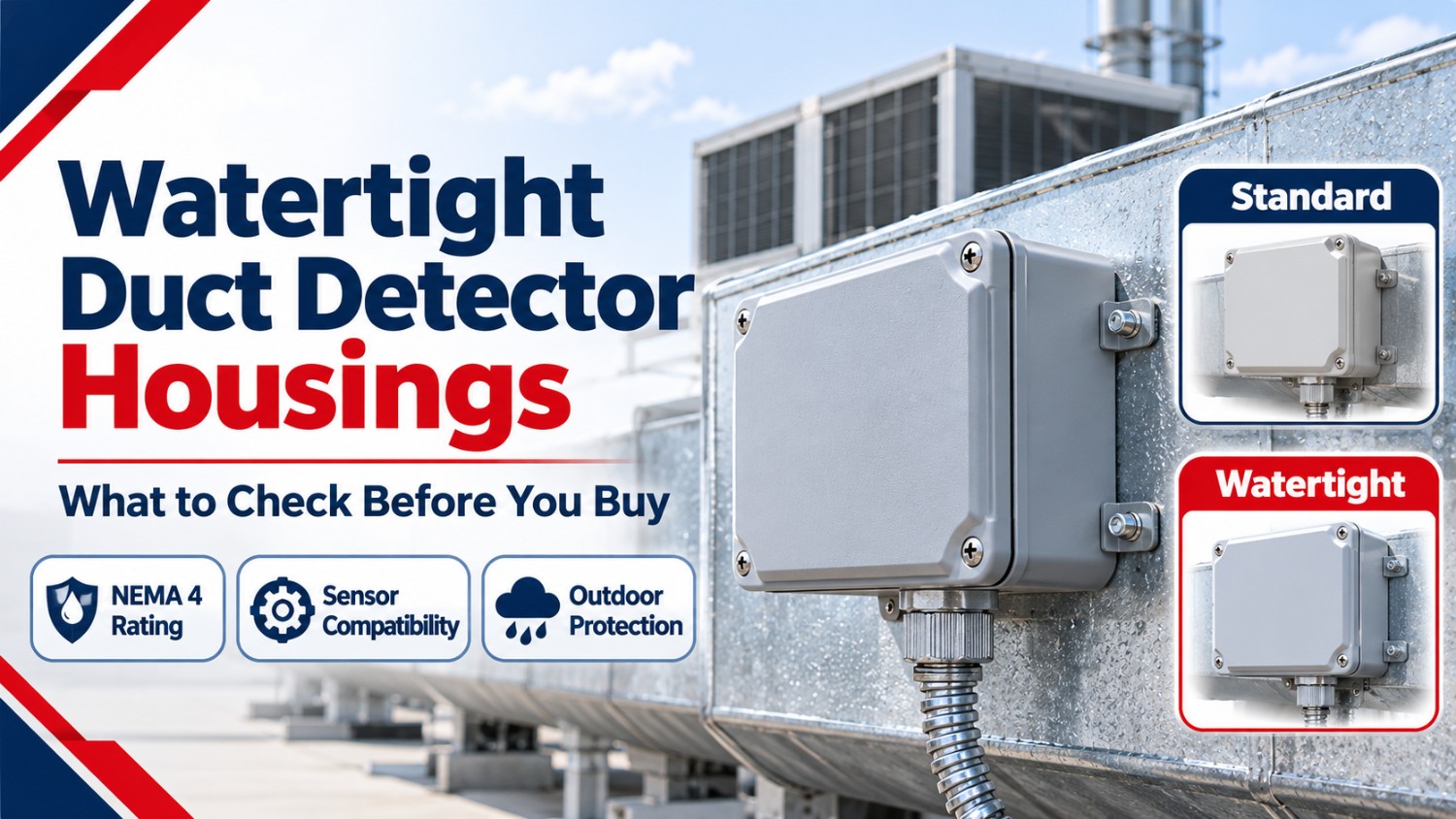
Buy watertight duct detector housings from a supplier that can verify the exact model, sells it new in original packaging and spells out its return and warranty terms. This guide covers what a watertight housing does, when outdoor and wet-location ducts call for one, how to confirm compatibility and what to ask a seller before you order, so your replacement or new installation works the first time.
What Watertight Duct Detector Housings Do
A duct smoke detector does not protect a room. It samples air as it moves through an HVAC duct and reports smoke, so the fire alarm system can shut down fans and limit how far smoke travels through the building. The housing is the enclosure around the smoke sensor: it holds the sensor, channels air across it and shields it from the surrounding environment.
Standard housings are made for conditioned indoor spaces. If a duct sits on a roof, in an unconditioned plant room or anywhere exposed to rain, condensation and big temperature swings, a standard enclosure may not be suitable. Watertight housings are built to keep moisture away from the electronics, which is why they are specified for outdoor and harsh locations.
When Watertight Duct Detector Housings Are Needed
In exposed locations, moisture is the leading cause of duct detector trouble. Water inside an enclosure can corrode contacts, trigger false alarms or leave the device unable to respond.
Consider a watertight housing if any of these apply:
- The duct or air handler is outdoors or on a rooftop
- The housing is exposed to rain, snow, washdown or condensation
- Large temperature changes cause moisture to form inside enclosures
- Local code or the system design calls for a weatherproof, watertight or NEMA 4 duct detector housing
- The previous housing has failed more than once because of water or corrosion
Your fire protection engineer or authority having jurisdiction decides what your project requires. Duct smoke detection rules come from locally adopted codes and standards, so confirm what applies before you specify equipment.
NEMA 4 and Other Enclosure Ratings Explained
Enclosure ratings describe how well a housing protects what is inside it. The NEMA system sorts enclosures by the conditions they are designed to withstand. A NEMA 4 enclosure is generally intended for indoor or outdoor use and for resisting splashing and hose-directed water. That is why the rating appears so often in specifications for exposed HVAC equipment, and for watertight duct detector housings in particular.
As a result, a NEMA 4 duct detector housing is commonly requested for rooftop and outdoor air handlers. Always check the rating against the manufacturer’s datasheet for the specific model instead of inferring it from the product name, because ratings depend on the exact configuration and installation.
System Sensor DNRW: A Frequently Specified Watertight Housing
The DNRW is among the best-known products in this category. QuickShipFire’s catalog describes the System Sensor DNRW duct detector housing as an outdoor HVAC duct-mount smoke detector enclosure for commercial and industrial buildings, and you can review it on the DNRW watertight duct housing page.
Keep in mind that this is an enclosure, not a complete detection system. A compatible smoke sensor still has to be installed, and the job needs the right sampling tubes for the duct width, wiring back to the panel and any relay or remote test accessories your design requires. Check each of these against the manufacturer’s documents before you place the order.
Standard vs. Watertight Housings Compared
Standard and watertight units differ in the environment they suit, their features and how they connect to the fire alarm panel. This quick comparison shows which type fits a given location.
| Factor | Standard duct housing | Watertight duct housing |
| Typical location | Indoor conditioned ducts | Rooftop, outdoor and exposed ducts |
| Moisture protection | Basic | Designed to resist water ingress |
| Common concern | Unsuitable if exposed to weather | Sealing correctly during installation |
| What drives the choice | Standard indoor duct requirements | Outdoor exposure, code and design |
| Best suited for | Air handlers inside the building | Rooftop units and outdoor air handling |
Treat this table as a general guide. The correct choice depends on your project’s design documents.
Commercial Duct Smoke Detector Housing Options
Not every project needs a watertight housing, and some systems use an integrated detector and housing instead of a housing alone. A supplier with a good catalog lets you compare these options side by side.
A commercial duct smoke detector housing may be sold as an empty enclosure, as a housing with a detector or as a unit with a relay for fan shutdown. QuickShipFire, for example, lists an addressable duct smoke detector and housing for commercial air handling systems, along with a version that includes a relay for fan shutdown. Which one you choose depends on whether your panel controls fans directly or you need local relay contacts.
Confirming Compatibility Before You Order
Ordering the wrong housing is the most common and most expensive mistake with watertight duct detector housings. A few checks will head it off.
Compatibility Checks
- Read the model number on the existing housing and sensor
- Confirm the sensor head works with the housing
- Check the duct width and the sampling tube length required
- Verify the voltage and communication type the system uses
- Determine whether relay, remote test or other accessories are needed
- Check that the panel and loop support the device
If you are replacing a damaged unit, photos of the nameplate and the installed housing help a supplier confirm the part quickly.
Planning a Watertight Duct Smoke Detector Replacement
Even watertight housings age faster outdoors than they would in a clean interior. Gaskets harden, covers crack and fasteners corrode. Regular inspection and testing programs often catch these problems before anything fails.
A watertight duct smoke detector replacement should start by working out why the original failed. If water got in through a damaged gasket or cover, replacing that part may be enough. If the housing was wrong for the location, fix that at the same time. For stock that is not shown online, you can request a quote and ask about availability and lead times.
Replacement Steps
- Document the existing model, location and wiring
- Notify the monitoring company and occupants before shutting down the system
- Disconnect power following your lockout procedure
- Install the new housing and seal conduit entries properly
- Mount the sensor and sampling tubes as the manufacturer directs
- Test airflow, alarm response and fan shutdown, then record the results
Qualified fire alarm technicians should carry out duct detector work, following the manufacturer’s instructions and local requirements.
Where to Buy Watertight Duct Detector Housings: Choosing a Supplier
The best source is a seller that treats the part as life-safety equipment. Price matters, but accuracy, condition and support matter more.
Ask whether the equipment is new and in original packaging. For a System Sensor DNRW duct detector housing, also ask which components are included, whether the seller is an authorized distributor, how returns and warranties work and how quickly the item ships. QuickShipFire states that it is an independent reseller and not an authorized distributor of the brands it lists, that all products are brand new in original manufacturer packaging and that it offers a 30-day money-back policy where applicable and a one-year warranty, refund or replacement option. Reading these terms before you order lets you judge whether they suit your project.
You can browse watertight duct detector housings by brand, including System Sensor listings, and confirm availability before committing.
Common Mistakes When Buying Duct Detector Housings
Many duct detector problems trace back to purchasing errors instead of product faults. Watch for these.
Mistakes to Avoid
- Buying a standard housing for an outdoor location that needs a watertight one
- Assuming an enclosure rating without checking the datasheet
- Forgetting that the sensor and sampling tubes are separate requirements
- Overlooking duct width when choosing tubes
- Skipping a functional and airflow test after installation
- Buying from a seller that cannot confirm condition or return terms
Frequently Asked Questions
What is a watertight duct detector housing?
A watertight duct detector housing is an enclosure that holds a duct smoke sensor and is designed to keep moisture out. It is used in outdoor, rooftop or damp HVAC locations where rain or condensation could damage a standard housing. It still needs a compatible smoke sensor.
What does NEMA 4 mean for a duct detector housing?
NEMA 4 is an enclosure rating that describes protection for indoor or outdoor use against conditions such as splashing or hose-directed water. A NEMA 4 duct detector housing is commonly specified for exposed HVAC equipment, but you should confirm the rating on the manufacturer’s datasheet for the exact model.
When do I need a watertight duct smoke detector housing?
Typically when the duct or air handler is outdoors, on a rooftop or otherwise exposed to rain, condensation or washdown. Your design documents, fire protection engineer and local authority determine the requirement, so confirm them before ordering equipment.
Does the System Sensor DNRW duct detector housing include the smoke detector?
The DNRW is described as a watertight duct detector housing, so the enclosure is the main item. A compatible smoke sensor, sampling tubes and any required accessories are generally needed to finish the installation. Check the product documentation to see what comes with the version you order.
Where can I buy a duct detector housing?
From fire alarm equipment suppliers that list the exact model, state the item’s condition and publish return and warranty terms. Confirm whether the seller is an authorized distributor, ask about shipping speed and verify compatibility before you buy.
How do I choose the right commercial duct smoke detector housing?
Start with the location, duct width, existing model and system type. Choose a watertight housing for outdoor or damp locations, confirm sensor and tube compatibility and check whether a relay is needed for fan shutdown. Review the manufacturer’s documents before you finalize the order.
Who should install a duct detector housing?
Qualified fire alarm technicians should install and test it. The work affects HVAC shutdown and life-safety signaling, and local rules may require permits, monitoring notifications and documented testing. Follow the manufacturer’s instructions for mounting, wiring and airflow verification.
Conclusion
Choosing watertight duct detector housings means matching the enclosure to its environment, confirming compatibility and buying from a seller that is open about condition and terms. Identify the existing model, check the enclosure rating, confirm the sensor and tube requirements and test the finished installation.
If you are planning a watertight duct smoke detector replacement or specifying a new rooftop installation, review the duct detector catalog or send your model numbers through the QuickShipFire quote page. The team can help confirm the right housing and the accessories that go with it.