
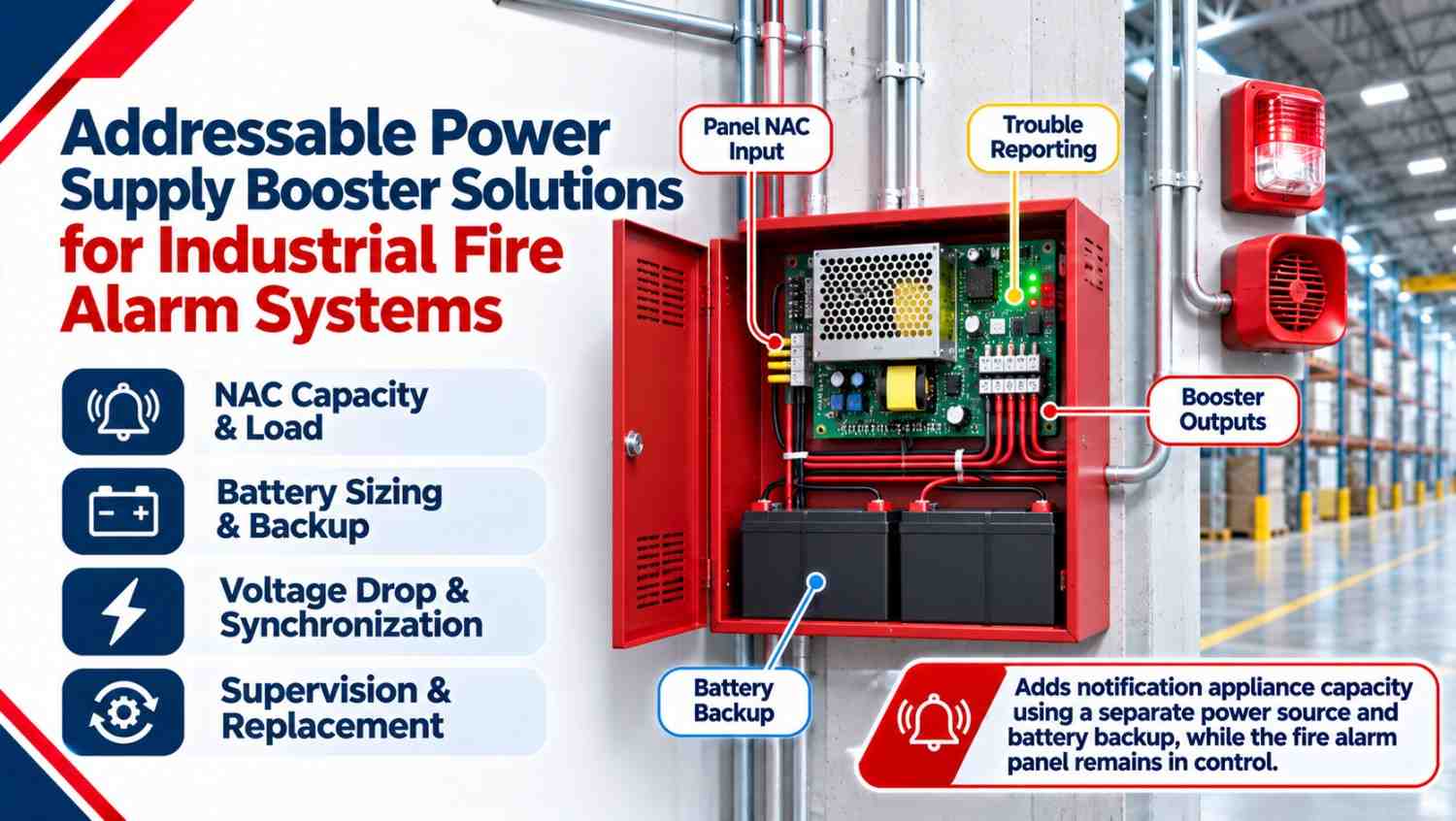
An addressable power supply booster gives a fire alarm system the extra current it needs to run horns, strobes and other notification appliances when the main panel cannot supply enough on its own. In large industrial buildings, long cable runs, high ceilings and noisy production areas often push notification demand beyond what a panel’s built-in circuits can support. This article explains how an addressable power supply booster works, how to size one, and what to check before you specify or replace it.
It is written for facility managers, fire alarm contractors and maintenance teams responsible for industrial and commercial sites. The guidance is general. Always follow the equipment manufacturer’s instructions, the edition of NFPA 72 in force locally and the requirements of the authority having jurisdiction (AHJ).
What an Addressable Power Supply Booster Does
Every fire alarm control panel has a limited amount of power available for its notification appliance circuits (NACs). When a project needs more horns, strobes or speakers than that supply can handle, a booster adds capacity. It receives a signal from the panel, usually from an existing NAC output, and then drives its own outputs using a separate power source and a battery backup. The panel stays in control, while the booster carries the electrical load.
A modern addressable fire alarm power supply is also supervised. Depending on the model, it can report trouble conditions such as AC loss, low battery or a circuit fault back to the panel through supervisory outputs or an addressable interface. That reporting matters because an unmonitored power supply that fails silently can leave a whole zone without audible or visible warning. The wider background on how these systems fit together is covered in general references on the fire alarm system.
Why Industrial Facilities Often Need an Addressable Power Supply Booster
Industrial buildings place unusual demands on notification circuits. Distances are long, so voltage drops along the cable can leave appliances at the far end below their minimum operating voltage. Ceilings are high and equipment is loud, which calls for more appliances or higher output ratings. Buildings also grow, and each expansion adds devices to circuits that were sized for the original layout.
A fire alarm booster power supply solves several of these issues at once. Placing it close to the devices it serves shortens the high-current cable runs and reduces voltage drop. This is the reasoning behind a fire alarm remote power supply: instead of pulling heavy circuits from the panel across the whole site, power is generated near the load.
Consider a distribution warehouse that adds a mezzanine and a new loading area. The panel’s original NAC is already close to its limit. Rather than replacing the entire panel, the contractor installs an addressable power supply booster near the new area, triggers it from the existing circuit and adds the new appliances to its outputs. The result is more capacity without redesigning the system.
Key Factors to Consider
- Total appliance current: add up the worst-case alarm current of every appliance on each output, using the manufacturer’s published data for the selected settings.
- Voltage drop: confirm that the farthest appliance still receives adequate voltage at the end of the cable run.
- Battery capacity: batteries must support the standby period and the alarm period required for the system.
- Synchronization: strobes and horns should stay synchronized across the panel and the booster, so check compatibility between the booster and the appliances.
- Input type: boosters can be triggered by a NAC input or a relay, and the panel must be able to provide the signal expected.
- Supervision: decide how AC loss, battery trouble and output faults will be reported to the panel.
How to Size an Addressable Power Supply Booster
Sizing an addressable power supply booster starts with the load. List every notification appliance that the booster will serve, note the current each draws in alarm, and total them for each output. Compare the result with the booster’s rated output and keep a sensible design margin so the unit is not working at its limit. Ratings vary by model: the Wheelock PS-8-LP PowerPath, for example, is described as an 8 amp NAC booster, while the VPS-100US-120 is described as a 10 amp NAC booster. Always check the listing and datasheet before relying on a headline figure.
Batteries come next. NFPA 72 sets secondary power requirements, and for many systems that means a defined period of standby operation followed by a period of full alarm, commonly 24 hours of standby plus five minutes of alarm. Emergency voice systems and some occupancies differ, so confirm the requirement with the AHJ and use the manufacturer’s calculation method. Finally, calculate voltage drop to the last device on each circuit and adjust wire size or the booster location if the margin is thin.
Comparing Notification Power Options
There is more than one way to add notification capacity. An addressable power supply booster is one of several routes. The table compares the usual approaches in qualitative terms only, because actual figures depend on the specific products and design.
| Option | Power source | Strength | Limitation |
| Panel onboard NAC | Panel power supply | Simplest design, fewest components | Limited current and range for large buildings |
| NAC power supply booster | Dedicated supply with battery backup | Adds capacity near the load without replacing the panel | Needs space, AC power, battery and supervision |
| Additional or larger panel | New panel supply | Expands the whole system | Higher cost and more reprogramming |
| Fire alarm remote power supply cabinet | Local supply near devices | Reduces cable length and voltage drop | Requires a location with AC power and access |
In practice, a NAC power supply booster is the most common choice for adding capacity to an existing site, because an addressable power supply booster avoids touching the control panel itself.
Matching Power Supplies to Modules and System Components
An addressable power supply booster does not work in isolation. Control and monitor devices connect it to the rest of the system, and fire alarm power supply modules are one part of that picture. Depending on the design, a module may trigger the booster, monitor a trouble output or interface its outputs with the panel’s loop. Confirm that these fire alarm power supply modules and other devices belong to the same manufacturer family and protocol as the panel.
The same rule applies to the full range of addressable fire alarm system components around the booster, including panels, boards, detectors and modules. Mixing equipment from different families is the fastest route to communication faults, so check compatibility before you finalise an order. A commercial fire alarm power supply that suits one panel family may not synchronize with the appliances used on another.
Addressable Power Supply Replacement: What to Check
Power supplies are among the first components to age, and an addressable power supply booster is no exception. Batteries lose capacity, capacitors fail and enclosures corrode. When an addressable fire alarm power supply fails or is discontinued, addressable power supply replacement should begin with the existing installation, not the catalogue. Identify what is installed, how it is wired, which fire alarm power supply modules trigger or monitor it, and what other addressable fire alarm system components depend on it, and then decide whether a like-for-like unit is available.
- Manufacturer, model number and rating from the nameplate
- How the unit is triggered, for example from a NAC input or a relay
- Number of outputs in use and the appliances connected to each
- Battery size and age, and whether the charger is still serviceable
- Synchronization protocol used by the existing strobes and horns
- Supervisory connections to the panel, including trouble reporting
Where a model is obsolete, a specialist supplier can sometimes find a compatible alternative, and a commercial fire alarm power supply with the same or a higher rating may be an acceptable substitute if the installer confirms compatibility. Buy only new equipment in original packaging with a clear return policy.
Common Mistakes to Avoid
Most problems with an addressable power supply booster, or any addressable fire alarm power supply, trace back to design shortcuts rather than faulty hardware.
- Sizing to the nameplate only: the capacity of a fire alarm booster power supply should be based on the real appliance load plus a design margin.
- Forgetting the batteries: an adequate booster still fails the system if the battery cannot support the required standby and alarm periods.
- Ignoring synchronization: mixed appliances and boosters can flash or sound out of step.
- Leaving the unit unsupervised: an unmonitored failure may not be discovered until the next test.
- Placing the unit in a hard-to-reach location: batteries and indicators need regular inspection.
Installation and Maintenance Notes
An addressable power supply booster, like any commercial fire alarm power supply, is only as dependable as its upkeep. After installation, test the outputs under alarm load and with the main power removed to confirm battery operation. Then maintain it to the schedule set by the manufacturer and the AHJ.
- Inspect enclosures for moisture, dust and corrosion
- Check battery date codes and replace batteries on the manufacturer’s schedule
- Verify that trouble conditions reach the panel as intended
- Label every output so future technicians can trace each circuit
- Keep as-built drawings and calculations with the system records
Frequently Asked Questions
What is an addressable power supply booster?
An addressable power supply booster is a supervised power unit that adds current capacity for notification appliances such as horns and strobes. It is triggered by the fire alarm panel, powers its own outputs from a separate supply and battery, and can report trouble conditions back to the panel.
When does a fire alarm system need a NAC power supply booster?
A booster is needed when the total appliance current exceeds what the panel’s own circuits can supply, or when voltage drop on long cable runs leaves devices underpowered. Large industrial buildings, building expansions and added appliances are the most common triggers. A load and voltage-drop calculation confirms whether one is required.
How do I size a fire alarm booster power supply?
To size an addressable power supply booster, total the alarm current of every appliance on each output, compare it with the booster’s rated output and leave a design margin. Then calculate battery capacity for the required standby and alarm periods, and check voltage drop at the farthest device. Follow the manufacturer’s data and the AHJ’s requirements.
Can I use any addressable power supply booster with any fire alarm panel?
No. Compatibility depends on the panel’s NAC output type, the booster’s input requirements and the synchronization protocol of the appliances. Check the manufacturer’s compatibility information before ordering, and if you are unsure, give the supplier the panel model and appliance type so they can confirm a match.
Where should a fire alarm remote power supply be installed?
Install it as close as practical to the devices it serves, in a location with reliable AC power, adequate ventilation and safe access for testing and battery service. Mounting near the load reduces cable length and voltage drop. Follow the manufacturer’s installation instructions and local code requirements.
How long do the batteries in a booster need to last?
Battery capacity must cover the system’s standby period followed by an alarm period. For many systems NFPA 72 points to 24 hours of standby plus five minutes of alarm, though some applications differ. Confirm the requirement with your AHJ and calculate capacity using the manufacturer’s method.
What information do I need for an addressable power supply replacement?
Provide the existing model number and rating, the panel make and model, how the unit is triggered, the number of outputs in use, the appliance types and the battery size. Photos of the nameplate and wiring help a supplier identify a compatible replacement quickly and accurately.
Conclusion
An addressable power supply booster allows an industrial fire alarm system to grow and to cope with long distances without overloading the control panel. The essentials are straightforward: calculate the real load, protect it with correctly sized batteries, keep voltage drop within limits, choose addressable fire alarm system components that are compatible with the panel and supervise the unit so that faults are reported. Doing this work upfront prevents costly corrections after commissioning.
If you are planning an upgrade or a replacement, collect the model numbers, circuit details and appliance list first. You can then browse the power supplies range at QuickShipFire or contact the team for help identifying a suitable addressable power supply booster for your site.