
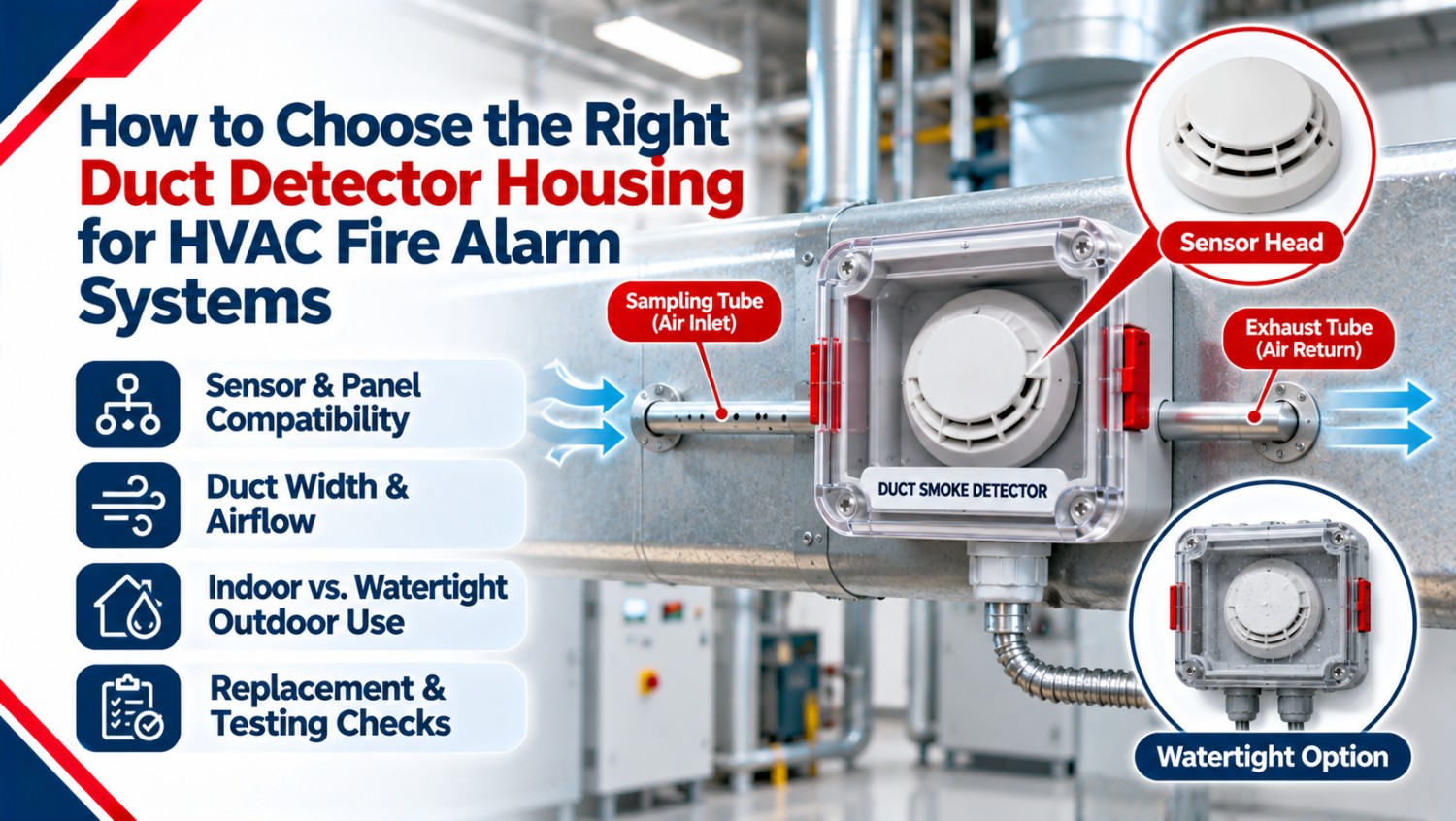
Choosing the right duct detector housing starts with four questions: which duct it will be mounted on, which sensor head it must hold, which fire alarm panel it must report to, and what conditions it will face once installed. A mismatch on any of these can lead to poor air sampling, nuisance alarms, or a fan that keeps running while smoke moves through the building. This guide explains how a duct detector housing works, what separates one option from another, and how to approach replacement without creating compatibility problems.
It is written for facility managers, maintenance teams, fire alarm technicians and purchasing staff who need the right duct detector housing for a commercial duct smoke detector installation. Treat it as general guidance only. The manufacturer’s installation instructions, the edition of NFPA 72 adopted in your area and the authority having jurisdiction (AHJ) always take precedence.
What a Duct Detector Housing Does
A duct smoke detector is not a ceiling detector fitted inside a vent. It is an assembly designed to sample air that is moving through ductwork. The housing is the enclosure that holds the sensing element, while sampling tubes extend into the duct to draw in a portion of the airflow. That air passes the sensor and returns to the duct through an exhaust tube. Because the housing controls how air reaches the sensor, it is part of the detection function rather than a simple cover. Understanding that role is the first step in selecting the right duct detector housing.
In most commercial buildings, the purpose of this equipment is to help control the HVAC system. When smoke is detected, the signal can shut down an air handling unit or close dampers so that smoke is not distributed to other areas. Codes generally treat duct detection as a way to manage air movement, not as a replacement for the smoke detector coverage that protects occupants in open spaces. Confusing those two roles is one of the most common misunderstandings around a duct smoke detector housing.
Why the Right Duct Detector Housing Matters for HVAC Smoke Detection Systems
Ductwork carries air across entire floors, and in a commercial duct smoke detector installation a failure here has consequences well beyond the equipment room. If the unit cannot sample air reliably, the building may lose its early warning that smoke has entered the air stream. If it reacts badly to its environment, repeated false alarms erode trust in HVAC smoke detection systems and sometimes lead to a device being disabled, which creates a bigger problem than the one it was meant to solve.
Selecting the right duct detector housing also shapes long-term maintenance. A housing that is easy to open, test and clean will be inspected properly. One that is awkward to reach, or does not match the sensor head, tends to be neglected. Duct smoke detectors are also evaluated to their own product standard in the United States, UL 268A, so substituting an incompatible component can undermine the listing of the whole assembly.
Key Factors to Consider
- Sensor compatibility: the housing must be designed for the specific sensor head or detector model in use. Mixing parts across product families is a frequent cause of failed installations.
- Panel and communication type: confirm whether the system is conventional or addressable, and which manufacturer’s protocol the panel uses.
- Duct width: sampling tube length is chosen to suit the width of the duct. A tube that is too short may not capture a representative sample of the airflow.
- Airflow conditions: housings are listed for a defined range of air velocity. Check it against the actual HVAC design values.
- Environment: rooftop and outdoor units call for a watertight enclosure, and temperature and humidity also matter.
- Control outputs: if the detector must shut down a fan directly, confirm the assembly includes the required relay or that a control module is planned.
Comparing Duct Smoke Detector Assembly Options
The term duct smoke detector assembly can describe a housing on its own or a complete unit with the detector included. Understanding the difference prevents ordering the wrong item. The table below summarises the main categories, using examples that appear in the duct detector range at QuickShipFire. Comparing them side by side makes it easier to identify the right duct detector housing for your application.
| Option | What it is | Main consideration | Best suited for |
| Basic housing (e.g. Simplex 4098-9755) | HVAC duct-mount enclosure for smoke detectors | Sensor head and base must match the housing | Indoor ducts where a housing needs replacing |
| System Sensor housing (e.g. 4098-9756) | Duct-mount enclosure for commercial and industrial systems | Confirm the detector model it accepts | Like-for-like housing swaps |
| Watertight housing (e.g. DNRW) | Enclosure intended for outdoor duct-mount use | Gasket and cover condition affect weather protection | Rooftop units and exposed ducts |
| Complete addressable unit (e.g. SD505-DUCT) | Addressable detector and housing supplied together | Must suit the panel protocol | New installations or full unit replacement |
| Unit with relay (e.g. SD505-DUCTR) | Addressable detector and housing with relay | Relay wiring and fan shutdown logic | Fan shutdown in air handling systems |
Product listings change over time, so confirm the current specification and compatibility notes on the product page, or with the supplier, before ordering.
Matching the Right Duct Detector Housing to the Detector and Fire Alarm Panel
Compatibility is where most replacement problems begin. An addressable duct smoke detector communicates with the panel digitally, so the device must speak the same protocol as the panel’s signalling line circuit. A conventional detector, by contrast, simply opens or closes a circuit on a zone. The two approaches are not interchangeable, and a housing built for one may not suit the other. Getting this right is central to choosing the right duct detector housing.
Many installations use a separate sensor head mounted inside a housing, while others use an integrated unit sold with the detector and housing together. For an existing system, the safest course is usually to stay within the original manufacturer’s family. For a new job, choosing a complete commercial duct smoke detector as one listed product removes much of the guesswork and often points straight to the right duct detector housing. A version with a relay can be used where the detector must stop a fan.
If you are unsure what is installed, photograph the nameplate and the sensor head label. Those two images normally contain what a supplier needs to identify the right part.
Installation Conditions That Influence the Right Duct Detector Housing
Duct Size and Sampling Tube Length
Sampling tubes are supplied in different lengths because ducts vary in width. The tube should span the duct as the manufacturer directs so that it can collect air from across the flow, not just from the edge. The right duct detector housing is always paired with a tube that suits the duct. When you replace a housing, measure the duct rather than assuming the old tube was correct. Previous installers do not always get this right.
Airflow Direction and Placement
Housings are meant to be installed with the airflow direction in mind, and the sampling tube holes must face the oncoming air. Manufacturers also give guidance on placement relative to bends, transitions and dampers, because turbulent air can reduce sampling performance. Follow those instructions closely and avoid placing the unit where access will be difficult.
Outdoor and Rooftop Locations
Consider a rooftop air handler that serves a retail floor. Rain, sun and temperature swings will all act on the enclosure, so the right duct detector housing for that location is a watertight design. A standard indoor housing in the same position may allow moisture to enter, leading to corrosion, faults and repeated service calls.
HVAC Duct Detector Replacement: A Practical Approach
When a unit is damaged, corroded or no longer available, HVAC duct detector replacement should begin with identification, not purchasing. Record what is installed, check what the panel expects, and then decide whether a like-for-like swap or a complete unit is the better route. The right duct detector housing for a replacement is the one that matches both the sensor and the panel. A like-for-like duct detector housing replacement is usually quickest when the sensor head is still in good condition and the model is still sold.
Information to Gather Before You Order
- Manufacturer and model number from the housing nameplate and the sensor head label
- Panel manufacturer, panel model and the device protocol it uses, including whether you need an addressable duct smoke detector or a conventional one
- Duct width and orientation, and whether the location is indoor or outdoor
- Whether the detector must operate a relay for fan shutdown
- Photos of the wiring terminals, mounting points and sampling tubes
- Any known problems, such as water ingress, crushed tubes or repeated nuisance alarms
Many older systems rely on parts that manufacturers have retired. In that case, duct detector replacement parts from a specialist supplier can keep a working system in service without a full upgrade. Confirm that items are new, supplied in original manufacturer packaging and backed by a clear return and warranty policy before you commit.
Common Mistakes to Avoid
Most errors in selecting the right duct detector housing come from a handful of avoidable habits.
- Ordering by appearance: two housings can look alike and still accept different sensor heads.
- Ignoring tube length: an incorrect tube length affects how well the unit samples the duct.
- Placing the unit near turbulence: bends, dampers and transitions can disturb airflow.
- Mixing manufacturers: combining parts that were never evaluated together inside one duct smoke detector assembly can affect listing and performance.
- Skipping a functional test: after any duct detector housing replacement, test the detector and confirm that the fan or damper responds as designed.
Testing and Maintenance After Installation
Inspection and testing intervals are set by NFPA 72 and the local AHJ, so build the schedule around those requirements. A routine visit commonly covers the following points.
- Check that the cover is secure, gaskets are intact and conduit entries are sealed
- Inspect sampling and exhaust tubes for blockage, damage or dust build-up
- Perform the functional test method the manufacturer recommends
- Verify that connected controls, such as fan shutdown, operate correctly
- Record the date, result and technician for the building’s fire alarm records
A well-chosen duct smoke detector housing makes each of these steps easier, which is one more reason to treat the purchase as part of lifecycle planning rather than a one-off transaction.
Frequently Asked Questions
What does a duct detector housing do?
A duct detector housing holds the smoke sensor and directs a sample of the air moving through HVAC ductwork across it. Sampling tubes draw air in and return it to the duct. When smoke is sensed, the system can signal the panel and shut down fans or close dampers to limit spread.
How do I choose the right duct detector housing for an existing system?
The right duct detector housing matches your sensor head and panel. Start with the nameplate data on your current housing and sensor head, then confirm the panel protocol. Measure the duct width, note whether the location is indoor or outdoor, and decide whether a relay is needed.
Can I use any duct smoke detector housing with any sensor head?
No. Housings are designed and listed for specific detector models, and an addressable duct smoke detector will not suit a conventional circuit. Mixing components from different product families can cause poor sampling, communication problems or loss of listing. Always confirm that the housing and sensor head are approved for use together by the manufacturer before ordering or installing.
When does a duct detector need a watertight housing?
A watertight housing is the sensible choice when the duct is outdoors or exposed to weather, such as on a rooftop unit. Moisture can corrode terminals and cause faults. Indoor locations that stay dry usually do not need one, but always follow the manufacturer’s guidance and local requirements.
How often should duct smoke detectors be tested?
Testing frequency is set by NFPA 72, the manufacturer’s instructions and the local authority having jurisdiction. Many facilities carry out a functional test at least annually, with cleaning and inspection as conditions require. Confirm the schedule that applies to your building and keep written records of every test.
Is a duct detector a substitute for ceiling smoke detectors?
No. Duct detection is mainly used to control HVAC equipment and limit the spread of smoke through air distribution. It does not replace the smoke detectors that protect occupants in rooms and corridors. Building and fire codes determine where each type of detection is required, so check them for your project.
What information is needed for duct detector housing replacement?
Provide the housing and sensor head model numbers, the panel manufacturer and protocol, the duct width, and whether the unit is indoor or outdoor. Mention any relay requirement and attach photos of the nameplate and wiring. This lets a supplier confirm the right duct detector housing and any duct detector replacement parts before the order is placed.
Conclusion
Choosing the right duct detector housing is a compatibility and application decision more than a price decision. Match the housing to the sensor head and the panel, size the sampling tube to the duct, protect the unit from its environment, and keep access in mind for testing. Doing so supports dependable HVAC smoke detection systems and avoids the repeat service calls that follow a poor match.
If you are planning HVAC duct detector replacement or sourcing duct detector replacement parts, gather the model numbers, panel details and duct measurements first. You can then review the duct detector range at QuickShipFire or request a quote so the team can help you find the right duct detector housing for your system.