
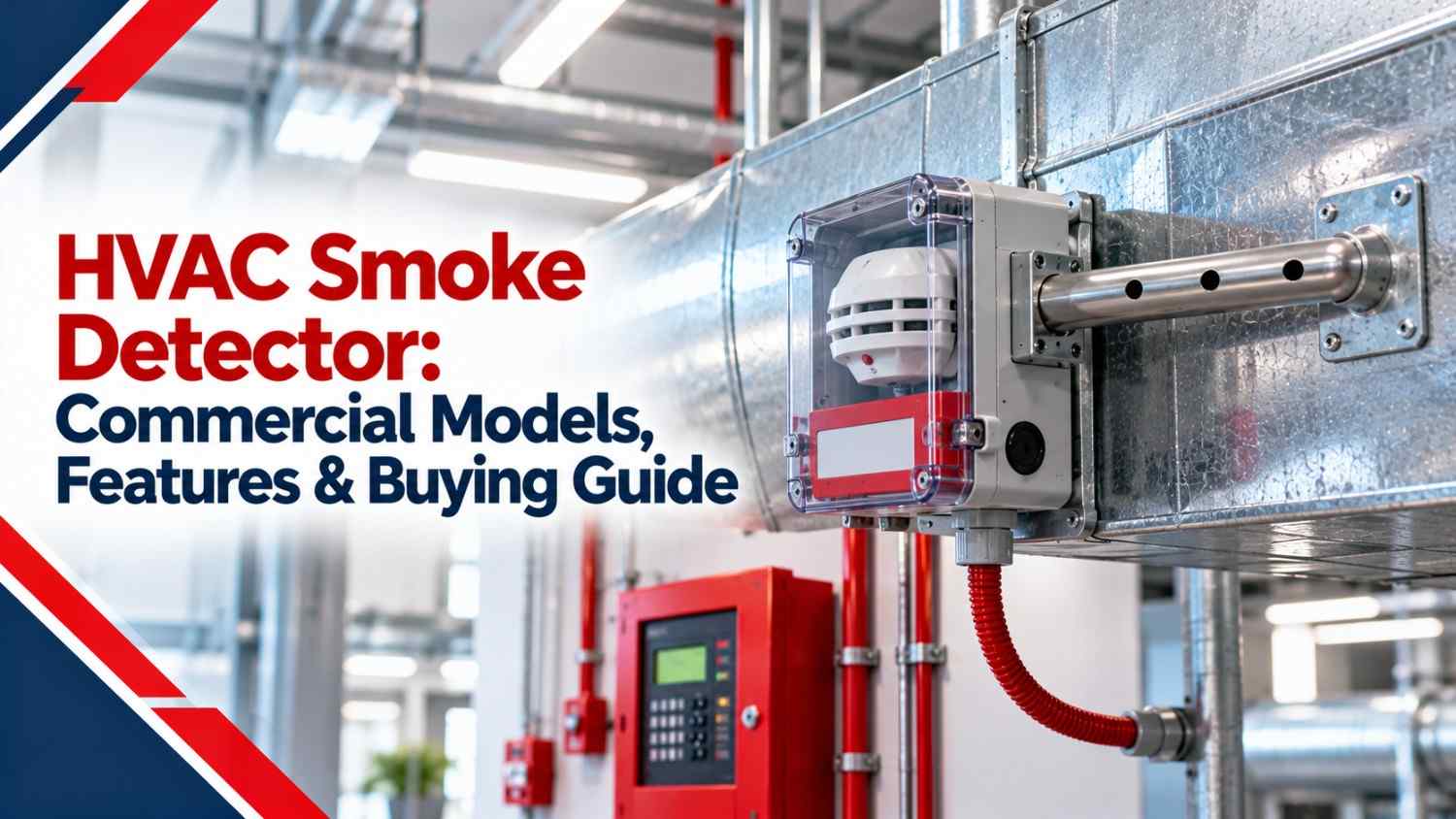
An HVAC smoke detector, usually installed as a duct detector, senses smoke carried through air handling equipment so the fire alarm system can shut down fans and limit the spread of smoke. This guide explains how these devices work, which models and features matter in commercial buildings, what housings and parts are involved and how to approach replacement without buying the wrong unit.
What Is an HVAC Smoke Detector?
An HVAC smoke detector monitors the air moving through a supply or return duct. A housing is mounted on the outside of the duct, and a sampling tube extends across the airflow. Air passes through the tube into the housing, where a sensor looks for smoke particles. If smoke is detected, the device signals the fire alarm panel and, through a relay, can stop fans or close dampers so smoke does not circulate through the building.
These detectors are valuable because HVAC systems can move smoke quickly from one area to another. They do not replace ordinary smoke detectors in occupied spaces, however. A duct detector protects the air system, while area detectors protect people in rooms and corridors. For general background, see this overview of the smoke detector.
Where an HVAC Smoke Detector Is Required
Whether an HVAC smoke detector is required depends on the air handling system’s size, the building type and the codes adopted locally. NFPA 90A and the mechanical code are commonly cited for air handling units, and the fire alarm code covers how duct detectors are connected and monitored. Because requirements vary, confirm with the authority having jurisdiction before you specify equipment. Doing so early avoids rework, since an HVAC smoke detector that is under-specified for a unit’s airflow or duct width may fail inspection.
Commercial HVAC Smoke Detector Types
A commercial HVAC smoke detector is built for the demands of larger buildings, where air handling units are common and fan control is part of the fire strategy. The main differences are in signalling and sensing.
Conventional and Addressable Duct Detectors
A conventional duct detector connects to the fire alarm panel as a zone device. An addressable duct smoke detector has its own address on the signalling line circuit, so the panel identifies exactly which air handler is in alarm. That precision speeds up response in buildings with many units. Addressable units must match the panel’s protocol, so confirm any addressable duct smoke detector against the panel’s supported device list before ordering.
Photoelectric Duct Smoke Detector Technology
A photoelectric duct smoke detector uses a light source and sensor to detect particles scattered by smoke. Photoelectric sensing responds well to smouldering fires and fits the low-visibility smoke that moves through ducts. It is the common technology in duct applications.
Key Features to Compare
- Signalling: conventional or addressable, matched to the panel.
- Relay outputs: the number and type of relays available for fan shutdown or damper control.
- Sampling tube options: tube length must suit the duct width.
- Remote indicators: remote test and alarm indicators make inspection easier when the unit is above a ceiling.
- Maintenance access: an accessible cover and a simple test method.
HVAC Duct Smoke Detector Housing and Components
A typical HVAC duct smoke detector has four parts: the housing, the sensor head, the sampling tube and the cover with test and indicator features. Understanding each part helps when ordering replacements.
Duct Smoke Detector Housing
The duct smoke detector housing holds the sensor head, the terminals and the airflow path. It is mounted to the duct with a gasket to prevent leakage. Damaged covers, cracked housings or worn gaskets can allow air to bypass the sampling path and reduce performance. Housings are usually matched to a specific sensor head, so do not assume parts from different brands are interchangeable.
Duct Smoke Detector Parts
Duct smoke detector parts include sampling tubes, end caps, covers, gaskets, sensor heads, remote test stations and mounting hardware. Sampling tubes come in different lengths for different duct widths, and an incorrect length leads to unreliable sampling. When ordering duct smoke detector parts, record the model number printed on the housing.
Comparing Duct Detector Options
The table below compares common approaches using qualitative factors only.
| Factor | Conventional Duct Detector | Addressable Duct Detector | Area Smoke Detector in Return Air |
| Reports to panel as | Zone device | Individual address | Usually a standard detector |
| Fan shutdown | Through relay | Through relay or control module | Not designed for duct airflow |
| Location detail | Zone only | Exact unit identified | Depends on installation |
| Best suited for | Small or older systems | Larger commercial systems | Not a substitute for duct detectors |
Brand and Competitor Considerations
Several manufacturers offer duct detectors. System Sensor is widely associated with HVAC duct smoke detector housings, and Notifier, Fire-Lite, Simplex and Silent Knight each offer duct detector solutions that pair with their own panels and sensor heads. When comparing any HVAC smoke detector across brands, note that signalling protocols differ, so the housing and head should be selected for the specific panel family rather than mixed across brands.
For buyers comparing a commercial fire alarm duct detector across brands, check how each unit handles relay outputs, sampling tube options and remote indicators. QuickShipFire stocks products from System Sensor and other major brands, which helps when a system includes mixed legacy equipment.
Common Buying Mistakes
- Choosing a unit before confirming the panel’s protocol.
- Ordering a sampling tube that does not suit the duct width.
- Treating a duct detector as a substitute for room detectors.
- Ignoring access, so the unit cannot be tested or cleaned later.
Duct Smoke Detector Replacement
Duct smoke detector replacement is usually needed after failed tests, contamination, physical damage or when a model is discontinued. Because duct detectors operate in dusty, airflow-heavy locations, they need periodic cleaning and testing, and some units eventually need replacing. Before ordering, record the manufacturer, model, signalling type, relay configuration and sampling tube length. Replace the unit with a compatible one, set the correct address if it is addressable and test the fan shutdown function before returning the system to service.
Replacement Checklist
- Confirm the panel brand and addressing method.
- Match the sensor head to the housing.
- Verify the sampling tube length against the duct width.
- Test relays, remote indicators and alarm response after installation.
Installation and Maintenance Considerations
The installation position matters as much as the unit. The detector should be placed where airflow is representative, with the sampling tube oriented so that its ports face the flow. Accessibility is just as important, since an unreachable detector is rarely tested properly. Codes such as NFPA 90A and local mechanical rules govern when duct detectors are required, so confirm your obligations with the authority having jurisdiction.
Every HVAC smoke detector in the building should be on the inspection schedule, and a commercial fire alarm duct detector located above a ceiling or in a mechanical room should have a remote indicator so that it can be found easily. A simple example: a facility manager finds that an air handler’s detector fails its annual test. The sampling tube is clogged with dust and the cover gasket is worn. A cleaning and replacement parts restore operation, but the unit is also old and its model is discontinued, so the manager schedules full replacement with a compatible unit at the next shutdown.
Frequently Asked Questions
What is an HVAC smoke detector?
An HVAC smoke detector is a device mounted on air ducts that samples the airflow to detect smoke. When smoke is found, it signals the fire alarm panel and can shut down fans or close dampers. It helps stop smoke from spreading through the building.
Do duct smoke detectors replace regular smoke detectors?
No. Duct smoke detectors protect the air handling system, not occupied rooms. Area smoke detectors are still needed for early warning. A duct detector’s role is to detect smoke in the airstream and control fans or dampers to limit smoke spread.
What is the difference between conventional and addressable duct detectors?
A conventional duct detector reports as a zone device, so the panel only knows the zone. An addressable duct smoke detector has its own address, so the panel shows exactly which unit is in alarm. Addressable models must match the panel protocol.
Why use a photoelectric duct smoke detector?
A photoelectric duct smoke detector senses visible smoke particles using light scatter, and it responds well to smouldering fires. This suits duct environments, where smoke is carried through moving air. It is the common sensing technology in commercial duct detectors.
When should a duct smoke detector be replaced?
Duct smoke detector replacement is needed after failed tests, damage, persistent contamination, repeated false alarms or when the model is discontinued. Always replace with a compatible unit, confirm addressing and relay settings, and test fan shutdown after installation.
What parts are available for duct detectors?
Duct smoke detector parts include sampling tubes, covers, gaskets, sensor heads, end caps, remote test stations and mounting hardware. Parts are normally model-specific, so check the manufacturer and model number printed on the housing before ordering.
How do I choose a commercial HVAC smoke detector?
Choose a commercial HVAC smoke detector by matching the panel brand and protocol, the duct width and sampling tube length, relay requirements and access for testing. Confirm local code requirements with your authority having jurisdiction before ordering.
Conclusion
A well-chosen HVAC smoke detector protects the building by detecting smoke in the airstream and triggering fan or damper control. The key decisions are protocol compatibility, correct housing and sampling tube, relay needs and a clear plan for testing and maintenance. Treat the duct detector as one part of the full fire alarm design rather than a standalone device. A commercial fire alarm duct detector works best when the panel, relay wiring and fan controls are all documented together.
If you are replacing or adding detectors, gather the panel model, current detector model and duct details first. Browse the range on QuickShipFire or contact the team to match the right unit and parts to your system.