
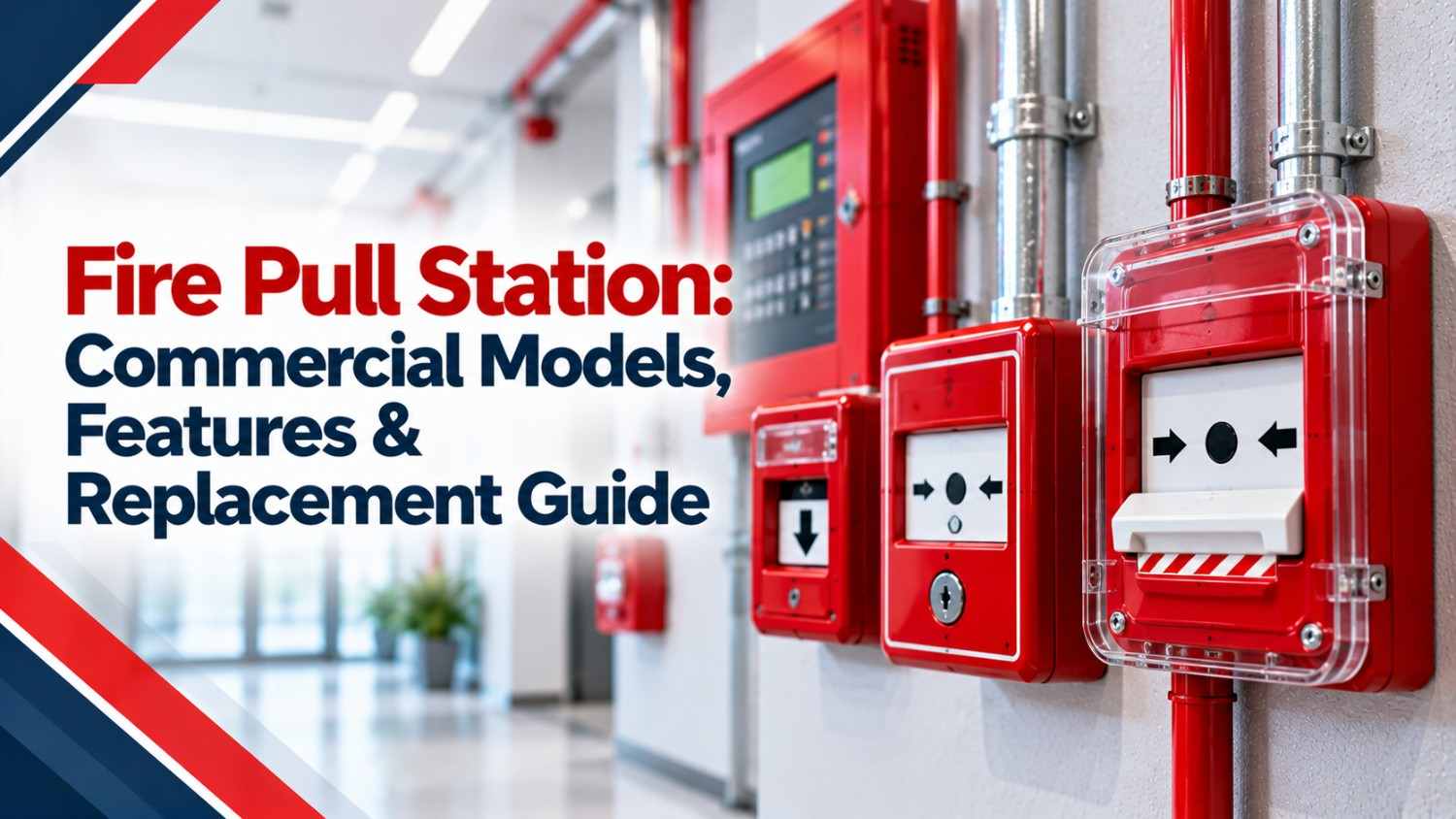
A fire pull station is the manual device that lets an occupant trigger a building’s fire alarm, so choosing or replacing one correctly affects both life safety and code compliance. This guide explains how the main types differ, which features matter in commercial buildings, how to confirm compatibility with your panel and what to check before replacing a damaged or obsolete unit.
How a Manual Fire Alarm Pull Station Works
A manual fire alarm pull station is a wall-mounted device with a handle or lever. When someone operates it, the station closes a contact or sends an addressable signal to the fire alarm control panel, which then activates horns, strobes and, where connected, off-site monitoring. Unlike automatic detectors, the device depends on a person noticing a hazard, which is why placement near exits and along egress routes matters. A general background on these devices is available in this overview of manual fire alarm activation.
Most stations are reset with a key or tool after use, so a tested or accidentally operated unit can usually be restored without being replaced.
Types of Commercial Fire Pull Station
A commercial fire pull station is built to be durable, tamper-resistant and compatible with the building’s alarm panel. The main differences come down to how the device communicates and how it is operated.
Conventional and Addressable Designs
A conventional station reports as a simple contact on a zone, so the panel knows which zone is in alarm but not which device. An addressable fire alarm pull station has its own address on the signalling line circuit, so the panel can display the exact station that was operated. In a large building, that detail saves responders time. The Simplex 4099-9001 individually addressable manual station is one example of this design.
Single-Action and Dual-Action Stations
A single-action station needs one motion, usually a firm pull. A dual-action fire pull station requires two steps, such as lifting a cover or pushing in a lever before pulling. The extra step helps reduce accidental activations in places like schools, hospitals and busy public buildings. Confirm with your local authority whether dual-action stations are required or permitted for your occupancy. A dual-action fire pull station is sometimes combined with a clear protective cover in public buildings, but a cover addresses vandalism and nuisance activations rather than replacing correct station selection.
Key Features to Compare
- Signalling type: conventional or addressable, matched to your panel.
- Action type: single-action or dual-action, based on your accidental-activation risk.
- Housing and mounting: indoor or weatherproof, surface or semi-flush backbox.
- Reset method: key or tool reset, and whether a test feature is included.
- Brand family: the panel manufacturer, since protocols differ between brands.
Comparing Station Types at a Glance
The table below compares station types using qualitative factors only.
| Factor | Conventional | Addressable | Dual-Action |
| Signal to panel | Zone-level contact | Device-level address | Depends on the underlying type |
| Location detail | Zone only | Exact device shown | Depends on the underlying type |
| Operation | One motion | One motion | Two motions |
| Typical use | Small or older systems | Larger commercial systems | Locations with accidental-activation risk |
| Best suited for | Simple zoned panels | Networked or addressable panels | Schools, healthcare, public spaces |
Addressable Pull Station Compatibility
Addressable pull station compatibility is the point buyers most often overlook. Addressable devices communicate using a protocol tied to the panel family, so a station from one brand does not automatically work on another brand’s panel. Simplex stations are designed for Simplex systems. Notifier and Fire-Lite offer addressable manual stations for their own panel lines, and Silent Knight and Gamewell-FCI follow the same pattern. Always match the station to the exact panel model and signalling circuit before ordering.
Compatibility Checks Before You Buy
- The panel manufacturer, model and signalling protocol.
- The address-setting method used by the station.
- The backbox, trim and mounting style already on the wall.
- Whether the existing wiring can support the new device.
Placement, Testing and Maintenance
Stations are generally located along the normal path of egress and near exit doors, at a mounting height and reach range set by the applicable code and local authority. They should be clearly visible, unobstructed and easy to operate. Whether you specify a manual fire alarm pull station for a small office or a large campus, the installed position matters as much as the model.
Periodic inspection and testing are part of normal fire alarm maintenance. Technicians check that the handle moves freely, the housing is intact, the reset key works and the panel reports the correct device or zone. Early signs of wear, such as a sticking lever or a loose backbox, are easier to fix before they become a failed test or a missed alarm.
A Practical Example
Consider a warehouse whose older panel shows only zone-level alarms. After several nuisance activations, the owner decides to upgrade to addressable devices. The team confirms the panel family, orders matching stations and re-addresses each unit, so the panel now reports the exact station involved. Responders no longer search an entire zone.
Fire Pull Station Replacement
Fire pull station replacement is usually triggered by a cracked housing, a failed reset mechanism, tamper damage, an obsolete model or an upgrade from conventional to addressable. Because the station is part of a life-safety system, replacement should be planned with the building’s fire alarm contractor. Notify the monitoring company, place the system in test mode, install the new unit, confirm its address and run a functional test before returning the system to normal.
Fire Pull Station Parts and Accessories
Fire pull station parts include replacement keys, back boxes, protective covers, mounting hardware and, on older stations, glass rods. Small components are often cheaper than replacing the whole device, but only when the part is correct for the exact model. A station with a damaged housing is usually better replaced outright.
Common Replacement Mistakes
- Choosing a station on appearance instead of the exact model and protocol.
- Ignoring the address or zone settings on the old unit.
- Skipping the functional test after installation.
- Mixing devices from different manufacturers on one signalling circuit.
Commercial Fire Alarm System Components That Work With Pull Stations
A pull station is one part of a larger system. Commercial fire alarm system components include control panels, detectors, modules, notification appliances and power supplies, and each must be compatible with the others. QuickShipFire carries commercial fire alarm system components from brands such as Fire-Lite, Notifier, Simplex, Silent Knight and System Sensor, including new and refurbished options.
Fire pull station replacement should therefore be planned alongside the rest of the circuit. Planning the whole circuit, not just the station, prevents mismatches. If you are replacing a station on an older panel, check the panel’s remaining life and parts availability at the same time.
Frequently Asked Questions
What is a fire pull station?
It is a wall-mounted manual device that lets a person activate the fire alarm system by operating a handle or lever. It sends a signal to the control panel, which sounds alarms and may alert a monitoring company. It is typically located near exits and along egress routes.
What is the difference between single-action and dual-action pull stations?
A single-action station activates with one motion, usually a pull. A dual-action fire pull station needs two steps, such as lifting a cover and then pulling. The second step helps prevent accidental activation, which is why dual-action designs are common in schools and healthcare settings.
What is an addressable fire alarm pull station?
An addressable fire alarm pull station has a unique address on the signalling line circuit, so the control panel identifies exactly which station was operated. This differs from a conventional station, which only reports at zone level. Addressable stations must match the panel’s protocol.
Can I use any addressable pull station with my fire alarm panel?
No. Addressable pull station compatibility depends on the panel manufacturer and protocol. A station designed for one brand’s panel generally will not communicate correctly with another brand’s panel. Check the panel model and signalling circuit requirements before ordering any replacement device.
When should I replace a fire pull station?
Replace a station when it shows cracks, a failed reset mechanism, tamper damage or repeated false signals, or when the model is obsolete. Replacement is also common during upgrades from conventional to addressable systems. Have a qualified technician install and test the unit.
Are fire pull station parts available separately?
Yes, some components such as keys, covers, back boxes and mounting hardware are sold separately. Availability depends on the exact model. For heavily damaged stations, replacing the complete unit is usually more reliable than repairing individual components.
What should I check before ordering a commercial fire pull station?
Check the panel manufacturer and model, the signalling protocol, single-action or dual-action requirements, indoor or weatherproof use and the existing backbox. Confirm local code requirements with your authority having jurisdiction. Our team can help match parts to your system.
Conclusion
A correctly selected fire pull station gives occupants a dependable way to raise the alarm and gives the panel clear information about where it came from. The decisions that matter are the signalling type, single-action or dual-action operation, protocol compatibility and a planned, tested replacement. Whether you are upgrading to an addressable fire alarm pull station or swapping one failed unit, record the model, address and test result for future service. Treat the station as part of a complete system rather than an isolated device.
If you are replacing or adding stations, collect your panel model, current station model and mounting details first. You can browse compatible parts on QuickShipFire or request a quote for help matching the right device to your system.