
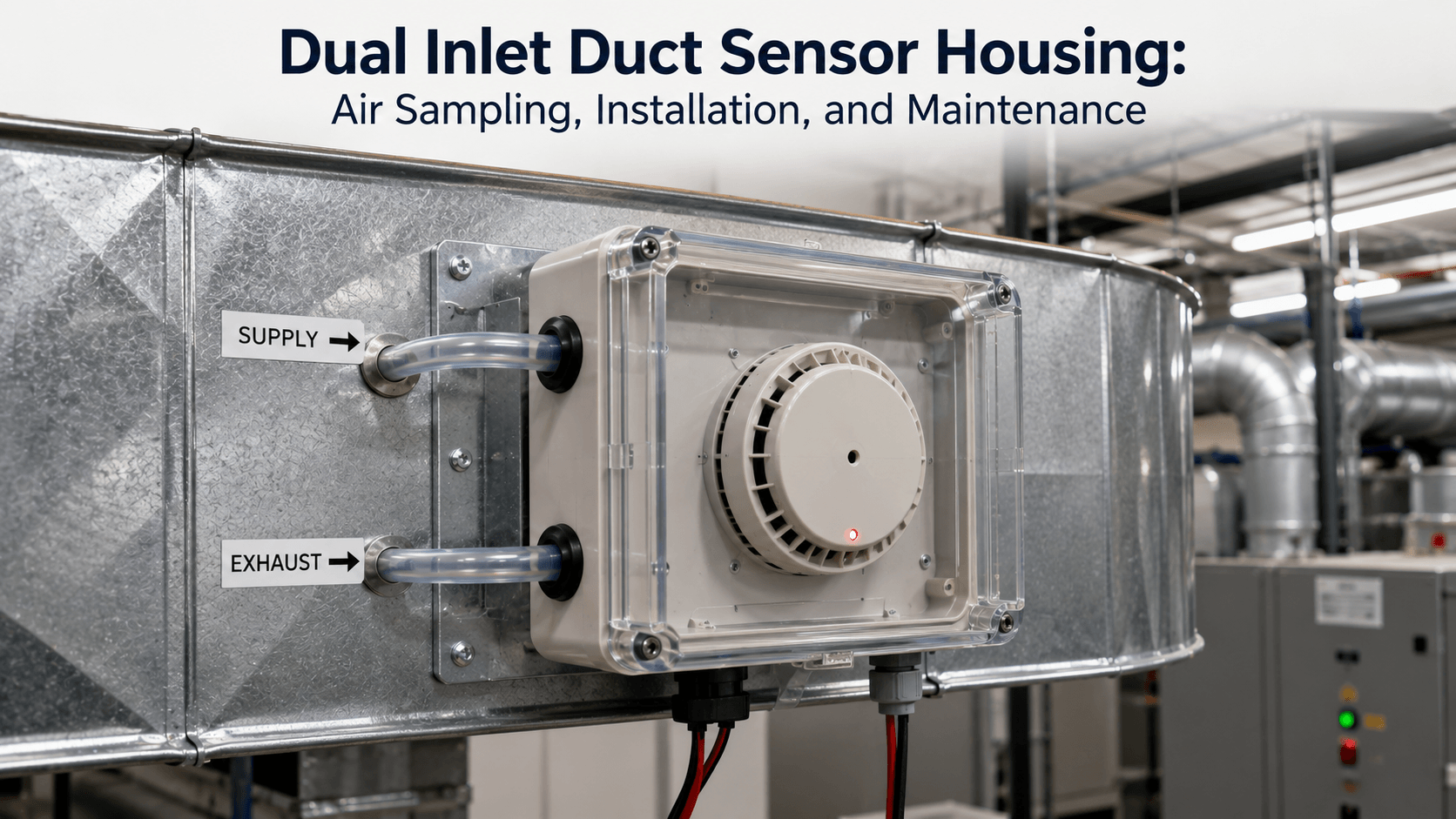
Getting reliable smoke detection inside HVAC ductwork comes down to one often-overlooked component: the dual inlet duct sensor housing. If you’re specifying or maintaining a commercial fire alarm system with duct-mounted detection, understanding how this housing samples air, how it should be installed, and how to keep it working properly over time can mean the difference between a system that passes inspection smoothly and one that causes headaches down the road. At QuickShipFire, we stock the dual inlet duct sensor housing new, in original manufacturer packaging, ready to ship fast when your project needs it.
In this guide, we’ll walk through how air sampling works inside these housings, what a proper installation looks like, and the maintenance routine that keeps duct-mounted detection reliable year after year.
What Is a Dual Inlet Duct Sensor Housing?
A dual inlet duct sensor housing is an enclosure that mounts to the exterior of an HVAC duct and houses a smoke detector head, using two sampling tubes instead of one to draw air from the duct interior. Unlike single inlet designs that pull air from a single sampling point, a dual inlet duct sensor housing draws air from two separate points across the duct’s cross-section, giving the detector a more representative sample of the airflow passing through.
This design matters because airflow inside large ducts is rarely uniform. Smoke can travel unevenly, hugging one side of a duct or moving in unpredictable patterns depending on duct geometry, air handler placement, and system pressure. A dual inlet duct sensor housing compensates for this by averaging air samples from two points, improving the odds that smoke gets detected quickly regardless of exactly where it enters the airstream.
How Air Sampling Works Inside the Housing
Supply and Exhaust Tubes
Air is drawn into the housing through a supply tube positioned to face into the airflow, while a second exhaust tube returns sampled air back into the duct after it passes across the detector’s sensing chamber. This continuous sampling loop means the detector is always evaluating a fresh stream of air from inside the duct, rather than relying on ambient conditions near the housing itself.
Detector Response and Airflow Velocity
Duct airflow velocity directly affects how quickly smoke reaches the sampling tubes and, in turn, how fast the system responds. This is why manufacturers specify minimum and maximum air velocity ranges for proper operation, installers should always confirm actual duct velocity falls within the supported range before finalising placement.
Installation Guidelines for Duct Sensor Housing Systems
Selecting the Right Mounting Location
Proper placement of a duct sensor housing depends on duct size, airflow direction, and accessibility for future maintenance. Manufacturers typically recommend installing the unit on a straight section of duct, away from elbows, dampers, or other turbulence-inducing fittings, to ensure sampling tubes capture representative airflow rather than disrupted or recirculating air.
Sampling Tube Length and Positioning
The sampling tubes must extend far enough into the duct to reach beyond boundary layer air near the duct wall, which does not accurately represent the main airflow stream. Manufacturer instructions specify exact tube lengths based on duct width, and cutting tubes too short is one of the most common installation errors that compromises detection performance.
Electrical and Wiring Requirements
Most duct sensor housing units, including the dual inlet duct sensor housing, require a separate 24 VDC power source and connect to the fire alarm control panel through supervised wiring, allowing the panel to monitor circuit integrity continuously. Relay outputs are typically programmed at the panel level, enabling functions like fan shutdown or damper closure automatically upon smoke detection.
Choosing Between Duct Detector Configurations
Not every application calls for a dual inlet duct sensor housing. Smaller ducts or lower-risk applications may be adequately served by a single inlet duct detector, while larger commercial duct runs, hospitals, and facilities with complex airflow patterns generally benefit from the improved sampling accuracy a dual inlet configuration provides. Reviewing your project’s specific duct detector requirements against manufacturer specifications helps ensure you select the right housing for the application.
Cost is also a factor worth considering upfront. Dual inlet units typically carry a higher price point than single inlet alternatives, but for larger or more complex duct systems, the improved detection reliability often justifies the additional investment, particularly in facilities where early smoke detection is critical to life safety.
Maintenance Best Practices for Long-Term Reliability
Routine Inspection Schedule
Duct-mounted detection housings should be inspected at least annually, and more frequently in environments with high dust or particulate loads, such as manufacturing facilities or commercial kitchens. Inspectors should check that sampling tubes remain unobstructed, housing gaskets are intact, and wiring connections show no signs of corrosion or looseness.
Cleaning and Blockage Prevention
Dust and debris accumulation inside sampling tubes is one of the most common causes of degraded detector performance over time. Regular cleaning, following manufacturer-specified procedures, prevents blockages that could delay smoke detection or trigger nuisance alarms from restricted airflow.
Testing and Functional Verification
Beyond visual inspection, functional testing using approved smoke or aerosol test methods confirms that the detector inside the housing responds correctly and that relay outputs trigger as programmed. This testing should align with your local fire code’s required testing frequency, typically annually at minimum for commercial systems.
Documentation and Record Keeping
Maintaining clear records of inspection dates, test results, and any maintenance performed is not just good practice, it is often a code requirement that inspectors will ask to review. Keeping a maintenance log for each housing location also helps facilities teams spot recurring issues, such as a specific unit that consistently accumulates dust faster than others, which might indicate a duct design or airflow issue worth investigating further.
Cost Considerations for Duct Detection Equipment
Budgeting for duct detection equipment involves more than just the housing and detector purchase price. Installation labour, sampling tube customisation for wide ducts, wiring back to the fire alarm control panel, and ongoing maintenance all factor into total project cost. Facilities teams planning a retrofit should budget for potential access challenges too, since running new wiring through finished ceilings or walls can add unexpected expense compared to new construction projects where wiring is planned from the outset.
Buying new equipment in original manufacturer packaging, rather than used or grey-market components, also protects your investment. Counterfeit or unauthorised replica parts can fail certification requirements entirely, creating liability risk that far outweighs any upfront savings.
Common Installation Mistakes to Avoid
A frequent mistake is installing the housing too close to duct elbows or branch takeoffs, where turbulent airflow can produce inconsistent sampling results. Another common error involves under-sizing sampling tubes for wide ducts, leaving the tubes short of the duct’s centreline where representative airflow sampling actually occurs.
Skipping proper airflow velocity verification before installation is another pitfall. Installing the housing in a duct with airflow outside the manufacturer’s supported velocity range can result in delayed detection or failed inspections, requiring costly rework after the fact.
Compatibility with Fire Alarm Control Panels
Before ordering, it’s worth confirming that your chosen housing and detector combination is compatible with your existing fire alarm control panel, since different manufacturers use different communication protocols and addressing schemes. Mixing incompatible components is a common source of commissioning delays, particularly on retrofit projects where the panel predates the duct detection equipment being installed.
Most commercial-grade duct smoke detectors are designed to integrate with a specific manufacturer’s addressable or conventional panel architecture, so checking compatibility during the specification phase, rather than after equipment arrives on site, saves significant rework. Suppliers with deep product knowledge can often flag compatibility issues before you place an order.
Code Requirements and Where Duct Detection Is Required
Building and fire codes in most jurisdictions require duct smoke detection in HVAC systems above a certain airflow threshold, typically tied to NFPA 90A and local amendments. These requirements exist because HVAC systems can rapidly spread smoke throughout a building if detection and automatic shutdown don’t happen quickly enough during a fire event.
Understanding your local code requirements early in a project, ideally during design rather than during inspection, helps avoid costly change orders. Duct smoke detectors are frequently flagged during commercial building inspections, so working with a supplier who understands common code requirements can help your project move through approval more smoothly.
Why Choose QuickShipFire for Your Duct Detection Needs
We carry the dual inlet duct sensor housing brand new, in original manufacturer packaging, backed by fast U.S. shipping and knowledgeable installation support. Whether you’re outfitting a new commercial build or replacing an aging unit during a system upgrade, our team helps you find the exact part your project specifies, including hard-to-locate components that other suppliers often can’t source.
Beyond the housing itself, we stock a full range of compatible duct smoke detectors and accessories, making it easy to source everything your duct detection system needs from a single trusted supplier. Request a quote today and our team will help confirm the right configuration for your specific duct dimensions and airflow conditions.
If you have questions about compatibility, sampling tube length, or wiring requirements before you order, our customer support team is ready to help you get it right the first time.
Conclusion
A dual inlet duct sensor housing plays a small but critical role in commercial fire protection, ensuring that smoke moving through HVAC ductwork gets detected quickly and reliably, even when airflow patterns are uneven or unpredictable. Getting the installation right, correct mounting location, properly sized sampling tubes, and verified airflow velocity, sets your system up for years of dependable performance, while consistent maintenance keeps it that way. Whether you’re specifying new equipment or maintaining an existing system, choosing quality components and following manufacturer guidelines closely will save you time, reduce false alarms, and keep your building’s occupants safer.
Frequently Asked Questions (FAQs)
1. What does a dual inlet duct sensor housing do?
It samples air from two points inside an HVAC duct, giving smoke detectors a more representative reading than single-point sampling designs.
2. How is a dual inlet duct sensor housing different from a single inlet model?
A dual inlet design draws air from two locations across the duct, improving detection accuracy in larger or more complex duct systems.
3. Where should a duct sensor housing be installed?
It should be placed on a straight section of duct, away from elbows or dampers, to ensure accurate and representative air sampling.
4. How often should duct detectors be inspected?
Most systems require annual inspection at minimum, with more frequent checks in dusty or high-particulate environments like factories.
5. Can a dual inlet duct sensor housing trigger HVAC shutdown?
Yes, relay outputs are typically programmed at the fire alarm control panel to trigger fan shutdown or damper closure upon smoke detection.
6. What causes duct smoke detectors to give false alarms?
Blocked or dirty sampling tubes, incorrect installation location, and airflow outside the supported velocity range are common causes.
7. Do I need a licensed technician to install duct detection equipment?
Most jurisdictions require licensed fire alarm technicians for installation and programming to ensure code compliance and proper system integration.